|
|
During the
early morning hours, Wilford Woodruff watched and cared for Margaret Hutchinson
Sheets in her final hours. She died at
3:30 a.m. of canker at the age of twenty‑seven. Elder Woodruff spent the morning with her husband, Elijah Sheets.[1]
At 7 a.m.,
John D. Lee checked in on Brigham Young, who was still quite ill. President Young asked Brother Lee to travel
to Trader’s Point, to redeem a thirty dollar note. At 11 a.m., Brother Lee left with George Grant, Sister Powers,
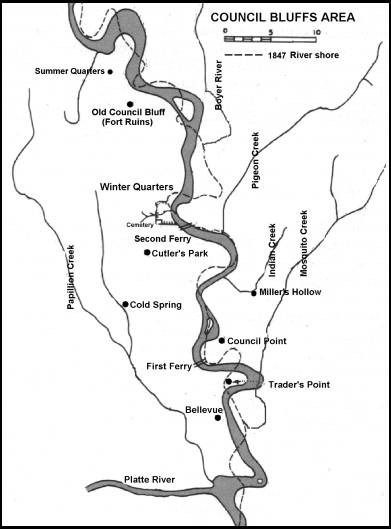
and Rebecca Holman in Brigham Young’s carriage. They arrived at Bellevue at 2 p.m. Brother Lee described Bellevue as “an Indian and French village”
that also had a residence of Protestant missionaries. Sister Holman was left at this residence while the others crossed
the Missouri River and conducted their business at Trader’s Point. At 4:35 p.m., they started back toward
Winter Quarters. Brother Lee wrote that
it “turned cold as Greenland.” The wind
“blew like a tornado” and snow began to fall.
They could only travel four miles and stayed the night at Homan Hyde’s
home. Brother Lee shared his
experiences while traveling to visit the Mormon Battalion. He spoke highly about their relative,
battalion member William Hyde. Brother
Lee slept on a bed of cottonwood puncheon, covered with a buffalo robe.
Back at
Winter Quarters, during the day, the newly appointed Captains of Hundreds in
Brigham Young’s company met in the Council House. They appointed their captains of tens and assigned ten families
to each of these companies.
Mary
Richards spent the day with her sister‑in‑law, Jane. She wrote:
“A cold day. Jane’s chimney
smoked very bad, so [bad] that it kept the tears running down my cheeks about
all the time was very uncomfortable, did a little sewing, and in the eve was
knitting.”[2]
Members of
the Twelve met in council during the evening.
Brigham Young was still feeling ill and stayed in his room, but the
brethren did conduct some business with him.
Willard Richards reported that there were rumors flying around that some
of the Saints had robbed the dead Omahas who had been massacred by the Sioux
back in December. Hosea Stout had
reported that some visiting Omaha Indians had been to Winter Quarters looking for
some of their articles. He investigated
and learned that Azra Adams and Henry W. Miller may have taken a load of
buffalo robes and leggings from the massacre site. He was not certain that these charges were true, but he was very
concerned and reported the news to Willard Richards. It was decided to send a letter to the men telling them to return
any items taken. Another letter would
be written to Indian agent, Major Miller, explaining what was known about the
affair and the views of the Church leaders.
President
Young attended to one final act of business for the evening. He signed a letter of recommendation for
Lucius N. Scovil, appointing him to superintend the emigration of the Saints
from New Orleans to Council Bluffs.
Priscilla
Harris, age thirty, died of colic. She
was the wife of Walter Harris. Mary
Hyde Grant, age twenty-six, died. She
was the wife of David Grant. A son,
Robert Harris III, was born to Robert and Hannah Eagles Harris. A son, Joseph Edwards Walker, was born to
John and Elizabeth Walmsley Walker.[3]
A son,
Edward Bunker Jr., was born to Edward and Emily Abbott Bunker.[4]
Melchee
Oyaler, a member of the Mormon Battalion, died at the age of thirty-three. He was the husband of Elizabeth Oyaler.
The
battalion again took up their march, leaving the San Diego Mission to return to
the San Luis Rey Mission to the north.
They were to rest at the mission and secure this strategic location
between San Diego and Los Angeles. It
had been rumored that there were a hundred Mexican troops in the nearby
mountains. The battalion marched with a
company of General Kearny’s troops, traveled sixteen miles, and established a
camp. William Coray wrote: “There was no clothing to be had at San
Diego or any other place in California at present. I was told so by many who ought to know at least which made it
hard traveling, the boys without shoes, etc.”
Sergeant William Coray notified Colonel Cooke that his company was out
of rations. Colonel Cooke immediately
ordered beef rations to be issued.
Parley P.
Pratt and John Taylor boarded a ship and again set sail for America. They had tried to leave about two weeks
earlier, but the storms had driven them back to England. Orson Hyde was left behind to finish up some
mission business. Shortly after they
set sail, Elder Joseph Cain, a returning missionary, was married on board the
ship to Elizabeth Whittaker. Parley P.
Pratt wrote, “It was a fine affair, and we had a good dinner on the occasion.”
Watson, ed., Manuscript
History of Brigham Young, 519; Kenney, ed., Wilford Woodruff’s Journal,
3:125; Brooks, ed., On the Mormon Frontier, 1:233; Kelly, ed., Journals
of John D. Lee, 63; Nibley, Exodus to Greatness, 321; Ward, ed., Winter
Quarters, 108; Autobiography of Parley P. Pratt, 356; “The Journal
of Robert S. Bliss,” Utah Historical Quarterly, 86; Ricketts, Melissa’s
Journey with the Mormon Battalion, 65
In the
morning, Heber C. Kimball, Willard Richards, and Wilford Woodruff visited
Brigham Young. They were pleased to
find him feeling better. They read
letters to him addressed to the Indian agents in response to the excitement
caused by rumors that some of the Saints had robbed the dead Omahas.
Harrison
Burgess brought in sixty‑five letters and several newspapers from the
post office in Austin, Missouri.
John D. Lee
continued to journey back to Winter Quarters from Bellevue. After traveling six miles in the storm, the
carriage lost a linch‑pin that held the wheel onto the axle. He substituted a wooden pin and continued on
his way, arriving in Winter Quarters at 2 p.m.
Harriet
Young spent the day preparing for a big party to be held at the Council House
the following day. On this night, there
was a gathering at the Council House consisting of some members of Brigham
Young’s extended family. William
Clayton and the Quadrille Band played for the party.
A funeral
was held for Margaret H. Sheets.
Mary
Richards wrote to her missionary husband:
“We have heard nothing from Joseph [Richards, Samuel’s brother] for a
long time but live in hopes that he is well.”[5]
A son,
Solomon Farnham Kimball, was born to Heber C. and Vilate Kimball.[6] A son, Alpheus C. Clements, was born to
Alvin and Rhoda Gifford Clements. Patty
Sessions helped all night with the labor and delivery. Elizabeth Miller Neeley, age forty‑two,
died. She was the wife of Lewis Neeley.
The
battalion traveled another sixteen miles toward San Luis Rey Mission. They passed by a location where they were
told General Kearny’s dragoons had been surrounded by the Mexicans for several
days after their bloody battle at San Pascual and had to survive on sixteen
mules. They called the place, “Mule
Hill.” (See December 6‑11,
1846 in Volume Two).
Watson, ed., Manuscript
History of Brigham Young, 520; Kelly, ed., Journals of John D. Lee,
64; “Diary of Lorenzo Dow Young,” Utah Historical Quarterly, 14:155;
Kenney, ed., Wilford Woodruff’s Journal, 3:125; Nibley, Exodus to
Greatness, 321; Patty Sessions Diary, Our Pioneer Heritage, 2:63; William
Clayton’s Journal, 72; “Private Journal of Thomas Dunn,” typescript, 20;
Yurtinus, A Ram in the Thicket, 528; Ward, ed., Winter Quarters,
130-31
Brigham
Young was feeling much better and held a big family party in the Council House
during the afternoon and evening. John
D. Lee wrote: “The festival was rich
and sumptuously furnished.” Harriet
Young added: “Had a splendid time. We refreshed our selves with the luxuries of
earth, then went forth in the dance, both young and old. The music was excellent.” Eliza R. Snow noted that four of President
Young’s brothers were present and one sister.
His brothers were John, Joseph, Phinehas and Lorenzo. There were about one hundred people in
attendance.
William
Clayton noted:
President
Brigham Young was quite sick and seemed very low spirited. After the meeting had been opened by prayer,
the President called on his brothers to stand up by him in the center of the
room which they did according to age.
John Young took his place at the head, then Phineas, Joseph, Brigham and
Lorenzo. The President then called on
Heber [C. Kimball] to take his place in
the line inasmuch as he had been recognized about fifteen years as a member of
the Young family. He took his place
between Joseph and Brigham. The
President then said this was the first time that father Young’s boys had been
together in the same capacity for a number of years, etc. After a few remarks the remainder of the
evening was spent by partaking of a good supper and cheerful dancing.
Eliza R.
Snow recorded: “We supp’d at a table
that would have done honor to a better cultivated country.” The evening was closed with addresses from
Brigham Young and Heber C. Kimball. The
party broke up at 2 a.m.
John D.
Lee visited the family of Truman Gillett.
Brother Gillett was away and Sister Fidelia Gillett said that the family
had only eaten bran for the past two days.
Brother Lee recommended that Brother Gillett go to the Missouri
settlements to start up a school.
Brother Lee promised to take care of his family while he was away. He stopped at Brother Free’s house and then
sent Sister Gillett a bushel of meal and ten pounds of salt pork. In the evening, he wrote a letter to Mount
Pisgah asking that Sister Lucinda Pace be brought to Winter Quarters. Sister Pace was the wife of James Pace, a
member of the Mormon Battalion. Brother
Lee sent $2.50 of gold to help Sister Pace.
Albert
Carrington Jr., age seventeen months, died of scarlet fever. He was the son of Albert and Rhoda Woods
Carrington.[7]
Charles C.
Rich, James S. Haleman, and others, started off for Winter Quarters. They wanted to discuss with the brethren
what preparations should be made by the Saints at Mount Pisgah to get ready for
the journey to the west.
Joseph
Knight Sr., age seventy-four, one of the earliest members of the Church, died
and was buried at Mount Pisgah. Sarah
Rich wrote in her history:
Sickness
continued to increase and nearly everybody was sick, and many died. I think about eighty died at Mount Pisgah,
and among that number was Father Joseph Knight, one of the first members of the
Church of Latter‑day Saints, one that assisted the Prophet Joseph Smith
to means to support his family while he was translating the Book of
Mormon. So, in this lonely spot in the
graveyard at Mount Pisgah, in what was then called Pottawattamie lands, lies
one of the noble benefactors of the Prophet Joseph, who still will come forth
in the morning of the resurrection to meet the Prophet Joseph, as well as all
good saints.
The
battalion arrived at the San Luis Rey Mission in the afternoon. At the mission they would perform what was
called “fatigue duty” ‑‑ cleaning up the place because it had been
neglected for some time. William Hyde
described the mission:
The chapel
and all the buildings connected with it enclose, I should judge, five or six
acres of land. The buildings form a
square in the center of which are orange trees. Connected with this mission is a beautiful grape vineyard and an
orange orchard, also pepper and cocoa trees.
This place is situated in plain view of the ocean, the shore of which is
some five or six miles in the distance.
The mission of San Luis had been built and occupied by the Catholics,
but at the commencement of the war, this, with many others in California, had
been vacated, and had fallen into the hands of the United States Government as
public property.
Henry
Bigler believed that the mission could accommodate one thousand men, “a first‑rate
barracks.” The men were assigned rooms
inside the mission. Corporal Thomas
Dunn, Sergeant William Coray, and Captain Jesse Hunter roomed together in a
comfortable room. “We felt ourselves
quite at home.”
Levi
Hancock wrote a poem, reflecting more positive feelings about their
circumstances:
I now can
tell a better story
Than I
could about Sonora
For the
soil is little wetter
And the
land a little better
I think
‘twill bring corn and potatoes
Beans and
cabbage and tomatoes
Raise all
things to suit our notion
Along by
the Pacific Ocean.
A general
meeting was held by Captain James Brown.
John Steele was frustrated with Captain Brown’s leadership and
wrote: “Captain Brown is something
above all the men that is here in priestly authority and has told us so often
that we do not know who he is, he is so high.”
John H.
Tippets and Thomas Woolsey, of the battalion, continued their journey back to
Winter Quarters along the Platte River.
On about this day, the weather was better and they came to a camp of
Pawnee Indians who took them prisoners.
Almon W.
Babbitt wrote to his fellow Nauvoo Trustees, Joseph L. Heywood and John S.
Fullmer, informing them that he had been unsuccessful in selling public
property in Nauvoo to a company in Baltimore, Maryland.
Watson, ed., Manuscript
History of Brigham Young, 520; Kelly, ed., Journals of John D. Lee,
64‑5; “Diary of Lorenzo Dow Young,” Utah Historical Quarterly,
14:155; Beecher, The Personal Writings of Eliza Roxcy Snow, 154; Brown, Life
of a Pioneer, 87; Yurtinus, A Ram in the Thicket, 308, 529‑30;
“William Hyde Journal”; “Private Journal of Thomas Dunn,” 20; Gudde, Bigler’s
Chronicle of the West, 49; Nibley, Exodus to Greatness, 324; William
Clayton’s Journal, 72‑73; “Sarah Rich Autobiography, typescript,”
BYU, 60, 64;
|
|
It had
been one year since the first wagons, led by Charles Shumway, crossed the
Mississippi River to start the official exodus from Nauvoo.
Albert P.
Rockwood and George Grant visited with John D. Lee. They extended to Brother Lee an invitation from Brigham Young to
attend a party for his adopted family which would be held at some time when the
Council House was available. President
Young asked that “each one bear a part by bringing their proportion of cakes,
pies, sweetmeats &c., all to be done under his superintendence.” John D. Lee fell ill with a fever. His wife, Louisa, took tender care of him.
Hosea
Stout received orders from Colonel Stephen Markham to gather all of the public
arms in the city and safeguard them in his possession. Brother Stout started to determine where all
of these arms were located.
In the
evening, Wilford Woodruff called his company together and organized it
according to the pattern given in the revelation received by Brigham
Young. Abraham O. Smoot was appointed
captain of hundreds. Zera Pulsipher was
named captain of fifties. The captains
of tens included: John Benbow, Elijah F. Sheets, Chauncy W. Porter, John M.
Woolley, Thomas Clark, David Evans, Robert C. Petty, and Andrew J. Stewart.
A wedding
was held. Charles F. Decker and Vilate
Young were married. Vilate was the
seventeen‑year‑old daughter of Brigham Young. Eliza R. Snow commented: “Vilate Y[oung] & C[harles] Decker were
married without noise or bustle‑‑nobody invited‑‑I
address’d the following lines to the young wedded pair:
Please
accept my warmest wishes
For your
good, ye youthful pair;
That the
riches, choicest blessings
Heav’n may
grant your lot to share,
Peace &
friendship‑‑love and union
Plentious
as the summer dew,
Shall upon
your op’ning pathway;
Gems of
sacred pleasure strew.
May you
feel the holy Spirit
Freely
thro’ your bosoms flow;
Till at length
you shall inherit
All the
Priesthood can bestow.
When your
life, both long & happy,
You have
finish’d here on earth;
Sweetly
sleep: then reawaken
In a more
celestial birth.”
It was
Patty Session’s fifty‑second birthday.
Eliza R. Snow held a party during the evening. Sister Sessions wrote:
I was glad
to see her. Told her it was my birthday
and she must bless me. She said that if
I would go to the party they would all bless me. I then went and put James Bullock’s wife to bed,[8]
then went to the party. Had a good time
singing, praying, and speaking in tongues before we broke up. I was called away to Sister Morse’s then to
Sister Whitney, then back to Sister Morse’s and put her to bed at 2 o’clock.
Members of
the Twelve met with the High Council.
Patriarch John Smith complained about problems with the beef
committee. The discussion dragged on
and on. Finally, Brigham Young proposed
that the whole matter be “laid over till the first resurrection & then burn
the papers the day before.”
Cirvillia
Jane Babcock, age one month, died of chills.
She was the daughter of Amos and Mary Archer Babcock.
A son,
Elijah Knapp Fuller, was born to Elijah and Catherine Walker Fuller.[9]
The
battalion stayed very busy sweeping and cleaning the rooms and yards of San
Luis Rey Mission. They had a terrible
time combatting against all the fleas and other insects. Daniel Tyler wrote: “Many of the men were almost naked, without
a change of underclothing to keep off dust or the worst of vermin.” They tried boiling their clothes to get rid
of the fleas. Colonel Cooke also
ordered the men to clean themselves up.
Some of the men had beards a foot long, but Cooke ordered that all
beards be shaved off and all hair be trimmed above the ear. Colonel Cooke also drilled the men each day
during their stay at the mission. He
read to the battalion the historic order he wrote on January 30, which praised
the accomplishments of the battalion.
The men enjoyed
their new surroundings. Thomas Dunn
wrote a description: “The country round
about is pleasant and good, cattle and horses in numerous herds feeding on
green ridges and valleys.”
The Pawnee
Indians, who held John H. Tippets and Thomas Woolsey prisoners, convened a
counsel to discuss what they should do with the brethren. At noon, the brethren escaped and fled for
their lives. They rode until dark and
camped in some brush. Thomas Woolsey
later wrote: “We knew we were in a
trap, and only through the power of God would we hope to escape, and believe
me, we did send up a petition to God.
Our prayers were answered.”
Watson, ed., Manuscript
History of Brigham Young, 520; Kenney, ed., Wilford Woodruff’s Journal,
3:125; Kelly, ed., Journals of John D. Lee, 65; Brooks, ed., On the
Mormon Frontier, 1:235; Patty Sessions Diary, Our Pioneer Heritage,
2:63; Beecher, The Personal Writings of Eliza Roxcy Snow, 154‑55;
“Private Journal of Thomas Dunn,” typescript, 20‑1; Daniel Tyler, A
Concise History of the Mormon Battalion, 264; Ricketts, Melissa’s
Journey with the Mormon Battalion, 66; Brown, Life of a Pioneer, 89;
Nibley, Exodus to Greatness, 324; 1997-98 Church Almanac, 157
In the
morning, the band rode around in a carriage, playing music throughout the city,
“so sweetly that it did rend the air.”
The member
of the Twelve met together in the recorder’s office for a council meeting. They decided that George A. Smith and Amasa
Lyman’s company (the fifth company) should be organized into either Brigham
Young’s company or Heber C. Kimball’s company.
These two companies would be called the first and second divisions of
the Camp of Israel. Wilford Woodruff
reported that his company was organized.
Patty
Sessions went to take care of Joanna Roundy, wife of Lauren H. Roundy. Sister Roundy had earlier in the day given
birth to a son, William Heber Roundy.
She was very ill and she told Sister Sessions that this would be the
last time that Sister Sessions would see her in this life. Sister Sessions believed sadly that this was
true and gave Sister Roundy a message to take to Sister Sessions’ children who
had died and were in the Spirit World.
Joanna Carter Roundy, age twenty-two, died shortly in the evening of
canker.
At 3 p.m.,
Patriarch John Smith sent an invitation to the Twelve to attend the “Silver
Gray Picnic,” a party for the elderly in Winter Quarters. They went to the Council House and found it
filled with brethren and their wives.
Brigham Young instructed them on whether or not dancing was
appropriate. He knew that some of these
Saints felt that dancing was contrary to their traditions. He recognized that the wicked in the world
danced, but he explained: “There is no
harm in dancing. The Lord said he
wanted His Saints to praise Him in all things.” He referred to the ancient daughter of Israel who danced for the
Lord. “For some weeks past I could not
wake up at any time of the night but I heard the axes at work. Some were building for the destitute and the
widow; and now my feelings are, dance all night, if you desire to do so, for
there is no harm in it.” He further
gave this example: “The prayer of the
wicked is an abomination in the sight of God, but it is not a sin for a Saint
to pray; where there is no evil intended, there is no sin. I enjoin up on the Bishops that they gather
the widow, the poor and the fatherless together and remember them in the
festivities of Israel.”
John Smith
shared his feelings and then exhorted everyone to dance, sing, and enjoy
themselves. The center of the floor was
cleared for the dance. The “Silver
Greys” and “Spectacled Dames” enjoyed dancing to the music of the Quadrille
Band. Brigham Young wrote, “it was
indeed an interesting and novel sight, to behold the old men and women, some
nearly an hundred years old, dancing like ancient Israel.”
A son,
William Morse, was born to Gilbert and Cynthia Morse. John Ralph Petty, age nine, died of chills. He was the son of Albert and Catherine
Petty.
The
battalion spent the day resting at the San Luis Rey Mission, washing clothes,
shaving, trimming hair, and preparing for an inspection. An order was read that all the private mules
and horses must be disposed of by the 15th.
John H.
Tippets and Thomas Woolsey were stopped by seven Indian warriors. They were searched and the Indians took from
them many items. The brethren were
permitted to leave. They rode until
dark, and camped in a grove, in the snow.
A son,
James Butler, was born to John L. and Caroline Butler.
Reuben
Miller wrote a letter to Brigham Young seeking an official reaction to his
first pamphlet against the Strangites, former members of the Church following
after a self-proclaimed prophet, James J. Strang. Brother Miller, who at one time had followed after Strang, but
saw his error, wrote: “I consider it
for the welfare of the cause of God to publish my second epistle.” He admitted that his pamphlet might seem too
contentious, but he felt it was the best way to reach out to those who were
being deceived.
Watson, ed., Manuscript
History of Brigham Young, 520‑21; Kenney, ed., Wilford Woodruff’s
Journal, 3:126; Nibley, Exodus to Greatness, 322, 324; Patty
Session’s Diary, Our Pioneer Heritage, 2:63; William Clayton’s
Journal, 73; Richard Lloyd Anderson, BYU Studies, 8:3:288; “Private Journal
of Thomas Dunn,” typescript, 21; Bigler, The Gold Discovery Journal of
Azariah Smith, 75
The
weather was mild. John D. Lee was
confined, sick in bed, for the third day in a row. He sent a letter to Brigham Young requesting that he come to
bless him. Later in the evening, Levi
Stewart brought a reply. President
Young stated that his health was still poor and would not allow him to go out
in the evening. However, he let Brother
Lee know that he had blessed him in the name of the Lord and promised him that
he would recover. Brother Lee
immediately revived and talked with Brother Stewart late into the evening.
Wilford
Woodruff was also feeling ill and stayed home all day. In the evening, he visited with Willard
Richards and read the news of the day.
Hosea Stout spent the day gathering up the public arms and arranging
assignments for the police guard. He
wrote: “The weather has been fine for a
day or two. Today I took down my tent
& was now entirely dwelling in my house.
It will be just one year on the 12th of this month since I first erected
my tent on the shores of the Mississippi river and have not been in a situation
to live with out it untill today & even now we are preparing to move on
again.”
Newel
Melchizedek Whitney was born to Newel K. and Elizabeth Smith Kimball.
Henry
Standage went into the garden to wash his shirt and a pair of pants that he had
made out of an old wagon cover. That
was all the clothing he had. Levi
Hancock called a meeting of the Seventies to give religious instruction. He warned the men against taking the Lord’s
name in vain. He also wanted them to
wash each other’s feet, as was done anciently.
This would bring humility to the men and also help their sore joints.
A general
meeting was held at which the battalion officers condemned some critical poetry
that had been circulating around the camp, mocking their leader, James
Brown. It displayed a “mutinous spirit”
that they said was unjustified.
Joseph
Stratton was released as the president of the St. Louis Saints. He had been asked by the Twelve to go to
Winter Quarters to prepare for the trek to the west. He was to bring with him several maps of Texas, California,
Oregon, and all the regions in between.
Journals of
John D. Lee, 66; Kenney, ed., Wilford Woodruff’s Journal,
3:126; Brooks, ed., On the Mormon Frontier, 1:235; Journal of Henry Standage
in Golder, The March of the Mormon Battalion, 209; Yurtinus, A Ram in
the Thicket, 310, 539; Our Pioneer Heritage, 5:440
A severe
frost fell overnight, but it warmed up and was a pleasant day. Hosea Stout recorded: “I took a long walk up the river with my
wife among the high bluffs and frightful precipices which was a fine relief to
my mind after being so much hemmed up all winter. We crossed the river on the ice & came down on the bottom
& had a agreeable walk.”
Mary
Richards attended a meeting in Jane Richards’ ward. From there, they went to the Council House where they heard
Zebedee Coltrin speak about the need to be united.
In the
afternoon, Charles C. Rich, Allen Weeks, and James Woolsey arrived from Mount
Pisgah. Brigham Young, Wilford
Woodruff, and Willard Richards visited John D. Lee. Brother Lee wrote that they anointed and blessed him “with a
promise of immediate health from my bed of affliction that my usefulness should
continue a great many years on the earth; that my wakeful moments should be
employed in contemplation of the glory and happiness of the Faithful and while
enwrapped in repose the Heavenly visions of Eternity should be opened to my
view, to increase my glory and happiness.”
Later that evening his strength increased “beyond expectation.”
A mob
started to persecute some Saints near Farmington. On this day, the mob “hung” six brethren by their heels with
ropes. (See March 9, 1847.)
The
weather continued to be very pleasant.
In the morning, an official inspection was held of the men, their arms,
and their quarters. Thomas Dunn wrote: “The companies appeared respectable as far
as in their power, though many were destitute of clothing.” William Coray added: “By this time everything began to look like
a regular garrison. The strictest
discipline was enforced. Five men were
put into the stocks for passing through the Colonel’s hall and other like
offenses.” In the evening, the companies
were divided up into ten squads and were told that they would start being
drilled as soldiers.
A
daughter, Malinda Catherine Kelly, was born to Milton and Malinda Allison
Kelly.[10]
Ezra T.
Benson, Erastus Snow, and others arrived at the Ponca settlement which on this
day numbered 396 Saints, including 98 men.
They presented to the camp “The Word and Will of the Lord” which had
been received by Brigham Young the previous month.
Watson, ed., Manuscript
History of Brigham Young, 535; Kelly, ed., Journals of John D. Lee,
67‑8; Brooks, ed., On the Mormon Frontier, 1:235; Ward, ed., Winter
Quarters, 108; Our Pioneer Heritage, 1:496
The Twelve
wrote a letter to Joseph A. Stratton in St. Louis, confirming the appointment
of Nathaniel H. Felt as his successor as President of the St. Louis Conference
of the Church. They looked forward to
having Elder Stratton join them soon in the Camp of Israel.
The
brethren met with Charles C. Rich, who gave a report of the poor at Mount
Pisgah, and he gave an account of how the tithing funds were used to help them.
William E.
Clifford and a Brother Hathaway opened a second store in Winter Quarters at
Albert P. Rockwood’s house and began to trade goods. Lorenzo Dow Young and Israel West left for Missouri to do trading
at the settlements.
Morgan
Thomas, age twenty, died of consumption.
He was the son of Daniel and Martha P. Thomas.
Ezra T.
Benson and Erastus Snow met with the Ponca Saints and organized an emigrating
company. Titus Billings was elected
President, with Erastus Bingham and Joseph Holbrook as his counselors. Hyrum Clark was appointed Captain of
hundreds, David Lewis and Vinson Shurtliff captains of fifty.[11]
Luman
Shurtliff and Daniel D. Hunt left Garden Grove, heading to the east to collect
donations for the destitute Saints in Garden Grove. Brother Shurtliff wrote:
The
families now in my care were in log houses, rolled up, rough and chunked,
mudded on the outside, no floors, no windows, no doors, only what was made of
split timber. Each one had a sort of
fireplace and there was plenty of wood standing over and around the houses, but
they would have it to prepare for burning.
As for food, they had but little.
Well, those who never parted with a family in such circumstances can
have but a feeble idea of the feelings of a man’s heart when he turns his back
upon his family, not knowing but he had looked on some of their drawn faces the
last time on this earth. I can endure
pain, cold, hunger, scoffs, insults, and persecutions, if I know all is right
with the dear ones at home.
They rode
with Clinging Smith, who was heading to the Mississippi on business. As they started out, the snow was one foot
deep.
Azariah
Smith wrote: “We was drilled without
our arms today, and it is the first time that I ever was taught how to turn
around.” The men drilled for an hour,
both in the morning and afternoon.
During the
month, a memorial was presented to the Queen of England proposing a plan for
emigration to Oregon or Vancouver Island.
This memorial measured 168 feet and contained nearly thirteen thousand
names of the Saints. A copy was also
sent to each member of Parliament.
Watson, ed., Manuscript
History of Brigham Young, 521‑3; “Luman Shurtliff Autobiography,”
typescript, BYU, 70; “Diary of Lorenzo Dow Young,” Utah Historical Quarterly,
14:155; Hartley, My Best for the Kingdom, 227; Bigler, The Gold
Discovery Journal of Azariah Smith, 77
The
morning was cloudy, “bleak,” and cold.
Jedediah M. Grant arrived from Fort Leavenworth. He brought letters including one from Thomas
L. Kane. The Twelve went to the post
office to read them.
William
Clayton and the Quadrille Band rode around Winter Quarters in a carriage to
play for the city. But it was so cold
that they could not play very long.
The
bishops in Winter Quarters held a picnic party and dance at the Council
House. Mary Richards attended the dance
and was privileged to dance a “cotillion” with Brigham Young. She wrote:
“When he took me to my seat he said Sister Mary you have learned me I am
very much obliged to you.”
A
“blessing meeting” was held at the home of Heber C. Kimball. This meeting was held to bless Elder
Kimball’s son, Solomon, who was eight days old. Elder Kimball also blessed other sons and daughters and these blessings
were recorded by Willard Richards.
Ezra T.
Benson and Erastus Snow, along with George Miller and others, departed to
return to Winter Quarters.
John H.
Tippets and Thomas Woolsey crossed the Platte River on ice, as they pushed
eastward to reach Winter Quarters.
There was
heavy dew and fog at the San Luis Rey Mission.
The battalion soldiers were ordered to return their cartridges. They drilled at 10 a.m. and again at 3
p.m. Some of the men felt that Colonel
Cooke was abusive to the men during the drills. They only had beef to eat, but at least they were given
plenty. Their daily routine at the
Mission was: Roll call at daylight, sick call at 7:20 a.m., room cleaning,
breakfast at 8:40 a.m., drilling from 10 to 11 a.m., drilling again at 3 p.m.,
roll call at sundown, tatoo at 8:30 p.m., and taps at 9 p.m.
A
religious meeting was held at which “many confessed that they had felt the
necessity of a reform in the Battalion and felt to turn to the Lord and forgive
and seek forgiveness of the Lord and sin no more.”
A letter
was written to Oliver Cowdery, in Ohio, reporting that his father, William
Cowdery, was very sick. William had
been stricken with a severe case of inflammatory rheumatism a few months
earlier. He was suffering much but not
complaining. William Cowdery was also
the father of Lucy Cowdery Young, the wife of Phinehas H. Young.
Watson, ed., Manuscript
History of Brigham Young, 523; Kelly, ed., Journals of John D. Lee,
68‑9; Ward, ed., Winter Quarters, 109; Journal of Henry Standage
in Golder, The March of the Mormon Battalion, 209; “Private Journal of
Thomas Dunn,” typescript, 21; Bigler, The Gold Discovery Journal of Azariah
Smith, 76; Ricketts, Melissa’s Journey with the Mormon Battalion,
67; Oliver Cowdery to Phineas Young, 14 Feb 1847 in Gunn (1962), 253-54; William
Clayton’s Journal, 73; “The Journal of Robert S. Bliss,” Utah Historical
Quarterly, 4:86‑7 Yurtinus, A Ram in the Thicket, 540
The day
was cold, cloudy, rainy. Ebenezer C.
Richardson, George Peacock, and D. Shockley arrived from the herding grounds,
located about seventy miles up the Missouri River. They reported terrible problems with the Sioux Indians, who had
been stealing the horses and killing the cattle. The brethren in the north wished to return the remaining cattle
to Winter Quarters.
Midwife,
Patty Sessions helped deliver Sister Lamb’s baby in the morning. After going home for breakfast, she went to
find someone to take care of Sister Polly Knight, widow of Joseph Knight, who
had recently arrived from Mt. Pisgah.
Eliza Mitchell offered to care for Sister Knight. Sister Sessions wrote: “I came home very tired. Brother Kimball said he would say for
himself and, in behalf of Joseph [Knight], that I have done my part.”
Mary
Richards visited the home of Helen Mar Whitney. Sister Whitney shared with her a poem that her mother (Vilate
Kimball) wrote upon giving birth to her new son, Solomon Kimball. The first verse was:
The Lord
has blessed us with another Son
Which is
the seventh I have Born
May he be
the father of many lives,
But not the
Husband of many Wives.
Before
Sister Richards left the Whitney home, Orson Whitney ordered that a bowl of hot
punch be made and they all drank freely.
The
bishops held a social at the Council House.
Wilford and Phoebe Woodruff attended and had a wonderful time.
David
Calvet, age sixteen, died. Sally S.
Carter, age twenty, also died. She was
the wife of Daniel Carter.
John H.
Tippets and Thomas Woolsey crossed Loup Fork on the dangerous, thawing ice and
came to what was known as “Miller’s Trail.” They camped on a little island in
the Platte River.
Colonel
Cooke continued to drill the battalion.
Some of the men obtained some corn from Indians, ground it up in the
afternoon, and had a fine supper.
Watson, ed., Manuscript
History of Brigham Young, 523‑24; Kenney, ed., Wilford Woodruff’s
Journal, 3:126; Kelly, ed., Journals of John D. Lee, 69‑70;
Ward, ed., Winter Quarters, 109; Our Pioneer Heritage, 2:63;
Bigler, The Gold Discovery Journal of Azariah Smith, 76
The Twelve
met in council and decided to send twenty to thirty men up to the herding
grounds managed by Asahel A. Lathrop.
These additional men were to visit the Sioux Indians and demand that
twenty stolen horses be returned.
Hosea
Stout, Horace S. Eldredge, and Daniel Carn organized a dance to be held for the
police. They had an enjoyable time
dancing until 11 p.m. Mary Richards
attended the party on an invitation from William Cahoon. She danced with William Cahoon, Daniel
Cahoon, George Grant, and others.
A son,
Ezra Jonas Day, was born to Abraham and Elmira Buckley Day.[12]
Luman
Shurtliff and Daniel Hunt continued their journey to the east in an attempt to
gather donations for the poor at Garden Grove.
On this day the roads and creeks were flooded with water and it made the
traveling slow. Brother Shurtliff
wrote: “We had but one dollar and that
was expense money and were obliged to do the best we could and was to beg,
which thing I had done traveling many thousand miles.”
The
battalion continued their daily drills.
James S. Brown wrote: “Our
training daily was one hour for each pound of beef issued, the beef costing
less than a cent a pound to the government.”
He wrote that their rations were about two pounds of beef per day “for
we were ravenously hungry all the time.
If the reader doubts this, let him try the ration for a little while,
and doubt will disappear.” Azariah
Smith wrote about his day’s activities:
“After breakfast, Father, Thomas and myself [got] permision of the
captain to take a walk down to the Pacific, about four miles; when we got there
the Ocean was all in a foam. I saw a
very large Whale bone on the coast.”
Wilford Woodruff’s
Journal 3:126‑27; Brooks, ed., On the Mormon Frontier, 1:235;
Ward, ed., Winter Quarters, 109; “Luman Shurtliff Autobiography,”
typescript, BYU, 70; Brown, Life of a Pioneer, 89; Bigler, The Gold
Discovery Journal of Azariah Smith, 76
The
weather was clear and pleasant. Brigham
Young met with the Captains of his first division. He shared information about the loss of horses and cattle at the
rush bottoms, seventy miles up the Missouri River, where Asahel A. Lathrop was
in charge of 1,200 head of cattle.
President Young asked for twenty men to be sent north, to help the
herdsmen and prevent further stealing from the Sioux.
Brigham
Young visited the Winter Quarters grist mill.[13] Brothers Weeks and Kesler told him that they
were able to grind two or three quarts of corn. One man would walk on the wheel and the other would feed the
hopper.
Orson
Pratt returned to Winter Quarters from a visit to Mount Pisgah and other Iowa
settlements. In Mount Pisgah, he had
organized a company of one hundred ten families, headed by Lorenzo Snow. Garden Grove was also organized with one
hundred twenty families. David Fulmer
was the president with Aaron Johnson as his counselor. Other settlements were being led by
President Fulmer. Lorenzo Snow was his
counselor in Mount Pisgah. The small
settlement of Lost Creek was also organized with these two larger
settlements. The “Word and Will of the
Lord” was read to each of the settlements visited by Orson Pratt and was
universally approved.
In the
afternoon, Willard Richards and Joseph Young visited John D. Lee to see how he
was feeling. They stayed an hour and
discussed the problems at the herding grounds, where they said thirteen horses
had been stolen and thirty head of cattle killed. These brethren thought George Miller was partially to blame
because he had sent a company out against the Sioux in favor of the Poncas.
Patty
Sessions went to Jane Dunn’s home, but her child was born before she arrived, a
son, Joseph Moroni Dunn. His father was
Simeon Dunn. Sister Sessions then went
to visit the sick. Abigail Hatch, age
forty-eight, died. She was the wife of
Israel Hatch. Sally West, age
forty-six, died. She was the wife of
Alva West.
A
daughter, Sarah Emeline Jenkins, was born to William and Mary Rowberry Jenkins.
John H.
Tippets and Thomas Woolsey camped in some timber on the Platte where there were
plenty of rushes for their mules to feed on.
The
battalion drilled in the morning and afternoon. Daniel Tyler recorded an incident during a drill about this
time. He recorded that a “nervous
lieutenant” was asked to lead a formation:
He was directed
not to move until the line was formed.
As he was ‘bout face’ to the battalion, however, as the little army
moved, he turned as pivot man to correspond with what he supposed to be the
intended movement. The Colonel,
discovering this, ran and turned him back and held him a few moments, saying:
‘Now, Lieutenant . . . I will take my hands off carefully, and see if you can
stand still,’ fitting the action to the word.
No sooner were the hands fairly off than the officer again began the
usual turn, when the commander left him with the remark, ‘No d‑‑d
if he can.’
Watson, ed., Manuscript
History of Brigham Young, 524; Kelly, ed., Journals of John D. Lee,
71‑2; Nibley, Exodus to Greatness, 324‑35; Our Pioneer
Heritage, 2:.63; Tyler, A Concise History of the Mormon Battalion,
265‑66
The
weather was warm. Brigham Young met
with twenty‑three brethren who had volunteered to travel to the herding
grounds about seventy miles up the Missouri River in order to provide
protection from Indian raids. The
group, led by Addison Everett, left Winter Quarters in the afternoon with three
baggage wagons. A letter from President
Young was sent with them to Ashael Lathrop, who was in charge of the herd. It included the following statements:
You must be
diligent and sleep with one eye open, and never again let the Indians or any
other enemy within your fort. To do
this is to throw yourself in the power of your enemy, as it gives him and
advantage you cannot recall, until it is too late. . . . Keep them at [a]
respectful distance with the power always in your hands. . . . Now Brother
Lathrop, you must watch as well as pray, and let the Indians get no advantage
of you, or learn your numerical strength again, but do the best you can to give
them such an opinion of your resources as to put them in awe . . . and at the
same time inspire them with confidence in your good intentions as far as
possible . . . and promote peace among the Indians.
President
Young met with Charles Bird and advised him to accept labor contracts to build
houses, mills, and open farms.
In the
evening, Brigham Young and Heber C. Kimball attended a “Seventies picnic.” Mary Richards attended with Sister Sarah
Noon Kimball (wife of Heber C. Kimball), who had said she would not go unless
Sister Richards went with her. Sister
Richards wrote: “We had a very nice
party. I danced with Bros Smithies,
O[rson] Whitney, G[eorge] Grant, [Edward] Duzette and others.” The party concluded about midnight.
John D.
Lee spent the evening in conversation with Nancy Gibbons Armstrong, the sister
of Sarah Gibbons, wife of Abraham O. Smoot.
Sister Armstrong had left her wealthy husband of Louisville, Kentucky to
join the Church in Nauvoo. Brother Lee
wrote: “Spent a part of the evening in
conversation with Sister Nancy Armstrong who had sacrificed a large fortune of
earthly substance, forsook her own dwelling habitation, merchandise and
kindreds for the gospel sake, having spent a good portion of the substance that
she succeeded in getting away.” She
requested to be part of John D. Lee’s camp in the spring which he agreed to.
A
daughter, Julia Ann Hadden, was born to Alfred and Mary Carter Hadden.[14]
In the
evening, the battalion was inspected by Colonel Cooke. Henry Standage wrote that there was a “very
disagreeable heavy mist all night.”
Watson, ed., Manuscript
History of Brigham Young, 524; Kenney, ed., Wilford Woodruff’s Journal,
3:127; Kelly, ed., Journals of John D. Lee, 72; Ward, ed., Winter
Quarters, 109; Bigler, The Gold Discovery Journal of Azariah Smith,
76; Journal of Henry Standage in Golder, The March of the Mormon Battalion,
210; “The Journal of Nathaniel V. Jones,” Utah Historical Quarterly,
4:13
The day
was very pleasant and warm. The High
Council met at the Council House at sunrise to hold a “Class Meeting” which was
essentially a testimony meeting. They
expressed their feelings toward one another.
The meeting lasted until 10 a.m.
Brigham Young, Wilford Woodruff, and George A. Smith visited Willard
Richards, who was ill. They then
attended a Sabbath meeting in Bishop Hunter’s ward. Elders Smith and Woodruff addressed the congregation.
John D.
Lee met with Brigham Young to plan a family meeting later on in the week. President Young wanted the gathering to be
“something better than dancing and frolicking.
He expected to teach and instruct and show his children the relationship
which they held to him and one another.”
A table would be prepared with boiled hams, corn beef, bread, cakes and
other delicious food. John D. Lee
invited President Young to have supper at his home, but when Brother Lee
arrived to his house, he discovered that one side of the roof had slid and
blown off, filling the house with dirt.
The supper was postponed to another time.
Also in
the morning, Heber C. Kimball held a meeting with his extended family. He was not feeling well. He said, “My body feels as if it was
shattered to pieces with fatigue, but I care nothing about it -- I have no fear
of death; I have no fear about seeing my Heavenly Father, but I want to live
for the good of this people -- life is sweat.”
He added: “I want to go to a land of liberty, where we can be free from
mobs and strife, in which we have been all our lives.”
Elder
Kimball spoke about the duties of his family toward their father. They should sustain him and love his wife,
for she was a good woman and worthy of their love and esteem. He shared the parable of the watch: “You
minds [need] stirring up by way of remembrance -- not to tell you what you
don’t know, but you are run down like watches.
I want you to wind them up two or three times a day. It does not hurt a watch half as bad to run
as it does to lay dormant, therefore do not let your minds, like watches, lay
dormant.”
Elder
Kimball spoke about Mary Richards, when she was a young girl in England. He said, “I shall never forget Sister
Richards’ kindness to me, and she shall be blessed for it.”
Bishop
Newel K. Whitney next arose. He said,
“When we have a bad spirit, and call upon the Lord, we will find that He is a
great deal farther off than we would imagine.”
He spoke of the last days: “We are now in the dispensation of the
fulness of times, and every ordinance or office that has been practiced in the
church of former days, will be revived in this dispensation, even to the
offering of sacrifice.” About recreation,
he said: “The Almighty does not intend that a man will stay on his knees
twenty-four hours praying, but he is willing that we should have our
recreations, but we must not get giddy, nor transcend the bounds of reason and
right.”
Heber C.
Kimball closed out the meeting. He
shared an interesting idea: “I believe
that some of my old progenitors, of whom I have no knowledge, will appear and
tell me when the time shall come for me to rise up and administer in the
ordinances for them, and I shall receive a great deal of knowledge from them,
which I could not receive directly by revelation.”
In the
afternoon, a meeting was held at the Council House. Orson Pratt, who had recently returned from visiting the
scattered branches of the Church in Iowa, addressed the assembly. He spoke about the future work ahead and
taught them the word of the Lord.
President
Young met with the high council and bishops.
He advised them to make a feast for the poor. He also gave wise counsel for all those who lived in sod houses
to pack up their goods to prepare for the rains that soon would be coming. Hosea Stout spoke about the Winter Quarters
police. The council encouraged the
police to do their duty and “stop the noise of the boys in the streets” which
was becoming quite a problem.
Elder
Woodruff later preached at Bishop Spencer’s ward and then spoke at his own ward
at early candlelight.
Jane Terry
Young, age twenty-seven, died of consumption.
She was the wife of George Young.
Alexander
McRae and Andrew L. Lamoreaux left Nauvoo with a package of letters. They observed that there were only eight or
nine stores doing business on Main and Mulholland Streets. There were six taverns in town. Only about one‑third of the brick
homes in town were occupied. The log
homes and fences had been burned. The
Seventies Hall was being used as a school house. Most of those living in Nauvoo were Methodists.
A general
parade was held with an inspection.
Adjutant Philemon Merrill read military laws to the men. Colonel Cooke gave two rooms to Company E
for their quarters. Forty‑five
men had been crowded into a room eighteen by twenty feet, without a stove for
their cooking. These new rooms would
make things much more comfortable.
A
detachment was sent to Robidoux Ranch, seventy miles to the north, for flour,
two men from each company.
A Church
meeting was held during the day and in the evening. George P. Dykes preached on Daniel chapter two. Jefferson Hunt next addressed the men and
reminded them to do their duty to God and to each other. Some of the men still had hard feelings
toward the officers. James Pace wrote
of Captain Hunt’s sermon that it “was all a combustible of wind & but
little water or a great cry & but little wool.”
Levi
Hancock was making efforts to organize the seventies in the battalion to
provide priesthood leadership for the men. This was hard for some of the men to accept because before the
battalion left Council Bluffs, there was no mention that Brother Hancock should
preside over them. But he was a
President of the Seventies. William
Coray wrote: “I could no more than
acknowledge his authority over me in spiritual things, but still I thought the
course he pursued improper in getting up an influence with the men whom they
should control . . . Neither could I justify the officers altogether, because
some of them set very bad examples and were somewhat tyranical.”
Nathaniel
Felt was officially appointed president of the St. Louis Conference of the
Church, taking over the presidency from Joseph Stratton. St. Louis was a gathering place for many of
those who had been driven out of Nauvoo during the summer. It was also a gathering place for converts
who came from foreign to America by way of New Orleans. President Felt was to help the Saints
purchase outfits and supplies to get ready for the trek to the West.
Oliver
Cowdery wrote a letter to his brother‑in‑law, Phinehas Young. Oliver had received a letter that Phinehas
had written in January. Oliver wrote, “No
day passes without our thoughts being turned toward our relatives and loved
friends, who are toiling and struggling in the far‑off wilderness, during
a cold pitiless winter.” He related
that the public feelings toward the Saints in the states were sympathetic as
the nation’s attention was being directed to the war with Mexico. He cautioned the Saints to be careful to not
excite the Indians, to have good relations with them. He agreed with the plan to move the Saints west as soon as
possible. He continued: “I have made the above suggestions, from the
conviction that I believe I have some wisdom on the subject. I have done so with a view solely for your
benefit, though you may not be benefitted thereby. I am decided that it is not safe for you to think of making
permanent homes in the territory east of the mountains.”
Oliver
Cowdery mentioned that he received a newspaper from Honolulu, Hawaii, dated
July 1, 1846, which announced the arrival of the Brooklyn to the
Sandwich Islands. It said there were
ten deaths during the voyage, four adults and six children, and two
births. The article praised the Saints
on the ship.
Oliver
concluded by asking that the Lord preserve Phinehas. He also requested that Phinehas give his best wishes to “Brother
Brigham,” Luke Johnson, W.W. Phelps, and other friends.
Watson, ed., Manuscript
History of Brigham Young, 525, 535; Kenney, ed., Wilford Woodruff’s
Journal, 3:127; Kelly, ed., Journals of John D. Lee, 73‑4;
Ward, ed., Winter Quarters, 109‑10; Brooks, ed., On the Mormon
Frontier, 1:236 Bigler, The Gold Discovery Journal of Azariah Smith,
76; Ricketts, Melissa’s Journey with the Mormon Battalion, 67; Yurtinus,
A Ram in the Thicket, 541‑42; Journal of Henry Standage in Golder,
The March of the Mormon Battalion, 210; Our Pioneer Heritage,
5:445; Oliver Cowdery to Phineas Young, February 14, 1847 in Gunn (1962), 252‑54;
Woman’s Exponent, 14:2:11, 14:3:18
Brigham
Young met with members of the Twelve at the historian’s office. Captains of Hundreds, Fifties, and Tens,
were also in attendance and handed in reports for their companies. Thomas Bullock and Brother Campbell were the
clerks for the meeting. Brigham Young
asked that the whole camp be numbered:
people, wagons, horses, oxen, mules, cows, sheep, provisions, groceries,
cash, seeds, tools, etc. Then the
captains would decide how to assign the battalion families across the
companies.
At noon,
Ezra T. Benson, Erastus Snow, George Miller, Orrin Porter Rockwell, and others
returned from Ponca. Ezra T. Benson
gave a report of the visit to Ponca, where he and Erastus Snow read the
revelation which had been received in January.
They reported that Ponca was organized with ninety‑eight men. With the additional women and children, the
number was 396. Wilford Woodruff and
Abraham O. Smoot were appointed to go to Keg Creek in Iowa, to organize the
Saints there. Jedediah M. Grant,
Charles Bird, and Zebedee Coltrin were also assigned to visit other
settlements.
Brigham
Young, Willard Richards, and Wilford Woodruff attended a dancing school at the
Council House during the afternoon.
About fifty people were in attendance.
Patty
Sessions had been out all night helping to deliver babies. Even though she did not sleep at all, she
spent the entire day visiting the sick.
There were several deaths during the day. Janet Bullock, age seven, died of canker. She was the daughter of James and Mary Hill
Bullock. Sally Hill, age forty‑five,
died. She was the wife of Leonard
Hill. Lucy F. McFate, age twenty‑six,
died. She was the wife of James McFate.
Late into
the night, Willard Richards wrote a letter to Thomas L. Kane. He expressed the warm feelings of the
brethren toward Colonel Kane, and shared some news of the Camp of Israel. “We have about 700 log and mud houses, or
huts, at this place, and there are some who are still living in tents and
wagons.” He explained that many of the
cattle had been killed by the Indians.
This meant it would be impossible for many of the families to continue
traveling west in the spring.
We have not
changed our views relative to a location.
It must be somewhere in the Great Basin. We have no doubt that we shall plant as many of the camp there as
possible before another winter; but should our bread stuff fail for the lack of
means to procure, we will then be obliged to stop part of the camp at the foot
of the mountains, and plant late crops, so as to get a supply for another
season.
A son,
William Lovell, was born to John and Ann Parsons Lovell. A daughter, Mary Elizabeth Oakley, was born
to John and Mary Patterson Oakley.
A son,
Francis Gates, was born to Hyrum and Maryetta Rowe Gates.
Private
Robert Bliss wrote:
[This day]
passed away as usual lonesome to me because I am absent from my Family whom I
want to see more than ever. I hope
& pray we may go to Francisco & there be discharged so that we may do
something for our Families; more than we are now doing. . . . If we could draw
something to eat besides beef, the time would pass away better. . . . My
thoughts go to my family continually, how they fare, are they well and
contented, are they looking for the time to meet me in the fall with as much
anxiety I do them, often Dream of home & its Pleasant fireside, but wake
only to hear the Bugle sound or Drums beat for Duty. But after all I am glad I come for the Spirit whispers I am doing
work great & good which will appear in after days & my absence from my
family will be made up when I meet them again to enjoy their society perhaps to
part with them no more in time.
The men
started to drill with their muskets.
Watson, ed., Manuscript
History of Brigham Young, 525‑26; Nibley, Exodus to Greatness,
325‑27; Kenney, ed., Wilford Woodruff’s Journal, 3:127; Kelly,
ed., Journals of John D. Lee, 74‑5; Our Pioneer Heritage,
2:63; “Journal of Robert S. Bliss,” Utah Historical Quarterly, 4:87
Tyler, A Concise History of the Mormon Battalion, 267
The
morning was clear, warm, and pleasant.
The Winter Quarters bishops met at the Council House to organize a feast
for the poor. It was determined that
there were 117 needy adults. This feast
would be split up into three groups of eight wards each.
At 1:30
p.m., Brigham Young’s extended family, including those adopted into his family
by sealing, started to assemble for a family meeting. Members of the Twelve were also in attendance. The meeting opened with singing “O Happy
Souls That Pray,” led by Stephen H. Goddard.
Brigham Young offered an opening prayer asking the Lord to send the
Spirit to “inspire the hearts” of those in attendance. After which the congregation sang, “The
Glorious Day is Rolling On.”
President
Young addressed the gathering. He
promised to not speak long because he said, “if I talk much I will be sick as
my lungs are very much affected.” He then
launched into a powerful and long sermon.
He first addressed a few problems that had arisen in the Camp of
Israel. “Many have suffered jealousies
to arise which afflicted their minds, which borrowed trouble and unnecessary
uneasiness for fear that the Lord loved some other person more than he did
them.” He stated that these feelings of
jealousy had been a problem in the Church since their days in Kirtland,
Ohio. “This spirit has been the
overthrow of many in this church and in fact upon this principle thousands have
fallen in all ages.” He told the
brothers and sisters to put away such feelings and build up others. “For when he does all that he can through
himself he helps advance it through others although they may receive the honor
of it and he still be aware of it. Such
a man will never be forgotten and to his honor, glory and exaltation there
shall be no end.”
President
Young than addressed another sensitive area causing “uneasiness and trouble . .
. the idea of some men having more wives than one.” He tried to calm the fears of those who did not yet understand
the principle. He stated: “You see the propriety of the Lord calling
upon men who bears the priesthood to take to themselves wives from among the
daughters of men and raise up a righteous seed unto Him that he might fill up
the measure of their creation and hasten the consummation of his purpose in
righteousness in this dispensation.” He
condemned the practice of taking additional wives without the knowledge or counsel
of the authority of the Church.
Finally,
President Young spoke about the “law of adoption,” the practice of sealing
members of the Church to worthy priesthood leaders. He explained: “Had the
keys of the priesthood been retained and handed down from father to son
throughout all generations up to the present time, then there could have been
no necessity of the law of adoption.”
He looked forward to the time when “I will extend the chain of the
priesthood back through apostolic dispensation to Father Adam just as soon as I
can get a temple built.”[15]
President
Young condemned those brethren who were acting like a tyrant over their wives,
and misusing their position as leader in the family. “Some say that a woman can’t be saved without a man. Neither can a man without a woman.” He asked that his adoptive family cease from
calling him “Father.” Instead he asked
them to call him “Brother Brigham.” He
stated, “Father in the priesthood implies the Great Head. The term would be proper to Father
Adam.” He concluded by expressing a
desire to again participate in temple ordinances. “I expect to live in the house of the Lord and receive and administer
ordinances to my brethren and for the dead all the year round.” Elders Kimball and Orson Pratt testified of
the truth of President Young’s words.
Elder Pratt said that he was ready to do anything that might be required
of him and that he knew of no man that he preferred as a leader to President
Brigham Young. The meeting was
adjourned until after supper.
A well‑spread
table was prepared, large enough to sit forty people. The men were seated on the right side, with their wives opposite
them. Brigham Young sat at the head,
with the Twelve near him. John D. Lee
wrote, “The band and choir kept their seats and continued their sweet strains
of music while the guests were partaking of the rich festival that were spread
in great plenty before them.”
Near dusk,
John H. Tippets and Thomas Woolsey arrived from the Mormon Battalion detachment
at Pueblo [Colorado] on the Arkansas River.
They had started their day by reaching the Elkhorn River. The river was frozen and very slick. They had to throw sand out on the ice in
order to prevent their mules from slipping.
After crossing, they were stopped by some Indians. A man who spoke English was with the
Indians. Brother Tippets explained that they had been without food for three days
and asked the man where they were. He
told them that they were only sixteen miles from Winter Quarters. They pressed on and finally reached their
long‑sought destination. Brother
Tippets wrote: “We rode into Winter
Quarters and stopped in front of President Brigham Young’s door. Our arrival was a surprize to the whole
camp. The folks were just sitting down
to eat supper and they would accept of no excuse when they invited us to eat
with them, rough and dirty as we were.”
John D.
Lee added, “Just after rising from the feast, I heard my name called by a voice
that I once knew. I sprang to the door
and [to] my astonishment I met Brother Thomas Woolsey . . . just from the
Battalion. Bro. John H. Tippets came
with him.” They brought 137 letters,
mostly from those with the detachment at Pueblo. Brother Lee wrote: “Their
faces were covered with hair and their persons resembled a mountaineer. . . .
Their arrival produced no small stir in camp.
Men and women came in every direction to inquire after their friends in
the Bat. and to see the faces of those who had been so miraculously preserved
from the dangers and perils of their journey.”
After the
two men were well fed, they met in private with the Twelve in President Young’s
sitting room. They gave an account of
their journey and reported on the condition of the main body of the battalion
when they left it south of Santa Fe.
They had heard that the battalion had taken El Paso without firing a
gun, and had taken on provisions. [This
was actually Tucson.] They reported that some of the officers were “tyrannical
and oppressive.” Brigham Young
stated: “Had they gone according to our
council, not a man of them would ever have fallen, but they would all have
returned to their families and friends in perfect safety.” He wished that they could have all wintered
at Bent’s Fort where there were plenty of supplies.
John H.
Tippets wrote: “After eating supper, I
went out in search of my family and soon found them. We had spent fifty‑five days on this journey from Pueblo to
Winter Quarters. Throughout all of our
experiences, I acknowledged the hand of the Lord in our preservation and our
arrival in safety among our families and friends on the Missouri River.”
Later in
the evening, the Twelve again joined a meeting in the Council House where the
brethren were bearing testimonies.
Brigham Young announced the arrival of Thomas Woolsey and John H.
Tippets. He asked that fifteen cents be
paid to them for each letter received from the battalion because they had been
robbed of their clothing from the Indians.
President Young then conducted a question/answer session. He explained that the “law of adoption” was
“as a schoolmaster to bring them back into the covenant of the
priesthood.” He admitted that he only
understood a “smattering” of this law, but that the Lord would reveal more
knowledge later. He stated, “We are all
dependent on one another for our exaltation. . . . This rule applies to the
whole human family . . . they cannot be made perfect unless some scheme should
hereafter be introduced for their redemption.”
President
Young concluded the evening by telling the brethren to treat their wives
kindly. To the sisters he said: “I want you to be cleanly, keep your faces
and hands and skin clean from head to foot, your clothes, dishes and houses
clean and nice, also your children and learn them manners, and when you mix up
bread, don’t have a dozen flies in your tray.”
Those in attendance voted to have music and to dance for the rest of the
evening. They danced “before the Lord”
until 11 p.m.
The
meetings of the day left a great impact on those who attended. Wilford Woodruff wrote: “This was one of the most interesting days
of my life.”
Mary
Richards left Winter Quarters with Samuel and Charles Burton to visit their
home on the Nishnabotna River, in Missouri.
They crossed the Missouri River on the ice and traveled much of the day,
arriving at the “Pony Creek Indian Village.”
Sister Richards had a long discussion with James McLellen. He argued that it was better for the Saints
to live where they could get the most to eat and be comfortable. Sister Richards felt that it was better to
sacrifice and suffer with the Saints in order to enjoy blessing with them. Those who lived in luxury could not expect
the same blessings until they also experienced trials.
Charles C.
Rich arrived back at Mount Pisgah from his visit to Winter Quarters. Meetings were held to share the counsel
received regarding preparations for the journey to the west.
Private
Robert S. Bliss wrote: “This ends 7
months of my service in the army & I hope before our time expires we
receive a discharge that we may sooner go to our Famileys & the Church of
which I am a member.”
Watson, ed., Manuscript
History of Brigham Young, 526; Kelly, ed., Journals of John D. Lee,
75‑90; Wilford Woodruff’s Journal 3:127‑137; Ward, ed., Winter
Quarters, 111; “Journal of Robert S. Bliss,” Utah Historical Quarterly,
4:87
Brigham
Young was very ill in the morning with a severe stomach and bowel problem. He would faint away and even felt that he
left his earthly life for several moments.
He later related:
I was taken
so suddenly sick, just as I was getting out of my bed that I could not go
out. I tried to return to bed again,
but could not even get back. As to how
I felt, No one can tell how I felt, until he dies and goes through the veil and
when he does that he can then tell how I felt.
All that I know, is that my wife told me about it since. She said that I said, I had been where
Joseph & Hyrum was. And again that
I said, it is hard coming to life again.
But I know that I went to the world of spirits.
At 11
a.m., John D. Lee visited him and he looked better. He told Brother Lee. “I
have frequently [fainted] away but never died before.” He later related a dream experienced while
in this state.
I dreamed
that I went to see Joseph. He looked
perfectly natural, sitting with his feet on the lower round of his chair. I took hold of his right hand and kissed him
many times and said to him, “Why is it that we cannot be together as we used to
be? You have been from us a long time and we want your society, and I do not
like to be separated from you.” Joseph, rising from his chair and looking at me
with his usual earnest, expressive and pleasing countenance said, “It is all
right.” I replied, “I do not like to be away from you.” Joseph said, “It is all
right; we cannot be together yet. We
shall by and by; but you will have to do without me awhile and then we shall be
together again.”
Brigham
Young asked Joseph for words of counsel for the brethren.
Joseph
stepped towards me and looking very earnestly, yet pleasantly, said, “Tell the
people to be humble and faithful and be sure to keep the spirit of the Lord and
it will lead them right. Be careful and
do not turn away the still small voice; it will teach them what to do and where
to go; it will yield the fruits of the kingdom. Tell the brethren to keep their hearts open to conviction, so
that when the Holy Ghost comes to them, their hearts will be ready to receive
it. They can tell the Spirit of the
Lord from all other spirits; it will whisper peace and joy to their souls; it
will take malice, strife, and all evil from their hearts, and their whole
desire will be to do good, bring forth righteousness and build up the Kingdom
of God. Tell the brethren if they will
follow the Spirit of the Lord, they will do right.”
Joseph
further explained sealings to Brigham Young.
Joseph
showed me the pattern, how they were in the beginning. This I cannot describe, but I saw it, and
saw where the priesthood had been taken from the earth (and then restored) and
how it must be joined together, so that there would be a perfect chain, from
Father Adam to his latest posterity.
Joseph again said, “Tell the people to be sure and keep the Spirit of
the Lord and follow it, and it will lead them just right.”[16]
Brigham Young further related: “After this, I turned away & saw Joseph
was in the edge of the light; but where I had to go was as midnight darkness. He said I must bo back, so I went back in
the darkness.”
At noon,
the second company of Brigham Young’s family started to gather for another
family meeting. President Young could
not attend because of his illness, but Heber C. Kimball presided. The meeting opened with singing, “The Spirit
of God Like A Fire is Burning,” and prayer offered by Orson Pratt. Elder Kimball addressed the
congregation. He spoke on the “law of
adoption” and said, “I look upon the law of adoption as being the means of
uniting families together by the connecting of links of the priesthood.” He spoke about the concern by some that they
were giving away a birthright by being sealed to another family. He assured them that this was false
thinking. “We are or all will be one
family when united by the priesthood to Father Adam’s. This has been a privilege that God has
offered to the children in all dispensations.”
He compared this link to the rod of iron in Lehi’s dream. This sealing link must be held onto to help
them through dark valleys of sorrow and despair.
A supper
was held while music was played to cheer the assembly “with their sweet
melodious sound.” Four tables were
“covered with eatables.” In the
evening, Willard Richards addressed the gathering. He said that he rarely addressed the people but greatly enjoyed
the instruction of the past two days.
He spoke on jealousy, “fearing that some now is rising or gaining power
and influence faster than what I am.”
Rather than pulling a person back, they should support them and push
them on ahead. Wilford Woodruff said he
had never before enjoyed himself as well as he did the past two days listening
to the instruction from the brethren.
George A. Smith spoke about sealings and said, “It does not matter so
much where we are sealed provided we form a part of link the Priesthood. Then let jealousy stop and be united that we
may speedily build up the kingdom of God on the earth.” Amasa Lyman followed up with words of
support and then the congregation voted to dance for the rest of the night and
into the early morning. John D. Lee did
not feel like dancing while Brigham Young was so ill and almost died that
day. He went to visit him and found
President Young more comfortable.
Captain
Tarlton Lewis and a company returned from the herding ground. They reported that the Sioux chief had sent
his men on a spring hunt. The Indians
had quarreled over thirteen horses that they had stolen from the Saints and
they ended up shooting twelve of the horses.
Two teams left for the herding grounds under the direction of Brothers
Wooley and Pierce, assisted by Elijah Clifford and John Cole.
A son,
Jeremiah Russell Willey, was born to Jeremiah and Samantha Call Willey. Sally Forbush Hill died. She was the wife of Leonard Hill.
Mary
Richards continued her journey to visit the Burton home on the Nishnabotna
River. She wrote:
Brother
B[urton] was walking and an Indian who had got some lickure took hold of him
and would not let him go untill I turned back and loosened his hands and made
him let go his hold. We then traveled
along through some woods & passed several Indians & their Wigwams &
several houses that were inhabited by our brethren and across a long prairie
and about Sun down came to Bro [Libbeus T.] Coons.
They had
supper and then went to attend a prayer meeting. Sister Richards spoke a few words about the good meetings that
were held at Winter Quarters. She
recorded: “They all seemed to rejoice
and many of them seemed anxious to be in the camp.”
James A.
Scott, a member of the Mormon Battalion, died.
The
battalion continued to drill in the warm sunshine.
Watson, ed., Manuscript
History of Brigham Young, 527; Kelly, ed., Journals of John D. Lee,
90‑95 Nibley, Exodus to Greatness, 328‑29; Ward, ed., Winter
Quarters, 111; Brooks, ed., On the Mormon Frontier, 1:238
The
morning was clear, warm, and pleasant.
Brigham Young was feeling better.
Many visitors came to see Thomas Woolsey all day to ask about their
family and friends in the Mormon Battalion.
In the afternoon, John D. Lee took Brigham Young on a carriage ride
around the city. President Young
encouraged Brother Lee to find a span of mules and a wagon for Thomas Woolsey
to use, to bring his family to Winter Quarters from Mount Pisgah. Thomas Woolsey desired to return to Pueblo
with messages for the battalion members.
John D. Lee obtained mules from McGee Harris and James M. Flake, and a
wagon from Job Hall.
Wilford
Woodruff and Abraham O. Smoot left Winter Quarters to start their journey to
visit the Saints at Keg Creek, in Iowa.
They first crossed over the Missouri River and arrived at Council Point,
where a meeting was being held under the direction of the branch president, James
Allred. Elder Woodruff addressed the assembly,
followed by Brother Smoot and others.
The “Word and Will of the Lord” was read and sustained by the Saints.
The Twelve
met to read letters from the battalion and then visited Brigham Young to
counsel with him until midnight. A
letter of authorization was written for Levi Stewart to call on Major Harvey,
the Superintendent of Indian Affairs in St. Louis, to again ask for government
permission for the Saints to remain on the Omaha Indian lands.
Brigham
Young wrote a letter to his nephew Feramorz Little which included: “The Saints are enjoying peace at Winter
Quarters and making every preparation they can to move on in the spring; and we
are anxiously waiting the time when they can once more settle down in some lone
valley and quietly enjoy the fruits of their own labor, and there I hope to see
all my friends. I pray God to bless you,
that you may walk in the light of truth at all times.”
In the
evening, John D. Lee went to the basket factory which was crowded with young
people. He addressed them and “taught
them to reverence the priesthood and our sovereign and eternal benefactor in
the dance as well as in the pulpit for this would be pleasing to Him.” He started his journey home at 11 p.m., but
it was very dark and rainy, making it difficult to find his way home. After midnight, it started to snow.
A son,
Enoch K. Whitney, was born to Lyman and Rhoda Whitney.
Mary
Richards wrote:
A pleasant
morn, took Breakfast and about 1/2 past 7 proceeded on our journey to day the
scene was beautiful, the prairie through which we traveled was dressed in a
white Mantle of frost, while to our left was a range of Eternal Bluffs raising
their Magestic Summits in solemn and confused grandure like the rolling Waves
of the ocean, beating before a tempestious Wind, while on our right to the West
flowed the dark Waters of the Missouri.
Mary
Richards finally reached their destination at the home of the Burtons. The Burton family asked Mary Richards many
questions about Winter Quarters.
Henry
Standage wrote: “It is now 26 days
since I have eaten anything but beef. I
purchased a little wheat of some Indians and ground it in a hand mill, made
some cakes, which was a treat.” In the
evening Levi Smith and others visited the room of Azariah Smith’s company. The men washed and anointed each other’s
feet and joints, then they listened to Levi Hancock’s counsel.
Luman
Shurtliff and others arrived from Nauvoo on their mission to obtain donations
for the poor in Garden Grove. They
crossed the Mississippi River and went to visit the Nauvoo Trustees, who
endorsed their letter asking for donations.
The Trustees gave them thirteen girl’s bonnets. The traveling brethren returned to Montrose,
went to a small store, stated their mission, and the merchant donated two
dollars for the poor.
Watson, ed., Manuscript
History of Brigham Young, 527; Kelly, ed., Journals of John D. Lee,
95‑96 Wilford Woodruff’s Journal, 3:137‑38; Ward, ed., Winter
Quarters, 112; Nibley, Exodus to Greatness, 330; Journal of Henry
Standage in Golder, The March of the Mormon Battalion, 210; Bigler,
The Gold Discovery Journal of Azariah Smith, 76; “Luman Shurtliff
Autobiography,” typescript, BYU, 70; The Historians Corner, BYU Studies,
11:3:310; Cowan and Homer, California Saints, 84;
The day
was cloudy and somewhat cold. Overnight
about one inch of a “hard crusty sleeting snow” fell. Snow continued to fall during the day. In the morning, John D. Lee met with Brigham Young, who was
feeling much better but still sick in bed.
They spoke of the battalion and the need to send messengers to
Pueblo. President Young mentioned that
a letter had been sent to Thomas L. Kane, requesting that the President
discharge the battalion early to enable them to return and remove their
families in the spring. President Young
asked Brother Lee to lend Thomas Woolsey ten dollars to be used to obtain a
mule. This was done and later on Thomas
Woolsey left Winter Quarters, heading for Mount Pisgah to retrieve his family.
Several of
the companies had been meeting together to choose those who would go in the
spring to the mountains.
William C.
Staines arrived at Winter Quarters from Ponca.
He recalled,
The news of
my arrival was soon known, and before I could get out of the wagon, I was met
by a number of old traveling companions, all of whom gave me a hearty welcome,
and such a shaking of hands as I never had before or since. A number of Brethren invited me to their
houses, but I preferred to go to a log house kept for Indians, until I had
thoroughly washed myself and changed my clothes.
Brother
Hathaway met with Brigham Young in the evening. President Young wrote that he addressed himself “emphatically on
the necessity of the Saints being honest and upright in all their
transactions.”
A
daughter, Sarah Jane Alleman, was born to John and Christean Alleman.
Wilford
Woodruff traveled south of Mosquito Creek, covered fifteen miles, and spent the
night with Robert Petty.
Mary
Richards had an enjoyable time visiting with the Burton family. She played with the children, made
handkerchiefs for the family, and in the evening sang songs while brother
Robert T. Burton played the fiddle.
Some mules
came to the mission in the morning loaded with beans for the battalion. This was a welcome sight for the men who had
just been living off of meat for so many days.
In the evening, the men who had been sent to obtain flour from Robidoux
Ranch, returned with 2,300 pounds of flour which brought great joy throughout
the battalion. About 5,000 pounds
additional flour would be sent within a few days.
Luman
Shurtliff and Daniel Hunt continued their travels to solicit help for the poor
in Garden Grove. On this day they went
to Keokuk. Brother Shurtliff
wrote: “We learned here that there was
a wealthy gentile living there who had two Mormon girls living with him under
rather suspicious circumstances, he professing to be on very friendly terms
with the Saints. We thought it best to
try his integrity by soliciting a donation, which we did, and he donated eight
dollars. We also learned that there was
a merchant who it was said was hard on the Mormons.” They decided to visit him on the next day.
The first
rescue party reached the stranded, starving, frozen Donner party.[17] George R. Stewart wrote of their rescue
arrival:
They saw
only snow, and a sudden fear fell upon them that they had struggled so hard
only to arrive too late. Spontaneously,
they hallooed together. At the sound
they saw a woman emerge, like some kind of animal, from a hole in the snow. They floundered toward her, and she,
tottering weakly, came toward them. She
spoke, crying out in a hollow voice, unnerved an agitated: “Are you men from
California, or do you come from heaven?”
Journals of
John D. Lee, 96‑7; Watson, ed., Manuscript History of
Brigham Young, 527; Kenney, ed., Wilford Woodruff’s Journal, 3:138;
Brooks, ed., On the Mormon Frontier, 1:236; Ward, ed., Winter
Quarters, 112; “Luman Shurtliff Autobiography,” typescript, BYU, 70;
Journal of Henry Standage in Golder, The March of the Mormon Battalion,
210; Staines, “Among the Poncas,” A String of Pearls, 9‑42; George
R. Stewart, Ordeal By Hunger: The Story of the Donner Party.
The Twelve
met with Brigham Young and decided to send Jedediah M. Grant to
Washington. At about 11 a.m., the snow
began to fall rapidly and continued all day.
Hosea Stout wrote: “To day was
the most snowy day we have had this winter.
It was hurled full force with a hard wind from the sides of the North
where old Lucifer sits, falling fast and bids fair to be a deep one.”
Sally
Perry Carter, age twenty-one, died. She
was the wife of Daniel Carter.
Wilford
Woodruff wrote: “This day witnessed a
very disagreeable & tedious snow storm.”
He and Abraham O. Smoot visited the branch of the Church about twelve
miles from Keg Creek, and organized it with Robert C. Petty as a captain of Tens. They then traveled through the snow storm to
Keg Creek and spent the night at A.J. Stewart’s home. Their horses suffered terribly in the storm.
The
battalion received beans and flour. Two
ounces of flour and a “grill” of beans were issued as a man’s daily
rations. Their meat ration was cut back
to two pounds per day. Colonel Cooke
received word that a ship loaded with provisions had landed at San Diego from
the Sandwich Islands. A few teams and
wagons were send for the “grub.”
Luman
Shurtliff and Daniel Hunt went to visit a store owner who was known to be
unfriendly to the Mormons. They decided
to have Brother Shurtliff do the talking while Brother Hunt would pray in his
heart to soften the man’s heart that he might donate something for the poor at
Garden Grove.
Brother
Shurtliff recorded:
When we
reached the store, the old gentleman had made a good fire and was enjoying the
warming influence of it. We passed the
time and was pointed to a seat. I soon
entered into a familiar conversation while Brother Hunt prayed. I soon informed him where I was from and our
business by handing him our petition.
He took it and while he read it, I prayed. When he handed it back to me he said he had nothing to give the
“damned Mormons.” “Well,” I said, “if
you do not believe as they do, it would be very kind of you to give the little
children something to keep them warm while their mothers are picking up sticks
to bake a corn cake for breakfast, if they had got the meal.” All this time I
had my eye on a piece of cloth, called hard‑time, which lay on the
counter and I saw him cast several glances at the same. I saw the old man’s heart was
softening. I arose, stepped to the
counter, gave the piece of cloth a slap with my hand saying, “How a pair of
pants off that piece of cloth would make their little bright eyes shine.”
“Well,” says the old man, “I can let them have some of that,” and he measured
off four dollars worth. I then spoke in
favor of the little girls. Then he
measured off four dollars worth of check.
Thus we obtained eight dollars in the very kind of cloth needed.
Watson, ed., Manuscript
History of Brigham Young, 528; Kenney, ed., Wilford Woodruff’s Journal,
3:138; Kelly, ed., Journals of John D. Lee, 97; Brooks, ed., On the
Mormon Frontier, 1:237; “Luman Shurtliff Autobiography,” typescript, BYU,
70‑1; Journal of Henry Standage in Golder, The March of the Mormon
Battalion, 210; “The Journal of Robert S. Bliss,” Utah Historical
Quarterly, 4:87
About
fifteen inches of snow had fallen, and it blew into drifts between four and six
feet high in some places. Hosea Stout
wrote:
The snow
had blown and drifted untill it was near half way to the top of my door & I
could scarcly get it opened & had to throw away the snow to make roads
before I could get around. It was
decidedly one of the deepest snows that has fallen for some years & is
still blowing and drifting all day, the air still full as in a snow storm. Those who are caught out in the large
prairie are in a bad snap for the deep ravines will be filled level full &
impassable. But little stir this
morning.
Eliza R.
Snow added, “Very tedious‑‑snow last night drifted in hills several
feet in height. The water is plentifully
dripping thro’ the tent cloth which lines our clapboard roof.”
The High
Council met and decided that the bishops should send thirty men on the next day
and sixty on Tuesday to rebuild the mill dam under the supervision of Albert P.
Rockwood. Because of the cold weather,
a portion of the dam had given way and it needed to be repaired in order for
the mill to function.
Brigham
Young spent the day visiting his brothers.
He was feeling much better.
Wilford
Woodruff met with the branch of the Church at Keg Creek. He and Abraham O. Smoot rebuked the Saints
for some false spirits that were among them.
They organized the company there and then started to head back toward
Winter Quarters. They traveled twelve
miles in two feet of snow and spent the night at Brother Petty’s home.
A company
of men was sent to obtain some provisions that arrived by ship from the
Sandwich Islands. The morale of the men
was improving as they looked forward to receiving full rations. Thomas Dunn wrote that the health of the men
had been improving: “Our men were
hearty and well with but few exceptions.
The weather continues pleasant and fair. We have had one shower of rain during the week.”
An
inspection was held. At 9 a.m. and 11
a.m., Daniel Tyler preached a Sabbath sermon “on the necessity of remembering
their covenants especially those who have clothed themselves with the garments
of Salvation, speaking very much against swearing and other vices.”
Luman
Shurtliff and Daniel Hunt started to head south. Brother Shurtliff wrote:
The ground
was frozen, the wind blew from the north, we knew nothing of the road we should
travel and no inhabitants of whom we could inquire the way. When we had gone about five miles, we came
to the Des Moines River as we supposed was near the Mississippi River. We knew nothing of this water, how wide or
how deep. We waited for some time for
some one to cross but no one came so we prepared to cross the water. It proved to be waist deep, about 60 rods
wide and ice cold. We were benumbed
when we reached the other shore but started on and soon got more
comfortable. We traveled until nearly
night and then came in sight of a few buildings in the distance.
We turned
our thoughts seriously to a bed and warm fire and something to eat, none of
which we had all day. We turned out of
the road into a hollow, where there was a little shelter from the chilly wind
and here we bowed upon the frozen ground and asked the Lord to have mercy on
his servants and direct them to a kind family where we would be
comfortable. We pursued our journey but
had not gone over one mile when the road forked. We were inclined to take the left fork and soon came to a
comfortable looking house. We felt that
was the place for us to stay and so it proved.
We sat before a warm fire in the grate and had a good supper and a
comfortable bed and a good night’s rest.
Watson, ed., Manuscript
History of Brigham Young, 528; Wilford Woodruff’s Journal 3:138;
Kelly, ed., Journals of John D. Lee, 97; Brooks, ed., On the Mormon
Frontier, 1:237; Beecher, The Personal Writings of Eliza Roxcy Snow,
155; “Luman Shurtliff Autobiography,” typescript, BYU, 71; “Private Journal of Thomas
Dunn,” 21; Journal of Henry Standage in Golder, The March of the Mormon
Battalion, 210
Brigham
Young sufficiently recovered from his illness to received reports from the
officers in his company regarding their progress toward organizing the company
for emigration in the spring.
In the
afternoon, Brigham Young came to John D. Lee’s house and took him on a sleigh
around the city. He asked Brother Lee
to assist Jedediah M. Grant to organize his company.
Wilford
Woodruff and Abraham O. Smoot returned to Winter Quarters from Keg Creek after
traveling thirty miles through the cold snow.
Some of the Twelve attended a dance at the Council House.
A
daughter, Mary Melvina Taylor, was born to Joseph and Mary Moore Taylor.[18]
Mary
Richards continued to visit the Burtons at the small settlement on the
Nishnabotna River, in Missouri. Word
came that Brother Priddy Meeks received a letter from the Mormon Battalion,
brought by Brothers Thomas Woolsey and John Tippets from Pueblo. The letter contained the very sad news that
Mary’s brother‑in‑law, Joseph Richards, died at Pueblo. Mary felt uneasy and had to see the letter
herself. She rode with John and Judith
Temple to the Meeks’ and heard the letter read to her. The letter was from David Wilkin and
contained: “Please tell Bro Phinehas
Richards that his Son Joseph is dead.
He died of a lingering sickness.
I helped to wash him a lay him out, and convey him to his narrow home.”[19]
Mary
Richards went with some friends to a Methodist meeting, expecting to hear a
preacher condemn Mormonism. He had
previously boasted that he would put an end to it. But he never showed up.
She then returned to the Meeks home for supper and a dance. Sister Richards wrote: “But it was no enjoyment to me for my heart
was weighed down with grief, for the loss of our beloved Brother Joseph.”
A
daughter, Nancy Melissa Wilson, was born to Lewis D. and Nancy Wagoner Wilson.[20]
Luman
Shurtliff and Daniel Hunt continued their travels to collect donations for the
poor in Garden Grove. Brother Shurtliff
wrote: “We were up early, and after
breakfast, by the direction of our hostess, we took a trail which soon took us
into the main road to Quincy. We
traveled all day and at night the landlord of a tavern took us in on the
promise that we would tell no one that we were Mormons.”
Watson, ed., Manuscript
History of Brigham Young, 528; Wilford Woodruff’s Journal 3:138;
Kelly, ed., Journals of John D. Lee, 98; Ward, ed., Winter Quarters,
112‑13; “Luman Shurtliff Autobiography,” typescript, BYU, 71
Brigham
Young met with the Twelve in the historian’s office. He related the dream that he had on February 17, during his
sickness. President Young met with
Jedediah M. Grant and John D. Lee to discuss plans for the pioneer company that
would start out in the spring. They
also read a letter from James Pace of the Mormon Battalion which pleased
President Young because of the good spirit and noble ideas expressed. He promised to “hold them by the prayer of
faith until they would return.”
Several of
the Twelve visited the Council House for a party organized by the bishops to
benefit the poor and the battalion wives.
After a large feast for three hundred people, there were twenty‑two
baskets of provisions untouched.
William Cutler and others started a journey back to Nauvoo.
Rebecca
Mangum, age sixty, died. She was the
wife of John Mangum.
Luman
Shurtliff and Daniel Hunt found a Brother Pine who Brother Shurtliff knew from
the old days in Kirtland. Brother Pine
had served as a scribe for Joseph Smith Sr., and had taken down the patriarchal
blessing for Brother Shurtliff.
Robert S.
Bliss recorded: “Today I drew 1 oz.
more of flour per man; hope it will not be long before we draw full rations; my
health is improving as wholesome food is increased; the weather is most
beautiful; I saw oats the other day almost headed out.”
Orson Hyde
sailed for America, bound for New York City.
Watson, ed., Manuscript
History of Brigham Young, 528‑30; Kelly, ed., Journals of John D.
Lee, 98 Beecher, The Personal Writings of Eliza Roxcy Snow, 155;
“Luman Shurtliff Autobiography,” typescript, BYU, 71; Andrew Jenson, Church
Chronology, February 23, 1847 (Tuesday); “The Journal of Robert S. Bliss,” Utah
Historical Quarterly, 4:88
The
morning was cloudy and snow flurries fell all day. Willard Richards wrote a letter to Thomas L. Kane. Included was a reference to Winter
Quarters: “Most of the lots south of
Hyrum Street have been vacated by locating buildings on [the] said street so as
to form a line of defense against the Indians on the south.”
Hosea
Stout called the police together and he wrote that he “had a little sport at
the expense of Br I[saac] C. Haight & a good enjoyment among ourselves.”
Horace K.
Whitney wrote in his journal:
Snowed
considerably today, as well as yesterday.
My wife’s health is improving slowly.
She has lately been afflicted with canker. She has now been sick five weeks last Sunday. I am also troubled considerably with the
canker in my mouth. The company of
pioneers will probably start for the mountains in about four weeks, in order to
get to our place of location in time to put in a spring crop.
A
daughter, Eleanor Coolidge, was born to Joseph W. and Elizabeth Tuttle
Coolidge. Frederick J. Ott, age two,
died. He was the son of Frederick and
Nancy Ferguson Ott. Martha Reaves, age
seventeen, died. She was the wife of
Seeley Reaves. Sabina Ann Harrison, age
twenty-eight, died. She was the wife of
Isaac Harrison.
Mary
Richards wrote: “I went out each day to
the corn crib and offered up a prayer to my Heavenly Father that he would
preserve the life of my dear companion [Samuel W. Richards, on a mission in
England] and permit us again to meet and enjoy each others society.”
Luman
Shurtliff and Daniel Hunt called upon the mayor of Quincy and showed him their
petition to help the poor at Garden Grove.
They asked for his advise as to what to do to raise funds in Quincy. The mayor advised them to “get up a
subscription and pass it among the citizens for signers.” The mayor signed for five dollars. They then visited the ex‑mayor who
also signed for five dollars. They
continued to visit people and obtained about 75 dollars of goods. They packed up the goods and left them at the
store. They then did some preaching and
“administering along the way and were blessed.”
The men
received additional rations of flour, beans, and beef. In the evening the battalion had a “dress
parade” and made “a pretty good show.”
Watson, ed., Manuscript
History of Brigham Young, 530; Ward, ed., Winter Quarters, 113;
Brooks, ed., On the Mormon Frontier, 1:237; “Luman Shurtliff
Autobiography,” typescript, BYU, 71; Bigler, The Gold Discovery Journal of
Azariah Smith, 77; Woman’s Exponent, 14:4:30-1
Brigham
Young spent time at the historian’s office writing letters with Willard
Richards. He asked Elder Richards to
write to Jesse C. Little, president of the Eastern States Mission. Enclosed was a survey of Winter Quarters
containing 41 blocks, 820 lots, with 700 houses in 22 wards.
In the
evening, Wilford Woodruff held a meeting with the captains of his emigrating
company. Hosea Stout went around the
city preparing for a police ball.
A daughter,
Margaret Greenwood, was born to William and Alice Houghton Greenwood. A son, Joseph Lorenzo Allen, was born to
Joseph S. and Diantha Morley Allen.
Joseph Fairbanks, age sixty-eight, died. He was the husband of Mary Brooks Fairbanks.
Four men
ended up in the guard house. Three
killed a cow that belonged to an Indian and another had been sentenced to three
hours a day in a dark hole for sleeping on duty. All the men were also fined.
Colonel Cooke felt the penalty imposed on the sleeping man by the
Battalion court martial was much too lenient, but the evidence showed that the
man was worn out and sick.
Watson, ed., Manuscript
History of Brigham Young, 531; Brooks, ed., On the Mormon Frontier,
1:237; Wilford Woodruff’s Journal 3:138; Bigler, The Gold Discovery
Journal of Azariah Smith, 77; Ricketts, Melissa’s Journey with the
Mormon Battalion, 68
The
morning was cloudy, cold, and light snow fell all day. Brigham Young spent the afternoon and
evening with the Twelve and others to plan the journey to the west. They discussed the construction of boats,
the route to be taken, the need for a flag, irrigation methods, science, teams
needed, and other matters. While they
were meeting, a William McCarey from New Orleans, a black man who claimed to be
part Indian and had been baptized by Orson Hyde, came into the room. He played on the flute, fife, saucepan,
rattler, whistle, and other instruments.
After the meeting, the brethren went to hear his music again, but
Brother McCarey was angry for some reason and would not play.
Brigham
Young wrote a letter to Jesse C. Little in Boston, who was the president of the
Eastern States Mission:
I expect to
start for the mountains before you arrive, as it is necessary for a pioneer
company to be on the way as early as possible to insure crops ahead, and I know
of no better way than for me to go with the company, and if the brethren love
me as I do them, they will not be long behind.
I feel like a father with a great family of children around me, in a
winter storm, and I am looking with calmness, confidence and patience, for the
clouds to break and the sun to shine, so that I can run out and plant and sow
and gather in the corn and wheat and say, Children, come home, winter is
approaching again and I have homes and wood and flour and meal and meat and
potatoes and squashes and onions and cabbages and all things in abundance, and
I am ready to kill the fatted calf and make a joyful feast to all who will come
and partake. . . . We have done all we could here and are satisfied it will be
all right in the end, for we are sure our Father will do all that is necessary
to be done, when the strength of his children fails.
He also
wrote a letter to Alexander Badlam in Boston, thanking him for his monetary
support for the Winter Quarters flouring mill.
“In this then you have the consolation of having borne a share in the
good work; of having helped to sustain the poor of the Camp, and of
establishing a mill which will be of incalculable benefit to thousands of
Saints who may hereafter pass this way.”
He shared the plans ahead:
A company
of pioneers, I expect, will accompany me in a few days, to the Rocky Mountains,
for the purpose of planting for the Saints who will soon follow: and before
another winter, I trust, we shall be enabled to find a permanent location west
of the mountains. . . . Many will go this season and their places will be
filled by others coming on ready to follow the season following.
A
daughter, Marion Kimball, was born the William and Mary Kimball. A daughter, Mary Thedotia Savage, was born
to David L. and Mary White Savage. A
daughter, Hannah Matilda Snyder, was born to Robert and Almeda Snyder. Alpheus C. Clements, age three weeks, died
of canker. He was the son of Alvin and
Rhoda Gifford Clements.
The men
and wagons sent to San Diego for provisions returned with pork, sugar, flour,
soap, candles, and other items. Rations
were distributed to the men which they felt was “a great relief to us after
doing without so long & suffering almost every hardship.”
William
Cowdery, age eighty, died. He was the
father of Oliver Cowdery, one of the three witnesses of the Book of Mormon.
Watson, ed., Manuscript
History of Brigham Young, 531; Kenney, ed., Wilford Woodruff’s Journal,
3:138‑39; Clark, Messages of the First Presidency, 1:318‑19;
Ricketts, Melissa’s Journey with the Mormon Battalion, 68; “The Journal
of Robert S. Bliss,” Utah Historical Quarterly, 4:88; Nibley, Exodus
to Greatness, 332‑33
In the
morning, as Wilford Woodruff was meeting with Brigham Young, the musician
William McCarey came in, feeling much better than the previous evening, and as
Elder Woodruff put it, “made the most music on several instruments of any man I
every heard.”
Brigham
Young met with his emigration company in the Council House. It was decided to build two rawhide boats for
the company and fit out fifty wagons with a horse and mule team for the pioneer
journey. Three men would go with each
wagon and haul one bushel of seed corn, one bushel potatoes, one and a half
bushels of oats, all the garden seeds that could be found, plows, drag teeth,
log chains, pit saws, cross‑cut saws, axes, and guns. Tents would not be needed because the three
men could lodge in the wagons.
Additional teams could travel with the advance group as far as the
Pawnee village and then return.
Every mule
and horse going on the journey must be newly shod and an extra set of shoes
taken. Everything should be ready by
March 15 and all the wagons would be inspected. The company would meet again on the following Saturday. Brigham Young wanted 200 pioneers with 100
wagons. He wanted mules and horses
instead of oxen. If any in his company
refused to give mules or horses to be used by the advance pioneers, they would
be crossed off the roll of his company.
The pioneers should leave their families behind, but take the battalion
families with them to meet up with the returning soldiers.[21]
After the
meeting, Brigham Young gave some instructions on using the Council House for
parties. The building was needed for
other purposes and these parties should be held elsewhere. This was disappointing to Hosea Stout and
the police, who were almost ready to hold a police ball at the Council House.
Willard
Richards wrote a letter to William I. Appleby at Philadelphia, to be delivered
by Jedediah M. Grant. Elder Appleby was
informed that he should preside over the Eastern States Mission until the fall. Then he could travel to Winter
Quarters. Jesse C. Little, the
president of the mission, had been asked to return to Winter Quarters to
prepare for the pioneer journey in the spring.
It was made clear to Elder Appleby that he should not plan to stay in the
East very long.
If you stay
where you are a few years longer, you will become like the dried reed on the
parched ground, or like the scion (the sprout or shoot of a plant) that is
separated from the Mother tree . . . you will wither for lack of the spirit and
that intelligence which flows forth to the Church through the means which God
has appointed and which are only to be found at the fountain head or the body
of the tree of Zion.
The letter
was concluded with: “Come then and do
us good and we will do you good, and we will live and rejoice together for a
season, preparatory to spreading abroad upon the earth, and carrying the
fullness of the Gospel to all nations.”
In the
evening, Wilford Woodruff met with his company. He later wrote, “I had the spirit of the Lord resting upon me
& I addressed the captains upon principle & their duty & had a good
time.” He then went to Sister Sheen’s
home and heard Heber C. Kimball teach the family.
Brigham
Young asked John D. Lee to prepare a wagon for the spring and load it with
turkeys, geese, ducks, peafowls, guinea hens, dung hill fowls, pigs, she goats,
and sheep.
Samuel R.
Aikens, age twenty, died of canker.
Pleasant
Green and Clara Lake were married.[22]
More
wagons were sent to San Diego for provisions.
The men spent the day washing their belts and other items.
Watson, ed., Manuscript
History of Brigham Young, 531; Kenney, ed., Wilford Woodruff’s Journal,
3:139; Kelly, ed., Journals of John D. Lee, 99‑103; Brooks, ed., On
the Mormon Frontier, 1:237 Nibley, Exodus to Greatness, 334‑35;
Journal of Henry Standage in Golder, The March of the Mormon Battalion,
211
The day
was very cold. Willard Richards was
quite ill. Brigham Young and the Twelve
met at his home.
In the evening, the Twelve and the High Council met together. Bishop George Miller gave a report on the progress of repairing the mill dam. Seventy days worth of volunteer work had been given. More work remained and it was decided to call for all available men in the city to work on the dam, on Tuesday.
Brigham
Young related to the High Council the vision of Joseph Smith which he
experienced earlier in the week. (See
February 17, 1847.) President Young testified: “I want you all to remember my dream for it is a vision of God
and was revealed through the spirit of Joseph.” John D. Lee recorded:
“The vision I know to be of God.”
Hosea
Stout left the meeting but was shortly asked to return. The Twelve were discussing whether or not
the police party should still be held.
They learned that the police just wanted a small party with the Twelve
and the band. Brother Stout explained
that they had decided to cancel the party because of the recent counsel against
more parties. Instead the police had
decided to spend the time and effort working on the mill dam. The brethren decided that the party should
be held as planned for Tuesday evening.
Susannah
Cummings, age fifty-four, died of consumption.
William Lovell, age two weeks, also died. He was the son of John and Ann Parsons Lovell.
A son,
Levi Ward Hancock Jr. was born to Levi W. and Clarrisa Reed Hancock.[23]
Colonel
Cooke mustered the battalion and inspected them all very carefully. A detail led by Lt. Samuel Thompson left to
travel back as far as the Colorado River to bring back wagons and other items
that the battalion had left behind on the trail.
Watson, ed., Manuscript
History of Brigham Young, 532; Kelly, ed., Journals of John D. Lee,
104‑05; Brooks, ed., On the Mormon Frontier, 1:237‑39;
Bigler, The Gold Discovery Journal of Azariah Smith, 78; Journal of
Henry Standage in Golder, The March of the Mormon Battalion, 211
[1]Elijah and Margaret
had been married by Wilford Woodruff on a ship as they were returning from
their missions to England. Later, Elijah Sheets would serve as bishop of the
8th Ward in Salt Lake City.
[2]Contrast what she
wrote to her missionary husband, Samuel W. Richards, on this same day: “A beautiful day, almost like Spring.”
[3]Little Joseph would
die just two months later and was buried in Winter Quarters.
[4]Edward (Sr.) was
away serving in the Mormon Battalion at Los Angeles. He later served as bishop
of the Ogden 2nd Ward, Santa Clara, Utah Ward, and of the Bunkerville, Nevada
Ward. After his death, his son Edward also served as bishop of the Bunkerville
Ward.
[5]It was of course
impossible for them to know that Joseph, who went off with the Mormon
Battalion, had died on November 21, 1846 in Pueblo, in present-day Colorado.
[6]In later years,
Solomon Kimball would write articles for the Improvement Era on historical
subjects and helped to preserve the history of the pioneers. He was a peace officer and served as a
Bailiff in the U.S. District Court.
[7]Albert Carrington
would later be in the original pioneer company of 1847.
[8]Patty Sessions
helped deliver Mary Catherine Bullock, daughter of James and Mary Hill Bullock
[9]The Fuller family
later settled in Harrisburg, Utah.
[10]Milton Kelly died
earlier on the way to Pueblo, on November 7, 1846
[11]This company would
later be dissolved after Brigham Young learned that they were poorly equipped
and supplied.
[12]Abraham Day was away
in the Mormon Battalion. He would later build the first grist mill in
Springville, Mount Pleasant, and Nephi, Utah.
[13]The mill was powered
by water, but the creek was frozen at this time.
[14]The Hadden family
later settled in Parowan, Utah.
[15]Later, as temples
were built in Utah, President Wilford Woodruff received a new revelation in
1894 which put aside the practice of adoption sealing, and instead every person
was to be sealed to his or her own parents, and so on back, and “not to any man
outside the lineage of his fathers.”
[16]Hosea Stout recorded
Brigham Young’s version of the vision told to the High Council: “Joseph said: ‘Do you be sure and tell the
people one thing. Do you be sure and
tell the brethren that it is all important for them to keep the spirit of the
Lord, to keep the quiet spirit of Jesus.’ And he explained how the spirit of
the Lord reflected on the spirit of man and set him to pondering on any
subject, and also explained how to know the spirit of the Lord from the spirit
of the enemy. He said the mind of man
must be open to receive all spirits, in order to be prepared, to receive the
spirit of the Lord; otherwise it might be barred so as not to receive the
spirit of the Lord, which always brings peace and makes one happy and takes
away every other spirit. When the small
still voice speaks always receive it, and if the people will do these things,
when they come up to the father, all will be as in the beginning, and every
person stand as at the first.”
[17]Two of the seven men
who risked their lives to rescue this party were John and Daniel Rhodes,
members of the Church who had arrived in California, in October, 1846.
[18]Joseph Taylor was
away in the Mormon Battalion. He would later be selected for General Kearny’s
detachment that returned to Fort Leavenworth. The Taylor family settled in
Weber County, Utah.
[19]When Joseph’s
brother, Franklin D. Richards, received this sad news in England, he wrote,
“May the Spirit of the Lord be upon mother and father and enable them to bear
these afflictions, conflicting dispensations and feel willing, if necessary to
give up all their sons to the Lord.”
[20]Lewis Dunbar Wilson
joined the Church in 1836. He later served on the High Council in Ogden, Utah.
[21]This plan was later
changed. The battalion families stayed at the Missouri River.
[22]Pleasant Green had
earlier enlisted in the Mormon Battalion, but did not go because of illness.
The Taylor family would later settle in Weber County, Utah where Pleasant Green
would serve as the bishop of the Harrisville Ward.
[23]Levi Hancock was
away in the Mormon Battalion.