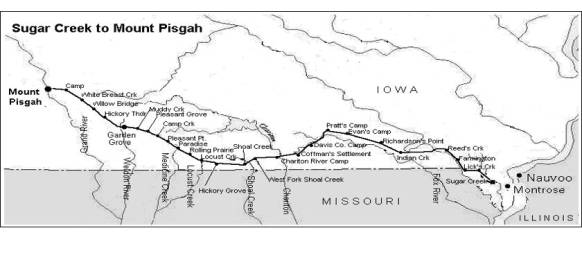
It was
another chilly, but pleasant, sunny morning.
It was nineteen degrees at sunrise.
At 8 a.m., Brigham Young notified the camp to prepare to leave the Sugar
Creek Camp by noon. A meeting of the
brethren in the camp opened at 10 a.m. Brigham Young was not feeling well, so
he sent Heber C. Kimball to speak to them.
Elder Kimball expressed President Young's desire to move to a new
location. They were too close to Nauvoo
and many brethren continued to return to the city. They were neglecting their families and teams, worrying about
their property back in the city, and going to see their grandmother or
grandfather.
Elder Kimball continued
by prophesying that the Kingdom of God would be established. He encouraged the brethren to go forward,
that the grass would start growing soon.
“If Nauvoo has been the most holy place it will be the most wicked
place.” He called for all to do what
President Young asked. He warned them
about the plagues that fell on Zion's Camp.
At about 1 p.m., the
camp began to move and by 4 p.m., nearly 500 wagons were rolling forward,
traveling to the northwest for about five miles. It was a beautiful, warm day, and the wagons rolled through the
slush and mud. Many people came from
Nauvoo to say good-bye again to their family and friends. Some camp members stayed behind at the Sugar
Creek Camp because they were not ready or they were sick. For instance, Allen Stout stayed because he
had “sore eyes” and could not see. The
Camp of Israel traveled on the ridge in between Sugar Creek and the Des Moines
River.
Brigham Young's
carriage did not arrive from Nauvoo until about 4 p.m., which caused him to
delay his start. He arrived into the
new camp at sunset. The main camp was
situated on low ground among the trees.
As he was coming down a hill into the camp, President Young's carriage
almost tipped over. When Parley P.
Pratt was coming down another part of this hill, his “neck yoke” broke, causing
horses and wagons to plunge down the hill among the tents, women and
children. Thankfully, no one was
injured.
The men went to work,
set up camp, scraped away the three or four inches of snow on the ground, and
put up the tents. They built large
fires in front of the tents to keep their families warm.
The pioneers who had
preceded them to this camp a day earlier, had spent the day splitting 3,000
rails and husking 150 shocks of corn for local Iowan settlers in exchange for
corn and hay for the animals. Eliza R.
Snow, who came with this group the day before, watched the hundreds of wagons
come into the camp. As they rolled into
camp, she composed another poem:
Lo! a mighty num'rous
host of people
Tented on the western
shore
Of noble Mississippi
They for weeks were
crossing o'er.
At the last day's
dawn of winter,
Bound with frost
& wrapt in snow,
Hark! the sound is
onward, onward!
Camp of Israel! rise
& go.
All at once is life
in motion‑‑
Trunks and beds &
baggage fly;
Oxen yok'd &
horses harness'd‑‑
Tents roll'd up, are
passing by.
Soon the carriage
wheels are rolling‑‑
Onward to a woodland
dell,
Where at sunset all
are quarter'd‑‑
Camp of Israel! all is well.
Thickly round, the tents
are cluster'd
Neighb'ring smokes
together blend‑‑
Supper serv'd‑‑the
hymns are chanted‑‑
And the evening
pray'rs ascend.
Last of all the
guards are station'd‑‑
Heav'ns! must guards
be serving here?
Who would harm the
houseless exiles?
Camp of Israel! never
fear.
Where is freedom?
where is justice?
Both have from this
nation fled;
And the blood of
martyr'd prophets
Must be answer'd on
its head!
Therefore to your
tents, O Jacob!
Like our father
Abra'm dwell‑‑
God will execute his
purpose‑‑
Camp of Israel! All
is well.
After the tents were
pitched, Brigham Young invited the Saints to dance to the tunes of Captain
Pitt's brass band. About fifty couples
joined in the festive event. Some curious,
local Iowan settlers gathered around to watch and listen. The members of the band were most likely:
William Pitt, William Clayton, Stephen Hales, William Cahoon, Robert Burton,
James Smithies, Daniel Cahoon, Andrew Cahoon, Charles Hales, Martin Peck, J.T.
Hutchinson, James Standing, William Huntington, Charles Smith, Charles Robbins
and John Kay.
At 8 p.m., Parley P.
Pratt, Heber C. Kimball, and Willard Richards met with Brigham Young in his
tent to make plans for the week. They
decided to move the camp again in the morning toward Farmington, where Bishop
Miller's group was working. Orson Pratt
met with two men from Iowa who were interested in buying his property in Nauvoo
for the low sum of about three hundred dollars. The sky was clear in the evening. At midnight the temperature was twenty‑eight degrees.
Several
miles ahead, a Brother Smith's child died.
Brother Smith was in George Miller's company of pioneers. Charles C. Rich helped bury the child and
he, along with Bishop Miller, preached the funeral sermon. A number of settlers in the area attended
and were attentive to the speakers.
John
Taylor's wife, Elizabeth, gave birth to a daughter, Josephine Taylor.
“Henry Bigler
Autobiography”, typescript, 17-18; “Sarah Rich Autobiography,” typescript, 47;
“Eliza Lyman Autobiography,” 8-9; Beecher, The Personal Writings of Eliza R.
Snow, 115‑16; Leona Holbrook, BYU Studies, 16:1:125; Watson,
The Orson Pratt Journals; Nibley, Exodus to Greatness, 127‑29;
Brooks, The Diary of Hosea Stout; Watson, Manuscript History of
Brigham Young, 56‑8; Kimball, Heber C. Kimball ‑ Mormon
Patriarch and Pioneer, 130; Black, Membership of the Church 1830‑1848
At 7 a.m.,
the temperature was twenty-three degrees.
At 9 a.m. the teams started moving out of the camp. There was some confusion because some of the
companies had camped down in the valley
while the other part was up on the prairie.
The groups left their camp on different roads. Brigham Young took the lower group across Sugar Creek and Hosea
Stout took a group of 200 wagons on the ridges.
The camp traveled
about ten miles over “several tedious hills” through mud and water. Hosea Stout recorded:
We had a very bad road
all day and often at hills and difficult places to cross branches [of
streams]. I saw teams standing waiting
for those forward to pass over which were a mile long and often at hills teams
would stall and have to be rolled up by hand thus making it both laborious for
men who were on foot, and also slow for the teams to be thus detained for each
other. It was beautiful country.
At some point during
the day, the companies reached a summit of a hill where they were able to catch
a glimpse of the Nauvoo temple, far to east.
Lewis Barney wrote:
On reaching the summit
between the Mississippi and Des Moines Rivers the company made a halt for the
purpose of taking a last and peering look at the Nauvoo Temple, the spire of
which was then glittering in the bright shining sun. The last view of the
temple was witnessed in the midst of sighs and lamentations, all faces in gloom
and sorrow bathed in tears, at being forced from our homes and Temple that had
cost so much toil and suffering to complete its erection.
At 2 p.m., Hosea
Stout went ahead on horseback to try to find the “forward team.” He was concerned that he may have had the whole
wagon train heading down the wrong road, which would have been a disaster and a
great loss of time. He found a house,
asked directions, and found out they were heading the right way. He soon located the “forward team” of
Stephen Markham, Brothers Darby and Allen who were trying to purchase corn and
hay for the camp that night. A field
was located nearby which was a beautiful piece of ground in timbered land. There was timber already cut and scattered
in piles almost as if they were prepared for the camp. The owner let the camp use the wood for
fires. The wagons arrived and formed
the camp which was on the west side of Lick Creek1
about a half mile from its junction with the Des Moines. The waters of the rivers were very
clear. “The country was timber land and
quite broken, with high bluffs rising loftily over low valleys, and but little
cultivated.” The people who lived
nearby were friendly and gave members of the camp straw for their cattle.
At some point during
the day, there was a problem with teams using two converging roads. This caused some separation of teams and
collisions, resulting in damage to some wagons. The artillery company broke several of the William Clayton
company wagon boxes.
Heber C. Kimball and
Newel K. Whitney had to stay behind in the morning to mend a wagon. This delay caused them to end up camping
three miles behind the main camp.
Samuel Bent and a few others stayed behind to finish up the work that
they were hired to do.
Orson Pratt traveled
on horseback to Farmington, where he looked at the items which were being
offered in exchange for his Nauvoo property.
He did not reach a firm agreement with the men. He headed back to meet the camp, but they
did not take the route across the prairie which he had expected them to
take. After some time searching, he
finally found the camp. Each night
Elder Pratt would calculate the latitude of the camp by using the stars. The band played in the evening.
Warren
Foote was mourning the continued sickness of his mother who had been recently
baptized. He wrote:
I felt very much cast
down in my mind. I felt that I had done
all I could for her in my circumstances, and still I had a desire to know if
there was anything more that I could do.
I was impressed to go and pour forth my soul to my Father in Heaven in
secret. I did so, and through the
inspiration of His Holy Spirit it was made known to me, that I had done all
that was required of me for her; and that she would be taken from me, and that
she should rest with Father, and should come forth with him in the morning of
the first resurrection, and receive an exaltation with him in the Celestial
Kingdom of our God. Therefore though I
mourn my bereavement of her for a season, yet I rejoice in the promises of the
Lord.
Thomas
Bullock was out of employment. He had
been working for Willard Richards in the Historian's Office, but Elder Richards
was no longer in Nauvoo. Brother
Bullock went to the temple office and showed them orders from Elder Richards to
take Thomas Bullock into their temple office.
Almon W. Babbitt refused to hire him, saying that he only took orders
from Brigham Young. Brother Bullock
went away feeling hurt and disappointed.
A daughter, Isabella
Jane Forsyth, was born to Thomas and Isabella Forsyth.2
Watson, Manuscript
History of Brigham Young, 59‑60; Stanley Kimball, “The Iowa Trek of
1846"; Brooks, The Diary of Hosea Stout; The Orson Pratt
Journals; William Clayton’s Journal; “Warren Foote Autobiography,”
typescript, 76; Beecher, The Personal Writings of Eliza R. Snow, 116;
“Thomas Bullock Journal,” 55; Black, Membership
of the Church 1830‑1848; “William Huntington autobiography,”
typescript, 48; “Lewis Barney Autobiography,” typescript, 28
At 7 a.m.,
the temperature was twenty‑three degrees. The weather was very pleasant and warm all day. At about 9 a.m., the bugle was sounded
calling the camp together. Brigham
Young gave them some instructions. He
told the “pioneers” to go ahead and prepare the roads by cutting and trimming
trees and filling up the bad places in the roads. He instructed the guard to carry axes instead of guns, and to
help the teams. They should not order
the teamsters. Everyone should help
each other. He asked any man to quit
the camp who could not quit swearing.
President Young wanted to correct the traffic problems that were
encountered the previous day. He
instructed the men that the teams must not crowd each other. The ox teams must let the faster horse teams
pass. No teams should come within two
or more rods of each others. President
Young directed those designated as “pioneers” to leave first, followed by the
band, then the ox teams, and the remainder of the camp.
The camp soon started
to move up the north bank of the Des Moines River. Hosea Stout observed that the Des Moines was “a beautiful stream
with a rock bed but appeared very narrow after being so long accustomed to the
broad rolling Mississippi.” The road
was dry and level.
At 10:30 a.m.,
Brigham Young left the Lick Creek Camp along the same route and arrived in
Farmington at noon. He traded in the
town for thirty minutes. Hosea Stout
also went into town. “It is situated on
the river, the site is level and not very romantic but rather dull looking and
I should think sickly.” When Brother
Stout went into the store, there was a group of shady looking characters who
looked like they wanted to start a fight, but Brother Stout kept his two six‑shooters
and a large Bowie knife in plain sight, and they stepped aside when he came
near them.
The rest of the wagon
train soon passed through Farmington.
While traveling through town, one of Brother Roger's boys drove his team
accidentally over a hog and killed it.
The owner witnessed the event, did not seem to mind, and retrieved the
carcass. However, some of the rough
characters in town came forward, swearing, and demanded that the owner be paid
for the hog. Some of the brethren
agreed while others did not. Brother
Hunter, of the guard, came forward, ordered the teams to move on and decided
that payment did not need to be made for the hog. The Farmington men made remarks about Brother Hunter’s guns. Brother Hunter let them know that the guns
could be used if he was molested. Eliza
R. Snow wrote that the people of Farmington “manifested great curiosity and
more levity than sympathy for our houseless situation.”
From Farmington, the
wagon train continued up the north bank about three miles, where they reached
the next encampment. The roads for
these final three miles were bad and several wagons were broken and
damaged. The camp was about three
quarters of a mile north of the Des Moines River, on a ten-acre lot owned by
Dr. Jewett. This land had been cleared
of timber and fenced by George Miller, Charles C. Rich, and about thirty or
forty pioneers who had been there for about a week. The camp was situated on the bank of a small, clear creek. Because of the warm weather, the ground was
thawed, and was quite muddy, making it unpleasant for those who would need to
sleep on the ground. Orson Pratt
scraped together some leaves which helped to keep his family out of the
mud. Most of the camp arrived before dark. They had traveled about eight miles.
Hosea Stout arrived
at 2 p.m. and chose a nice spot for the guard to camp. But he soon found out that the place he
chose would be occupied by President Young and others. Brother Stout believed that he should step
aside for his priesthood leader, so he selected a nice new spot in a wooded
area with sugar maple trees. He was
then informed that the owner of the land did not want anyone camping in the
woods. Brother Stout decided that they
would go ahead and work things out with the owner if needed, because all the
best ground within the field was already taken. After they had set up camp, the owner came and was satisfied with
what he saw. He just asked them not to
use any green wood or wood that could be made into saw logs.
The evening sky was
clear and beautiful. The band played in
camp. As Eliza R. Snow was eating her
supper while seated in her buggy, she was surprised to see Sister Elizabeth Ann
Whitney who came to visit. Sister Snow
was delighted to hear that the Whitneys had arrived into camp and were tented
nearby.
George Miller brought
Dr. Jewett to meet Brigham Young. Dr.
Jewett related a long history of experimentation with “animal magnetism”
(hypnotism), claiming that it had nearly cured him of infidelity. Dr. Jewett asked what the Mormons thought of
the principle. Brigham Young made it
clear that they believed in the “Lord's magnetism.” The Lord had “magnetized” Daniel so that he could interpret the
hand writing on the wall.3
Corn was brought into
the camp, including one hundred and seventy-two bushels of tithing corn, and
corn received for payment for the work completed by George Miller and the other
pioneers.
Former
apostle, now Strangite, John E. Page preached in the temple on the west stand
at 1 p.m. He spoke against the Twelve
and claimed that James J. Strang was the true successor of Joseph Smith. Jehiel Savage also spoke in support of
Strang. Elder Orson Hyde then spoke,
and according to Thomas Bullock, “knocked every one of their arguments in the
head and ordered Savage to go to Voree [Wisconsin] and tell them [followers of
Strang] they would be damned. . . .”
Elder Pratt also spoke words of reprovement toward Page. Page was then said to have stated “I will go
to hell sooner than take abuse, and the Devil shall have it to say 'here is a
man that is damned like a man.'” The meeting closed at 4:30 p.m.
Watson, Manuscript
History of Brigham Young, 61‑63; Stanley Kimball, “The Iowa Trek of
1846";Watson, The Orson Pratt Journals; Brooks, The Diary of
Hosea Stout; William Clayton’s Journal; Beecher, The Personal
Writings of Eliza R. Snow, 116‑17; “Thomas Bullock Journal,” 56
The
morning was warm and the day was beautiful.
The camp was awakened to the music of the Band which was “delightfully
sublime.” At 8:00 a.m., the temperature
was forty‑three degrees.
At 9 a.m., Brigham
Young called the brethren in the camp together and announced that they would
remain in the camp until the following day, when part of the camp would move
out. He wanted everyone to be busy
during the day repairing and greasing their wagons, shoeing their horses,
mending harnesses, getting ready for an early start the following day. Each team would be provided with two days of
corn.
At 10:30 a.m.,
Brigham Young met with members of the Twelve, the bishops, and a few of the
captains. It was agreed that a few of
the pioneers and George Miller would go on twelve miles, right away, to form
another camp. The remainder of the camp
would be numbered again and be divided into hundreds and fifties under the
direction of the Twelve. The first
hundred would start in the morning.
Two tons of hay was
purchased and brought into camp. George
Miller rolled on ahead with some pioneers, heading in a westerly direction,
crossing the Des Moines River at Bonaparte Mills.
At 12 p.m., Hosea Stout
called a meeting to discuss the need to have the guard work together and spoke
to them at length about the guard working their way to relieve the Church from
the expense of supporting them. They
should work when the camp was not traveling.
After the meeting, Charles Allen, a captain in the guard, held a meeting
with his men and declared that he would not work, would not take orders from
Hosea Stout, but that he would go by himself to President Young to receive
orders. Some joined in with him in these
feelings.
Brother Scott found
some work for the camp involving removing dirt from a coal bed, and splitting
two thousand rails. The payment for the
work would be in flour, pork and cash.
Fifty men started to work on the contract.
Many citizens of the surrounding
area walked into the camp, strolling down the makeshift streets of the
temporary city. Orson Pratt finished the negotiations with men in Farmington
who wanted to buy his Nauvoo property.
Some of the citizens
from Farmington came into camp and invited the band to go to their village for
a concert. The band left at about 3
p.m. on horseback, arriving in Farmington at about 4:30 p.m. They played at the hotel, then went to the
schoolhouse and played until dark. The
house was filled with men and women, including the town leaders. The band was fed supper in the hotel and
given five dollars. At 8 p.m., they
left the town and were given three cheers.
On the way, they were met by thirty of the guard, who had just started
out to find them. President Young had
felt uneasy about them returning without men to protect them. They returned to camp at 9 p.m.
In the evening, Eliza
R. Snow took a walk with Hannah Markham and they lost their way in the large
tent city. They stopped at Elder Amasa
Lyman's tent and after chatting with Eliza Partridge Lyman, Elder Lyman
escorted the ladies toward their camp.
The buggy which Sister Snow had been using as her sitting room and
dormitory was exchanged this day for a lumber wagon by Brother Markham.
Also in the evening,
Brother Stout reorganized the guard.
Because there were no longer enough men for four groups of fifty, he
wanted to reorganize with three groups of fifty. The reorganization was performed and supported by the guard. Right after this, Brother Stout was called
to go camp headquarters, instructed to divide the guard into four groups, and
to have one group ready to leave in the morning. Brother Stout went back to the guard and let them know that the
reorganization performed earlier was void.
John D.
Lee left Nauvoo, and started his return trip to the Camp of Israel. He had returned to the city to help free
some relatives who had been arrested.
With everything settled, he started his return journey. George Laub crossed the Mississippi River on
a flat boat with Brother Lee's teams and goods. The river was no longer frozen and crossings were again made by
boat. The Lee family camped for the
night about one mile from the Mississippi River.
The ship Brooklyn
crossed the equator about this time, heading south for Cape Horn. Samuel Brannan organized the ship into a
form of the United Order. They would be
in one body and share together the debts of the voyage. They were asked to agree to give three
years’ labor into a common fund. If
they left the covenant, the common property would remain with the elders. It was an imperfect agreement, and there was
some grumbling, but they all signed their names to the agreement.
Watson, Manuscript
History of Brigham Young, 63‑64; Brooks, The Diary of Hosea Stout;
Watson The Orson Pratt Journals; William Clayton’s Journal;
Beecher, The Personal Writings of Eliza R. Snow, 117; “George Laub
Autobiography,” typescript, 38-39; Bailey, Sam Brannan and the California
Mormons
At 8:30
a.m., Brigham Young held a meeting with the brethren in the camp. He asked for three teams to pull the cannon
and called for volunteers to husk corn at the next camp. He announced that only the first company was
leaving on this day to prepare the next camp.
If there was a family without the means to continue, they must be
provided for. No one was to be left
behind who wished to continue. He
recommended that they should lighten their loads by eating certain food that
could be replaced. When they reached
the Missouri river, they would go to work and buy more flour and other
foods. After the meeting, several men
came forward and offered to pull the cannon.
A Colonel Swazy and his
family visited the camp and mentioned that the band's performance last evening
had created many good feelings among the citizens of Farmington.
At 10 a.m., Brigham
Young rolled out of the camp with the
first company. They traveled along the
banks of the Des Moines River for two miles and crossed just below Bonaparte
Mills. The water was about two feet
deep with a nice rocky bottom. Sister
Eliza Snow wrote about their day’s journey:
Sis[ter] M[arkham] and
I are nicely seated in an ox wagon, on a chest with a brass kettle and a soap
box for our foot stools, thankful that we are as well off. The day fine, we travelled 2 miles on the
bank of the river & cross’d at a little place called Bonaparte. I slung a tin cup on a string and drew some
water which was a very refreshing draught.
The company proceeded
up the west bank of the river for a short distance and passed through the
little town of Bonaparte. There was a
“splendid” mill on the river in this town.
A dam at the mill extended across the entire river and a lock was used
to pass boats up or down the river.
After Hosea Stout
passed through the town, he found the road full of wagons and teams standing
still. He knew that something was wrong
and went on ahead to check things out.
Not far up the river, the road took a branch and then went up a
hill. The teams at the bottom of the
hill were waiting because the hill was full of stalled wagons stuck in the
mud. On the sides of the road there
were thick woods which prevented the teams from going around bad spots. The wagons would frequently sink all the way
down to their axles. This two-mile
stretch was by far the worst road that the camp had experienced so far.4
Eliza Lyman called it “the most muddy road I ever saw.” As Father John Smith’s wagon was traveling
up this steep road, it tipped over injuring Sister Smith slightly.
Brigham Young arrived
at the top, on the prairie at about 1 p.m.
A load of corn was supposed to be there, as planned the day before. He
was disappointed to find nothing left there by the advance group. The horses had not been fed in the morning,
so they were turned loose on the prairie to eat the scarce dry grass. Men were sent back one mile to purchase a
load of corn. Hosea Stout found corn at
the home of an uncle of Charles C. Rich.
By 4 p.m., most of
the teams in the first company had come up to the prairie and the horses had
been fed. The camp traveled west on a
very good road for seven miles and started to make camp at about sunset on a
low piece of flat prairie land on the north bank of Indian Creek.5
The camp had traveled twelve miles on this day.
Brigham Young had
expected to see George Miller and his pioneers to help provide feed for their
exhausted teams. But there was no sign
of this company. Corn had to be
purchased with cash, enough to give each beast eight ears.
The ground was too
wet to pitch tents, so most of the camp stayed in their wagons. Despite the uncomfortable conditions, there was
no murmuring and all appeared to be happy.
Several horses were sick. One
thought to have distemper was removed from the camp. When Brigham Young arrived, he did not like the location that had
been chosen for him. He pitched his
tent on the bank of Indian Creek in the woods at about 10 p.m.
It was learned that
Newel K. Whitney broke an axle and was camping on the south bank of the Des
Moines River. Elders Heber C. Kimball,
Parley P. Pratt, John Taylor and John Smith were camping out on the prairie between
four and seven miles to the east. Their
teams could not travel further that day, after coming up the long, muddy
hill. This group did not have a fire
that night and had to have a cold supper.
Some neighbors gave them some straw for the animals. Orson Pratt learned that a wagon that was
carrying one of his loads broke an axle further back.
Late into the night,
George Miller and Henry G. Sherwood called on Brigham Young and told him their
company did not stop at this spot as planned because they could not find
work. They had continued on fourteen
miles further and found a place to camp near Brother Stewart's home. George Miller's company had been busy that
evening harvesting Brother Stewart's corn to help pay his debts and to bring
the rest of the corn to the camp.
The snow
was nearly all melted and the river almost open, free of ice. Warren Foote’s mother, Irene Lane Foote
died, at about 4 a.m. She had joined
the church on February 28. Brother
Foote mourned for his mother:
My feelings at this
moment who can describe. O how much
care she has taken of me, how many sleepless nights she has spent watching over
me through the many spells of severe sickness I have had, when nothing but a mother's
care could have saved my life, with the blessings of God. O how little I have repaid her for all this
care and anxiety, but if the Lord will spare my life, I will see that her work
in this probation is completed and united with Father through the sealing
power, no more to be parted forever.
A daughter, Melissa
Miner, was born to Albert and Tamma Durfee Miner.6
Elder
Addison Pratt experienced the great missionary joy of receiving a letter. He wrote: “This is a day long to be
remembered. We have received a letter
from Br. Woodruff dated November 1844.
This is the first letter from the Twelve. . . . Tho old as this letter
is, it contains news that is as refreshing to us as cooling waters to a thirsty
soul.”
Watson, Manuscript
History of Brigham Young, 64‑66; Stanley Kimball, “The Iowa Trek of
1846"; Watson, The Orson Pratt Journals; Brooks, The Diary of Hosea
Stout; Beecher, The Personal Writings of Eliza R. Snow, 117‑18;
“Thomas Bullock Journal,” 57; Kimball, Heber C. Kimball ‑ Mormon
Patriarch and Pioneer, 132; “Warren Foote Autobiography,” typescript,
76-77; Black, Membership of the Church 1830‑1848; “William
Huntington autobiography,” typescript, 48; Our Pioneer Heritage, 2:323;
Lyman, Amasa Mason Lyman, Pioneer, 148; Ellsworth, The Journals of
Addison Pratt, 273
At 7 a.m.,
the temperature was thirty‑five degrees.
The weather was clear, pleasant and warm. One of Brigham Young's horses died during the morning. It turned out that the other horse suspected
of having distemper, did not have it after all and was returned to camp. In the morning, many of the Saints decided
to move their tents and wagons to the banks of the creek, where it was not
quite as muddy.
Parley P. Pratt and
his company arrived at the camp at 11 a.m.
But they continued to travel on to the west, to start working on a local
contract to split rails and clear land.
Heber C. Kimball arrived at 1 p.m. and John Taylor arrived at 2
p.m. One hundred bushels of corn were
purchased for the camp.
Hosea Stout had to
deal with more dissension among the guard.
Samuel Gully, one of the captains of the guard, had brought his wagon to
the Reed's Creek camp. There, he met up
with his wife, and declared that he would have nothing more to do with the
guard and advised his men to join other companies. He complained that he was not used well, but had never mentioned
anything to Brother Stout. He took his
yoke of oxen, and took his things out of the wagon that he left by the
roadside.7 When Brother Stout heard about the
problem, he sent two members of the guard with three yoke of oxen to bring up
the wagon. They started heading back at
4 p.m. and returned with the wagon before daybreak, traveling all night.
In the evening,
Charles Allen continued to disregard Hosea Stout's orders. Brother Allen's group of guards was called
to take their regular turn guarding the camp, but he refused to let anyone go,
saying that they were too tired.
In the evening, Dr. John
D. Elbert, a nearby resident, came into camp and met with Brigham Young and
Willard Richards in Elder Richards’ tent.
Dr. Elbert stated that when news first arrived that the Mormons were
coming, there was much excitement and worry because of the false reports that
had been circulating. They feared that
“they should be swallowed up alive” by the Mormons. But the more recent reports of honest dealings with the camp had
helped to calm the fears. Dr. Elbert
said that he had treated several Mormon families who lived in the vicinity and
that all had paid him honestly. He couldn't say the same for all the non‑Mormon
families. Dr. Elbert set aside a
section of land seven miles ahead for a camp and contracted with the brethren
to split rails and clear land. Payment
would be in corn. While the Doctor was
there, the band came up to the front of the tent and played for him.
Brigham Young wrote a
letter (penned by Willard Richards) to Orson Hyde in Nauvoo, reporting that all
was well and that the camp was in good spirits.
Christina,
wife of John Lytle, delivered a son, Charles Lytle, at 2 p.m.8
The ice
was finally broken up and was running on the river. Brother Charles W. Wandell wrote a bogus revelation to see what
effects it would have on the Strangites.
He sent it to Jehiel Savage, a Strangite, telling him it was a
revelation from the Lord given through James J. Strang. Savage took the revelation and from the
temple stand read it to the people, bearing testimony that he knew it was from
the Lord. Brother Wandell came forward
and acknowledged that he was the author of the article, that the Lord had
nothing to do with it, and that Strang never saw it. Brother Wandell later found out it was unprofitable and dangerous
to use the name of the Lord falsely, that it produced evil among men. While it did show the brethren that the
followers of Strang were more ready to receive fables than truth, the brethren
understood that no man should use this deceptive method.
A daughter, Louisa
Cox, was born to Amos and Philena Cox.
A son, Henry Jefferson Keele was born to Richard and Nancy Keele.9
Lydia Faunce was also born in Nauvoo on this day.
Wilford
Woodruff arrived on a ship from Liverpool, England.
Cowley, The
Discourses of Wilford Woodruff, p. vii; Watson, Manuscript History of
Brigham Young, 66‑68; Comprehensive History of the Church,
3:112; Brooks, The Diary of Hosea Stout; Watson, The Orson Pratt
Journals; Black, Membership of the Church 1830‑1848; “Thomas
Bullock Journal,” 57
At 7 a.m.,
the temperature was thirty‑two degrees.
The skies were clear and the day was pleasant. The wagons moved out of camp in the morning.
After traveling about
two and a half miles on bad roads, Brigham Young stopped in the morning to
transfer a load of biscuit from some sacks to boxes. The sacks were worn through by the traveling. While he was working, most of the wagons
passed him. When he was finished, he
caught up and overtook many of the teams after another four miles. The roads during this stretch were much
better. Eliza R. Snow got out of her
wagon and walked for the first time on the journey. The timber in this area was mostly oak which was quite different
from the maples that they had become accustomed to near the Des Moines River.
Brigham Young reached
Dr. Elbert's campground where part of the group was already setting up
camp. Hosea Stout had arrived at 1 p.m.,
after a two-hour journey, and had pitched his tent on a beautiful ridge.
Word came to Brigham
Young that there were better locations for camping further ahead. Because the traveling was so nice, and the
day was pleasant, President Young decided to go on another five miles to a
place called Richardson's Point. The
roads were bad along this next stretch.
They then passed through several miles of rolling prairie and they pitched
their tents at about 4 p.m., on a very dry spot, close to the road, and near a
branch of Chequest Creek.10 There was plenty of corn nearby that could
be obtained in exchange for splitting rails.
The Camp of Israel was fifty‑five miles from Nauvoo. Some of the wagons arrived after dark, but
traveling at night was possible because the moon shined very bright.
There was confusion
at the Dr. Elbert camp because Brigham Young did not stop as planned. Some of the guard took down their tents and
followed after him. Hosea Stout did
likewise and arrived at Richardson's Point at dark. Hosea Stout sold a bedstead for eight bushels of corn that he
used to feed the guard's animals. His
wife had been afflicted with much pain in her right side and was unable to sit
up in the wagon all day. They had made
a bed for her to lie in, but even with extra care, the traveling during the day
was painful for her.
Newel K. Whitney
camped about two miles back. Amasa
Lyman, the band, and a portion of the guard camped at Dr. Elbert's camp, four
miles back. The band worked on splitting
130 rails for Dr. Elbert. In the
evening Dr. Elbert and some others came to hear the band play. John Kay also sang some songs which pleased
the visitors.11
Parley P.
Pratt and Orson Pratt continued on four more miles to George Miller's camp on
the Fox River. In this region was
located a small branch of the Church.
They camped near Brother Stewart's home. Some corn was donated to the camp, which was gathered by George
Miller and his men.
The ice
was running on the river and three steam boats were spotted across from Nauvoo,
puffing upstream. Pigeons were seen
flying north in large numbers. There
were some false rumors circulating through Nauvoo. The first rumor was that John Taylor was on his way to Nauvoo to
preach his last Mormon sermon. The
second rumor was that Hosea Stout had shot President Brigham Young, and Brother
Stout had been hung by the neck on a tree.
It was said many of the guard had left the camp. These rumors were of course false.
Watson, Manuscript
History of Brigham Young, 66‑68; Stanley Kimball, “The Iowa Trek of
1846"; Watson, The Orson Pratt Journals; Brooks, The Diary of
Hosea Stout; William Clayton’s Journal; Beecher, The Personal
Writings of Eliza R. Snow, 118; “Thomas Bullock Journal,” 57; Black, Membership
of the Church 1830‑1848; Holzapfel, Women of Nauvoo, 142; Woman’s
Exponent 12:9-12
The
weather was dry, warm, and pleasant. At
6:52 a.m. a son, David Kimball Smith, was born to Heber C. and Sarah
Kimball. This birth occurred where
Bishop Whitney was camping, two miles east of Richardson Point. He was given the last name of Smith, no
doubt in honor to Joseph Smith whom Sarah was sealed to. Sarah was the daughter of Bishop Newel K.
Whitney.12 Using Book of Mormon tradition, Elder Kimball named the valley
his son was born, the Valley of David.
At 11 a.m., a Sabbath
meeting was held, attended by many in the camp and about forty or fifty
nonmembers from the surrounding area.
Elder Jedediah M. Grant spoke on the first principles of the
gospel. He was followed by Elder George
A. Smith. Eliza R. Snow went to the
meeting, but when she discovered that the talks were addressed mainly to the
nonmembers present, she decided to go visit Sister Leonora Taylor, wife of
Elder John Taylor. Sister Taylor was
feeling down because she was experiencing great pain caused by rheumatism. Sister Snow spent three hours encouraging
her, and letting her know that God would heal her.
Brigham Young and
Heber C. Kimball rode three to four miles west to inspect the campground that
was previously selected by George
Miller on the west bank of the Fox River.
It was located near Brother Stewart's home but they found the ground was
too wet there. They decided to keep the
camp where it was, at Richardson's Point, until Tuesday. Brigham Young had heard that George Miller
had obtained and stored one hundred and seventy-five bushels of corn for the
camp. When President Young came to the
camp at Fox River, he was disappointed to learn that George Miller, Parley P.
Pratt and others had gone on ahead that morning and taken the corn with
them. Several companies, not
understanding the new plans, had started to head for the Fox River camp. These groups turned around and went back
when they learned about the new plans.
The William Pitt
band, at Dr. Elbert's Camp, four or five miles behind the main camp, spent the
morning playing for many of the residents who lived nearby. They greatly enjoyed hearing the band and
gave them an invitation to play in the town of Keosauqua. The invitation could not be accepted right
away because instructions had been
given for the band to join the camp at Richardson Point. The band immediately took down their tents
and arrived at the main camp at about 5 p.m.
Some of the citizens of Keosauqua followed the band to the camp, hoping
that permission would be granted to accept their invitation. President Young advised the band to accept
the invitation and arrangements were made for a concert on the following day.
Other groups rolled
into the Richardson Point Camp. Brigham
Young's brother Lorenzo was among those who arrived this day.
Brigham Young and
Heber C. Kimball rode two miles back, to the Valley of David, probably to be
with Sarah Ann Kimball and the new baby.
They returned to the main camp at Richardson Point at 9:30 p.m., at
which time a council meeting was held for the first time in Brigham Young's new
large tent. The discussions centered on
a travel schedule needed for an advance party to reach the Great Basin region
soon enough in the season to plant a crop.
The proposed plan was to have a body of about three hundred men leave
their families and travel with speed over the mountains.
The Council discussed
the need to have John L. Butler return to the Emmett company.13
It was time to have this group of Saints gathered in with the main body
of the Saints. The Council also
discussed retrieving George Herring, an Indian, who was two hundred miles to
the south, preaching the gospel to his tribe.
(See October 29‑30, 1845.)
The Council meeting lasted until midnight.
A meeting
was held in the temple. Elder Orson
Hyde read a letter that he had received from Brigham Young (see March 6,
1846) stating all was well in the camp.
This put to rest the crazy rumors which had been circulating the day
before about Hosea Stout killing Brigham Young.
After preaching,
Elder Hyde’s brother‑in‑law, Luke S. Johnson,14
arose and addressed the congregation. He told how he had for some time been away from the work of the
Lord, but his heart was now with the Saints, and he wanted to go west with
them. A vote was taken whether to accept
him back. Brother Johnson was so
affected by the outpouring of support that he wept with joy, as did many
others. At 5 p.m., he was re‑baptized
by Orson Hyde in the Mississippi River.
Three other people were also baptized.
At 7 p.m., Elder Orson Hyde
confirmed Luke S. Johnson a member of the Church in the temple attic.15
At 2 p.m., William
Smith (brother of Joseph), former apostle, not a member of the Church, arrived
in Nauvoo by boat with a group of drunken men who started to fire their guns
into the air, creating a great disturbance.
William was not welcomed warmly back to Nauvoo this day because he had
been publicly preaching against the Church and its leaders. (See October 21
and 28, 1845.)
In the afternoon,
John E. Page preached a sermon in support of Strangism in the streets of
Nauvoo. A hat was passed around for a
collection. It was returned with a few
pennies, chips, buttons, and sticks, indicating that his words were not being
accepted by the faithful members of the Church.
Watson, Manuscript
History of Brigham Young, 71‑72; Kimball Heber C. Kimball ‑
Mormon Patriarch and Pioneer, 133; Hartley, My Best for the Kingdom,
187; “Hosea Stout Diary”; Jenson, LDS Biographical Encyclopedia, 4:709
JOHNSON, Luke S.; Brooks, The Diary of Hosea Stout; William Clayton’s
Journal; Beecher, The Personal Writings of Eliza R. Snow, 118;
“Thomas Bullock Journal,” 57; Bruce Van Orden, Church News, March 8,
1996; Black, Membership of the Church 1830‑1848;
The weather was very
pleasant, thirty‑two degrees at sunrise.
The morning sky was clear and bright.
At 10 a.m., the Twelve met in council in Brigham Young's large field
tent. They wrote a letter to the Nauvoo
Trustees. Instructions were given to
gather up cows, sheep, oxen, mules, pigs and other animals to be taken with the
next group of Saints who would leave Nauvoo.
Elder Orson Hyde was instructed to remain in Nauvoo to dedicate the
temple if the Twelve were not able to return to for this event.
The Council
instructed Captain John Scott, in charge of the artillery, to bury between
twenty-three and twenty-four hundred pounds of cannon balls, near Richardson's
Point Camp, to lighten the loads. The
cannon balls would be retrieved at a later time. The Council again attempted to better organize the camp. They decided to form new companies of
“fifties.” These groups of fifty wagons would be led by Brigham Young, Parley
P. Pratt, Amasa Lyman, and George A. Smith.
These independent companies would leave the camp at different times.
Hosea Stout was asked
to determine how many of the guard could continue on over the mountains,
without returning to Nauvoo to bring their family and other belongings. Brigham Young was being constantly
approached by many men who desired to be allowed to return to Nauvoo.
Brother Stout
continued to try to provide for the men under his charge. On this day he sold his table for a hog
which was divided among the guard, making up about one meal.
Many companies
arrived at Richardson's Point. Eliza R.
Snow wrote: “Our town of yesterday
morning has grown to a City.” Newel K.
Whitney arrived at about 3 p.m., moving his company from their camp two miles
away. Alexander Merrill came into the
camp bringing news from Nauvoo that William Smith (the Prophet Joseph's
brother) had returned to Nauvoo. Samuel
Bent, Charles C. Rich, Peter Haws, Shadrach Roundy and others joined the camp,
coming in from the Reed’s Creek Camp, below Bonaparte.
The camp was very
busy during the day. A blacksmith's
shop was observed in full operation.
The sisters were busy cooking.
Hannah Markham baked eleven loaves of bread. Washing clothes was not as convenient as in former camps because
the water was not located as close.
Tubs and washboards were taken about a half mile to the side of a
stream. Meals consisted of pot‑pies
of rabbits, squirrels, pheasants, quails, prairie chicken, and other items that
the hunters would catch.
In the evening, rain
started to fall. President Young and
Elder Willard Richards visited with Edwin Little, Brigham Young's nephew, who
was very sick in his tent. They
counseled him to leave the camp and to stay with his brother who lived in the
area.16
At 8 p.m., Henry G.
Sherwood came into camp. He had been
with the advance group of George Miller and Parley P. Pratt. Brother Sherwood reported that a fine
location for a camp had been located near Bloomington.
Brigham Young
finished writing to his brother Joseph Young, who had been appointed to preside
over the Church remaining at Nauvoo. He
expressed feelings of urgency for his brother and friends to quickly prepare to
leave Nauvoo. He desired that his
property be sold and the funds be used to help others to join the trek across
Iowa.
“I feel as though
Nauvoo will be filled with all manner of abominations. It is no place for the Saints, and the
Spirit whispers to me that the brethren had better get away as fast as they
can.” He doubted that any of the Twelve
would be returning to Nauvoo any time soon.
He commented on the recent events in Nauvoo including the outrageous
rumor that he had been shot. “We have
the most perfect peace that ever a Camp had.”
At 10 p.m., Pamela,
wife of Ezra T. Benson gave birth to Isabella Benson. It was raining very hard at the time. They had to raise her bed on brush to keep her away from the
water in the tent.
Pigeons
were seen flying in large numbers to the north. The Nauvoo Brass Band (another band, separate from William Pitt's
band) played for the 25th Quorum of Seventies.
A son, Hyrum Smith
Church, was born to Hayden and Sarah Church.
Watson, Manuscript
History of Brigham Young, 71‑72; Black, Membership of the Church
1830‑1848; “Hosea Stout Diary”; The Orson Pratt Journals; The
Personal Writings of Eliza R. Snow, 22, 118‑19; T. Edgar Lyon, BYU
Studies, 18:2:167; History of the Church, 7:610; Ezra Benson
Autobiography, Instructor 80 (1945), 216; “Thomas Bullock Journal,” 59
Warm rain
continued to fall in the morning. At 7
a.m., the temperature was fifty degrees.
Many more teams rolled into camp during the day including the families
of Thomas Grover, John Gheen and Theodore Turley. The brethren husked over one hundred bushels of corn in order to
pay for corn and fodder.
At 1 p.m., the band
started toward Keosauqua in carriages for their concert. After a ten-mile journey to the east, they
arrived in town at about 3 p.m. and were requested to go through the town to
play at different stopping points. A
grocery store keeper asked them to play, and he then graciously invited them in
to choose a treat of anything in the store.
Other store keepers did the same.
The procession then marched up to the Des Moines hotel and courthouse,
where supper had been prepared for them.
At 7 p.m., they gave a concert in the courthouse which lasted until
9:30. The audience was extremely
pleased and gave loud applause. They
were paid $25.70 and invited to play again the following evening. After an exhausting, but rewarding visit to
Keosauqua, the band started back to camp after 10 p.m., arriving at about 1
a.m.
During the day, the
Camp of Israel at Richardson Point was very uncomfortable because of the
rain. Hosea Stout's tent leaked badly,
making it very difficult to keep dry.
During the day a quail landed on top of the Stouts’ tent and fluttered
down in the tent door. Brother Stout
picked the bird up and thought about the account in the Bible (Numbers 11:31‑33)
when the Lord sent thousands of quail into the Camp of Israel. After the children of Israel ate the quail,
the Lord smote them with sickness.
Brother Stout felt that this quail had not been sent in wrath, so he
cooked it. It proved to be a wonderful
blessing, and a nice meal.
Eliza Lyman wrote:
“We tried to dry our clothes, but one side got wet while the other was getting
dry. It rained all day and it was
almost impossible for us to get anything to eat.”
Sickness in the
various camps continued to be of great concern. Isaac Chase was sick at Richardson's Point. Brigham Young's nephew, Edwin Little, was
feeling somewhat better. Daniel and
Orson Spencer were camping about ten miles back at Indian Creek with Orson
Spencer's wife, Catherine, who was critically sick. Her little children would ask at the door of the wagon, “How is
mamma? Is she better?” Catherine would turn to her husband and say, “Oh you
dear little children, how I do hope you may fall into kind hands when I am
gone.” She told her husband on this night that a heavenly messenger appeared to
her and told her that she had suffered enough, that he had come to convey her
to a mansion of gold. The continual
rain made it impossible to keep her bedding dry and comfortable, but her
husband sat by her side, doing his best to keep the rain and cold away from
her. Friends held milk pans over her
bed to keep her dry.
Albert P. Rockwood's
wife, Nancy, presented him with a hat made of straw gathered from the horse
feed.
Elder Willard
Richards wrote to Sheriff Jacob B. Backenstos.
Elder Richards, who was the church historian, asked him to send a list
of the Carthage Greys and other names of members of the mob in Hancock
County. He wished to add these names to
the history of the Church.
Orson Pratt left
Richardson Point and traveled about eleven miles on very muddy roads in the
rain, attempting to join Parley P. Pratt's forward group. He camped about two miles north of
Bloomfield, on the north side of the Fox River. Parley P. Pratt and George Miller were camping about one mile
east of Bloomfield. Part of George A.
Smith’s and Amasa Lyman’s companies also moved out of camp.
A party was held at
Fox River, four miles to the west, at the home of Brother Stewart. About twenty brethren attended.
It was
also a rainy day in Nauvoo, fifty‑five miles to the east. The state troops came into the city
providing protection for Francis M. Higbee.17
John E. Page, William
Smith and Hiram Statton (a Strangite) held a council meeting at Page's home.
A daughter, Isabell
Wardrobe, was born to John and Lucy Wardrobe.
Watson, Manuscript
History of Brigham Young, 76‑7; Aurelia Spencer Rogers, “Life
Sketches.”; Nibley, Exodus to Greatness, 132‑33; The Orson
Pratt Journals; William Clayton’s Journal; Brooks, The Diary of
Hosea Stout; “Mosiah Hancock Autobiography”, typescript, 31; “Thomas
Bullock Journal,” 59; Black, Membership of the Church 1830‑1848; Memoirs
of John R. Young, Utah Pioneer 1847, 18; “William Huntington
autobiography,” typescript, 49; Lyman, Amasa Mason Lyman, Pioneer, 150
Light rain
showers fell during the morning. The
rain and muddy roads continued to put a halt to any movement of the camp.
The band left camp at
about 11 a.m. to put on another performance at Keosauqua. The traveling was very unpleasant in the
rain and William Pitt had a severe chill all the way. When they arrived at Keosauqua, they were again welcomed warmly
by the citizens of the town. The
courthouse was filled. They received
$20.00 for the concert and returned to camp at about 3 a.m.
Brigham Young's
nephew, Edwin Little continued to be very sick and was taken to a nearby house
in Brigham Young's carriage. There were
also four cases of measles and one case of mumps reported in the camp.
Eliza R. Snow was not
feeling well because of the dampness.
For dinner, her good friend Hannah Markham brought her “a slice of
beautiful, white light bread and butter, that would have done honor to a more
convenient bakery, than an out‑of‑door fire in the wilderness.”
At 2 p.m., a heavy
rain shower started which continued for two hours. The skies then cleared and the moon shined bright in the
evening. Brigham Young and Willard
Richards spent the evening with George A. Smith in his tent.
Hosea Stout rode
around the camp and found Henry G. Sherwood surveying and taking compass
readings of the spot where the cannon balls had been buried. They had been buried in a hole near the
roots, on the west side of a white oak tree.
Brother Sherwood calculated that the distance from Nauvoo to that spot
was fifty-five and one quarter miles.
There was a problem
in the portion of the camp that had gone on ahead. James M. Hemmick of the pioneers challenged Wilbur J. Earl to
fight a duel. This was reported back to
Brigham Young.
Most of the camp
retired to wet bedding at night.
To the
west of Richardson's Point, about seventeen miles ahead, George Miller and
Parley P. Pratt moved their camp about twenty‑eight miles further to the west of Chariton River.
Catherine
Spencer continued to be critically sick at the Spencer camp, ten miles to the
east of Richardson’s Point at Indian Creek.
She called her husband and children to her bedside to give them a
parting kiss. She then said, “I love
you more than ever, but you must let me go.
I only want to live for your sake and that of our children.” She was asked if she had any message for her
father's family, to which she replied, “Charge them to obey the gospel.” The rain provided much discomfort and she
finally expressed a desire to be in a house.
A man by the name of Barnes, living nearby, consented to have her be
brought to his house.
Further
back, at the Des Moines River, many Saints were struggling to catch up with the
main camp. The river was swollen and a
ferry was being used to transfer the wagons and teams across. Long waits were experienced for their turns
to cross.
Many
brethren were still very busy making wagons, but were hindered because of the
wet weather.
Luke S. Johnson,
again a member of the Church, left for Kirtland to retrieve his family. Before he left, he called on John E. Page,
who he did not know was following after James Strang. Brother Johnson asked Page if he knew who he (Johnson) was. “No,” replied Page. Brother Johnson said, “You are my successor
in office [in the Twelve] and I am come to call you to an account for your
stewardship.” Page blushed and hung his
head.
A daughter, Clara
Lucinda Jones, was born to Nathaniel and Rebecca Jones.18
Also born was a son, Charles Drown Rollins, to Enoch and Sophia Rollins.19
Watson, Manuscript
History of Brigham Young, 77, 80, 81; John D. Lee Journal, March 14,
1846; Brooks, The Diary of Hosea Stout; Aurelia Spencer Rogers, “Life
Sketches”; Nibley, Exodus to Greatness, 133‑34; Beecher, The
Personal Writings of Eliza R. Snow, 119; William Clayton’s Journal;
Black, Membership of the Church 1830‑1848; “Journal Priddy Meeks,”
typescript, 7‑8; Bruce Van Orden, Church News, March 8, 1996;
“Warren Foote Autobiography,” typescript, 77; Watson, The Orson Pratt
Journals
The skies
were cloudy all day, with occasional rain showers in the afternoon. But in general, the weather was much better
and the mud was drying up. At 8 a.m.,
the temperature was forty‑one degrees.
Several teams, including those belonging to the band, moved in the
morning to a dryer location, one quarter mile to the south.
Several of the
brethren left the camp to return to Nauvoo.
William Jepson was returning and volunteered to carry another load from
Nauvoo for Patriarch John Smith. Daniel
Carn20 and Jeremiah Root
returned to get their families.
They took back an order for the
Nauvoo Trustees to provide additional teams to the Carn and Root families. They also carried back sixty letters, an
order for a telescope, sextant, barometer and other items to be sent by water
to Council Bluffs.
There was plenty of
corn and hay in the camp because of all the recent labor performed by the brethren. Many continued to work, even in the pouring
rain.
At 5 p.m., Brigham
Young met with Heber C. Kimball and Willard Richards in Elder Richards'
tent. They discussed the dispute of the
day before, when James Hemmick challenged Wilbur Earl to fight a duel. They composed an order to discharge Brother
Hemmick from his duties in the pioneer company. At 6 p.m., Stephen Markham took the order to Brother Hemmick who
had gone on ahead. Brother Hemmick did
not want to leave the Saints and appeared to regret his actions.
At 7 p.m., Levi
Stewart arrived from Nauvoo bringing thirty‑four letters. One of the letters was to Brigham Young from
Orson Hyde, relaying the recent news regarding Luke Johnson, John E. Page, and
William Smith. Brigham Young spent the
evening with Heber C. Kimball, George A. Smith, and Willard Richards reading
letters.
Sadly,
Sister Catherine Spencer died at the age of thirty‑four. She left this world in peace, with a smile
on her face, and her hand held by her husband, Orson. The Spencer family started the trek back to Nauvoo for her
burial.21
A son,
Jeremiah Albert Robey, was born to Jeremiah and Ruth Robey.22
Watson, Manuscript
History of Brigham Young, 79‑81; Aurelia Spencer Rogers, “Life
Sketches”; Nibley, Exodus to Greatness, 134‑35; William’s
Clayton Journal; Black, Membership of the Church 1830‑1848;
Watson, The Orson Pratt Journals; “William Huntington autobiography,”
typescript, 49; Far West Record, 252
There were
several rain showers over night, and in the morning snow flurries fell. The weather cleared up during the day. The creeks nearby were so swollen with water
that they could not be crossed. During
the night, Eliza R. Snow's tent blew down and spilled a pail of potato soup
which was intended for breakfast.
Instead, she ate fried jole (either fish heads or the jowls of pork or
beef) and jonny cake (cornmeal bread).
Brother Isaac Chase
was very sick with “lung fever,” and was moved to a nearby house. There were several other cases of this fever
in the camp, but in general the Saints were in very good health, considering
the circumstances. News of Sister
Catherine Spencer's death spread through the camp and many spent the day
mourning the loss.23
At 10 a.m., Brigham
Young and other members of the Twelve met with John Smith and Bishop Newel K.
Whitney in Willard Richards' tent. They
decided to sell hardware and crockery to lighten the loads and to obtain more
teams. President Young was constantly
advising the brethren to lighten their loads for travel over muddy roads. On one occasion, Ezra T. Benson went to
Brigham Young informing the president that he could not continue on because of
the heaviness of his load and the weakness of his teams. Brother Benson was willing to wait until he
could go further. Brigham Young asked
what was loaded on the wagon. Brother
Benson replied, “Six hundred pounds of flour and a few bushels of meal.” President Young said, “Bring your flour and
meal to my camp, and I will lighten you up.”
Brother Benson appreciated the offer to help and did as he was
advised. To his surprise, Brigham Young
requested John D. Lee to weigh out the flour and divide it among the camps,
leaving Brother Benson with only fifty pounds of flour and a half a bushel of
meal for his family. But when it came
time to move on, Brother Benson's wagon rolled comfortably along. When he saw others sink to their axles in
the mud, he would tell them, “Go to Brother Brigham, and he will lighten your
loads.”
President Young was
concerned about the forward groups of Parley P. Pratt, Orson Pratt and George
Miller. He wrote a letter advising them
to remain where they were until the rest of the camp caught up with them, if
they were able to buy cheap grain where they were located. He counseled them to not sell useful
provisions.
The camp was also
concerned about the pioneers who had been left to complete jobs at the Reed
Creek camp, on the other side of the Des Moines River. Many were without food and needed help to rejoin
the main camp. Meat and other
provisions were obtained and sent back for the pioneers.
Another council
meeting was held at 5 p.m., attended also by the captains of the pioneers and
guard. They were asked to obtain the
names of the men in their charge, who wanted to return to Nauvoo for their
families. Those going back were to
leave their teams in the camp and to find other teams in Nauvoo. They would be credited the value of their
teams in camp and be given an order for the Trustees in Nauvoo for
assistance. Later in the evening,
Brigham Young met with several brethren who were about to return to Nauvoo.
There were many
people from nearby farms who came into camp, interested in exchanging oxen for
horses. It had been decided to exchange
many of the horses for oxen because the oxen would endure the journey
better. Most of the citizens wanted to
trade one yoke of oxen for a good horse which was really worth two yokes of
oxen. Because of the high price, few
trades were made. Three or four cases
of distemper were discovered among the horses in camp.
George
Edmunds, a lawyer, invited William Smith to study law under him if William
would drop all of his beliefs in the gospel.
The editor of the Illinois
State Register wrote: “The
universal desire [of the Mormons] seems to be to get away to a land of peace.”
Watson, Manuscript
History of Brigham Young, 81‑83; Brooks, The Diary of Hosea Stout;
“Ezra Benson Autobiography,” Instructor 80 (1945), 216; Watson, The
Orson Pratt Journals; Beecher, The Personal Writings of Eliza R. Snow,
199, 276; “Thomas Bullock Journal,” 60; Nibley, Exodus to Greatness 139;
Memoirs of John R. Young, Utah Pioneer 1847, 18; Esshom, Pioneers and
Prominent Men of Utah, 800;
Holzapfel, Women of Nauvoo, 177
The
morning was clear, windy and colder, becoming cloudy in the afternoon. At 8 a.m. the temperature was thirty‑six
degrees. There were a few cases of
dysentery reported in the camp. Willard
Richards was sick in bed again.
Reynolds Cahoon had been thrown from his wagon and dislocated his
shoulder.
At 8 a.m., members of
the Twelve and Bishop Whitney met at Willard Richards' tent. It was reported that Shadrach Roundy and his
company were fourteen miles ahead on some property occupied by a Widow Evans. Orson Pratt and others were seventeen miles
ahead. Bishop Miller and Parley P.
Pratt were believed to be forty‑five miles ahead on the Chariton
River. The Council closed with music
and songs by Brothers Kay and Hutchinson at 10 a.m.
There was a lot of
activity in the guard and pioneer companies to determine who needed to return
to Nauvoo for their families. In all,
about fifty‑five men decided to return, including thirty of the
guard. These men were given “honorable
releases.” They were told to leave
their teams in camp. Lorenzo Young and
Stephen Markham were kept busy appraising value of each team so the brethren
could be reimbursed back in Nauvoo. There
was some murmuring regarding this policy.
One brother swore that he would not give up his father's team, but would
sooner poison the horses. His team was
put under a special guard.
In the late
afternoon, Hosea Stout traveled to William Clayton's camp24 to have Brother Clayton write the
reimbursement orders to the Nauvoo Trustees.
It took longer than expected, well into the night. Hosea Stout had to return on a dark road to
the main camp. Brother Clayton sent a
man with a lantern to help light the way until Brother Stout reached the edge
of the prairie. Then, without a light, and
in pouring rain, he had to wade a considerable distance in deep mud and
water. He finally waded his way to
Brigham Young's tent with the orders which he left for signature. He was then met by a man who claimed that
President Young had given him permission to take a team back to Nauvoo. Brother Stout could see through this
dishonest statement and took the team into his charge.
Eliza R. Snow had
spent the day washing clothes at the creek.
In the evening, Brigham Young came in a buggy to take Sister Snow and
others to a dinner prepared by Sister Young.
It was a glorious feast of pot‑pie made from wild game: rabbits,
pheasants, quail, and other animals.
The rain finally
stopped. That night, Eliza R. Snow was
very glad to see the moon shining on the wagon cover a few inches above her
head.
During the
day, William Hall left camp with his team, and headed for the Des Moines River
to bring forward one of Allen Stout's loads.
Brother Stout had been sick with sore eyes and was trying to catch up
with the camp. While Brother Hall was
at Indian Creek, one of his horses became very sick with bloating and
colic. Elders Hall and Lluellen Mantle
decided to lay hands on the horse and bless it. The horse recovered immediately and went on for about two more
miles and then was again attacked with pain.
They tried unsuccessfully to give it medicine. The horse lay on its side.
Reuben Strong believed it was still alive and proposed to lay hands upon
it again. A discussion ensued. Some felt that it was not proper to use the
priesthood to bless a horse. Elder Hall
justified the action with the prophecy of Joel, “that I will pour out my spirit
upon all flesh” (Joel 2: 28). This
satisfied the brethren and they laid hands on the horse, commanding the unclean
and fouls spirits to depart and go to Warsaw, Illinois (home of the mob). The horse rolled over twice, sprang to its
feet, vomited, and by the next morning was performing work as usual.
In the
morning, Elder Orson Hyde, while troubled by seeing many follow after false
prophets, received an important revelation from the Lord that was published in
Nauvoo. The Lord told him that evil men
would try to divide the flock. These
men were not following after the Lord,
Yet they are
instruments in my hands and are permitted to try my people, and to collect from
among them those who are not the elect, and such as are unworthy of eternal
life. . . . My people know my voice and also the voice of my spirit, and a
stranger they will not follow. . . . Behold, James J. Strang hath cursed my
people by his own spirit and not by mine.
Never, at any time, have I appointed that wicked man to lead my people.
. . . But his spirit and ambition shall soon fail him and then shall he be
called to judgment and receive that portion which is his mete. . . . Let my
Saints gather up with all consistent speed and remove westward. Let there be no more disputes or contentions
among you about doctrine or principles, neither who shall be greatest. . . .
The thoughts of many
of the Saints were focused on the anticipated journey west. While lying in his bed, Thomas Bullock saw a
vision:
Last night
while lying in my bed, comfortable, I saw a vast range of mountains. A river
had been crossed and I saw the waggons pass up round a mountain into the hollow
of a hill, and again come round the other side of the defile and ascend the
road up the other side of the mountain. The waggons appeared to me to be about
8 or 10 rods in advance of each other and the cavalcade must have been several
miles in length. The tops of the mountains appeared to reach the clouds, almost
perpendicularly, while beneath the road was an immense precipice. The road
appeared scarce wide enough for the waggons to pass, being very narrow. The
waggon covers appeared a deal darker, as if they were dirty with use. I
involuntarily rose up in my bed and discovered it was a vision and not real.
Warren Foote wrote a
letter to his nonmember brothers showing that the Saints had a better
understanding where they would be heading: “We expect to start west the latter
part of April. We are not going to
Vancouver Island [Canada] (it had been reported that we were going to Vancouver
Island), nor to California. We shall
probably settle in the Rocky Mountains. . . . One company has gone and another
will start in April.”
Watson, Manuscript
History of Brigham Young, 83, 84; Brooks, The Diary of Hosea Stout;
Watson, The Orson Pratt Journals; Beecher, The Personal Writings of
Eliza R. Snow, 120; “Thomas Bullock Journal,” 60, 61; “Warren Foote
Autobiography,” typescript, 79-80; “Isaac Haight Autobiography,” typescript,
28; “John D. Lee Journal”; Millennial Star, 7:10, May 15, 1846, 157‑58
The
weather was cold with strong winds that capsized several tents. Sister Eliza R. Snow's tent kept blowing
over so she remained in the wagon for the entire day. Hannah Markham made the wagon comfortable with hot coals.
At noon, a public
Sabbath meeting was held. Elder Truman
Gillet and Henry G. Sherwood addressed the assembly on the first principles of
the gospel. There were many nonmembers
present who were offering oxen in exchange for horses. Some of the brethren declined to trade on
the Sabbath.
At 7 p.m., a council
meeting was held in Willard Richards' tent.
Brigham Young asked that an epistle be written on the following day, to
the Church in Nauvoo. They also wrote a
letter to the Trustees in Nauvoo. There
had been problems and some hard feelings regarding property ownership. The Trustees were asked to make a careful
record of transactions made by the Church on behalf of others. These sales, and a description of the
payment received, must be carefully entered into the record books. A copy of the entries should be sent to the
camp to help avoid further confusion.
A letter was also
written to Edward Duzette, who had served as the drum major for the Nauvoo
Legion Band. Brother Duzette was
instructed to come to the camp and bring with him the flags belonging to the
Nauvoo Legion. The tent of Willard
Richards was designated as the general post office. Elder Richards would serve as post master for the traveling camp.
Hosea Stout tried to
bring more order to the company of guards.
He told them to quit running to Brigham Young for advice and counsel on
matters which had been already settled.
When some of the men disagreed with Brother Stout, they would go to
Brigham Young hoping for a different answer.
President Young's counsel usually was the same counsel that Brother
Stout had originally given.
John
Taylor came to visit Charles C. Rich's family, who were camping four miles to
the west, on the Fox River. Brother
Rich had been working on a job making shingles for a farmer. Elder Taylor told them what they could
expect on the journey ahead. He said
that if they would be humble and patient, all would be right. Afterwards, Elder Taylor ate dinner with the
family and cheered them up with “his lovely jokes.”
Many of
the Saints, back in Nauvoo, experienced a spiritual “Day of Pentecost.” Elder Orson Hyde spoke to a large
congregation assembled in the temple and read the revelation that he had
received the previous day. He mentioned
that he had passed John E. Page in the morning. Page told him that he had received a revelation and said it
“makes me ashamed of myself and ashamed of my God.” Those in the congregation received testimony that when a man
falls from great light, he falls into great darkness. After the meeting, Rufus Beach25
confessed his error in believing Strangism.
In the afternoon, at
the Seventies Hall, Joseph Young and Benjamin L. Clapp spoke. At sundown, fourteen people gathered in the
temple to partake of the sacrament.
Some of the brethren spoke in tongues, others prophesied. While a brother related a vision, a light
was seen over his head. The face of
another brother shone with great brightness.
Two heavenly beings were seen in the northeast corner of the room and
the Holy Ghost rested on all present.
This spiritual meeting continued until midnight. Thomas Bullock said it “was the most
profitable, happy, and glorious meeting I had ever attended in my life.”
While this meeting
was taking place in the temple, Chester Loveland was called out of bed by his
mother‑in‑law, stating that the Temple was again on fire. (See February 9, 1846.) He dressed “as quick as lightning” and ran
outside, seeing the temple all in a blaze.
He studied it for a few seconds and realized that the flames were not
consuming the temple. He also did not
see anyone else running to the rescue and concluded that it was the glory of
God. He returned to bed. Another brother saw the belfry on fire at
9:45 p.m. He ran as fast as he could,
but when he reached the temple he found it dark and secure.26
At about this time,
Sister Almira Lamb, with others in her room, saw a vision of her dead child. It appeared to her in great glory and filled
the room with light. She said her child
told her to remove her bones where they were buried among the Gentiles and to
bury them among the Saints. Others
dreamed inspired dreams that night. It
was truly a day of spiritual feast.
Twins, Sariah and Henry Pulsipher were born to
Elias and Polly Pulsipher.
Watson, Manuscript
History of Brigham Young, 85‑86, 90; Brooks, The Diary of Hosea
Stout; Beecher, The Personal Writings of Eliza R. Snow, 120; “Thomas
Bullock Journal,” 61, 62; “Sarah Rich Autobiography,” typescript, 49;
The day
started off chilly with a temperature of twenty-nine degrees, but the weather
turned out to be more pleasant than any other day since the camp left
Nauvoo. It was still too wet to break
camp, but preparations could be made.
The Council met and
signed the epistle written to the church in Nauvoo. The brethren let the Saints know that they were constantly in
their prayers. The brethren discounted
the rumors that had been circulating Nauvoo by the Strangites regarding contention
in the camp. “We do not believe that so
large a company ever camped together so long upon the face of the earth, as
this has, with so many good feelings, contentedness, kindness, benevolence,
charity and brother love, as has been, and is still manifested among this
camp.”
They exhorted the
Saints in Nauvoo to “be patient, be humble, be prayerful, be diligent in
business, let Strangism alone, it is not worth the skin of a flea; remember the
Mormon creed 'Mind your own business.'”27 They were encouraged to travel light when
they would leave Nauvoo. The experience
so far had shown that the wagons should not be heavily loaded and that old
wagons should not be taken because they would break down at every creek. They should bring all their cows, sheep, and
farming tools.
The Saints were
encouraged to deal honestly with each other.
The wagon companies should continue their work in constructing
wagons. They should remember to not
turn away those who were serving positions for the public good and not directly
constructing wagons. These fine
servants should be provided with wagons.
The letter was closed with a blessing on the Saints.
The Trustees in
Nauvoo were instructed to immediately give Thomas Bullock an outfit. Brother Bullock was one of those public
servants who deserved assistance.
Many in the camp were
busy preparing their wagons to move on.
This involved changing loads in certain wagons. William Huntington and Nathan Tanner
traveled north, crossing the Des Moines River in Jefferson County in an attempt
to try to trade five horses for oxen.
They couldn’t find any takers there, but on their way back to Chequest
Creek, they made a successful trade.
Eliza R. Snow went to
Elder Amasa M. Lyman's tent and found the nineteen-month-old little boy, James
Monroe Tanner, at the point of death.
He was the son of Sidney and Louisa Tanner.
The band passed
through the camp, playing a few tunes.
Some of the citizens of Keosauqua came into camp requesting another
concert from the band. They agreed to
play in the town, on the following evening.
In the evening, it
was rumored that a Methodist preacher was in camp and that he would give a
sermon at Willard Richards’ tent. The
people were disappointed when the preacher did not show up. It appears that Brother Wilbur J. Earl28
had planned to preach a “Methodist” sermon, probably in jest. But nonmembers and even Methodists showed
up, thinking that they would hear a real Methodist preacher. It was thought wise to not have Brother Earl
preach in order to avoid any hard feelings among the nonmembers.
A Council meeting was
held at the post office. The letters
were read and approved. It was decided
that John L. Butler should return alone to the Emmett company, situated far to
the northwest on the Missouri River. He
was to notify them of the camp's travels and have them join the main camp. The current plan was to cross the Missouri
River at Bank's Ferry, a popular Oregon Trail operation located 55 miles north
of St. Joseph, Missouri.29
Watson, Manuscript
History of Brigham Young, 86‑90; William Clayton’s Journal; Hartley, My Best for the Kingdom, 187‑88;
Watson, The Orson Pratt Journals; Brooks, The Diary of Hosea Stout;
Beecher, The Personal Writings of Eliza R. Snow, 120; Black, Membership
of the Church 1830‑1848; “William Huntington autobiography,”
typescript, 49
Early in
the morning, at 5 a.m., little James Monroe Tanner died of “inflammation of the
brain.” He was nineteen months
old. The child was buried during the
day near the location where the cannon balls had been deposited, on a divide
between the Fox and Chequest Rivers. He
was the son of Sidney and Louisa Tanner.30
At 7 a.m. the
temperature was warm, forty‑three degrees. At 9 a.m., a number of brethren left the camp to return to
Nauvoo. Many were going back to bring
their families west.
At 10 a.m., the band
started their journey to Keosauqua to hold another concert. William Clayton took his music box and china
to try and sell them in the town. When
the band arrived into the town, they learned that the priests had been working
to prevent the citizens from attending the concert. The concert was poorly attended but it was by far the best
concert given there. It lasted until 9
p.m. The band then went to the hotel,
had supper, and played for a party until 3 a.m. Only $7.00 was received, but they were treated very well.
Brigham Young spent
much of the day in the post office writing and signing orders. He related a dream (nightmare) that he had
the previous night. He was pursued by a
beast trying to take his life. He fled
into a house and then the beast turned into a human. In defense, he tried to shoot the being with a seven‑shooter,
but the gun would not work. He then
drew a six‑shooter to try to scare the man away, but the gun accidentally
went off, shooting the man in his dreams.
The man came to his senses and was sorry for what he had been
doing. Brigham Young then woke up and
was very thankful that it was just a bad dream because he had felt very bad
about shooting the man in his dreams.
In the afternoon, Brigham
Young and Heber C. Kimball rode three miles to check out the next encampment
and the roads leading to it. Also in
the afternoon, Elder John Taylor moved his company three miles to the south,
where Samuel Bent and Charles C. Rich were located. This move was made to organize the companies into John Taylor's
“fifty.” There were several evening
rain showers.
At Orson
Pratt's camp, seventeen miles to the west, about two miles north of Bloomfield,
he ran into a problem. William
Higginbotham had been carrying a load for Orson Pratt in his wagon. Brother Higginbotham became sick and wanted
to return to Nauvoo. Elder Pratt tried
to reason with him but it did not help.
Brother Higginbotham unloaded Elder Pratt's goods and started for Nauvoo
with his empty wagon.31 Elder Pratt needed to significantly lighten
his load by distributing many pounds of flour to other brethren so that room
could be made for other items. He sold
a load of flour in Bloomfield for some farming utensils and gave some to the
other pioneers. Even after this
distribution, his wagons very all very heavily loaded.
Thomas
Bullock dreamed that some people were trying to build a tower to exceed the
height of the temple. He prophesied to
the people that their efforts would fail and that the building would fall. On this day he celebrated St. Patrick's day,
remembering days in Ireland. Rain
started to fall at about 7 p.m. Later,
Brother Bullock was returning home for the evening, he heard the singing of
frogs.
A son, John Brice
Hill, was born to John and Margaret Hill.32
Watson, Manuscript
History of Brigham Young, 91‑92; Watson, The Orson Pratt Journals;
Black, Membership of the Church 1830‑1848; “Thomas Bullock
Journal,” 62‑63; William Clayton’s Journal; Beecher, The
Personal Writings of Eliza R. Snow, 276;
The Camp
of Israel had planned to move on, but sadly, Brigham Young's nephew, Edwin
Little, died in a nearby house. His
body was brought back to camp. Brigham
Young spent the day preparing for the burial.
A service was probably held, and at dusk Edwin Little was buried near
the grave of the child, James Monroe Tanner.
He was buried in a rough board coffin which was the best that they could
provide. Lorenzo Dow Young wrote in his
journal: “We removed his remains to the camp and that evening interred them in
the silent grave; it was a melancholy day to many of us.” The locations of the graves were carefully
recorded, but they left no marking for fear they might be disturbed by the
enemies of the Saints. Edwin Little
left behind his wife, Harriet, and a nineteen-month-old son, George Edwin
Little. Edwin's younger brother James
Little recorded: “He was a strong man,
physically, with a heart overflowing with kindness, he assisted all who needed
help if possible.”33
The morning was
cloudy and windy, but warm. At 9:30
a.m., the temperature was sixty‑one degrees. The camp spent the day preparing for the move, arranging wagons
and baking food. Brigham Young planned
to move out on the following day. He purchased
two wagons from Ira E. West.
Conrad Staley arrived
from Nauvoo bringing letters. Brigham
Young received word that Elder Orson Hyde had received and printed a long
revelation. (See March 14, 1846.) He also learned that William Smith planned
to start giving apostate endowments in the temple within two weeks. President Young was informed that George
Miller was camping on the Chariton River, about forty‑five miles to the
west. They were at work splitting rails
for payment in corn.
Elder Willard Richards
took a ride with his family to see the next encampment. The roads were dry and good. On his return he called on Isaac Chase, who
had been sick, and found him much better.
Mr. Richardson (or Cox),
a nearby resident, came into the camp.
He complained about the damage caused by the horses gnawing on the oak
and ash trees. He felt that he was owed
$20.00. However, Mr. Richardson did not
own the land, only having a claim on it.
No land in this region had yet been bought on the open market and it
probably belonged to the Iowa Territory.
Richardson “made a fuss” over the trees, but apparently gave up.
Rain showers fell in
the afternoon with thunder and lightning, accompanied by a beautiful rainbow. The band returned from Keosauqua at about 7
p.m. Members of the Twelve met at 7
p.m. at the post office.
Thomas
Bullock, who had served as the clerk in the Church Historical Office, was still
worrying and struggling to obtain what was needed for the journey to the
west. He received good news from Joseph
Heywood (one of the Trustees). He was
promised that he would be in a company of Saints who would leave Nauvoo on May
1. However, he was disappointed when
Almon W. Babbitt (another one of the Trustees) took away Brother Heywood's
order for Brother Bullock's four boxes and a set of tent poles.
Signs of early spring
started to arrive. “Myriads of gnats”
were observed making their appearance in long columns.
The body of a Mr.
Bostwich was found and pulled from the river.
He had drowned across from Fort Madison on February 7, 1846.
Another very
spiritual meeting was held in the temple which was “filled with an exceeding
bright light, the gift of tongues and prophecy. . . .”
A son, John Havey
Tippits, was born to John and Caroline Tippets.34
Susan W. Easton,
“Suffering and Death on the Plains of Iowa,” BYU Studies, 21:4:437‑38;
Bruce Van Orden, Church News, March 23, 1996; Watson, The Orson Pratt
Journals; Brooks, The Diary of Hosea Stout; Beecher, The Personal
Writings of Eliza R. Snow, 121; “Thomas Bullock Journal,” 63; “Henry Bigler
Autobiography”, typescript, 18; James A. Little, From Kirtland to Salt Lake
City, 48; Brooks, John Doyle Lee, 86
The
weather was clear, cold and windy. The
camp pulled up stakes, packed up, and moved on toward the west, after spending
twelve days at Richardson's Point. As
the camp was pulling out, Brigham Young and Heber C. Kimball visited Isaac
Chase and found him feeling much better, which allowed him to make the trip. Alphonzo Young's family was ill and stayed
behind with others. Dr. Brailey also
remained behind to treat a man in exchange for a yoke of oxen. Amasa Lyman's company and Theodore Turley
did not leave because they were not ready and needed more teams. A company of the guard was also left behind
to provide protection for these Saints.
The camp traveled
about thirteen miles over a bad road, but the prairie was beautiful, with
occasional strips of timber. The farms
were becoming more scattered and very new, surrounded by much uncultivated
land. A few fine new peach orchards
were observed. There were many fences
near the roads which forced the wagons through unavoidable mud holes. At times they were able to open up the
fences, permitting the wagons to bypass these troubling spots. The first group arrived at the next
campground at about 1 p.m. On the way,
the tongue on David Sessions's wagon broke.
Eliza R. Snow's group had a late start and had to ford some mud holes by
starlight. They camped about two miles
behind the main camp.
The camp was located
on the South side of Chequest Creek on some land occupied by a Widow
Evans. Shadrach Roundy's company had
been camping there for several days.
Widow Evans, with much reluctance, permitted the camp to use some of the
fallen timber. She had been insisting
on payment for this timber on public lands.
There was very little corn or hay of any kind found in the area.
John Taylor's
company, who was camping three miles south of Richardson's Point, joined the
main camp in the morning but continued on three or four miles to the west of
the main encampment. They camped in the
spot where Orson Pratt had been camping for nine days, two miles north of
Bloomfield, on the north side of the Fox River.
In the evening, Brigham
Young visited several tents in the camp.
He went with Willard Richards to try to find a yoke of oxen for one of
Elder Richards’ heavy wagons, but they did not succeed in finding any. He then went to visit William Pitt, the band
leader, who was sick with “the ague.”
There, he listened to several tunes from the band and then returned to
his “home” at 8:30 p.m.
Some thin
ice was observed on the water in the morning.
The weather during this late winter continued to make this the coldest
and wettest winter for many years. To
Thomas Bullock's relief, a letter was received at the Trustee's office from the
Twelve at Richardson's Point. (See
March 16, 1846.) The Trustees were
instructed to provide an outfit immediately to Thomas Bullock so that he could
come to the camp.35
Watson, Manuscript
History of Brigham Young, 94‑5; Brooks, The Diary of Hosea Stout;
Beecher, The Personal Writings of Eliza R. Snow, 121; Nibley, Exodus
to Greatness, 137; “Thomas Bullock Journal,” 63;
The
weather was cold, but pleasant, with a brisk wind. At 6:30 a.m., the temperature was twenty‑two degrees.
The camp took down
their tents early in the morning and started their trek further west. Many of the teams started in confusion and
tried to rush by each other on the level prairie. Because of the cold wind, Eliza R. Snow had to close the front of
the wagon in order to stay warm. After
they had traveled three miles, they came to the spot where Orson Pratt, John
Taylor, and others were camping. Thirty
bushels of corn were picked up at this location.
Orson Pratt wished to
travel with the main camp, but William Rice, who was carrying one of Elder
Pratt's loads, did not want to leave.
He wanted to wait for his son, who was busy working on a plowing job. Elders John Taylor and Orson Pratt tried to
change Brother Rice's mind, but to no avail.
Elder Pratt reluctantly left the load behind.
The camp continued on
for seven miles and came to a long, deep mud hole on the bank of the Fox
River. It was very difficult to get
through and required the brethren to double up teams to haul the wagons through
the mud. It took several hours to get
the wagons through. Brigham Young,
Heber C. Kimball and Willard Richards stayed behind and helped until the last
of the wagons crossed the mud slue.
From that point, the
wagon train traveled about one and a half miles to a sturdy pole bridge that
crossed over the Fox River. Once over
the river, they traveled over some very hilly, rough and muddy roads for about
two miles and then followed “the Old Mormon Trail” for one mile which took them
to their next encampment in Davis County.36
The encampment was on
the edge of a timbered area with mostly hickory trees, one half mile from the
road. There was no corn or hay to be
found at this encampment. The Saints
began to pitch tents at about 2 p.m., after traveling a total of thirteen
miles. Many did not arrive into camp
until after dark. The Band camped back
about two miles. One of Brigham Young's
wagons broke its wagon tongue and stayed overnight at the river. President Young did not arrive into camp
until dusk.
In camp, a campfire
spread out of its controlled area and almost burned some tents and wagons. But with quick and hard work, the fire was
extinguished before any damage was done.
Jeremiah Root
returned to the camp from Nauvoo, bringing letters. A messenger also arrived from George Miller and Parley P. Pratt's
camp, stating that they were waiting for the main camp to catch up. They felt it best to proceed seven more
miles in the morning to Shoal Creek where there was plenty of corn. The messenger was to return in the morning
with a message approving the move to Shoal Creek.
Thomas
Bullock and Wilmer Benson walked through the Nauvoo Temple. They went up to the top of the tower and on
the roof. Then they went down to the
basement to take a look at the new stone baptismal font. Thomas Bullock remarked that it was “a most
beautiful structure . . . I wished to be baptized for all my dead relatives.”37
Watson, Manuscript
History of Brigham Young, 95‑7; Watson, The Orson Pratt Journals;
Brooks, The Diary of Hosea Stout; Stanley B. Kimball, “The Iowa Trek of
1846"; Beecher, The Personal Writings of Eliza R. Snow, 121;
Jenson, Church Chronology, June 26, 1845; Jay M. Todd, “Nauvoo Temple
Restoration”, Improvement Era, Oct 1968; “Thomas Bullock Journal,” 63
The
morning was cold. The temperature at
sunrise was twenty‑one degrees.
Most of the camp moved out by 9 a.m.
Some of the teams had trouble leaving the camp because of deep mud in
the road. During the morning, Brigham
Young rode back three miles to the Fox River to fix his broken wagon. He sent Brothers Grant and Hanks with three
of his horses to trade for oxen.
Brigham Young returned and started with his company at about 1 p.m. After about a mile, the tongue on his
omnibus (large carriage) broke. Hosea
Stout helped to repair it by lashing ropes to the tongue.
The camp traveled
twelve miles on a rich level prairie at a good pace on the “Old Mormon
Trail.” As they traveled on this
historic trail, some horseman performed some feats of horsemanship which had
been practiced in Davis County, Missouri, during the persecutions of 1838.
As Eliza R. Snow
traveled, at times she felt sorry for the poor tired cattle and horses, and
wrote:
It was painful to see
the poor creatures straining every joint and ligature‑‑doing their
best, and looking the very pictures of discouragement. . . . From the effects
of chills and fever, I had not strength to walk, or I would not have been
guilty of riding after those half‑famished animals. . . . In some
instances, a cow and ox‑‑and frequently two cows were yoked
together and these poor animals, after helping draw wagons through the day, at
night furnished all the milk with which the family was supplied; but the yield
was a small pittance, especially when divided among a number of tired, hungry,
houseless, little ones.
Near the end of the
day's journey, Hosea Stout found one of Willard Richards’ teams, stuck in a
ravine. Soon some teams came along and
helped to free the wagon. As they
worked, an unfortunate accident occurred.
Sixteen-year-old William Clyde broke his arm.
They camped on a bluff
within four or five miles of the Chariton River, at a place called Coffman's
settlement. They were truly in the
wilderness, not a house, barn or hut
was in sight. Corn and oats were
purchased in the area, but for a more expensive price than at previous
camps. They could only see hills,
grass, bushes and trees. All of the
wagons came in before dark.
Orson Pratt and those
in charge of the artillery passed on to the Chariton River, traveling a total
of twenty miles. They camped on the
west bank of the river.
Brigham Young was
frustrated that George Miller continued to seek to always be ahead of the rest
of the camp, away from the brethren.
President Young predicted that if he continued to do so, that he would
soon run into a problem and call upon the camp for help.
In the evening, the
band went and played for Brigham Young and Heber C. Kimball. Afterwards, they went to a farm house about
three quarters mile away. The owner had
requested the band to come and play for him.
He promised in return to give them some honey. They played for about an hour, left, and did not see any
honey. Later, William Clayton learned
that Joseph Hutchinson had put the pail of honey under his cloak after the rest
had left the house, and selfishly did not share it with the rest of the band.
Watson, Manuscript
History of Brigham Young, 97; Brooks, The Diary of Hosea Stout;
Watson, The Orson Pratt Journals; William Clayton’s Journal;
Beecher, The Personal Writings of Eliza R. Snow, 121
The camp
started to move early in the morning.
The morning was dark, rainy, and unpleasant. The wagon train passed through three miles of hills, timber and
prairie. They then descended onto two
miles of lowlands, reaching the Chariton River at about noon. They were then faced with the difficult task
of fording the river, which was two feet deep and about sixty feet across. It had a stony bottom, but worst of all,
steep, sandy banks on each side.
Because of the steep banks, it was necessary to lower the wagons down
into the river with ropes and to help the teams up with ropes on the opposite
side.
When the wagon
carrying Sister Zina Huntington Jacobs reached the river, she called for the
wagon to halt. In the middle of a rain
storm, Sister Jacobs delivered a son, who they named appropriately, Henry
Chariton Jacobs. Mother Lyman, the aunt
of Elder George A. Smith, helped with the delivery. Both mother and baby were fine, and the wagon moved on. Sister Jacobs wrote:
I had been told in the
[Nauvoo] Temple that I should acknowledge God, even in a miracle in my
deliverance in woman’s hour of trouble, which hour had now come. . . . I did
not mind the hardship of my situation, for my life had been preserved and my
babe seemed so beautiful.38
With hard work, all of
the teams were able to cross the river within three or four hours with only
minor damage. The exception was yet
another broken wagon tongue on one of Brigham Young's heavy wagons. Before crossing, Brigham Young, Willard
Richards and their families ate lunch with John Scott, who had camped on the
east bank, about five hundred feet north of the crossing point. After a good meal, they crossed over in
their carriages, the last to do so.
On the west side of
the river, the lowland was flat, wet, and flooded with water. John Taylor, Charles C. Rich and others had
been camping at this location since the previous day. Charles C. Rich cleared one acre of woodland nearby, in exchange
for corn. He had thought that the camp
would be moving on, and felt it an important labor, even though it was the
Sabbath. He obtained twenty‑three
bushels of corn.
The rest of the camp
continued on, up a steep, muddy hill for about a half mile. Allen Stout observed that it took twenty‑five
yoke of oxen to pull one especially heavy wagon up the hill! They had originally planned to travel
further, but plans were changed when it was soon realized that it would take
the rest of the day to bring the rest of the wagons up the hill. An encampment was established at the
top. William Clayton spent the entire
day helping teams up until he was so sore and tired that he could hardly walk.
This encampment was
located on a beautiful ridge covered with white oak trees. The ridge was filled with their tents and
about three hundred wagons for the length of a mile, camping on both sides of
the road.39
Other groups were
permitted to proceed on seven miles further to Shoal Creek, camping on the west
bank. Orson Pratt was among those who
moved on.
At 5 p.m., John Young
and Evan M. Greene arrived from Nauvoo bringing a large package of letters and
newspapers.
In the afternoon,
Brigham Young was disappointed to see that many of the brethren were forgetting
that it was the Sabbath Day and had been participating in hunting
excursions. It wasn't surprising that
they had very little success on their hunt.
In a council meeting that evening, President Young stated that he
“wanted a new leaf turned over.” He
warned that if the camp did not change its ways and start honoring the Sabbath,
that a scourge would come upon the camp.
There should be no more hunting and trading on this holy day. It should not be treated as just any other
day. They decided that the camp would
rest at this location for one day. On
the following morning, a few hunters would be organized and sent out to bring
in some game. Only those assigned
should go out to hunt. The rest of the
camp should be engaged in obtaining grain, feeding the cattle and horses,
burning coal, chopping wood, and fishing.
When the camp reached Shoal Creek, they would organize themselves more
perfectly.
Brigham Young was
still frustrated with George Miller's constant movement ahead of the forward
groups. He stated if Bishop Miller
moved again without approval, he would be disfellowshipped from the camp,
unless he repented.
In the
evening, Parley P. Pratt, Orson Pratt, George A. Smith, John Smith, and George Miller met together in council. Because of the scarcity of corn in this
area, they decided that it was wise for a portion of the camp to move on about
fifty miles to the Grand River, where there was supposed to be much grain. They also felt it was wise for the main camp
to cross back over the Chariton “in order to get on a road which goes through
the settlements” where there would be more feed for the animals. A messenger was immediately sent back to the
main camp to inform Brigham Young and receive information.
Elders
Orson Hyde and Almon W. Babbitt spoke at a Sunday meeting. Elder Hyde told the congregation that “it
was the will of God that every man who had money, after fitting himself out,
should leave the balance of his means to assist others.” There were so many poor in the city who
wished to leave for the west, but did not have the materials or money. Elder Hyde read the epistle to the Church
which was written by Brigham Young and the other brethren in the Camp of Israel. (See March 15, 1846.) It brought great satisfaction to the
congregation.
A daughter, Mary Ann
Fielding, was born to Joseph and Mary Ann Fielding. Also a daughter, Nancy Adelia Smith, was born to George A. and
Nancy Smith.40
Watson, Manuscript
History of Brigham Young, 98‑9, 110‑11; Watson, The Orson
Pratt Journals; Hosea Stout; Stanley B. Kimball, “The Iowa Trek of
1846"; William Clayton’s Journal; “Record of the Organisation of
the Camp of Israel” LDS Archives; Beecher, The Personal Writings of Eliza R.
Snow, 121‑2; “Allen Stout Journal,” typescript, 24; Black, Membership
of the Church 1830‑1848; Wallace Stegner, The Gathering of Zion, 59; Woman’s
Exponent, December 15, 1883; Nibley Exodus to Greatness, 142; “Sarah
Rich Autobiography,” typescript, 50; Newel K. Whitney Diary, March 23, 1846
Heavy rain
fell throughout the night on the weary travelers camped on the ridge. The morning was warm and cloudy with a few
light showers. The temperature was
forty‑five degrees at sunrise. As
planned, the hunters met in the morning and went to their hunting grounds. They were not very successful, but did find
a little game. Burrier Griffin brought
in a twenty-nine-pound turkey which he presented to Brigham Young. John D. Lee came in with thirteen squirrels.
A messenger from the
Shoal Creek Camp arrived, sharing the plans to move George Miller’s camp to
Grand River. Brigham Young felt that it
was more important to gather the camp, to get organized. He continued to be
frustrated that George Miller kept pushing on ahead. Brigham Young had not seen Bishop Miller in person since February
25 at Sugar Creek. He sent the
messenger back with word that Parley P. Pratt, George Miller, and the rest of
the company should stay where they were.
The letter was very direct. “If
they did not wait or return, the camp would organize without [them] and they
would be disfellowshipped.”
In the afternoon,
steady rain fell, and continued on into the evening. At 4 p.m., the ground became covered with a white blanket of pea‑sized
hail. Brigham Young spent much of the
day in the post office, which doubled as camp headquarters, attending to camp
business and writing letters. He wrote
to Brother M. Johnson, acknowledging that he had received a delicious plate of
honey which had come from a tree discovered by Brother Johnson.
In the evening, at 8
p.m., Brigham Young heard several days of the official camp journal read to
him, which he approved. He retired to
his wagon at 9 p.m.
The George
Miller company made an unfortunate decision to move on ahead before they
received a reply from the messenger sent to Brigham Young. The roads were very bad in the harsh
weather, causing the teams to be separated and scattered. George Miller camped on a small stream after
traveling five miles. Orson Pratt
camped a little further away on the west branch of Shoal Creek. Parley P. Pratt and George A. Smith advanced
only one half mile from the Shoal Creek Camp.
There were no houses or settlements within several miles. There was no corn to be found for the
animals. This group experienced great
hardship and should have stayed at Shoal Creek Camp.
At about 9 p.m, the
wind began to roar from the west.
Lorenzo Dow Young wrote: “I
stepped to the door of my tent and took hold to hold it, but in a moment there
came a gust of wind that blew the tent flat to the ground.” The rain started to fall so fast that it put
out campfires. Lorenzo Young continues,
“The rain wet me through and through, and I never felt in my life as though I
must perish with the cold more than I did then.”
Oliver
Cowdery wrote a letter to his brother‑in‑law, Phineas Young. Oliver was still concerned about his
reputation among Church members. He had
written to Phineas Young on this subject before (see December 18, 1845).
I have only sought,
and only asked, that my character might stand exonerated from those charges
which imputed to me the crimes of theft, forgery, etc. Those which all my former associates knew to
be false . . . I have cherished a hope, and that one of my fondest, that I
might leave such a character as those who might believe in my testimony, after
I should be called hence . . . I have been sensitive on this subject, I admit,
but I ought to so be, you would be under the circumstances, had you stood in
the presence of John with our departed Brother Joseph, to receive the lesser
priesthood, and in the presence of Peter, to receive the greater, and looked
down through time, and witness the effects these two must produce.
He also wrote about a
meeting planned in Nauvoo on April 6, 1846.
“Brother Phineas, I could be with you, and tell you about the 6th of
April 1830, when but six men then only belonged to the Church, and how we
looked forward to a future. I should
gladly, but I cannot, only in spirit‑‑but in spirit I shall be with
you.” Oliver closed his letter with, “I
am yours in the new and everlasting covenant.”41
A son,
Orson Omer Heath, was born to Luman and Lovisa Heath.42
Watson, Manuscript
History of Brigham Young, 100‑01; Brooks, The Diary of Hosea Stout;
The Gathering of Zion, 58‑9; Watson, The Orson Pratt Journals,
March 23, 1846; William Clayton’s Journal; Oliver Cowdery to Phineas
Young, 23 Mar 1846 in Gunn, 251; Encyclopedia of Mormonism, Vol.1,
COWDERY, OLIVER; Joseph Fielding Smith, The Restoration of All Things,
113; Black, Membership of the Church 1830‑1848
There were
a few rain showers in the morning that turned into snow later on. The weather was very chilly, damp, and
uncomfortable. The waters of the
Chariton River had risen so high, that teams could no longer cross. Grain was needed for the teams, but because
the brethren could not cross the river, the camp had to use the little corn
that had been brought with them. But
even this was not enough, so many of the animals were taken to a flat to feed
on the dry grass. They were then taken
to the woods to browse on the bushes and trees. To make matters worse, many in the camp were very low on
provisions.
The mud in the camp
was very deep and becoming trampled up by all the animals. Eliza R. Snow called it
“indescribable.” To help relieve some
of the great discomfort of camping in the mud, they would gather brush and bark
to place in their tents, and around the doors and fireplaces. Floors were also made from split timbers. Erastus Snow recorded: “When we wished to go to our neighbors or
see our teams, we forded the seas of mud and congratulated each other on the
prospects before us.”
Brigham Young and
Heber C. Kimball spent much of the day in the post office writing letters. John Lowe Butler returned from George
Miller's camp. He was sent back with
instructions that the leaders of that camp should return, bring their history
and numbers, so that the Camp of Israel could be better organized.
The hunters were more
successful, bringing in five deer. This
catch was very welcome, because many companies were out of meat. A job was found making rails for the payment
of ten bushels of corn and some bacon.
While at this camp,
Eliza R. Snow composed a poem in honor of Brigham Young and Heber C. Kimball:
Let us go, let us go
to the ends of the earth--
Let us go far away
from the land of our birth;
For the Banner of
Freedom no longer will wave
O’er the patriots
tomb--o’er the dust of the brave.
Let us go, let us go
from a country of strife,
From a land where the
wicked are seeking our life,
From a country where
justice no longer remains,
From which virtue is
fled--where iniquity reigns.
Let us go, let us go
from a government where
Our just rights of
protection we never can share--
Where the soil we
have purchas’d we cannot enjoy
Till the time when
“the waster goes forth to destroy.”
Let us go, let us go
to the wilds for a home,
Where the wolf and
the deer and the buffalo roam,
Where the
life-inspir’d “Eagle” in liberty flies,
Where the mountains
of Israel in majesty rise.
Let us go, let us go
to a country whose soil
Can be made to
produce wine, milk, honey, and oil;
Where beneath our own
vines we may sit and enjoy
The rich fruit of our
labors, and naught will destroy.
Let us go, let us go
where our rights are secure‑‑
Where the waters are
clear & the atmosphere pure‑‑
Where the hand of
oppression has never been felt‑‑
Where the blood of
the prophets has never been spilt.
Let us go, let us go
where the kingdom of God
Will be seen in its order
extending abroad‑‑
Where the Priesthood
again will exhibit its worth
In the regeneration
of man and of earth.
Let us go, let us go
to the far western shore
Where the blood‑thirsty
“Christians” will hunt us no more,
Where the waves of
the ocean will echo the sound
And the shout of
salvation be heard the world round.
In the evening, a
council meeting was held in the post office tent. Elder Richards was again sick in bed with a bad cough. They discussed rearranging some of the loads
to enable a few brethren to return to Nauvoo.
Hosea Stout made a wagon available and the load which it contained was
reassigned to other wagons. Plans were
made to obtain corn for the camp and assignments were made for a fishing
detail. It was reported that a Mr.
Devlin had come into camp, claiming that he wanted to join the Church. He was suspected to be a spy and to have
stolen a horse in Missouri. William
Hall was assigned by the guard to watch him.
A marriage was
performed. John Scott, in charge of the
artillery, married Sarah Ann Willis, his third wife.
Parley P.
Pratt, Orson Pratt and George Miller finally received the firm message from
Brigham Young that they were to return to Shoal Creek to organize the
camp. George Miller and Orson Pratt
immediately headed back in a snowstorm on horses. They stopped at the location where Parley P. Pratt had camped
overnight, one-half mile west of Shoal Creek.
Shoal Creek was so high that the only way to cross it would be to make
the horses swim. Also, because Parley
P. Pratt was ill, they decided to return to the main camp another day. They all returned back to their camps.
Bishop George Miller
just did not understand the reason for delaying the movement west, even in this
very harsh weather. He wrote: “One day orders would be issued to go ahead,
and the next day orders would be issued to stop.” He was becoming critical of Brigham Young's leadership and did
not take this most recent warning from him very well.
A son,
Joseph Loftus Jolly, was born to Reuben and Sarah Jolly.43
Watson, Manuscript
History of Brigham Young, 101‑02; Brooks, The Diary of Hosea Stout;
Dr. H.W. Mills, A Mormon Bishop and His Son, 23; Watson, The Orson Pratt
Journals; Larson, Erastus Snow, 107; Nibley Exodus to Greatness,
141; Beecher, The Personal Writings of Eliza R. Snow, 121‑23;
Black, Membership of the Church 1830‑1848
The
weather was still quite unpleasant. The
camp woke up to a nice blanket of snow covering all the unsightly mud. At 9:30 a.m., the temperature was thirty‑two
degrees.
Howard Egan left in
the morning to buy corn for the camp.44 The Chariton River was still so high that it
had to be crossed using a flat‑boat.
He was able to obtain a large amount of corn, for which he paid in
feathers. Corn was more important at
this time than items such as feather beds.
A problem arose in bargaining for the corn. After Brother Egan established a price for the corn, another
brother in the camp, who was also assigned to buy corn, offered the same man a
higher price, in cash. A load of flour
and pork, belonging to the Church, was distributed throughout the camp.
Much of the activity
in the camp consisted of feeding the animals, chopping wood for the fires, and
hunting deer.
In the afternoon it started to snow. At 5 p.m., the clouds finally parted and the sun was seen for the first time in four days.
Erastus Snow’s horse
left camp during the snow storm with three of his mules. For the next three days, Brother Snow would
spend time and six dollars getting them back.
They swam the Chariton and made their way into Missouri, where someone
found them. Brother Snow would quickly
trade away this troublesome horse because it would run away every chance it could
get.
Eliza R. Snow avoided
leaving her wagon because of the mud.
In the evening she ate a supper of jonny‑cake (corn‑meal
bread) and milk. The milk was obtained
from the family cow, “old whity” who had just given birth to a calf a few days
earlier.45
Brigham Young wrote a
letter to his wife, Harriet Cook, who was back in Nauvoo. She was left behind because she delivered as
son, Oscar Brigham Young, on February 10, 1846. Brigham wrote that he wished Harriet could have joined the camp
of John Young who would soon be leaving Nauvoo. He wished he could return to Nauvoo to see her, but it would not
be safe. He hoped that Joseph Noble
could bring her to the camp. He asked
her to bring a few tin plates and cups if she could get them.
Parley P.
Pratt and George A. Smith, with their boys, cut a set of logs for a log
house. They only partially constructed
the house, having to quit because of the rain.
George Miller moved
further west, joining Orson Pratt's camp.
Orson Pratt went hunting. He saw
both deer and turkeys, but only killed a turkey.
Watson, Manuscript
History of Brigham Young, 102‑03; Larson, Erastus Snow, 107;
Watson, The Journals of Orson Pratt; Brooks, The Diary of Hosea Stout;
“Sarah Rich Autobiography,” typescript, 49; Beecher, The Personal Writings
of Eliza R. Snow, 123; Dean C. Jesse, BYU Studies, 19:4:484; Black, Membership
of the Church 1830‑1848; LDS Biographical Encyclopedia
The skies
cleared up, but it was still quite cloudy and cold. At sunrise the temperature was thirty‑one degrees. Eliza R. Snow, who still had not left her
wagon for four days because of the mud and illness wrote: “The sun, which had not appear'd since last
Sat[urday] except a few minutes before setting last night, arose this mor[ning]
clear and beautiful, which was hail'd with much pleasure by our wayward‑deep‑in‑the‑mud
sojourners.”
At about 8 a.m., a
meeting of the captains was held in front of Brigham Young's tent. He lectured to the group regarding the
practice of overbidding one another in purchasing corn. He also asked the brethren to make sure they
were all attending to their family prayers and stressed the importance of
forgiving one another. Regarding camp
business, Howard Egan was again sent to purchase corn and it was proposed to
send a group of pioneers to find work at Grand River.
There was still no
word at all from George Miller's camp.
They had been asked to return immediately and still had not come into
camp. Brigham Young sent a messenger
with an even sterner letter. The letter
included,
You must know that
this large body of people cannot be transplanted in a distant county without
order in our travels. . . . It will not do for the camp to divide off in
parties and each take their own course. . . . We have labored diligently to
overtake your division of the camp so as to organize, but just so sure as we
come within a few miles of you we find you off again seemingly determined to
keep out of our reach. . . . Now this confused state of things cannot be borne
any longer.
Parley P. Pratt
wrote: “On account of exposure in the
storms, we did not immediately attend the council, as requested. However, we found means to cross after a
little delay, and were proceeding to [Brigham Young's] camp when an express met
us with another letter from the President, censuring us still more severely.”
They finally arrived
into camp at about 2 p.m. and met with Brigham Young at the post office. Parley P. Pratt wrote: “The President then
reproved and chastened us severely for several things, among which was our
drawing off from the council and main body of the camp and going ahead. He said there was manifestly a spirit of
dissension and of insubordination manifested in our movements.” Elder Pratt protested that he had no such motive
in his heart but was truly trying to do what was best for the teams and the
camp. But he learned a very important
lesson, “Although my motives were pure, so far as I could know my own heart,
yet I thank God for this timely chastisement; I profited by it, and it caused
me to be more watchful and careful ever after.”
George Miller, while
outwardly appearing to accept this correction, later wrote: “We got on our horses and rode back. I remonstrated at their high‑handed
measure. They said that [they] had sent
for us to have us in their council. And
in like manner our time was consumed, without our making much progress on our
journey.”
James W. Cummings46 was appointed to travel with John L.
Butler to the Emmett company located far to the northwest at Camp Vermillion,
in present-day South Dakota. (See
October 29, 1845.) They were
instructed to have the group move west to merge in with the main camp when they
reached Fort Laramie. They were given a
letter from the Twelve which told the Emmett camp that “the time had fully come
for this church to be transplanted into a far distant country in order to carry
out the designs of our heavenly father.”
They recognized that the Emmett company had been reproved in the past
for leaving Nauvoo too soon, and explained that those who stayed were able to
be given the blessings of the temple.
But it now was time to come together, “that we may soon strike hands
with you in a healthy country where we can worship God according to his law.”
Also in this
important council meeting, Brigham Young proposed that the camp be reorganized
into companies of fifty families. Each
company would have brethren assigned to certain roles in their company. These roles included men to purchase corn,
others to do trading, some to scout on ahead, and some to contract for
work. The council was closed, to meet
again the following day at Shoal Creek.
Many of the brethren
were sent out to look for work. Brother
Allen found a job to make 2,000 nails.
George Miller, Parley P. Pratt and the others who came in from Shoal
Creek returned to their camp in the evening.
A son,
James Erastus Snow, was born to James and Eliza Ann Snow.47
Watson, Manuscript
History of Brigham Young, 103‑05; Autobiography of Parley P. Pratt,
341‑42; Hartley, My Best for the Kingdom, 189; Brooks, The
Diary of Hosea Stout; Dr. H.W.
Mills, A Mormon Bishop and His Son, 23; Journal History,
March 26, 1846; Bruce Van Orden, Church News, March 22, 1996; Beecher, The
Personal Writings of Eliza R. Snow, 123; Black, Membership of the Church
1830‑1848
In the
morning, the ground was frozen and there was a cold wind blowing. Brigham Young spent the morning writing and
approving letters. John Young and Evan
Greene started out for Nauvoo carrying forty letters.
Brigham Young was
frustrated with the performance of the guard and reported his complaints to
Hosea Stout. He had seen the guards
sitting by fires, fast asleep, while cattle were eating pickles out of a wagon
and crackers out of sacks. Hosea Stout
also had to deal with another problem among his guards. Word came to him that one of his men was
planning to leave his post and return to Nauvoo. Brother Stout found the man's things packed up and realized that
the man planned to leave while Brother Stout was away at a council
meeting. He had to take the drastic
measure of putting the man's horse under guard until he could deal with the
situation later in the day.
At 10 a.m., the
leaders of the camp traveled about six miles in carriages and on horseback to
George Miller's camp, west of Shoal Creek.
They only had to pass through one mud hole, “which was about six miles
in length.” They met George Miller at
about the halfway point and he escorted them to the Parley P. Pratt's
encampment, near the east fork of Shoal Creek.
They held their morning meeting in George A. Smith's tent.
In the afternoon,
after a good dinner of baked beans and ham, the Council met again in the
afternoon to formally reorganize the camp.
In Nauvoo, the camp was organized into groups of one hundred
families. The captains over these
groups had selected sub‑captains over fifty families and ten
families. But these entire groups were
not yet in the camp and many men also had to return to get their families. Thus, a reorganization was needed.
President Brigham
Young was unanimously sustained President over the whole Camp of Israel. The various captains of hundreds and fifties
were selected. The camps would from that
time forward be identified by numbers, not by the name of their captain. William Clayton was appointed as the camp
clerk and Willard Richards was reappointed as the historian. Men were appointed commissaries, to counsel
and work together in purchasing corn and other provisions for the camp.
The captains were given
a charge from President Young. Rules
must be followed in their companies.
The companies needed to be very careful about their camp fires. As the season would become dryer, there
would be more danger in setting the prairie or the woods on fire. No guns should be discharged in the camp and
they must be kept out of sight. All
swords must also be kept out of sight.
No one should go out hunting unless he was assigned to go.
The route for the
camp to take was discussed. It was
decided to travel through Missouri on a southwest route among the more settled
areas, toward Banks Ferry on the Missouri River.
After the Council
concluded, the men who were camping at the Chariton River returned to their
encampment, traveling along the “Old Mormon Road,” arriving just before
sunset. As they traveled, some of them
recalled the time many years ago when they also traveled this road when fleeing
from Missouri.
Benjamin F. Johnson
came into camp and reported that his company had come down with the
measles. They were located three or
four miles to the east and needed some assistance.
Orson Hyde
wrote a letter to the brethren. He
asked for advice as to what should be done with the mortgages on several
buildings. Should they keep paying out
money for buildings that couldn't be sold?
He reported that the Trustees offered to help support Lucy Mack Smith,
the mother of Joseph Smith. They wanted
to pay her two hundred dollars per year, to furnish her a rent‑free
house. However, William Smith (her son)
convinced her to refuse the offer.
Elder Hyde wrote that William wanted property to be deeded to her which
he could claim at her death. The Trustees
wanted to place a condition on the deal.
They would deed Mother Smith a home if either William gave his support
to the Twelve, or she refused to let him live with her.
Elder Hyde mentioned
that he disliked staying in Nauvoo, but would do as he was told. The temple was still not finished, and would
not be ready to be dedicated on April 6.
Even during this time of confusion in Nauvoo, there were still many
people joining the church. Some of the
people desired to travel by water, down the Mississippi and then up the
Missouri. This could be done if they
knew where to gather. Elder Hyde was
counseling people to cross over into Iowa and do their best to travel west,
find jobs, and put in a crop.
Sister Mary Brower,
wife of Ari Brower, died and was buried on William Huntington’s lot, near the
grave of Brother Huntington’s first wife.
Watson, Manuscript
History of Brigham Young, 105‑11; Rich, Ensign to the Nations,
14; Brooks, The Diary of Hosea Stout; William Clayton’s Journal;
Bennett, Mormons at the Missouri, 37; Newell, Mormon Enigma‑‑Emma
Hale Smith, 233; “William Huntington autobiography,” typescript, 57
It was
another cold and cloudy day. In the
morning, Brigham Young met with Hosea Stout, the captain of the guard. They discussed together the problems that
President Young had observed in the guard.
Brother Stout explained that he was trying very hard to fulfill his
assignment. He asked for a little more
guidance from the President, so that he could lead the guard correctly. President Young agreed to provide this for
him.
During a council
meeting held in the afternoon, Theodore Turley came into camp and reported that
he had been chased for two or three days by three men. They had followed him all the way from
Richardson's Point. Through some tricks
and disguises, he was able to escape from them.48 He had to leave his family at
Richardson's Point and did not have a team to bring them further.
The camp had a little
bit of trouble involving a neighbor, that ended up with an important lesson of
honesty. During the day, a man who
lived nearby came into the camp. He stated
that he had set eight traps in the area and had lost six of them. He implied that members of the camp had
stolen them. In the evening the
brethren learned that a boy in the camp, Edmund Whiting, had shot an otter near
the bank of the river. The boy had
later discovered that the otter had been caught in a trap. He went ahead and skinned it, and brought it
back to the camp, leaving the trap on the bank. The Council was satisfied that the boy meant no harm. It was decided that Stephen Markham should go with the boy in
the morning, with the trap and the skin to explain what had happened to the
trapper. Brother Markham was instructed
to tell the man that if they found out that any of his traps had been taken by
a member of the camp, that they would return the trap to him even if the camp
was one thousand miles away. On the
following day it was learned that a member of the camp did take two of these
traps. They had been found in a hollow
log.
Another Council
meeting was held in the evening. After
it concluded at 10 p.m., John Taylor, Charles C. Rich and his wife Sarah, started
to return to their camp, a half a mile away on the lowlands by the river. It started to rain and became very
dark. This caused the small group to
lose their way. When they finally
reached camp, they were very wet and had mud clear up over their shoe
tops. But even with this mishap, Elder
Taylor kept the group laughing all the way to their tent.
Elisha
Averett and other pioneers in the camp constructed a sixty-foot long bridge
over Shoal Creek.
James
Richey and Lucinda Mangum were married.49
It must
not be forgotten that a large number of Saints were in England. Missionaries were very active baptizing
people. In 1846, Church membership in
Britain numbered almost 11,000. On this
day, in Bradford, a conference of the Church was held with eight branches. There were three hundred and thirty‑one
members in attendance.
Watson, Manuscript
History of Brigham Young, 111‑13; Turley, The Theodore Turley
Family Book, 14; “Sarah Rich
Autobiography,” typescript, 50-51; Brooks, The Diary of Hosea Stout;
Black, Membership of the Church 1830‑1848; Van Orden, Building
Zion, The Latter-day Saints in Europe, 50
The
morning was clear and very cool, with some gusts of wind. At 8 a.m., the temperature was twenty‑six
degrees. An inventory was conducted of
all the wagons and horses that David Evans of Nauvoo had provided to be used by
the Church. Over time, this property
had transferred hands, and now because of the reorganization of the companies,
it had been split between multiple companies.
It was important to Brigham Young that the property be accounted for
carefully. The inventory found twenty‑six
horses, ten wagons, a watch, several plows, and some seed wheat. Many people back in Nauvoo were concerned
about the property which they had loaned to this first company of Saints. They had expected the teams and wagons would
have been returned to them sooner, to enable them to also leave Nauvoo.
At about noon, a
package of letters was received from Nauvoo.
In the afternoon, a messenger arrived from Shoal Creek, stating the
alarming news that a member of Orson Pratt's company was lost. He had left before breakfast two days
earlier and still had not been heard from.
The camp was out looking for him.
Howard Egan reported
that he had bought one hundred and ten bushels of corn for a good price. Brigham Young decided to distribute the corn
equally across the camp. Hosea Stout
was assigned to lead about twenty of the guard in Brigham Young's fifty instead
of all of the guard in the Camp of Israel.
The wind finally died
down in the evening, making it a calm, clear, and cold night. Brigham Young went to visit Eliza R. Snow,
who was sick in her wagon. President
Young blessed her and “said in the name of the Lord [that she] should get [her]
health.” Elder Willard Richards was
also still sick in bed. He dictated the
camp's history to John D. Lee until after midnight.
Orson
Pratt learned that William Rice, at Evan's camp (see March 20, 1846) who
had been carrying a load for Elder Pratt, decided to return to Nauvoo. He sent word to Elder Pratt that he left the
goods in the camp and would not be carrying them anymore.
A son,
Allen Norton, was born to Charles and Fanny Norton.50
Also born was a daughter, Exile Liberty Parker, to Thomas and Martha
Parker.
John C.
Bennett wrote a letter to James Strang in Wisconsin.51
At this time, Bennett was attracted to the Strang's new movement. He had opened this correspondence with
Strang, hoping to persuade Strang to appoint him as a member of the Strangite
First Presidency. In the letter written
on this day, he asks again, “Can I depend upon my old place?” A few days later
he would write, “While you will be the Moses of the last days, I hope to be
your Joshua, my old positions, while you stand as the crowned Imperial Primate,
I will be . . . your General‑in‑Chief.” Bennett advised Strang to invite William Smith (Joseph's brother)
to be the church's patriarch and to “take with him his mother, with the mummies
and papyrus‑‑the bodies of Joseph and Hyrum‑‑etc. as all these things would have an
astonishing effect in congregating the people at Voree [Wisconsin].”
A
conference of the Church was held in Leamington. Elder Thomas Smith reported that he had been in this area for six
months. During that time he had seen
fifty‑two people baptized. On the
following day, he wrote a letter which was later published in the Church
periodical, Millennial Star.
Elder Smith reported that when he had first started preaching the gospel
in the streets of the Leamington area, men would try to pull them off their
platform, interrupt their meetings, and break their windows. However, he reported that the police in the
area had responded to their requests for help, and should be thanked “for their
kindness in protecting us in the right of Englishmen, as we can now hold our
meetings in quietness, which are well attended, and many appear to be
believing.”
Watson, Manuscript
History of Brigham Young, 114‑15, 118; Brooks, The Diary of Hosea
Stout, March 29, 1846; Van Noord, King of Beaver Island, 45;
Beecher, The Personal Writings of Eliza R. Snow, 124; Black, Membership
of the Church 1830‑1848; Watson, The Orson Pratt Journals
It was a
beautiful, sunny morning, although still very cool. At 9:45, Brigham met with members of the Twelve, captains, and
others at Brother Albert P. Rockwood's tent.
But because there were so many in attendance, the meeting was moved into
the woods.
Brother Asahel A.
Lathrop52 reported that he had been
twenty‑three miles ahead and found the roads to be much better. He had met a traveler who told him that much
corn, bacon and flour could be found at the Grand River. The council voted that two companies of
pioneers should leave in the morning for Locust Creek to complete a job of
splitting rails which had been contracted, and to build a bridge over the
creek. Henry G. Sherwood was to go
beyond Locust Creek, to scout out the best route, and find sources for grain. The rest of the camp would leave the
Chariton River Camp on the next day.
The Artillery under the command of John Scott was organized into the
first fifty.
In the afternoon,
Edward P. Duzette, who had served as drum major for the Nauvoo Legion, arrived
at the Chariton River. He had been requested
by letter to come to the Camp of Israel.
(See March 15, 1846.)
When his wagon was being lowered down the steep bank of the river, it
plunged into the water and turned over.
Most of his goods were saved, but they were all soaked. His cooking utensils were lost in the river.
Sister Eliza R. Snow
was still ill, but feeling a little better.
Hannah Markham and others went to the stream to wash, but Sister Snow
remained behind. Sister Young brought her
some apple pies, which she appreciated.
However, she was still too sick to enjoy them.
Stephen Markham
reported that he was unable to find Edmund Whiting (the boy that shot the otter
in the trap -- see March 28, 1846).
But Brother Markham did return the skin to the trapper, Mr. Davis. This man was satisfied with the explanation
and the actions of Brother Markham. The
two traps which had been found in a hollow log were also ready to be returned
to him. Brigham Young found out about
the two traps at 8 p.m., and ordered all wagons to be searched in the morning
for any more missing traps.
Early in
the morning, Orson Pratt unloaded a wagon and sent Henry Jackson back to Evan's
Camp to get the load which William Rice was about to leave.
A son,
Ezra James Clark, was born to Ezra and Mary Clark.53
A
son, Amasa Lyman Mecham, was born to
Edward and Irena Mecham.54
Watson, Manuscript
History of Brigham Young, 115‑118; Brooks, The Diary of Hosea
Stout; William Clayton’s Journal; Beecher, The Personal Writings
of Eliza R. Snow, 124; Black, Membership of the Church 1830‑1848;
Watson, The Orson Pratt Journals
The
weather was very pleasant, with clear skies.
There had been a severe frost overnight, but the temperature warmed up
nicely during the day. The health of
the camp was improving from some severe colds caught during the rain storms.
The camp spent the
day preparing to leave Chariton River on the following day. In the morning, Brigham Young helped some
mechanics repair his two large wagons.
One had been broken on the way to Coffman's Settlement Camp, and the
other while crossing the Chariton River.
The hunters from Brigham Young's fifty brought in two deer and two
turkeys.55
Hosea Stout and Jesse
Hunter went on a trip down “memory lane.”
They crossed the Chariton river and found the place where Brother Stout
had camped when fleeing from Missouri in 1838.
They also found the remains of an Indian camp which had been located
about a half mile away.
At about 2 p.m.,
Orrin Porter Rockwell arrived from Nauvoo, bringing with him a package of one
hundred forty letters. One of the
letters received was from the wife of Addison Pratt, whose husband was serving
a long mission in the Society Islands (near Tahiti). He had left Nauvoo on June 1, 1843. Sister Pratt forwarded a letter written by her husband dated on
July 2, 1845. She requested advice and
counsel. The brethren decided that she
should cross the mountains with her ox team to meet her husband on the west
coast.56
Hosea Stout received
a letter that contained a recent speech by Congressman Joseph P. Hoge of
Illinois. He addressed the House of
Representatives urging the use of military force to take possession of the
Oregon Territory from Great Britain.
William Clayton
received a letter from his wife, Diantha, written on March 13. She was the youngest of his four wives. She had been left behind in Nauvoo because
she was pregnant with her first child.
She missed her husband terribly: “To tell you I want to see you is
useless yet true. You are constantly in
my mind by day and I dream about you almost every night. As to my health, it is about the same as
when you left. . . . I often wish you had taken your house along, for it looks
so lonesome. It seems a long time since
I saw you.” She closed the letter with, “I will try to compose myself as well
as I can. I never shall consent to have
you leave again.”57
Eliza R. Snow came
out of her wagon for the first time since the past Thursday. She was feeling a little better. Sister Whitney brought by a gift of
kindness, a nice piece of codfish.
Sister Snow reflected how kind Hannah Markham and others had been to her
during Sister Snow's recent time of illness.
John L.
Butler and James Cummings left the camp at 1 p.m. to travel far to the
northwest where the Emmett company had been camping for the winter on the
Missouri River. Brothers Butler and
Cummings were going to bring this company to join the main Camp of Israel. They left on horseback and carried a tent,
sleeping blankets, cooking gear, a few clothes, and a meager supply of
food. That evening they camped near
some timber where Brother Butler shot their dinner, three squirrels.
A son,
George McKay Pugmire, was born to Jonathan and Elizabeth Pugmire.58
Watson, Manuscript
History of Brigham Young, 118‑119; History of the Church,
5:417; Ellsworth, ed., The Journals of Addison Pratt, 274‑75;
Brooks, The Diary of Hosea Stout; William Clayton’s Journal;
Beecher, The Personal Writings of Eliza R. Snow, 124; Hartley My Best
for the Kingdom, 190; Black, Membership of the Church 1830‑1848;
Reed C. Durham, Jr. “The Iowa
Experience: A Blessing in Disguise,” BYU Studies, 21:4, 471; Paul E.
Dahl, “'All is Well. . .'”: The Story of 'the Hymn That Went around the
World,'” BYU Studies, 21:4:517
1This is just above
today's town of Croton, Iowa.
2Thomas Forsyth was
born in Scotland. He joined the Church
in 1844. He later went to Utah in 1850
and served in the Nauvoo Legion. He built a sawmill and a shingle mill at Ash
Creek.
3Daniel chapter 5.
4On the frontier
there was a sarcastic saying about road conditions, “It was a middling good road
when the mud did not quite reach one's boot tops‑‑while astride a
horse.”
5This camp was
located just west of Lacey‑Keosauqua State Park, in Des Moines Township.
6Little Melissa would
die on October 4, 1846. Her mother
wrote: “When my baby died I took sick and never sat up only to have my bed made
for nine months.” Albert joined the
Church in 1832. He had helped to build
the Kirtland Temple. He did not make it
to Utah. He died in Iowa in 1848. Tamma later married John Curtis. She had joined the Church in 1831. Tamma was a daughter of Edmond Durfee, who
was murdered by the mob on November 15, 1845.
Tamma later wrote:
I
have passed through all the hardships and drivings and burnings and mobbings
and threatenings and have been with the Saints in all their persecutions. . .
. I write this that my children may
have a little idea of what their parents passed through. I hope my children
will appreciate these lives for I do feel highly honored to be numbered with
the Latter‑day Saints.
7Samuel Gully would
later join the Mormon Battalion, serving as quartermaster. When the battalion was taken over by Colonel
Cooke, Gully was forced out of his office.
At the advice of John D. Lee, he resigned from the battalion and
returned to Council Bluffs. He died before
reaching Utah.
8Charles Lytle would
later raise a large family in Ursine, Nevada.
9The Keele family
later settled in Payson, Utah.
10This camp is believed to have been located at a place later called Oak
Point, about three miles west of the town of Lebanon on county road J 40.
11Helen Mar Whitney recalled hearing John Kay sing at a gathering in her
home, in Nauvoo, the previous fall: “.
. . the singing by John Kay it would be useless for us to try to describe, but
suffice it to say, his voice (a baritone) was most magnificent.”
12Sadly, little David would die August 18, 1847 in Winter Quarters.
13A group of about 150 Saints, who were located far to the northwest at
Camp Vermillion on the Missouri River in present-day South Dakota). This group of Saints left Nauvoo in
September, 1844. (See October 29,
1845.)
14Luke S. Johnson, one of the original Twelve Apostles. He fell away from
the Church in 1838.
15Luke Johnson was later one of the 143 pioneers who arrived in Great Salt
Lake Valley in 1847. He remained
faithful and later served as the bishop of the St. John, Tooele Ward. He died in the home of Orson Hyde in 1861.
16Brother Little had become sick at Sugar Creek, suffering from a fever
and an infection in his lungs.
17Francis M. Higbee had been cut off from the church in May, 1844 for
apostacy. He was one of the editors of
the Nauvoo Expositor. Many Saints in
Nauvoo felt that he had taken an active role in the murders of Joseph and
Hyrum. They viewed him to be one of the
most evil apostates. Stories have been
left behind about evil doings attributed to Higbee. For example, Mosiah Hancock wrote that one day while walking down
Water Street in Nauvoo, near the Mansion House, Francis M. Higbee took aim from
a window and deliberately shot his father in the left breast. The bullet bounced off his chest and fell to
the ground. Brother Hancock picked up the
bullet and thanked the Lord that he had been protected.
18Nathaniel Jones would later serve in the Mormon Battalion. Later in
Utah, he would serve as the bishop of the Fifteen Ward in Salt Lake City.
19The Rollins family would later settle in Paradise, in Cache Valley,
Utah.
20Daniel Carn joined the Church in 1830.
He later served as a bishop of the first German-speaking branch in
Nauvoo. In 1851, he was called as the
mission president in Germany.
21Catherine Spencer would be buried next to her youngest child, who had
died six months earlier. She left
behind six children. Among them,
Aurelia Spencer (Rogers) who in 1878 would be the founder of the Primary
organization of the Church.
22Little Jeremiah would go west with his family and raise his own family
in Midway, Utah.
23When Sister Spencer had become ill, her husband Orson Spencer had
written to Catherine's parents, asking them to receive her into their home
until the Saints found their home. The
answer was, “Let her renounce her degrading faith and she can come back, but
never until she does.” When Catherine Spencer read that letter, she asked her
husband to read Ruth 1:16‑17, “. . .for whither though goest I will go,
and where thou lodgest I will lodge.
Thy people shall be my people and thy God my God.” This was the
dedicated, faithful sister for which the camp mourned on this day.
24The band was camped less than a mile to the south.
25Rufus Beach joined the Church in 1835.
In 1845 he was appointed as the president of the 27th Quorum of the
Seventies. He would later arrive in
Utah, in 1847. He died in California,
in 1850.
26Uriel C. Nickerson (a Strangite) tried to discount this miracle by
claiming that he saw men (Mormons) passing back and forwards on the roof with
candles in their hands wanting to make the people believe there was a
visitation by angels.
27The earliest reference I found to the Mormon Creed of "Mind your
own business" is in 1844 in the Times and Seasons. Brigham Young is credited for this
creed. In Journal of Discourses
11:107‑8, he explains the meaning of the creed somewhat. The creed has to do with stewardship. "Take care of your stewardship"
would be a good translation. The Church
periodical Mormon, published in the 1850's in New York, included the
creed in the banner of the broadside.
28Wilbur Joseph Earl joined the Church in 1838. He was a chairturner and school teacher. He later settled in Springville and Leeds,
Utah.
29This southerly route was not taken.
Instead the camp would cross the Missouri at Council Bluffs, in Iowa.
30Louisa
Tanner would give birth to a baby three months later in Council Bluffs, then
die of a fever the following September in Winter Quarters. Her baby would die
two months later.
31William Higginbotham joined the Church in 1844. He returned to Nauvoo and started to spread
lies about Orson Pratt that required the brethren to write a letter of
denial. He did not go with the Saints
to Utah, but instead returned to his native home in Virginia where he died in
1862.
32The Hills would later settle in Cache Valley. John Hill (Sr) would die in a hunting accident in 1863 between
Wellsville and Hyrum, Utah. John Brice
Hill would raise a large family in Wellsville, Utah.
33Harriet would later remarry to Ephraim Hanks. George Edwin Little would become a rider for the pony express.
34John Tippets (Sr.) would later serve in the Mormon Battalion. The family would settle in Salt Lake City.
35Plans would change and Brother Bullock would not immediately join the
camp. He would remain in Nauvoo for
many months.
36This was the trail that Hosea Stout and a company of twenty‑seven
used while fleeing from Far West, Missouri back in 1838 when Governor Boggs
issued the Extermination Order. Many
old memories came flooding back when Hosea Stout saw this trail again.
37The baptismal font was located in a depression at the center of the
basement.
38Zina Huntington later married Brigham Young in Winter Quarters. She later served as the Church's Relief
Society President for several years and was well respected throughout the
Church. Henry Chariton Jacobs was
raised in Brigham Young's home and would serve as a Patriarch in the
Church. Zina's daughter would marry
Hugh B. Brown.
39The camp was located a little southeast of present‑day Sedan, in
Wells Township, one hundred miles from Nauvoo.
The Camp of Israel was only averaging three to four miles per day since
leaving Sugar Creek.
40George A. Smith was with the camp in Iowa. Little Nancy would die, April 17, 1847. Another daughter, Zilpha Adelaide Smith was born the day before
in Nauvoo to another wife. Zilpha lived
less than two months.
41Oliver Cowdery would later be rebaptized into the church in 1848 and he
hoped to move west. He would die in
Richmond, Missouri on March 3, 1850.
42Orson would grow up and raise a large family in Smithfield, Cache, Utah.
43Reuben Jolly joined the Church in 1842.
He would not make it to Utah. In
1849, he died in Keosauqua, Iowa.
44In 1842, Howard and Tamson Egan were converted to the gospel by Erastus
Snow in Canada. Howard became a member
of the Nauvoo Legion and served in the police.
Later in 1846, he would go with John D. Lee to obtain pay from the
Mormon Battalion. He would be a member
of the original pioneer company of 1847. The Egans would make their home in
Salt Lake City, Utah.
45Milk was a scarce treat. To make
it go further, they would water it down.
“Squash pies” were also a treat.
Before leaving Nauvoo, they cooked and dried squash, making them into
small, thin cakes. With the camp
stopped, they would soak the pies in milk, creating what they called “squash
pies.”
46James Willard Cummings joined the Church in 1841. He served a mission to Illinois in 1842-43
and later would serve a mission to the Oneida Indians. He settled in Salt Lake City, Utah, where he
worked as a foreman in a woolmill.
47Little James would raise a family in Provo, Utah. His father would serve as the president of
the Provo Stake.
48Brother Turley was constantly being harassed by the mob. He had spent about a month in prison four
months earlier. (See November 16 and
December 13).
49The Richeys would make their home in Manti and later in the St. George
area.
50The Norton family would settle in Provo and Coalsville, Utah.
51John C. Bennett had once been a councilor to Joseph Smith but later
became a bitter apostate, publishing attacks on the Church.
52Asahel Albert Lathrop joined the Church in 1836. He later was in charge of herding the
Church’s cattle during the winter of 1846-47, north of Winter Quarters.
53Ezra James Clark would later serve a mission to England from 1865‑1867. Sadly, while he was returning, he died in
Albany, New York on the way home. The
Clark family settled in Farmington, Utah.
54Amasa Lyman Mecham later settled in Provo, Utah, and served in a
bishopric for seventeen years.
55By 1846, deer, elk, buffalo, and bear in Iowa were becoming scarce
because of Indian hunters and the westward movement. Raccoons, rabbits, and
squirrels existed in large
numbers, and were used in meals. Little
use was made of possums, groundhogs, skunks, hedgehogs, or porcupines, which
were also found along the trail. While
on the prairie, they would eat wild turkeys, prairie hens, quails, and
pheasants. When they were near lakes,
swans and ducks were the birds most often used.
56At this time in March, 1846, Elder Addison Pratt was working on the island
of Temarie where he had been for a week, preaching the gospel. His daughter's birthday would be celebrated
soon and he wrote on that day, “As ever, it brings home fresh to mind.” The work on the island of Tahiti was not
going well. The political state was
unstable making it impossible to preach to the natives. Addison Pratt would not rejoin his family
until September 28, 1848.
57Diantha Clayton delivered her baby, a son, on the day before Brother
Clayton received this letter. She “was
very sick with ague and mumps.” William
Clayton would return and collect Diantha on the trail on June 28.
58George Pugmire would settle in St. Charles, Bear Lake, Idaho.