Wednesday, July 1, 1846
Council Bluffs, in
Iowa:
In the
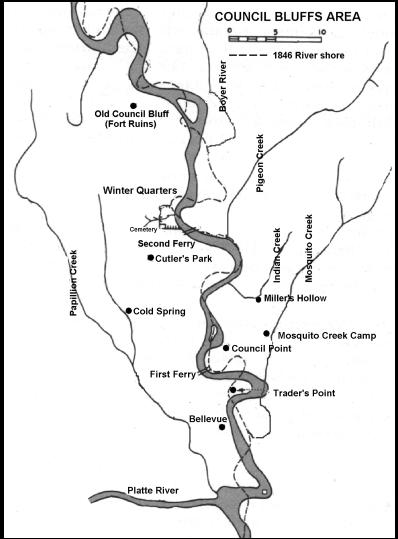
morning, Brigham Young and other members of the Twelve rode up the bluffs to
John Taylor’s camp on Mosquito Creek, where they met together with Captain
James Allen and his men from Fort Leavenworth.
Captain Allen presented a letter of introduction from President William
Huntington at Mount Pisgah. He also
showed the brethren a letter from Colonel Stephen W. Kearny, authorizing
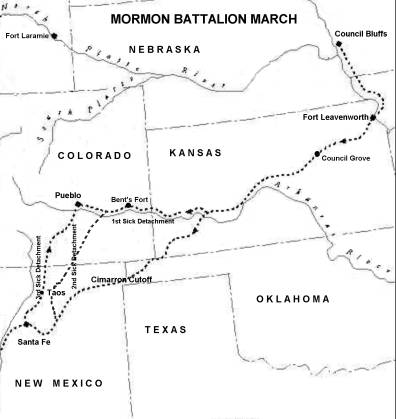
Captain Allen to recruit Mormons for a battalion to march toward Santa Fe. The decision had already been made by the
brethren the previous evening to support the government and raise the
battalion.
At 10:40
a.m., the council called the men in the camp to assemble. They gathered around a wagon used as a
stand. President Young introduced
Captain Allen, who then addressed the people.
He explained that his mission, authorized by the President of the United
States, was to enlist five hundred
Mormon men into a battalion to help take California in the Mexican War. He wanted the men to be ready to leave in
ten days. If he could not get five
hundred men, he did not want any. He
read his orders and passed out copies of a circular which had also been passed
out at Mount Pisgah.
President
Brigham Young next addressed the assembly.
The men were very anxious to know the feelings of the brethren on this
matter. President Young explained that
this call to service was something that he had been hoping for and that it
would bring about much good. He probably
explained about Jesse C. Little’s mission to Washington D.C. to enlist support
from the government.
There were
very bitter feelings in the hearts of the men toward the government for past
injustices. But President Young tried
to help them make a distinction between the general government and those in
public positions who oppressed the Saints in Missouri and Illinois. The government in general should not be
blamed for acts perpetrated by the mob.
He said, “The question might be asked, is it prudent for us to enlist to
defend our country? If we answer in the affirmative, all are ready to go. . . .
If we embrace this offer we will have the United States to back us and have an
opportunity of showing our loyalty and fight for the country that we expect to
have for our homes.”
President
Young next issued the call to raise the Mormon Battalion: “Now I want you men to go and all that can
go, young or married. I will see that
their families are taken care of; they shall go on as far as mine, and fare the
same, and if they wish it, they shall go to Grand Island first.”
Captain
Allen stated that he would write to President Polk and ask that permission be
granted to let the rest of the camp stay in Indian Territory while the
Battalion was away.
Elder
Heber C. Kimball formally proposed that the five hundred men be raised as asked
by the government. The motion was
unanimously supported by the brethren.
President Young immediately rose from his seat and said, “Come brethren,
let us volunteer.” Elder Willard
Richards started to take down names of volunteers.
The men in
the camp were still hesitant. Henry W.
Bigler wrote:
It was
against my feelings, and against the feeling of my brethren although we were
willing to obey counsel believing all things would work for the best in the
end. Still it looked hard when we called
to mind the mobbings and drivings, the killing of our leaders, the burning of
our homes and forcing us to leave the States and Uncle Sam take no notice of it
and then to call on us to help fight his battles.
Later,
members of the Twelve met in John Taylor’s tent to work out some of the details
with Captain Allen. There were good
feelings in the meeting. Brigham Young
proposed that he and Heber C. Kimball should travel to Mount Pisgah to raise
volunteers. He understood the urgency
to raise the Battalion. President Young
wished to have the rest of the camp settle on Grand Island for the winter while
the Twelve would travel further west with their families.
In the
afternoon Brigham Young and the others returned to their camp near the
river. Some of Brigham Young’s teams
had already been sent across the river.
President Young asked the Twelve to delay crossing over the river for
the present time.
Patty
Sessions recorded in her diary:
The boat
[ferry] is done, ready to cross. The word is for us to be ready to go to the
river at 10 o'clock. When 10 o'clock came the word was, put the teams to the
wagons and start in 10 minutes. Before that time was up the men were called to
a public council. One of the troops have come in to enlist men for one year to
go to California. The Twelve had a private council after and Brigham is going
back to Mt. Pisgah and sent word to us to stay where we were if we chose.
Lorenzo
Dow Young arrived back from his trading expedition to Missouri. He found the rest of his family well and
they were glad to see him.
A son,
Mason Lyman Tanner, was born to Sidney and Louisa Tanner.
Between Mount
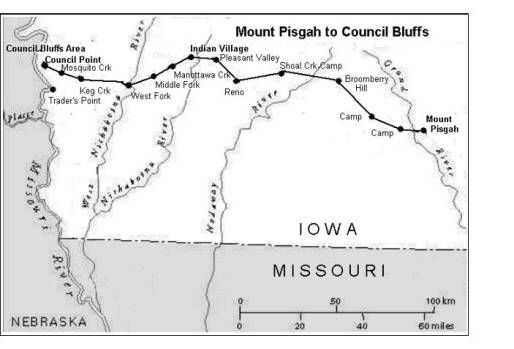
Pisgah and Council Bluffs, Iowa:
At 6 a.m.,
Parley P. Pratt, traveling back to Mount Pisgah, met William Clayton’s
company. Later in the morning, Wilford
Woodruff traveled a few miles and was also met by Elder Pratt, on his way to
raise a company of pioneers to go over the mountains. Elder Pratt of course had no idea that the plans and changed and
that now a battalion would be raised.
He delivered his message to Elder Woodruff’s camp of fifty wagons. Elder Woodruff traveled twenty miles this
day. William Clayton traveled seventeen
miles and remained a few miles ahead.
Further to
the west, near the Indian village, Hosea Stout and a large company returned to
work on a bridge. A new foreman was
selected and they decided to build a “drift bridge.” This bridge would be a large raft which was to be built on top of
the old bridge that had mostly been washed away. Many wagons were backed up at this point, waiting for the
bridge. Hosea Stout wrote, “Our
encampment now was very large. The
hills were full of our tents & waggons and seemed to be nearly as large as
the first camp when it started in February [at Sugar Creek].”
Mount Pisgah, Iowa:
Sister
Mary Richards spent the morning unpacking her chest to let things air out, and
spent the rest of the day packing for her planned departure on the following
morning. She had been at Mount Pisgah
since June 12.
In the
afternoon, Parley P. Pratt arrived and called for a meeting at 5:30 p.m. He informed Ezra T. Benson that he had been
called to serve in the Quorum of Twelve Apostles, taking the place of John E.
Page. Isaac Morley was being sent to
take Elder Benson’s place in the presidency of Mount Pisgah. Elder Benson wrote:
Bro. Parley
P. Pratt came down from the Bluffs with a line from President Brigham Young,
directed to me, stating I was appointed one of the Twelve Apostles to take the
crown of John E. Page, and if I accepted of this office, I was to repair
immediately to Council Bluffs and prepare to go to the Rocky Mountains. A brother offered to take my family to the
Bluffs with his own team, and not owning a horse at this time, I went to see
Bro. Ross to buy one. He said he had
none to sell, but said if I was called to be on of the Twelve Apostles he would
give me one, and he turned out to be his best riding horse.
The
meeting was held and Elder Pratt called for a company of five hundred pioneers
to travel without their families over the mountains.
Bonaparte, Iowa:
Far to the
east, on the Des Moines River, a daughter, Mary Coltrin was born to Zebedee and
Mary Coltrin.
Sandwich Islands
(Hawaii):
The Brooklyn
raised anchor and again started to sail for California. The Orrin Smith family was left behind
because of illness. As they sailed, it soon discovered that they
had a stowaway. The stowaway was a
young lad from the U.S. Army.
Sources:
Watson, ed., Manuscript
History of Brigham Young, 203‑207; “John Taylor’s Journal”; “Extracts
from the Journal of Henry W. Bigler,” Utah Historical Quarterly, 5:36;
Bennett, Mormons at the Missouri, 57‑8; Wilford Woodruff’s
Journal, 3:56; “Diary of Lorenzo Dow Young,” Utah Historical Quarterly,
14:144; Brooks, ed., On the Mormon Frontier, The Diary of Hosea Stout 1844‑1861,
173; William Clayton’s Journal, 52; Beecher, ed., The Personal
Writings of Eliza R. Snow, 137 The Instructor, May 1945, 217; Rich, Ensign to the Nations, 32;
“Diary of Daniel Stark,” Our Pioneer Heritage 3:498; Ward ed., Winter
Quarters, The 1846‑1848; Life Writings of Mary Haskin Parker Richards,
67‑8; Esshom, Pioneers and Prominent Men of Utah, 1198; Jenson, LDS
Biographical Encyclopedia; Patty Sessions Diary in Our Pioneer Heritage,
2:61
Thursday, July 2, 1846
Council Bluffs, in
Iowa:
A general
meeting had been called at 10 a.m. near the river. This meeting was to further inform the Saints about the Mormon
Battalion and the leaders asked able men to step forward and enroll. John Taylor recorded in his journal that he
had hard feelings against the government.
However, he felt that the raising of the Mormon Battalion would give
them a legal right to go to California.
Captain
James Allen worked to secure the formal permission of the Pottawatomie Indians
for the Saints to settle on their lands.
The agreement read:
We the
undersigned chiefs and braves representing the Pottawattomie tribe of Indians
near this subagency do voluntarily consent that as many of the Mormon people
now in or to come into our country as may wish from cause or necessity or
convenience to make our lands a stopping place on their present emigration to
California may so stop, remain and make cultivation and improvement upon any
part of our lands not now cultivated or appropriated by ourselves, so long as
we remain in the possession of our present country, or so long as they shall
not give positive annoyance to our people.
Brigham
Young ate dinner with Patty Sessions.
He instructed her company to move down to Council Point, so they all
started preparing to make the move.
Brother Freeman came to get Patty Sessions to deliver his wife’s baby. She went back three miles to Parley P.
Pratt’s camp and helped deliver a baby girl into the Freeman family.
Brigham
Young finished taking his teams across the Missouri River on the ferry. A camp was established about four miles to
the west at Cold Spring. Lorenzo Dow Young also started taking his
teams over. When he learned that his
brother, Brigham, was making another trip with the ferry, he paid those running
the ferry extra money so that he could also finish taking his teams over. He wrote, “I went over and got back about
half after ten, tired almost to death.
I actually felt as if I had not strength enough left to undress
myself. Went to bed and rested as well
as I could, for the mosquitoes.”
Heber C.
Kimball and Willard Richards moved their camps further away from the river on
the east bank, and dug a ten-foot well, finding plenty of good water. Elder Kimball’s daughter, Helen Mar Kimball
Whitney wrote:
Mosquitoes
were so troublesome near the river that we were obliged to move back, and as we
were far from water, the brethren dug a well close by. As it was nearly dusk when they concluded to
move from the river, and being very weary, I, with one or two others accepted
an invitation from the Chief’s daughter to accompany her home; and when
returning, finding the wagons gone and not feeling strong, she urged me to
return and stop over night, which invitation I accepted though I spent a
somewhat nervous and wakeful night.
Between Mount
Pisgah and Council Bluffs, Iowa:
With the
bridge finished, Hosea Stout attempted to cross it. There was a great rush to get across because everyone was afraid
that the poorly constructed bridge would not last. Brother Stout made it across and then
reached the next stream a mile further where another new bridge had just been
finished. He wrote:
There was
large companies of Indians followed us today for several miles and in fact they
thronged around us all the time we were building the bridge & at times
would come in droves to the camp but they were very civil, friendly & good‑natured
and done none of us any injury while we were here. They would amuse themselves sometime by swimming in the creek in
large numbers and sometimes at playing cards at which they seemed to be very
dexterous. They appeared to be much
interested at our operations while at work which seemed to be a great novelty
to them.
Brother
Stout moved on about 18 miles and camped in the prairie just after crossing a
small, deep stream.
William
Clayton lost his horses during the night.
He searched for them four miles to the east but could not find
them. He went back to his camp and
later found them a mile to the west.
His camp moved out about 10 a.m., passed through the Indian village at
sundown, and camped at the Nishnabotna River where the new bridge had been
built.
Mount Pisgah, Iowa:
In the
morning, Parley P. Pratt and Ezra T. Benson started for Council Bluffs. Sarah Rich wrote that at about this time the
brethren in the settlement found that they needed to “stake and rider” the
fences in order to secure their crops from the cattle. She explained, “Now I expect that many of my
readers will not know what stake and rider fences mean, for they do not see
much of that kind of work in this day.
They put stakes cross ways on each end of their poles, and then laid
another pole on top of the old fence, which made the fence some higher than it
was so the cattle would not jump over the fence.”
Phinehas
Richards also departed with his family in one wagon. They had originally planned to stay at Mount Pisgah longer, but
Phinehas’ brother, Elder Willard Richards, asked them to move ahead to Council
Bluffs. They traveled about eight miles
on good roads and in pleasant weather.
To the west, on the
Oregon Trail, Nebraska:
The
Mississippi Company of Saints neared the North Fork of Platte River. During the night someone came into the camp
and cut loose several of the Saints’ horses.
By morning, three were missing.
During the morning, the Saints met a company from California who told
them the distressing news that there were no Mormons on the route ahead of
them. All this time, the Mississippi
Company thought they were behind the main body of the Saints. They now understood the truth, which caused
much dissatisfaction in the camp. Some
wanted to turn back, but they decided to press on to Fort Laramie.
Nauvoo, Illinois
Franklin
D. Richards and his brother Samuel W. Richards were preparing to leave for
their mission to England. At the
temple, Thomas Bullock pronounced a blessing on some important packages that
would be taken by these brethren to the east and to England.
Sources:
Watson, ed., Manuscript
History of Brigham Young, 207; The Instructor, May 1945, 217; Woman’s
Exponent, 13:135, 150; Nibley, Exodus to Greatness, 195; William
Clayton’s Journal, 52; Brooks, ed., On the Mormon Frontier, The Diary of
Hosea Stout 1844‑1861, 173; “Diary of Lorenzo Dow Young,” Utah
Historical Quarterly, 14:144; “John Taylor Journal,” typescript BYU;
Roberts, Comprehensive History of the Church 3:143; “Thomas Bullock Journal,” BYU
Studies 31:1:74; “Sarah Rich Autobiography,” typescript BYU, 58; “John
Brown Journal,” Our Pioneer Heritage, 2:426; “Louisa Pratt
autobiography,” Heart Throbs of the West 8:241; Ward, ed., Winter
Quarters, 67; Patty Sessions Diary in Our Pioneer Heritage, 2:61
Friday, July 3,
1846
Council Bluffs, in
Iowa:
Helen Mar
Kimball Whitney had spent the night with the Chief’s daughter. In the morning they both went out to pick
blackberries and other wild fruit in the woods. Helen was impressed by her new friend.
I learned
that her parents had separated, as her mother was now living with her and did
most of the work. Though dressed in her
native costume she looked neat and kept the house tidy, and could cook equal to
white women. . . . Later she showed her taste and skill in braiding my hair in
broad plaits, after the latest French style, and put it up ‘a la mode’! In the
evening she accompanied me to the Camp.
Many of
the men were busy moving their wagons across the river. Lorenzo Dow Young got up very early and
worked hard, driving teams up the bluffs on the west side of the river. Charles Decker soon arrived across the river
with four yoke of oxen to help Brother Young.
With an additional yoke of oxen, they hauled wagons up the hill. They could only haul up one wagon at a
time. At one point, one of the oxen
panicked and tipped over a wagon which contained some children. Luckily, the children were not hurt. They made several more trips with the help
of Jedediah M. Grant and camped near a small creek at Cold Spring.
Brigham
Young, Heber C. Kimball, and Willard Richards started toward Mount Pisgah at 9
a.m. to raise men for the Mormon Battalion.
They rode in President Young’s carriage while other men in the party
rode on horseback. At 1 p.m., they
stopped at the Mosquito Creek camp and had dinner with George A. Smith, Orson
Pratt, and Orson Hyde. At 5 p.m., they
passed several companies traveling to Council Bluffs, numbering 180
wagons. After a thirty-four-mile
journey, they camped with Ebenezer Brown and John I. Barnard. The brethren talked with the men in the camp
about enlisting into the Battalion until midnight.
Zadoc Judd
was among those who heard President Young’s message to enlist. He wrote that they made
a request
that all who could possibly be spared should enlist as soldiers in the
government service to serve as such for the term of one year. This was quite a hard pill to swallow‑‑to
leave wives and children on the wild prairie, destitute and almost helpless,
having nothing to rely on only the kindness of neighbors, and go to fight the
battles of a government that had allowed some of its citizens to drive us from
our homes, but the word came from the right source and seemed to bring the
spirit of conviction of its truth with it and there was quite a number of our
company volunteered, myself and brother among them.
Between Mount
Pisgah and Council Bluffs, Iowa:
William
Clayton’s company started early and traveled four miles before breakfast. As they traveled, they met Brigham Young’s
company and learned about their mission to recruit the Mormon Battalion. It was their belief that raising the
battalion would help the Church, and if the call to service was rejected, it
would bring more persecution upon the Church.
After they parted, William Clayton traveled a total of twenty‑five
miles, camping near Hiram Clark.
Further to
the east, after traveling twelve miles, Hosea Stout’s oxen could go no further
because of exhaustion. The other
brethren he was traveling with wanted to go on and did. Brother Stout was totally out of food and
pleaded with them to leave some with him for his family but they did not.
Brother Stout found a nice camp by a beautiful spring and soon other companies
joined him there. A man named Henry
Nebeker, who was not a member of the church, let Brother Stout get milk from
his cows and gave him a piece of bacon, and ten pounds of flour. By night there were many companies at the
campsite. Shortly after dark, members
of the camp saw a carriage and some horsemen coming from the west and feared
that the U.S. officers might be returning.
They soon found out it was Brigham Young and his company. President Young only stopped for a few
minutes to talk with Hosea Stout. He
explained about the mission to raise recruits for the Mormon Battalion at Mount
Pisgah and Garden Grove. Brother Stout
wrote, “Their presence seemed to give new life to all the camp who flocked
around them and asking so many questions that they could not answer any of
them. But after a few words of comfort
to us they went on.”
Still
further to the east, as Wilford Woodruff was traveling toward Council Bluffs,
he was overtaken by Parley P. Pratt and Ezra T. Benson. These brethren wanted Elder Woodruff to
return with them immediately to Council Bluffs. Elder Pratt was still following
his mission to raise a company of pioneers and then to quickly return to
Council Bluffs. Elder Woodruff decided
to join them, so he saddled his horse and off they went. He commented that he “had an interesting
time once more with Br. Parley. And to add to the interest of the days ride,
we passed through the main village of the Pottawatomie Indians the first time I
ever passed through a large village of Indians in my life.” They continued riding until dark and made
their beds in the grass on the side of a hill.
Soon the mosquitoes attacked them and they moved to the top of the hill where
the wind was blowing.
Nauvoo, Illinois:
Franklin
D. Richards and Samuel W. Richards boarded a steam boat, leaving Nauvoo for
their mission to England.
Sources:
Watson, ed., Manuscript
History of Brigham Young, 207; William Clayton’s Journal, 52, 53; Wilford
Woodruff’s Journal, 3:56; “Diary of Lorenzo Dow Young,” Utah Historical
Quarterly, 14:144; Brooks, ed., On the Mormon Frontier, The Diary of
Hosea Stout 1844‑1861, 173‑74; Woman’s Exponent, 13:135;
“Zadoc Judd Autobiography,” BYU, 21;
Saturday,
July 4, 1846
Council Bluffs, in
Iowa:
William
Clayton finally reached the camp at Council Bluffs. He was delayed for much of the day, searching for horses and
trying to find food for his hungry family.
He attended a council meeting at Captain Allen’s tent.
Between Mount
Pisgah and Council Bluffs, Iowa:
Hosea
Stout continued his journey to Council Bluffs slowly because his teams were so
weak. The weather was hot and
muggy. He only traveled about six
miles, reaching Keg Creek, where there was a small grove. Here his oxen gave out again. After a rest in the afternoon, he continued
on for three more miles and camped on the prairie.
Further to
the east, and heading in the opposite direction, Brigham Young was in his
carriage ready to go at 8 a.m., when Elders Parley P. Pratt, Wilford Woodruff,
and Ezra T. Benson met him. Elder Woodruff had not seen President Young for
almost two years, as he had been away serving as the president of the British
Mission. He wrote, “It was truly a
happy meeting. I rejoiced to once more
strike hands with those noble men.”
Elder
Parley P. Pratt reported that he had raised a company of eighty-four pioneers
for the mountains. President Young
informed them about the new plans to raise the Mormon Battalion.
At 9 a.m.,
Parley P. Pratt continued his journey toward Council Bluffs. Since there was no longer an urgency for
Elders Woodruff and Benson to reach Council Bluffs, they joined Brigham Young’s
group, traveling back to Mount Pisgah where they would retrieve their families. After they had traveled twenty miles, they
found Elder Woodruff’s company. Brigham
Young met Elder Woodruff’s seventy-year-old father, Aphek Woodruff, for the
first time. Wilford Woodruff stayed
with his family then resumed his journey toward Council Bluffs. He rode fifty miles on this day and was very
sore, stiff, and sick.
At about a
half hour before sunset, Brigham Young’s group passed through Pottawatomie
Indian Village, pressed on for eight more miles, and spent the night in Isaac Morley’s camp. They counted 206 wagons during the day.
At 10:30
p.m., President Young retired for the night in Father Morley’s tent. It soon began to thunder, lightning and
rain. He had to crawl into a wagon to
avoid getting too wet. Many tents in
the area blew down during this hard downpour of rain.
Mount Pisgah, Iowa:
A wedding
party was held with dancing and music, with “a thunderstorm to wind up the
celebration.”
Putnam County, on
the border of Iowa and Missouri:
A Mr. L.
Marshall wrote a letter to the President of the United States, “There is a set
of men denominating themselves Mormons hovering on our frontier, well armed,
justly considered, as depredating on our property, and in our opinion, British
emissaries, intending by insidious means to accomplish diabolical
purposes.” He asked for an armed force
to be sent to “expel them from our border.”
Nauvoo, Illinois:
Almon W.
Babbitt, one of the Nauvoo Trustees, took William Law on a tour through the
temple. Brother Babbitt had been a
longtime friend of Law’s, who was one
of the missionaries that introduced Brother Babbitt to the Gospel. This temple tour did not please many members
of the Church still in Nauvoo. Thomas
Bullock wrote, “Many persons expressed their dissent of the act and well do I
remember Joseph’s words, ‘If it were not for Brutus, Caesar might have lived.’
So has Law proved a Brutus unto Joseph.”
William Law had published the “Nauvoo Expositor” which was a catalyst to
the martyrdom of the Prophet.
Martha
Haven wrote to her mother in Sutton Massachusetts: “We think soon of going to Farmington, Iowa. We shall probably stay there till fall.” Her husband, Jesse, “talks of boxing our
things ready for the wilderness. . . . We have sold our place for a trifle to a
Baptist minister. All we got was a cow
and two pairs of steers, worth about sixty dollars in trade.”
Pacific Ocean:
The Saints
on the Brooklyn recognized Independence Day. Samuel Brannan brought out the cloth that he obtained at Honolulu
and had the women make it into uniforms for the men. Each man had a military cap and there were fifty Allen revolvers
available. Brother Brannan then drilled
the men with the help of Samuel Ladd, an ex‑soldier, and Robert Smith,
another passenger who understood military tactics.
Sources:
Watson, ed., Manuscript
History of Brigham Young, 208‑9; Brooks, ed., On the Mormon
Frontier, The Diary of Hosea Stout 1844‑1861, 174; “Diary of Lorenzo
Dow Young,” Utah Historical Quarterly, 14:144; Wilford Woodruff’s
Journal, 3:57; “Thomas Bullock Journal,” BYU Studies, 31:1:74; Cook,
William Law, 117; “The Ship Brooklyn,” Our Pioneer Heritage
3:490; “Louisa Pratt Autobiography,” Heart Throbs of the West, 8:240;
Golder, The March of the Mormon Battalion, 96; Holzaphel, Women of
Nauvoo, 173
Sunday, July 5, 1846
Council Bluffs, in
Iowa:
The
weather was extremely hot and muggy.
Lorenzo Dow Young wrote, “It seems as if we could not live.” Hosea Stout finally arrived at Council
Bluffs. He searched and found Elder
Orson Hyde who was the presiding Church official at the camp. Elder Hyde recognized Brother Stout’s
destitute condition and invited him to stay near his camp, which was on a
ridge. Brother Stout pitched his tent
and prepared for what he expected would be a long stay. In the evening he took his wife to be
reunited with her mother. He wrote,
“Our feeling on meeting was very tender without a word being said we all burst
into tears in remembrance of the loss of my little son Hosea.”
Hosea
Stout then went to see U.S. Captain James Allen, who was on another ridge
“situated under an artificial bowery near his tents with several men in
attendance having the ‘Striped Star Spangled Banner’ floating above them. He was a plain non-assuming man without that
proud over bearing strut and self conceited dignity which some call an officer‑like
appearance.” They had a pleasant
conversation about the battles that had occurred recently on the Rio Grande
River.
Between Mount
Pisgah and Council Bluffs, Iowa:
During the
night, a White Hawk Chief named Oquakee came and camped near Brigham Young and
his company. They were hungry so
President Young asked a brother to give the Indians a fat cow. Brigham Young promised them another cow when
they returned to Council Bluffs. The
Indians, were of course, very pleased.
At 8:30
a.m., Brigham Young’s company resumed their journey toward Mount Pisgah. At 11:30 a.m., they stopped when they came
upon a number of brethren. Brigham
Young preached and continued recruiting for the battalion, but he sensed that
it had little effect. He reproved
Andrew H. Perkins for harboring a wrong spirit in his company, to which Brother
Perkins responded to with gratitude.
Samuel H.
Rogers reflected on reasons to join the Battalion, “It was like a ram caught in
a thicket and that it would be better to sacrifice the ram than to have Isaac
die. Reflecting upon the subject, it
came to my mind that Isaac, in the figure, represented the church . . . and for
the saving of its life I was willing to go on this expedition.”
At this
location was the Phinehas Richards’ company, including Mary Richards. President Young asked Mary Richards if her
husband, Samuel W. Richards, had left Nauvoo for his mission to England. She told him that she believed that he
had. President Young was pleased. He asked her if it had been hard to part
with him and how she was doing. She
responded: “[I] told him it was hard and I stood it the best I could being
satisfied that I had to endure it. I did
the best I know how.” Elder Kimball
also remarked that he was pleased that Samuel W. Richards had gone on the
mission and said that he was a good boy.
Mary wrote: “[They] told me to
be a good girl and it would only be a little while before I should meet him on
the other side of the Rocky Mountains.”
Willard
Richards, Samuel’s uncle, also visited with Mary Richards and the rest of the
family. He mentioned that if Samuel W.
Richards and Franklin D. Richards had not left for their missions, they would have
been asked to join the Mormon Battalion.
A third brother, Joseph, was being counseled to join the battalion as a
drummer. Mary shared with Willard
Richards her trials and asked for a blessing.
He replied, “You have got your hearts desire and there is every blessing
in the world for you and what do you ask more?” He gave them some good instruction and had to leave them at 4
p.m.
Brigham
Young’s company continued their journey.
During the day they counted 240 wagons.
Mount Pisgah, Iowa:
Jesse C.
Little arrived at the settlement on his way to deliver the news regarding the
battalion from President Polk to Brigham Young. Certainly he discovered that Captain Allen
had already been to Mount Pisgah on this mission. He went to the wagon of Louisa Pratt and delivered to her some
money from her husband, Addison Pratt, who was serving a mission in the South
Pacific.
Nauvoo, Illinois:
Meetings
were held in the temple. Almon Babbitt
spoke in the morning and Joseph Young spoke in the afternoon. He spoke against abusing wives, children,
and animals. Erastus Snow left Nauvoo
for his trip back to join his family whom he had left at Garden Grove. Brother Snow had earlier returned to Nauvoo
to try to sell his property. He did so,
for about one fourth the real property value.
On this day he crossed the Mississippi with his brothers William and
Willard Snow.
A
daughter, Barbara Young Crockett, was born to David and Lydia Crockett.
California:
With the
aid of American settlers in the vicinity of Yerba Buena (San Francisco) Colonel
John C. Fremont defeated the Mexicans recently in two battles. On this day, the American Californians
declared themselves independent, and placed Fremont as their leader.
Sources:
Watson, ed., Manuscript
History of Brigham Young, 209; “Samuel H. Rogers Journal”; “Diary of
Lorenzo Dow Young,” Utah Historical Quarterly, 14:144; Brooks, ed., On
the Mormon Frontier, The Diary of Hosea Stout 1844‑1861, 174‑75;
Beecher, ed., The Personal Writings of Eliza R. Snow, 138; Roberts,
Comprehensive History of the Church, 3:380‑81; Donna Hopkins Scott, The
Crockett Family, 14e; “Thomas Bullock Journal,” BYU Studies,
31:1:75; Jenson, LDS Biographical Encyclopedia, 1:103‑15; “Louisa
Pratt Autobiography,” Heart Throbs of the West 8:240; Ward ed.,
Winter Quarters, 68, 76
Monday, July 6, 1846
Council Bluffs, in
Iowa:
Hosea
Stout went to Trader’s Point, a little town on the Missouri River, a few miles
downriver from the ferry crossing. He
described it as an “Indian village which consisted of some scattering houses
and was mixed up with French & half breeds. All not amounting to many.
This was where they kept their trading houses & large business no
doubt is carried on.”
At the
river crossing, many were moving their wagons over to the other side. It was hard work and very slow going. George Miller crossed over with thirty-two
wagons. He was going 114 miles west
Pawnee Village, a Presbyterian mission station which was recently raided by
Sioux Indians. His mission was to go to the village,
salvage any possessions, and bring them back to Bellevue, which was across the
river from Trader’s Point.
Hosea
Stout went for a visit across the river.
“The hill is uncommonly steep on the other side. The landing was at the mouth of a deep
ravine up which it was now contemplated to make a road as it would not then be
a very steep hill to assend.” He went
with Orson Pratt, George A. Smith, and others to find a good route for the
proposed road. It would be very
difficult to make because the area was heavily timbered and there were very
many ravines.
On his way
home, Hosea Stout met George W. Harris.
They had a long talk and Brother Harris advised him to enlist in the
Mormon Battalion. Brother Stout wrote,
“I then returned home again as I went not yet knowing what to do.”
Between Mount
Pisgah and Council Bluffs, Iowa:
Wilford
Woodruff continued his journey toward Council Bluffs. An Indian chief and some squaws camped nearby that evening. The chief said that he was going to meet
with Mormons and “smoke the pipe of peace.”
Near Mount Pisgah,
Iowa:
Brigham
Young and his company arose very early, at 4 a.m., and were on the road by
4:30. They stopped for breakfast at
Ezra Chase’s camp. Eleven miles outside
of Mount Pisgah, they met Charles C. Rich and Jesse C. Little, who joined their
company. As they passed Daniel
Russell’s camp, they blessed his sick wife. In the evening they reached Mount
Pisgah. During the day they passed 241
wagons, including 63 that were camping across the river from Mount Pisgah. They had counted a total of 800 wagons and
carriages between Council Bluffs and Mount Pisgah. Brigham Young spent the night at President William Huntington’s
house.
Chimney Rock,
Nebraska:
The
Mississippi company of Saints came to Chimney Rock. They stopped at Horse Creek and repaired wagons.
Voree, Wisconsin:
James J.
Strang, who claimed to be Joseph Smith’s true successor, was proclaimed
“imperial primate.” John C. Bennett, a
former counselor to Joseph Smith, was named Strang’s general‑in‑chief.
Sources:
Watson, ed., Manuscript
History of Brigham Young, 209‑10; Brooks, ed., On the Mormon
Frontier, The Diary of Hosea Stout 1844‑1861, 175; Wilford
Woodruff’s Journal, 3:57; William Clayton’s Journal, 53; Hartley, My
Best for the Kingdom, 210; Van Noord, King of Beaver Island, 49;
“John Brown Journal,” Our Pioneer Heritage, 2:426
Tuesday, July 7, 1846
Council Bluffs, in
Iowa:
Hosea
Stout was looking for a way to get food for his family. He did not want to resort to begging, so he
went down Mosquito Creek to the sawmill and tried to find work. There was not any there and his health was
getting so poor that no one would have hired him anyway after taking a look at
him.
Thomas L.
Kane, the new influential non-Mormon friend, arrived at Council Bluffs from
Fort Leavenworth. Henry G. Boyle wrote,
While I was
waiting at Colonel Sarpy’s [trading post at Trader’s Point] for the Battalion
to be organized and mustered into service, a stranger (Colonel Kane) arrived at
the Point and obtained board and lodging at the same place. After gaining an introduction to me, he soon
entered into an animated conversation relative to our people, their history,
religion, etc. I found him to be a very
pleasant and affable gentleman, and very easy and fluent in conversation.
Brother
Boyle was at first cautious but Kane soon presented a letter of recommendation
from Jesse C. Little. “I soon found
that his sympathies and good feelings were all in our favor.”
Thomas L.
Kane later wrote about his first impressions of Council Bluffs:
They were
collected a little distance above the Pottawatomie Agency. The hills of the high prairie crowding in
upon the river at this point, and overhanging it, appear of an unusual and
commanding elevation. . . . This landing, and the large flat or bottom on the
east side of the river, were crowded with covered carts and wagons; and each
one of the Council Bluff hills opposite was crowded with its own great camp,
gay with bright canvas and alive with the busy stir of swarming occupants. In the clear blue morning air the smoke
streamed up from more than a thousand cooking fires. . . . From a single point
I counted four thousand head of cattle in view at one time. As I approached the camps, it seemed to me
that the children there were to prove still more numerous. Along a little creek I had to cross were
women in greater force . . . washing and rinsing all manner of white muslins,
red flannels and parti‑colored calicoes, and hanging them to bleach upon
a greater area of grass and bushes than we can display in Washington Square.
Between Mount
Pisgah and Council Bluffs, in Iowa:
The day
was very hot. Wilford Woodruff
described, “Our cattle came near melting.”
He moved his camp within twelve miles of Council Bluffs.
Phinehas
Richards’ company was several miles behind.
Mary Richards wrote, “Having no wood, we started before breakfast, went
1 mile, found wood & stopped to take refreshments, after which we proceeded. Crossed several bad slews and hard
hills. The weather being very hot, we
rested from 11 till 3. Met about 40
Indians.”
Mount Pisgah, Iowa:
At 10
a.m., Brigham Young dictated a letter to be sent to the Samuel Bent, the
president of the settlement at Garden Grove.
He sent him an advance message about the need for volunteers for the
Mormon Battalion. He explained that the
battalion would march to Fort Leavenworth to receive their arms, ammunition and
other provisions. He emphasized,
This is no
hoax. Elder Little, President of the
New England churches, is here also, direct from Washington, who has been to see
the President on the subject of emigrating the Saints to the western coast, and
confirms all that Capt. Allen has
stated to us. The U.S. want our
friendship, the President wants to do us good, and secure our confidence. The outfit of these five hundred men costs
us nothing, and their pay will be sufficient to take their families over the
mountains.
The
recruits were to be between age eighteen to forty‑five. They were to immediately go to Council
Bluffs. Drummers and fifers were
wanted. The rest of the Saints would be
gathering on Grand Island in the Platte River, about 120 miles to the west of
the Missouri River, where there was a salt spring which would be of use to make
salt. He anticipated that before
spring, they would be able to bring all of the Saints to Grand Island, even the
poor.
Brigham
Young and Heber C. Kimball conducted a meeting to raise the Mormon
Battalion. Heber C. Kimball said, “If
you leave your wives, your wives shall be taken care of . . . and if any of you
die, why die away and the work will go on.
I suppose that many think that you are going to starve to death. But I will tell you [that you] will never
want. You will have abundance and to
spare.” Jesse C. Little also spoke.
Sixty‑six
men volunteered. Eighteen-year-old
James S. Brown, was one of those who stepped forward. He had not as yet been baptized, but was so moved by the speaking
of Brigham Young that he went to Grand River and was baptized. He wrote in his memoirs:
This done
[my baptism], the happiest feeling of my life came over me. I thought I would to God that all the
inhabitants of the earth could experience what I had done as a witness of the
Gospel. It seemed to me that, if they
could see and feel as I did, the whole of humankind would join with us in one
grand brotherhood. . . . Elder [Ezra T.] Benson said the Spirit’s promptings to
me [to enlist] were right. . . . He told me to go on, saying I would be
blessed, my father would find no fault with me, his business would not suffer,
and I would never be sorry for the action I had taken or for my
enlistment. Every word he said to me
has been fulfilled to the very letter.
In the
afternoon, President Young wrote another letter, this one addressed to the
Nauvoo Trustees. He included one of
Captain Allen’s circulars asking for volunteers and wrote, “By this time you
will probably exclaim, is this Gospel? We answer, yes. We shall raise these five hundred men from
among those who are driving teams between this [Mount Pisgah] and Council
Bluffs.” He mentioned that there were
2,805 wagons between and including those points.
His main
purpose for this letter was to ask the Nauvoo Trustees to send all the men and
boys on the road to Council Bluffs immediately, leaving behind women and
children. These men would take the
place of those who would leave for the Battalion. The men were needed to move the camp to Grand Island, build
houses, and make hay. When they arrived
at Grand Island, they would unload and quickly return to Nauvoo to take all of
the Saints out of the city by fall. The
Trustees were encouraged to sell the temple, but not use the money to buy more
teams. Rather, it should be used to pay
off the temple hands and gather provisions.
They were instructed clearly to send Thomas Bullock and his family to
the camp immediately. Finally, he
mentioned that they received an offer to build a mill about fifteen miles north
of Council Bluffs on the east side of the Missouri River.
Monterey,
California:
Commodore
Sloat, in command of the United States squadron in the Pacific, bombarded and
captured Monterey, California
Sources:
Watson, ed., Manuscript
History of Brigham Young, 221‑26; Wilford Woodruff’s Journal,
3:57; Brooks, ed., On the Mormon Frontier, The Diary of Hosea Stout 1844‑1861,
176; “Juvenile Instructor,” 17:74; Nibley, Exodus to Greatness, 198, 99;
Brown, Life of a Pioneer, 22‑25; Roberts, Comprehensive History
of the Church 3:380‑81; “Mount Pisgah Journal,” July 7, 1846; Ward
ed., Winter Quarters, 67
Wednesday,
July 8, 1846
Council Bluffs, in
Iowa:
In his
quest to find a way to get food for his family, Hosea Stout started going
through all his things to select articles which he could take to the
settlements to trade for provisions.
However, his health was so poor that he knew that he would not be able
to go.
Keg Creek, Iowa:
Elder
Woodruff, twelve miles from Council Bluffs, went to bless Sister Mary Ann Grant
(wife of David Grant) who was in labor.
About five minutes later she gave birth to a daughter whom they named
Mary Ann Grant. He wrote, “Thus the
Saints bear children by the wayside like the Children of Israel in the
wilderness.”
Wilford
Woodruff saw about fifty Sioux Indians pass the camp, heading east. They said they were going to meet the Mormon
Chief. He supposed that they were
referring to Brigham Young who was at Mount Pisgah.
Mount Pisgah, Iowa:
Brigham
Young, Heber C. Kimball, and Willard Richards visited the Saints in Mount
Pisgah during the morning, encouraging and blessing them. They paid a visit to Lorenzo Snow. Brother Snow was counseled to leave Mount
Pisgah as soon as possible and to travel to the next planned settlement, Grand
Island. Lorenzo Snow asked what he
should do for provisions when he arrived there. President Young told him not to worry about that until he got
there. Lorenzo Snow had recently moved
into a house which had been used by Chandler Rogers, who went on to Council
Bluffs. Brother Snow wrote, “We had
suffered much inconvenience living in Tent and wagons in the hot weather.”
Those who
had already volunteered for the Mormon Battalion received some instructions
from Charles C. Rich, then started for Council Bluffs.
Willard
Richards administered to Sister Moss who had been bitten by a rattlesnake. Brigham Young spent the evening with Willard
Richards, Charles C. Rich, and Jesse C. Little.
Sources:
Watson, ed., Manuscript
History of Brigham Young, 226‑27; Brooks, ed., On the Mormon
Frontier, The Diary of Hosea Stout 1844‑1861, 176; Wilford
Woodruff’s Journal, 3:57‑8;
Beecher, ed., The Personal Writings of Eliza R. Snow, 138; “Iowa
Journal of Lorenzo Snow,” BYU Studies 24:3:260; LDS Biographical
Encyclopedia. Jenson, Andrew, 4:705
Thursday,
July 9, 1846
Council Bluffs, in
Iowa:
Wilford
Woodruff finally arrived at Council Bluffs, completing his long journey to
rejoin the main body of the Saints. His
journey began when he left his mission in England on January 23, 1846. He soon located the camps of other members
of the Twelve and enjoyed talking with Parley P. Pratt and John Taylor. Elder Woodruff pitched his tent on the bluff
near John Taylor’s camp.
The
brethren at Council Bluffs held a council meeting and wrote a letter to be
circulated throughout the camp, requesting volunteers for the Mormon Battalion.
Five
hundred men must be raised forthwith for the expedition to California. Don’t delay till the return of President
Young; but come forward hastily . . . for be assured it is the mind and will of
God that we should improve the opportunity which a kind providence has now
offered for us to secure a permanent home in that country, and thus lay a
foundation for a territorial or State Government, under the Constitution of the
United States. . . . The season is passing rapidly away; and it will take some
days to organize . . . and be assured that the Council and Camp will not move
from this place until this thing is done.
The
weather was very hot, but in the afternoon a cool and refreshing shower
fell. Anson Call, who had recently
arrived at Council Bluffs, lost another child.
His son, Moroni Call died.
Cold Spring Camp,
Nebraska:
Across the
Missouri at the Cold Spring camp, several of the men hauled in a load of poles
and bushes from which they made a fence and built a bowery.
George
Miller, joined by John Butler and other members of the James Emmett company,
left for their mission to journey 114 miles to the west. They were to go to the Pawnee Mission, which
had been recently destroyed by the Sioux Indians.
Mount Pisgah, Iowa:
At 11:30
a.m., Brigham Young and many of the other leaders were escorted to Alpheus
Cutler’s encampment and Brother Davis’ camp where President Young addressed the
brethren and ate dinner. At 2:40 p.m.,
the leaders left for Council Bluffs.
Their visit to Mount Pisgah had been good for the Saints there. Sarah Rich, the wife of Charles C. Rich
wrote, “Their visit to us at this time was encouraging, for they left a good
impression among the Saints which gave them new courage to preserve and prepare
themselves for what was ahead of them.”
At 5 p.m.
Brigham Young’s company rested their animals on the prairie for a time and then
continued until midnight after a journey of thirty miles. President Young and Heber C. Kimball slept
sitting up in the carriage.
Many of
the new recruits for the battalion were on their way to Council Bluffs. James S. Brown wrote,
We bade our
friends an affectionate farewell, and started on what we understood to be a
journey of one hundred and thirty‑eight miles [to the bluffs], to join
the army of the United States at our country’s call. We had provisions enough to put up to last us on our trip. . . .
Our initial trip was begun without a blanket to wrap ourselves in, as we
thought we could find shelter in the camps along the line of march. But in this we were mistaken, for everybody
seemed to have all they could do to shelter their own. The first night we camped on the bank of a
small stream, where we fell in with twelve or fifteen other volunteers who had not
so much as a bit of bread. . . . We divided with them, then scraped what leaves
we could and laid down thereon, with a chunk of wood for our pillow.
Sources:
Watson, ed., Manuscript
History of Brigham Young, 226‑27, 589; Wilford Woodruff’s Journal,
3:58; “Diary of Lorenzo Dow Young,” Utah Historical Quarterly, 14:145;
Brooks, ed., On the Mormon Frontier, The Diary of Hosea Stout 1844‑1861,
176; Hartley, My Best for the Kingdom, 210; Brown, Life of a Pioneer,
25‑6; Whitney, History of Utah, 4:144; “Sarah Rich Autobiography,”
typescript, BYU, 58
Friday, July 10,
1846
Council Bluffs, in
Iowa:
It had
rained all night and continued to rain during the day, causing many in the camp
to stay in their tents all day. Captain
James Allen and Indian Agent Robert B. Mitchell issued a proclamation granting
permission to the Mormons to reside on Pottawatomie lands. This was an important point, requested by
Brigham Young during the negotiations to raise the battalion. The proclamation acknowledged that many of
the men would have to leave their families behind, which necessitated this
action.
Between Mount
Pisgah and Council Bluffs, in Iowa:
Brigham
Young and company arose early, broke camp by 4:30 a.m., and rode a half mile to have breakfast with
Samuel and Daniel Russell. President
Young’s company continued on until a little after 9 a.m. when they rested their
teams during a thunder shower. At about
1 p.m., they halted their journey when some Fox Indians met then and asked the
“Mormon Chiefs” to wait until they could send for their chief who had something
to say to them. They agreed to delay
their trip ‑‑ it was raining very heavily anyway.
The chief,
named Powsheek, arrived at 7 p.m. He
wanted to see the “Mormon chief,” to learn where the Mormons came from and
where they were going. Powsheek stated
that his people were going off with the Pottawatomies who had recently sold
their land to the government. He was
interested in traveling with the Mormons as they traveled to their new tribal
lands.
James S.
Brown continued his trek to join the battalion. “We journeyed, much of the time in heavy rain and deep mud,
sleeping on the wet ground without blankets or other kind of bedding, and
living on elm bark and occasionally a very small ration of buttermilk handed to
us by humane sisters as we passed their tents.”
Near Fort Laramie,
Wyoming:
The
“Mississippi Company” of Saints, consisting of about fourteen families, decided
to leave the Oregon Trail and head south to spend the winter on the Arkansas
River at what would later be called Pueblo, Colorado. They had met a man named John Richards, who had a fur trading
post at Fort Bernard, about eight miles east of Fort Laramie. Richards told them that Mormons were going
up the South Fork of the Platte. When the Mississippi Company learned this
news, they held a council and decided not to head farther west, but to find a
place to spend the winter on the east side of the mountains. Richards told them that the head of the
Arkansas River was the best place, where corn was growing, and settlements were
nearby where they could get supplies.
He was on the way to take buffalo robes to Taos [New Mexico] from his
trading post and offered to be their guide.
The Saints decided to follow Richards to Pueblo.
Nauvoo, Illinois:
Daniel
Bailey, age forty-two, died. He was the
husband of Sarah Currier Bailey.
Sources:
Watson, ed., Manuscript
History of Brigham Young, 227‑28; Brown, Life of a Pioneer,
26; Brooks, ed., On the Mormon Frontier, The Diary of Hosea Stout 1844‑1861,
176; Journal History; “John Brown Journal,” Our Pioneer Heritage,
Vol. 2, p.428; Black, Membership of
the Church 1830‑1848
Saturday, July 11, 1846
Council Bluffs, in
Iowa:
Wilford
Woodruff went to visit Thomas L. Kane, who had also recently arrived at Council
Bluffs. Colonel Kane informed him that President Polk was
very favorable toward the Mormons.
Elder Woodruff wrote, “Col Kane manifested the spirit of a gentleman and
much interest in our welfare. From the
information we received from him, we were convinced that God had began to move
upon the heart of the President and others in this nation to begin to act for
our interest and the general good of Zion.”
Hosea Stout also met Kane. He
wrote of him, “he was quite an intelligent man notwithstanding he was
uncommonly small and feminine.” John
Taylor wrote, “We had some conversation with him [Kane] during which he
manifested a spirit of sympathy for us.”
After
meeting with the brethren, Col. Kane wrote a letter to George Bancroft, the
secretary of the navy. Col. Kane had
intended to travel with Mormons to California during this season but he wrote,
“Every day, too, renders it more vain for the [Mormon] people to attempt
proceeding to California this season, and I have been acquainted confidentially
by those in authority, that such has ceased to be their intention.” Thus he informed Bancroft that he would not
be traveling to California during this year.
Phinehas
Richards’ company arrived at the Council Bluffs area and set up camp near John
Van Cott’s tent. Mary Richards felt
very weary after the long journey from Mount Pisgah.
Between Mount
Pisgah and Council Bluffs, in Iowa:
Brigham
Young again met with the Indian Chief Powsheek. He authorized Cyrus H. Wheelock to give a two‑year‑old
heifer to the Indians. Powsheek was
still interested in locating his tribe near the Mormons. President Young told him that after they
settled over the mountains that they would send men to hunt for them in return
for blankets, guns and other goods.
Powsheek spoke of Joseph Smith and his murder. He had been acquainted with the Prophet and knew that he was a
great and good man.
At 8:10
a.m., Brigham Young and his company started their journey again. At 10:22 a.m., they stopped at the west
branch of the Nodaway to visit with Ezra Chase. They continued on at 11:30 a.m. and arrived at Pottawatomie
Indian Village at 1:45 p.m. An Indian
presented to them two sheets of hieroglyphics from the Book of Abraham and also
a letter from their father, “Joseph” dated 1843. The company continued on and arrived at the Nishnabotna at 8 p.m.
where they camped for the night.
Brigham Young tried to sleep in his carriage but the mosquitoes were bad
and he only had a little rest.
Nauvoo, Illinois:
A few
Mormons left Nauvoo and traveled about twelve miles, near Pontoosuc to harvest
a field of grain with some of the new non‑Mormon citizens. As they were working, at 9 a.m., a company of about twelve men was seen on
the north side of the field. Another
company of 50‑60 was on the west and a third company on the east. They were trapped. The workers sent one of their men, James Huntsman, with a white
handkerchief to meet them. He asked the
mob leader what they wanted. “You shall
soon know!” The workers were surrounded and their guns were taken from
them. One member of the mob threatened
to blow out the brains of Archibald Newell Hill if he did not give up his gun.
The mob
took the men to the house and after getting some hickory switches, they took
each man, two at a time to the field and gave them each twenty lashes. Archibald Hill’s brother, John, recorded, “I
was taken out, placed in the ditch on my knees with my breast on the bank, and
a man wielded a large hickory switch with both his hands across my shoulders
striking me twenty‑one times, which disabled me from doing the least
service for myself for about a week.”
The mob then smashed several of their guns and stole the others. The men were ordered to go back to Nauvoo
and not to look back. After they had
gone fifty yards, a gun went off and a ball “whizzed” close to John Hill’s
head.
When word
of this outrage was received back at Nauvoo, a handbill was issued calling for
the arrest of the men who beat the Hills.
A company of sixty men was organized.
They left Nauvoo at 10 p.m., and proceeded to the mob leader’s house,
John McAuley (or M’Calla). They
succeeded in arresting him late at night.
Sources:
Watson, ed., Manuscript
History of Brigham Young, 228‑32; Rich, Ensign to the Nations,
39; Wilford Woodruff’s Journal, 3:58; Brooks, ed., On the Mormon
Frontier, The Diary of Hosea Stout 1844‑1861, 177; “John Taylor’s
Journal”; “The Historians Corner,” BYU Studies, 18:1:127; “Lyman
Littlefield Reminiscences (1888),” 167‑68; Ward, ed., Winter Quarters,
69
Sunday, July 12, 1846
Council Bluffs, in Iowa:
Brigham
Young and his traveling companions broke camp at 4 a.m., rode for a few miles,
and ate breakfast with Pleasant Ewell. They then continued on and visited the
various camps along the way, passing 30‑40 companies. They finally arrived at Council Bluffs and
stopped at Elder John Taylor’s camp on the bluff, which was about sixty feet
west of the lower bridge on Mosquito Creek.
Wilford Woodruff was camping near this bridge. Elder Parley P. Pratt was
camping about 160 feet to the north.
A meeting
was held at 5:30 p.m. in a large bowery which had been recently put up between
Elder Taylor’s tent and Elder Woodruff’s tent.
Before the meeting, a “Liberty Pole” was raised nearby by William J.
Johnston and Samuel H. Rogers. It consisted of a white sheet with an
American flag underneath. The pole
would be a rallying point for raising the Battalion.
At the
meeting, Elder Woodruff spoke for an hour, telling about his mission to
England. Mary Richards wrote to her
husband, Samuel W. Richards who was on his way to England, “[Elder Woodruff]
spoke of the prosperity of the Church there, said if 50 good Elders would go
there who would know or teach nothing [but] Christ and him Crucified for was
all they had aught to teach that they would find plenty to do & their
labors would be blest with success.”
Elder
Parley P. Pratt next spoke and condemned the common practice of swearing among
the men and boys. He then spoke about
the raising of the battalion, trying to further convince the Saints that it was
the right thing to do. Even Hosea Stout
was feeling better about it. “Indeed it
needed considerable explaining for every one was about as much prejudiced as I
was at first.” John Taylor also spoke
and tried to convince the audience that defeating the Mexicans was in the best
interests of the Church because the Mexican government would only tolerate the
Catholic faith.
At 6 p.m.,
the Council met to write a letter to Orson Pratt, who was across the Missouri
River. They wanted to notify all those
who had already enlisted, to come to the main camp for a meeting in the
morning. All of the other brethren were
notified to attend a meeting at noon.
Pontoosuc,
Illinois:
Phinehas
Young, his son Brigham, Richard Ballanyne, and James Standing arrived at
Pontoosuc at 10 a.m. They were on their
way home to Nauvoo after purchasing flour at McQueen’s Mill in Henderson
County. A Mrs. Hanover came running
toward them, asking if they were Mormons and told them to flee. She said a mob had one of the Mormons, James
Herring, and was swearing that they would cut him to pieces and kill every
Mormon they could find. They had heard
enough, and started to flee as fast as they could. As they approached Appanoose, while watering their horses, ten
armed men came up yelling and screaming, pointing guns, asking if they were
Mormons. Phinehas said they were. The mob demanded that they return to
Pontoosuc. They asked why. The reply was, “because you are
Mormons.” The Mormons questioned the
men’s authority. The mob’s reply was,
“By God gentlemen, these weapons are our authority.” They were taken back to Pontoosuc, where they were met by fifty
armed men, including apostate Francis M. Higbee. Higbee told them that they were being taken hostage for the
safety of McAuley and the others who had been arrested in Nauvoo.
The
brethren were taken to Jeremiah Smith’s store house, near the river, and kept
under a guard until the evening. Then
they were taken in a wagon under heavy guard toward McQueen’s mill. They soon came to a thicket of brush, were
taken through a gate into the woods, and then on to a prairie. Next, they were ordered to get out of the
wagon and form a line. Phinehas Young
asked if they were going to kill them.
The hostages were assured that they would be safe as long as they did
not try to escape and if the prisoners at Nauvoo were freed.
Nauvoo, Illinois:
The Nauvoo
posse brought mob leader, John McAuley to Nauvoo in the morning. Later in the day, the “new citizens”
received a letter from Phinehas Young and others who had been taken hostage by
the mob. They wrote:
The citizens
of Pontoosuc have taken five of us (Mormons) in retaliation for the arrest of
Maj. McAuley and Mr. Brattle and perhaps others, and intend to detain us as
hostages for the safety and release of those gentlemen. They are determined to retaliate for any
outrage or insult that those gentlemen may receive, upon us, we therefore
request that you will immediately release the gentlemen alluded to, so that we
may gain our liberty and safety; you may depend upon this resolution being
carried into effect.
Sources:
Watson, ed., Manuscript
History of Brigham Young, 232‑33, 277‑78; “John Taylor
Journal”; Brooks, ed., On the Mormon Frontier, The Diary of Hosea Stout 1844‑1861,
177; Wilford Woodruff’s Journal, 3:59; Ward, ed., Winter Quarters, 75; Bennett, Mormons at the Missouri, 1846‑1852,
261
Monday, July 13, 1846
Council Bluffs, in
Iowa:
Heavy rain
showers fell, which lasted until 10 a.m.
Jesse C. Little offered to deliver a letter for Mary Richards to her
husband, Samuel W. Richards, who recently left on his mission to England. Mary wrote in her letter, “I have got up in
the waggon to try to write one but it rains so fast & the wind blows so
hard that I find it almost impossible, the things are piled so high in the
waggon that I cannot sit upright & you can well see that the rain blotches
every mark I try to make.”
At 11
a.m., the battalion recruitment meetings began. Major Jefferson Hunt called out the first company of
volunteers. Brigham Young met with
Thomas L. Kane and mentioned that “the time would come when the Saints would
support the government of the U.S. or it would crumble to atoms.”
Later, at
12:45 p.m., a general meeting for the camp was held. Music was played by the band.
Brigham Young arose and addressed the large assembly under the bowery. He stated that the purpose for the meeting
was to furnish the five hundred volunteers that were needed for the
battalion. He mentioned that many were
worried about leaving their families behind, but he said, “My experience has
taught me that it is best to do the things that are necessary and keep my mind
exercised in relation to the future. . . . The blessings we are looking forward
to receive will be attained through sacrifice.
We want to raise volunteers.”
He
mentioned that many felt that he did not understand their unique
circumstances. He replied that there
was not time to reason with them. “We
want to conform to the requisition made upon us, and we will do nothing else,
till we have accomplished this thing.
If we want the privilege of going where we can worship God according to
the dictates of our consciences, we must raise the battalion.” Some feared that they would die, fighting in
battles. He countered the argument by
prophesying, “All the fighting that will be done will be among yourselves, I am
afraid.” He pressed on, stated that
they had enough men in Council Bluffs on this day to raise the five hundred men
needed, they did not even need to wait for the men at Mount Pisgah. After they were finished talking, volunteers
would be called to come forward.
Colonel
Thomas L. Kane arose and apologized for being too sick to speak, but he
endorsed the words of President Young.
Elder Orson Hyde next spoke and called, “Arise, then, the standard is
raised, the call is made. Shall it be
in vain, NO! Let us rally to the standard and our children will reverence our
names; it will inspire in them gratitude which will last for ever and ever!”
Brigham
Young again spoke and mentioned that they had been fleeing from the “old
settlers” of various places for years.
Well, they now had the chance to be the “old settlers” themselves in the
west. “If any man comes and says get
out, we will say, get out.” He closed
by promising the men that their families left behind would be taken care of.
The men
voted that Brigham Young and the council should nominate the officers for the
battalion. Captain Allen, of the U.S.
Army, spoke and expressed his impatience, that time was wasting away. The battalion must be raised now. Any time wasted would have to be made up on
the road. Captain Allen spoke of
clothing that would be needed included some warm wool clothing. Merchandise would be available to purchase
at Fort Leavenworth at reasonable prices.
Brigham Young again spoke up and said, “Those who go on this expedition
will never be sorry, but glad to all eternity; but those who are not here to go
will be sorry.”
At 5 p.m.
the council met together to nominate officers.
Before the day was through, three and a half companies of at least
seventy men each were organized. The
captains named were Jefferson Hunt, Jesse D. Hunter, James Brown and Nelson
Higgins.
Hosea
Stout spoke for a time with George A. Smith.
Brother Smith explained how Jesse C. Little and Thomas L. Kane had
worked with the government to bring about the battalion. Brother Stout was finally convinced, “This made
the matter plain and I was well satisfied for I found that there was no trick
in it.”
At 6 p.m.,
a large party was held under the bowery with dancing to the music of the band
until dusk. William Clayton played with
the band. He was distressed because he
watched all of his teamsters enlist in the battalion. He reflected on his sad circumstances. He still had four yoke of oxen missing. His children were sick and he was being asked to look after
Edward Martin’s family while he was away with the battalion. He wrote, “on the whole, my situation is
rather gloomy.”
Mary
Richards was invited to attend the dance.
She later wrote about the dance to her husband, Samuel W. Richards. “Brother Brigham came & introduced Bro
Little to me & desired me to dance with him. I did so . . . this is the first time I have danced since I
danced with my Samuel in the House of the Lord.”
In the
evening, Elder Orson Hyde spoke at length on the law of adoption, which was the
practice at that time to seal people to some of the leaders of the church. This doctrine was new to many at the
meeting. Elder Hyde desired that “all
who felt willing to do so, to give him a pledge to come into his kingdom when
the ordinance could be attended to.”
Luther
Terry Tuttle and Abigail Haws were married on this day at Council Bluffs.
Nauvoo, Illinois:
The
arrested mob leaders were examined before the authorities in Nauvoo. There was great tension in the city. The new citizens again called for help from
the Mormons to organize for the defense of the city.
News had
been received in Nauvoo about the raising of the battalion and the teams which
were on the way back for the poor. The
saints were “greatly cheered” by the proposals made to move the poor out.
Near Nauvoo,
Illinois:
Phinehas
Young and the other hostages were moved the next morning when an alarm was
given that a posse of Mormons was in pursuit of them. It was determined that the hostages should be shot. Phinehas reasoned with the wicked men that
if they did shoot them, the noise would bring the whole Mormon force down on
them. The leader, “Old Whimp” was
convinced and decided to move them, but if they made a noise, or tried to get
away, he would kill them. They were
taken to the thickest part of the forest and led through thickets and swamps,
arriving at William Logan’s home after a journey of about twelve miles. They had been driven like wild beasts at the
point of a bayonet. Brother Ballantyne
was quite sick. They were fed some corn
and bacon, then taken to the woods and forced to march two more miles. They were then lined up and “Old Whimp” and
the others loaded their guns and cocked them.
As Phinehas was protesting, Mr. Logan rode up and warned them that the
Mormons were within a half mile. The
guards shouldered their guns and forced the men to march again to another spot
where they were made to lay still for the night.
Pontoosuc,
Illinois:
Brother
William Anderson was appointed deputy sheriff to raise a posse of 50 men to go
in search of the hostages. They
traveled through the night and arrived at Pontoosuc at daybreak. They discovered that a large company of men
was in the brush just outside the town.
The posse searched the brush on both sides of the road and soon found
them. Many of them had their rifles
cocked and were taking aim. They were
led by apostates Francis and Chauncey Higbee.
The mob numbered about three hundred men.
William
Anderson called out to the mob:
O, yes we
know you are there, and we know how many you number. If there were five times as many there we should not be afraid of
you. There are only 50 of us here but
there are five hundred a little way back.
We have the authority and hold the powers to search the town for our
brethren. If any one of you snaps a cap
we will lay your town in ashes. We
command you in the name of Sheriff Backenstos whose servants we are, to come
out of the bushes and lay down your arms.
The men came out and gave up their arms. The posse took the Higbees and others
prisoner and then searched the town for the hostages but could not find them.
Sources:
Watson, ed., Manuscript
History of Brigham Young, 233‑38, 278‑79, 329; Brooks, ed., On
the Mormon Frontier, The Diary of Hosea Stout 1844‑1861, 178; William
Clayton’s Journal, 54; Ward, ed., Winter Quarters, 78; “George Morris Autobiography,”
typescript, BYU; LDS Biographical Encyclopedia. Jenson, Andrew, 3:729
Tuesday,
July 14, 1846
Council Bluffs, in
Iowa:
At 9 a.m.,
the first Mormon Battalion company (Company A) with Jefferson Hunt as the
captain, started to make out their muster roll. Another general meeting was held, calling for more volunteers. Heber C. Kimball addressed the gathering and
said the opportunity for raising the Mormon Battalion should be “acknowledged
to be one of the greatest blessings that the great God of heaven ever did
bestow upon this people.” By 10:30, the
fourth company was filled up and marched out under the direction of Orson Pratt. The Council met together to select the
officers in that company.
Many of
the young men desired to enlist.
Eighteen-year-old Aroet Hale wrote:
I had a
desire to go with the battalion as a drummer boy, being a member of the martial
band in Nauvoo. . . . President Heber C. Kimball talked to me. Said he, “Aroet, you have been away from
your father and mother five months in the camp of Israel, as a teamster. Your dear father is on crutches with a
broken leg and no help but your mother and her little ones.” I took President
Kimball’s counsel and well that I did.
It was
about this day that Colonel Thomas L. Kane, still recovering from his illness,
was taking a walk through the woods near the camp with Henry G. Boyle. They passed by a man praying in secret hear
the edge of the woods. Brother Boyle
wrote: “It seemed to affect [Kane]
deeply, and as we walked away he observed that our people were a praying
people, and that was evidence enough to him that we were sincere and honest in
our faith.” As they walked on, they
walked near yet another man beginning to pray.
Boyle wrote:
We had
involuntarily taken off our hats as though we were in a sacred presence. I never can forget my feelings on that
occasion. Neither can I describe them,
and yet the Colonel was more deeply affected that I was. As he stood there I could see the tears
falling fast from his face, while his bosom swelled with the fullness of his
emotions. And for some time after the
man had arisen from his knees and walked away towards his encampment, the
Colonel sobbed like a child and could not trust himself to utter a word.
Hosea
Stout had a long interview with Brigham Young, seeking his counsel and
desires. Brother Stout recounted his
days of suffering as he tried to carry out Brigham Young’s order to bring the
public arms to Council Bluffs. Brigham
Young told him that he wanted him to continue to work for the Church in a
military role. After the battalion
left, he wanted to organize a military organization that Brother Stout would be
involved in. He asked Brother Stout to
not say anything about it before the battalion left, because it would only
hinder their desires to go. President
Young also took compassion on Hosea Stout’s destitute condition. He let him borrow 109 pounds of flour from
Wilford Woodruff and told him that he could borrow anything he needed. This brought great joy to Brother Stout who
wrote, “My prospects for living seemed to brighten for he acted like a friend
that was willing to help in time of need.”
Charles
Decker returned to Council Bluffs and reported that George Miller and the James
Emmett company were sixty miles to the west, on their way to the Pawnee Mission
(see July 6, 1846).
In the
afternoon, a council meeting was held at John Taylor’s camp. Many important decisions were made. It was decided to not send the entire camp
to Grand Island. Instead, as soon as
the battalion left, the Twelve would find a location on the east side of the
Missouri river for a winter settlement.
A small company would be sent to Grand Island, on the Platte River, to
build a fort and prepare for a settlement.
Bishop George Miller would be sent ahead with a company over the
mountains. Finally, it was decided to
send two of the Twelve to England on a mission to set things back in
order. The Twelve also discussed
sending some settlers to Vancouver Island.
Edward
Martin’s youngest child died at 1:30 p.m.
At 5 p.m.,
the volunteers for the battalion arrived from Mount Pisgah. One of their number, James S. Brown,
recounted:
We had
excellent music, the best dinner that the country could afford, and, above all,
a spirit of brotherly love and union that I have never seen surpassed. With all on the altar of sacrifice for God
and His kingdom and for our country, it seemed that everything and everybody
looked to the accomplishment of one grand, common cause, not a dissenting voice
being heard from anyone.
Mary
Richards also attended this dance. She
noted that the Twelve did not dance until the last figure. “Bro Brigham took me for a partner. We danced the hopa reel.”
The
dancing continued until 8:30 p.m. in
the camp on Redemption Hill. Brigham
Young gave the ridge a new name, calling it Chime Ridge “because on the night
before he laid on the chime of a barrel in a wagon.”
Eliza
Partridge Lyman, wife of Amasa M. Lyman gave birth to a son, Don Carlos Lyman. Eliza would be very ill for some time. She wrote, “I am very uncomfortably situated
for a sick woman. The scorching sun
shines on the wagon through the day, and the cool air at night is almost too
much to be healthy.” Also, Sarah Elsa
Dame, was born to Andrew and Sophia Dame. Patty Sessions helped deliver both these
babies.
Nauvoo, Illinois:
Tensions
were growing to a boiling point again in the county. Deputy Sheriff H.G. Ferris wrote a letter to G. Edmunds Jr.
Things are
hot here. Threats and demonstrations
are made of the most decided character.
They say the matter now will not be confined to lynching [whipping]! But
that the whole city (Nauvoo) shall be destroyed ‑‑ the property of
the new citizens as well as that of Mormons shall go together, for the former,
or at least a majority of them are as bad as the Mormons! . . . Already they
have threatened to shoot me in the streets if I did not leave. What they will do I don’t know. . . . If the
cowardly devils do put their threats into execution, I have only to say that I
hope my friends and the friends of all those injured will avenge their
indignities and brutality....I understand the mobbers have sent messengers to
every part of the country to raise a force.
No efforts will be spared and no lies will fail to be manufactured to
accomplish the object.
A son,
Hyrum Bassett, was born to Hiram and Lucinda Bassett.
Near Nauvoo,
Illinois:
Very early
in the morning while it was still dark, Phinehas Young and the other hostages
were forced to march to the north, staying in the brush and fields until
dawn. When they arrived at Shockoquon,
they were given some food and then taken to an island on the Mississippi River,
where they had to lie in nettles and mosquitoes until midnight.
Sources:
Watson, ed., Manuscript
History of Brigham Young, 238‑41, 279; William Clayton’s Journal,
54; Brooks, ed., On the Mormon Frontier, The Diary of Hosea Stout 1844‑1861,
178‑79; “Heber C. Kimball Diary”; Wilford Woodruff’s Journal 3:59;
Roberts, Comprehensive History of the Church 3:62‑3; Our
Pioneer Heritage, 19:256; “Aroet Hale Autobiography,” typescript, BYU, 11;
Arrington, “‘In Honorable Remembrance’:
Thomas L. Kane’s Service to the Mormons,” BYU Studies, 21:4:391‑92;
Amasa Mason Lyman, Pioneer, 156; Patty Sessions Diary in Our Pioneer
Heritage, 2:62
Wednesday, July 15, 1846
Council Bluffs, in
Iowa:
It was a
cloudy day, with a little rain. During
this gloomy weather, William Clayton went with Edward Martin to bury his child
on a high bluff, south of the camp on Mosquito Creek. They buried the child between two small oak trees. When William Clayton returned, he was
instructed to move his camp across the creek, to the bluff that John Taylor was
camping on.
A council
meeting was held in Elder John Taylor’s tent.
Brigham Young proposed that he would cross the Missouri River to visit
his family. He wanted Elders Heber C.
Kimball and Willard Richards to join him.
The rest of the Twelve would stay in Council Bluffs to instruct the
Mormon Battalion.
Lots were
cast between Elder Orson Hyde, Parley P. Pratt and John Taylor to determine who
should go to England. The lot fell on
Elders Hyde and Taylor.
The
Council discussed plans for the battalion after they were discharged. President Young suggested that they stay in
California and work. He further
remarked:
The next
temple would be built in the Rocky mountains, and I should like the Twelve and
the old brethren to live in the mountains, where the Temple will be erected. .
. . I could prophesy that the time would come when some one of the Twelve or a
High Priest would come up and say, can we not build a Temple on Vancouver
Island, or in California. It is now
wisdom to unite all forces to build one house in the mountains.
Captains
Jefferson Hunt and Jesse Hunter of the battalion called on the council to
discuss wages to be paid to the battalion members when they arrived at Fort
Leavenworth. The fifth company would be
mustered at 5 p.m. Jesse C. Little was
assigned to meet with Captain Allen to obtain an authorization for the camp to
stay in Council Bluffs or any place west of the Missouri River. He did obtain this authorization. The following day Captain Allen finished an
order that read in part, “The Mormon people, now en route to California, are
hereby authorized to pass through the Indian country on that route, and they
may make stopping places at such points in the Indian country as may be
necessary to facilitate the emigration of their whole people to California, and
for such time as may be reasonably required for this purpose.”
Hosea
Stout went to John Taylor’s camp in the morning and was surprised that he was
to receive 1900 pounds of bread stuff by order of Brigham Young. He was to be given enough provisions for
eight people to last a year. He also
received good news from Jesse D. Hunter that his cows had been found and were
on their way to Council Bluffs.
A baptism
was held for two brothers, Daniel and Miles Miller who recently enlisted into
the battalion. Daniel was baptized by
Elder A. Love, and on the following day he ordained an Elder by President
Brigham Young and George A. Smith.
A son,
Hyrum Scott, was born to John and Mary Scott.
In the
evening, Elder Parley P. Pratt instructed the battalion soldiers. They were not to abuse any enemies that
might fall into their hands, “but to remember that they were our fellow beings
to whom the gospel is yet to be preached.”
They should be honest in their dealings.
Mount Pisgah, Iowa:
Sister
Eliza R. Snow commented that Mount Pisgah had very few men in the
settlement. So many had gone on to join
the battalion that the settlement was almost entirely made up of sisters. She was hard at work braiding “hat timber”
(straw). Louisa Pratt (Addison Pratt’s
wife) wrote “I called on Sisters Markham, Eliza R. Snow, and Dana. They all seem resigned to the times and
circumstances. I wish I could. I pray earnestly for submission.”
Near Nauvoo,
Illinois:
A little
after midnight, a shrill whistle was heard from shore. The alarm was sounded that the Mormons were
coming. The guards came to the hostages
and pled for the brethren to protect them from the Mormons. The hostages agreed, but it was soon learned
that it was a false alarm. They were
next ordered to leave the island and were led downstream on a trail very
quickly for some hours. After they
turned east and ascended the bluffs, they came to Mr. Gidden’s farm. Soon, another alarm was sounded that the
Mormons were covering the Mississippi River bottoms. They were taken back out to the woods and
given some food.
Nauvoo, Illinois:
The Nauvoo
Trustees wrote a letter to Brigham Young, which he did not receive until a
month later, on August 17. They had
recently received a letter from President Young asking that young men be sent
on to Council Bluffs to help backfill the loss of men to the battalion. They wrote, “We shall use all our influence
to induce young men to hasten to you; but we have but few left in this place. .
. . We are again in the midst of war and anarchy which has become quite a
natural element with us. . . . In relation to sending back teams, it will be
necessary to send them as soon as possible, or else on their return it will be
too late to sustain them by grass.”
They reported on efforts to sell the temple. There had been some interest, but funds had not been raised to
secure the deal. Finally they asked to
forward word to Elder Woodruff that the man who bought his home died and was
buried on the lot.
Sources:
Watson, ed., Manuscript
History of Brigham Young, 241‑42, 279, 329; Roberts, Comprehensive
History of the Church 3:125‑26, 137; Wilford Woodruff’s Journal,
3:59; Brooks, ed., On the Mormon Frontier, The Diary of Hosea Stout 1844‑1861,
179; William Clayton’s Journal, 54; Beecher, ed., The Personal
Writings of Eliza R. Snow, 138; Jenson,
LDS Biographical Encyclopedia, 4:755; “Louisa Pratt Autobiography,” Heart
Throbs of the West 8:241
Thursday, July 16, 1846
Cold Spring Camp,
Nebraska:
Brigham
Young and Heber C. Kimball were across the Missouri River at the camp called
Cold Spring. At 9 a.m., they met with
the brethren who were in that camp.
Elder Kimball asked the brethren to decide whether they wanted to enlist
in the Battalion, go over the mountains, go to Grand Island, or go back over
the river for the winter. The emphasis of this meeting was to raise volunteers to go over the mountains. Many wanted to go over the mountains. Others
wanted to go to Grand Island.
Volunteers were asked to help repair the road by the ferry.
At noon,
the members of the Twelve at Cold Spring walked out on to the prairie to
further discuss the problems in the British Mission.
Council Bluffs, in
Iowa:
The Mormon
Battalion volunteers arose early in the morning to make last‑minute
preparations. Elder Parley P. Pratt
baptized William Sidney Willes, who was leaving with the battalion.
Before he
left, nineteen-year-old John Riggs Murdock became engaged to Almira Lott. He later wrote, “She, who was so greatly
admired for her beauty and intelligence, that her hand was sought by many,
while separated from me for more than two years, and in the greatest
uncertainty as to whether I would ever return, remained true to her
promise.”
The time
finally arrived for the Mormon Battalion to be officially called into
service. Mary Ann Jackson Woodruff
recalled, “I stood and watched the battalion break camp for their long western
march, composed of the beardless youth and the white‑haired
veteran.”
Four
companies of the Mormon Battalion, about four hundred men, were officially
mustered into service. They were formed
into a square by their captains on Redemption Hill, where they were addressed
by members of the Twelve. They then
marched double file seven miles down the bluffs to the flats by the river at
the ferry crossing.
At 1:30
p.m., Brigham Young (at Cold Spring) had started for the river and by 2:30 had
crossed over and met with the volunteers who were ready to be delivered over to
newly promoted Lieutenant Colonel Allen for service in the Mormon Battalion.
Colonel Allen read an order to the battalion, “In
virtue of authority given me by the Col. commanding the army of the west, I
hereby assume the command of the Mormon Battalion, raised at this place for the
service of the United States.
Therefore, companies now organized will be held in readiness to march at
the shortest notice, and as soon as the fifth company be filled all will be
ready for movement.”
Wilford
Woodruff wrote:
The
battalion have thus stepped forth promptly and responded to the call of the
government . . . leaving families, teams and wagons standing by the way side,
not expect to meet or see them again for one or two years. . . . And while casting
my eyes upon them I consider I was viewing the first battalion of the Army of
Israel engaged in the United States service for one year and going to lay the
foundation of a far greater work even preparing the way for the building of
Zion.
The
battalion was then taken to Trader’s Point where Colonel Allen issued
provisions which included, “camp kettles, knives, forks, spoons, plates,
coffee, sugar and blankets.” These
items were deducted from their first pay.
Henry
Bigler still felt “insulted” to having to join the battalion, but he wrote,
“there was one consolation and that was Brother Willard Richards . .. said, ‘If
we were faithful in keeping the commandments of God, that not a man shall fall
by an enemy, no not as much blood shed as there was at Carthage jail.’”
Afterwards
Brigham Young went to Orson Pratt’s tent on the flats near the bank of the
Missouri River. Members of the Twelve
met with Bishop Newel K. Whitney and Jesse C. Little for a council meeting.
Two
Indians came with a letter from Major Robert B. Mitchell asking the leaders
about six stray horses. They sent a
reply that they had no knowledge of them but would ask the camp to be on the
lookout for them.
The
council attended to a very sacred matter.
The Twelve unanimously sustained Ezra T. Benson to be ordained an
Apostle. President Brigham Young then
offered a prayer as they knelt together.
When they arose, they laid hands on Ezra T. Benson and ordained him an
apostle in the Church of Jesus Christ of Latter‑day Saints, “with all the
keys and power and blessings pertaining to the apostleship, and to take the
crown of him (John E. Page) who has fallen from the Quorum of the Twelve.” Elder Ezra T. Benson wrote later, “I was
ordained one of the Twelve Apostles . . . and many great and glorious things
did he pronounce and seal upon my head.
He said, I should yet have the strength of Sampson.”
The Twelve
rode up to Elder John Taylor’s tent on the bluff and at 7 p.m. had supper with Elder Woodruff. Afterwards, the Council met and decided by
vote that Elders Orson Hyde, Parley P. Pratt, and John Taylor should all go to
England. Elders Reuben Hedlock and
Thomas Ward were disfellowshipped from the Church. The Twelve drafted the following notice which would appear in the
Church’s periodical in England, the Millennial Star: “It now becomes our
painful duty to lay before the church in England an act of the Count of the
Twelve Apostles, in the American wilderness . . . The Twelve in Council, this
day, voted that Reuben Hedlock, and Thomas Ward, be disfellowshipped until they
shall appear before the Council and make satisfaction for their repeated
disregard of the Council.”
Near Nauvoo,
Illinois:
During the
night, the Mormon hostages were ordered to travel to the southeast through
fields and forests for about ten miles, where they were taken into a house
belonging to a brother of Mr. Giddins.
Phinehas Young’s son, Brigham H. Young asked for some water and was
refused. After much begging, the wicked
men gave the hostages some liquor and water drugged with a “corrosive
sublimate.” Only Brigham H. Young
drank. He soon became very ill with a burning
in his stomach and blindness. He
started beating his head. Phinehas Young
later wrote:
We
imperceptibly laid our hands upon him in the dark and claimed the promised
blessing, with a little help he was soon able to walk, and we were ordered to
move on. We reached a large field of
corn, where was an old house and well, where we were kept for an hour and a
half, our guards watching to see the effects of the poison upon us, intending
to put our bodies into the old well, but in this they were disappointed.
A new
guard, John Sanders, joined their ranks.
He became a friend of the hostages and would tell Brigham H. Young all
that was going on. When it was learned
that the hostages would not die from the poison, they were ordered into a wagon
and were taken to McDonough Count and shut up in a Mr. Johnson’s corn house for
one hour, then taken to the woods for the rest of the day.
Sources:
Watson, ed., Manuscript
History of Brigham Young, 242‑44, 588, 279‑80; Tyler, a
Concise History of the Mormon Battalion, 127‑28; “Henry W. Bigler
Journal,” Utah Historical Quarterly, 5:36; “Diary of Lorenzo Dow Young,”
Utah Historical Quarterly, 14:145 The Instructor, May, 1945,
217,227; Wilford Woodruff’s Journal, 3:60; Millennial Star,
8:103; Orson F. Whitney, History of
Utah, 4:191
Friday, July 17,
1846
Council Bluffs, in
Iowa:
At 9 a.m.,
Brigham Young met with the Twelve at John Taylor’s tent. He sent a letter of recommendation for
Elders Hyde, Parley P. Pratt and Taylor who would be leaving for the British
Isles on a mission.
A meeting
was held at 10 a.m. at the bowery, with the brethren who did not join the
battalion. Brigham Young still proposed
that a company go over the mountains this season. Another company would be sent to Grand Island for the winter
which would send their teams back to help the poor come from Nauvoo. President Young told the brethren that they
could choose to go or not, but those who would go over the mountains would have
a hard time. He exhorted the assembly
to remember the covenant they made in the temple “that we never would cease our
exertions till all were gathered.”
Bishop
Newel K. Whitney was instructed to gather the Church cattle and give them to
Cornelius P. Lott who would take them up the river for the winter.
Forty or
fifty volunteers were still needed to complete the battalion. President Young commented that “hundreds
would eternally regret that they did not go, when they had a chance, and
retired.” John Steele wrote that the leaders
never ceased their effort to “beat‑up for volunteers.”
Elder Hyde
next spoke, preaching about a parable of a woman in the wilderness and two
wings of a great eagle. Elder Kimball
stressed the importance of enlisting to fill up the battalion. At 10:30 a.m., the meeting was adjourned for
a few minutes to receive the new volunteers and complete the fifth
company. The meeting resumed at 11:30
when Elder Kimball asked for volunteers to work on the road on the west bank of
the Missouri River. About twenty
volunteers stepped forward. He also
asked for contributions for Brother William Yokum who had been shot at Haun’s
Mill in 1838.
Brigham
Young proposed that brethren be selected to take care of the families left
behind by the battalion soldiers. They
brethren would act as bishops for the families. Ninety men were called to serve in this position. The Mormon Battalion members had been asked
to leave their wages for the benefit of their families. The Bishops were to be held accountable to
keep correct records of the money and property received and sold for their
families.
William
Draper was one of these men called and later ordained to be a bishop. He wrote, “We could look in every direction
and see the prairies dotted with wagons and tents and speckled with cattle,
whose owners had gone. Now it was that
something must be done for the women and children that was left unprovided for
and without protection and in an Indian Country.”
At 3 p.m.,
Brigham Young, others of the Twelve, and many other brethren left to search out
a location for a winter settlement.
They went to Trader’s point and then rode north through the woods, along
some ridges and ended up, around 7:40 p.m. at Pigeon Creek, on the Missouri
River. There, they camped for the
night.
A
daughter, Mary Louisa Stocking, was born to John and Harriet Stocking.
Trader’s Point,
Iowa:
Members of
the battalion were permitted to return and visit their families. William Hyde was one who returned and
described his feelings:
The
thoughts of leaving my family at this critical time are indescribable. Far from the land which we had once called
civilized, with no dwelling save a wagon, with the scorching mid‑summer
sun beating upon them, with the prospect of the cold December blast finding
them in the same place. My family at
this time consisted of a wife and two children, the eldest of which was but
three and a half years old, and the situation of my wife was such as to
require, if ever, the assistance and watch‑care of her companion.
He later
added these feelings, which were echoed throughout the battalion, “When we were to meet with them again, God
only knew. Nevertheless, we did not
feel to murmur.”
James Pace
was appointed to be First Lieutenant in Company E and was entitled to a servant
to be paid $15 per month. Looking to
keep the money in the family, he asked Colonel
Allen for a furlough to go back to Mt. Pisgah to get his
fourteen-year-old son, William. The
request was granted and James Pace started his journey.
Near Nauvoo,
Illinois:
After midnight,
the hostages were made to travel until daylight, suffering much abuse from
their guards. Brothers Ballantyne and
Herring were worn out from sickness and fatigue. Nevertheless, they continued to be pricked with bayonets and
threatened with death if they fell behind.
At sunrise they were taken and hidden in some brush near a log house in
the woods. During the day they were
visited by strangers and new schemes were suggested for taking their
lives. It was finally agreed to put a
noose around their necks while they were asleep and strangle them. But “Old Whimp” said they did not have
enough men there to dispose of the bodies in a mud slough near the Illinois
River.
Nauvoo, Illinois:
Word was
received from Joseph Cain in England that the many Saints there were doing well
and the Church was growing.
Society Islands in
the South Pacific:
On his
mission to the islands, Addison Pratt was dealing with the natives’ strong
belief in superstitions. He
commented: “They used to have much
witchcraft among them before the Bible was introduced amongst them, but since
then, their wizards have lost most of their power.” On this day he finally recovered from a bad headache which was
brought on by an experience the previous Sunday. He was called on to bless a sister who was troubled “by the
powers of darkness” because of her involvement with superstitions. As he anointed her, he described, “I felt a
heavy pressure upon top of my head and the powers of darkness overshadowed my
mind, and brought with it a foretaste of the horrors of hell. Such feelings are not to be described, and
are known only to those who experience them.
This darkness remained 24 hours, but a severe pain in my head which
commenced with the pressure, and lasted till today.” The woman also recovered.
Sources:
Watson, ed., Manuscript
History of Brigham Young, 260‑63, 280, 329; “Franklin Allen Journal,”
Church Archives; Jenson, LDS Biographical Encyclopedia, 1:759; Tyler, a
Concise History of the Mormon Battalion, 128; “John Steele Diary,”
typescript, BYU; Yurtinus, “Recruiting the Mormon Battalion in Iowa Territory,”
BYU Studies, 21:4:484; Ellsworth, The Journals of Addison Pratt,
284‑85 Wilford Woodruff’s Journal, 3:60‑1; “William Draper
Autobiography,” typescript, BYU, 25‑6; Jenson, Church Chronology;
History of the Church, 4:389; Our Pioneer Heritage, 20:385; “William Pace Autobiography,” BYU, 10
Friday, July 18,
1846
Council Bluffs, in
Iowa:
Brigham
Young and other leaders were exploring the land north of Council Bluffs. Wilford Woodruff examined Pigeon Creek. He described it as a stream about fifteen
feet wide and one to ten feet deep, “with a hard blue clay bottom, well
supplied with good fish. I saw a flock
of ducks. One brother shot one. I went fishing and Brother [Cornelius] Lott
caught one.”
Henry W.
Miller and seven others were sent to scout out the country further to the
north. Brigham Young and the other
leaders returned south to Council Bluffs, arriving at 1 p.m.
At 5:25
p.m., President Young met with the officers of the Mormon Battalion in some
cottonwoods near the bank of the Missouri River, by the ferry. He called for a complete list of the
families and property which would be taken to Fort Leavenworth, Kansas. Many of the officers were permitted to take
their families with them. Thirty‑three
wives and many children were permitted to go.
President Young also called for a report of the wages that would be
issued.
Next,
Brigham Young gave some last instructions to the officers. They were to be “fathers to their companies
and manage their affairs by power and influence of their priesthood.” He further promised that every man would
return alive if they would perform their duties faithfully, without
murmuring. The soldiers were counseled
to pray every morning and evening in their tents. There must not be swearing, nor contentions with the Missourians
or any people. They were to only preach
to those who desired to hear and should not
impose their faith on any people.
“Take your Bibles and Books of Mormon.
Burn up cards if you have any.”
The officers should regulate any dances, but they should not dance with
those of the world. If they were to
engage in battle, they should treat prisoners well and never take a life if it
could be avoided. Daniel Tyler said
that President Young prophesied the no one would fall into the hands of the
nation’s foes and their only fighting would be with wild beasts.
Elder
Heber C. Kimball endorsed the words of President Young. He exhorted the brethren to turn to the Lord
in humble prayer, to hold their tongues and to remember the Mormon motto to
mind their own business. If there were
sick among them, the Elders should be called in to rebuke all manner of
diseases. Elders Taylor and Parley P.
Pratt also briefly spoke.
Brigham
Young told the brethren that “we should go into the Great Basin, which is the
place to build temples, and where our strongholds should be against mobs.” He mentioned that the battalion would
probably be disbanded about eight hundred miles from the place where the Saints
would gather. They were instructed to
go to work in California for a season, save their means, and then to bring
seeds to the Great Basin.
Bishop
Newel K. Whitney, Daniel Spencer, and Jonathan H. Hale were asked to be agents,
to go to Fort Leavenworth and receive the pay for the soldiers and their
families. Brigham Young said, “We consider the money
you have received, as compensation for your clothing, a peculiar manifestation
of the kind providence of our Heavenly Father at this particular time, which is
just the time for the purchasing of provisions and goods for the winter supply
of the Camp.”
William
Clayton went with the band to Trader’s Point where, they played at a farewell
ball for the Mormon Battalion until sundown.
One of the battalion, Guy Keysor wrote:
“Every one of the assembly was invited to join in the dance: officers, soldiers, citizens & natives ‑‑
Everything moved in perfect order . . . all was still and quiet and nothing was
heard but the music, except now & then a soft breeze stealing over the tops
of the lofty cottonwoods.”
Thomas L.
Kane was very impressed by this ball.
He later recounted: “a more
merry dancing rout I have never seen, though the company went without
refreshments, and their ball room was of the most primitive.” The dance was started by the leaders of the
Church. Kane marveled,
They, the
gravest and most trouble‑worn, seemed the most anxious of any to be the
first to throw off the burden of heavy thoughts. Their leading off the dancing in a great double cotillion, was
the signal bade the festivity commence.
To the canto of debonair violins, the cheer of horns, the jingle of
sleigh bells, and the jovial snoring of the tambourine, they did dance! . . . French Fours, Copenhagen jigs,
Virginia reels, and the like . . . with the spirit of people too happy to be
slow, or bashful, or constrained. Light
hearts, lithe figures, and light feet, had it their own way from an early hour
till after the sun had dipped behind the sharp sky‑line of the Omaha
hills.
Indians
from nearby gathered to watch, “staring their inability to comprehend the
wonderful performances. These loitered
to the last, as if unwilling to seek their abject homes.”
Silence
was then called for and one of the sisters sang, “By the rivers of Babylon we
sat down and wept. We wept when we
remembered Zion.” This was an altered
version of “Jewish Maid.” The lyrics
had been altered by the musician, John Kay.
Kane
described: “There was danger of some
expression of feeling when the song was over, for it had begun to draw tears!
But breaking the quiet with his hard voice, an Elder asked the blessing of
heaven on all who, with purity of heart and brotherhood of spirit had mingled
in that society, and then all dispersed, hastening to cover from the falling
dews.”
A
daughter, Olive Chase, was born to Eli and Olive Chase.
Near Nauvoo,
Illinois:
In the
evening, the Mormon hostages were taken on a forced march to the south,
traveling through fields and forest for two and a half hours. They reached a small stream where a fire had
been built. They were instructed to
sleep.
Phinehas
Young told the other brethren that he would keep awake to watch the mob. After one hour, ten men quietly joined the
mob. Soon Mr. Logan crept towards the
hostages to see if they were asleep. As
he approached, Phinehas Young called out to him. This was repeated four or five times, to the frustration of Logan
who commented: “That Young never
sleeps!” Soon, a wagon pulled up and
two more men joined the mob. The
hostages were awakened and moved out.
After an hour, they arrived at a home near Blandensville, where they were
taken into the woods until dawn.
Sources:
Watson, ed., Manuscript
History of Brigham Young, 263‑66 Wilford Woodruff’s Journal,
61; William Clayton’s Journal, 55; Yurtinus, “Recruiting the Mormon
Battalion in Iowa Territory,” BYU Studies, 21:4:485‑86; “Guy M.
Keysor Journal”; Mulder & Mortensen, ed,. Among the Mormons, 181‑83;
Bennett, Mormons at the Missouri 1846‑1852, 261; Carter, The
Mormon Battalion, 14‑15; Roberts, The Mormon Battalion, Its
History and Achievements, 25; Campbell, BYU Studies, 8:2:129;
William Kelly in Our Pioneer Heritage, 16:509
Sunday,
July 19, 1846
Cold Spring,
Nebraska:
In the
morning, Brigham Young, Heber C. Kimball, and Willard Richards, who had spent
the night at Ezra Chase and Brother Ross’s tents, harnessed borrowed horses to
Brigham Young’s carriage, and went across the river to visit their families at
Cold Spring.
After they
arrived, Brigham Young’s brother, Lorenzo Dow Young borrowed the carriage to
take his sick wife, Harriet, out for a ride.
Two of Brigham Young’s wives also went for the ride. They visited several Indian huts which were
vacated. The ride seemed to do Harriet
good, but in the evening she again had a bad fever and was very sick during the
night.
In the
afternoon, at 1:30, a public meeting was held.
Brigham Young spoke about starting a company to go over the mountains
and getting men to repair the river road and tend the ferry. To avoid starting severe problems with the
Indians, he asked the herdsmen to be very careful to keep the cattle out of the
Indian’s corn.
The
leaders started out at sunset and headed back over to the main camp on the
bluff near Mosquito Creek, arriving at about 11 p.m.
North about forty
miles, up the Missouri
Henry W.
Miller and his exploring expedition reached the Boyer River which empties into
the Missouri, but found that it could not be forded. They went up the Boyer for a distance and saw an Indian who told
them that there were rushes above the Boyer and that the country at this
location was good during the fall and spring but no better during the winter
than Mosquito Creek.
Council Bluffs, in
Iowa:
After roll
was called in the morning at Trader’s Point, the Mormon Battalion members were
furloughed for the rest of the day.
Most of them quickly returned to the Bluffs to spend one more day with
their loved‑ones and to attend a Sunday service.
During the
meeting, the people were addressed by Parley P. Pratt, John Taylor, and Wilford
Woodruff. Efforts were made to raise
more volunteers to complete the five hundred required for the Mormon
Battalion. It was made clear that the
raising of the battalion was a “command of the Lord.” After the meeting, about forty people came forward to join the
battalion. Henry Standage was one of
those men.
On finding
the 5th Co. yet needing some men, I felt willing to leave my friends and enlist
according to council, though at this time my wife was without house or tent,
and with but little provisions, 3 dollars in money, one cow and property
belonging to Joseph Pierce to take care of.
Accordingly after meeting I gave my name to Capt. Hunt as a soldier though not without counsel
from Elder Benson of the Quorum of the 12.
William
Kelly and Anna Farragher were married.
Garden Grove, Iowa
A son,
Caleb Hyrum Baldwin, was born to Caleb and Ann Robinson Baldwin.
Mississippi Saints,
in Wyoming
The
Mississippi Saints were traveling south towards Pueblo. On this day, they were visited by twelve
Cheyenne Indians. A feast was made for
the Indians and presents were exchanged.
Near Nauvoo,
Illinois:
At 8 a.m.,
a Mr. Vance came into camp where the hostages were being held, bringing a razor
and soap saying, “Gentlemen, this is the Sabbath morning. You had better shave yourselves.” They were permitted to do so. Soon after, “Old Whimp” stared to trample
down grass in a straight line a few feet away.
Phinehas Young whispered to Brother Richard Ballantyne that he thought
they again intended to shoot them. A
few minutes later, the prisoners were ordered to stand on a line marked
out. Before they did, Phinehas spoke up
and was allowed one minute to speak. He
tried to play on the emotions of the mob, speaking of the hostages’ families
and the trial that would be placed on the widows and fatherless. Phinehas offered himself to spare the lives
of his brethren and added, “I was about worn out and could do but little more
good.”
At this
moment of crisis, a man rode up at full speed and shouted, “Gentlemen, the
Mormons are three hundred and fifty strong within a mile and a half, right on
your trail.” He advised the mob to let
the hostages go, but three of the guards objected. They said that they had taken an oath to shoot the Mormons and
would not let them go. The hostages were
instead taken away quickly for the rest of the day and were not given anything
to eat until night. After they had
eaten, they were rushed away in the darkness for more traveling all night.
Sources:
Watson, ed., Manuscript
History of Brigham Young, 266‑67 “Diary of Lorenzo Dow Young,” Utah
Historical Quarterly, 14:145; “Guy M. Keysor Journal”; “John Steele Diary”;
Yurtinus, “Recruiting the Mormon Battalion in Iowa Territory,” BYU Studies,
21:4:487; Brooks, ed., On the Mormon Frontier, The Diary of Hosea Stout 1844‑1861,
180; Wilford Woodruff’s Journal; Journal of Henry Standage in Golder, The
March of the Mormon Battalion, 138, 39; William Kelly in Our Pioneer
Heritage, 16:509; “John Brown Journal,” Our Pioneer Heritage, 2:428;
Monday,
July 20, 1846
Council Bluffs, in
Iowa:
In the
morning, at 8 a.m., Brigham Young, Heber C. Kimball, and Amasa Lyman crossed
the Mosquito River to try to raise the remaining volunteers. They returned at 9:30 a.m.
Wilford
Woodruff put up his new iron wheat mill to experiment with grinding wheat and
corn.
The Twelve
met in council under the bowery. Now
that the battalion was almost fully staffed, they turned their attention to
finding a winter settlement for the thousands of Saints at Council Bluffs and
scattered across Iowa. At 11 a.m.,
Henry W. Miller and his company returned from their expedition to the
north. They reported that they did not
find a better place to settle for the winter.
After receiving the report, Brigham Young remarked that there might be
found a place to settle which was better than the Pottawatomie lands on the
west side of the Missouri River, but for now they would stay where they
were. Brigham Young shared some private
feelings for the first time that it would be dangerous to send a company to go
over the mountains.
Major
Robert B. Mitchell, Indian Agent for the government, signed a document at
Trader’s Point that ratified the earlier permission given by Colonel Allen (see
July 16, 1846) for the Church to settle on Indian lands. He added, “I willingly certify that it is
for the apparent good of both parties, and that there is no prospect of evil
arising therefrom.”
Colonel
Thomas L. Kane wrote to President James K. Polk, and forwarded him a copy of
the permission documents. He added, “I
have no hesitation in . . . saying that while I can see no reason why the
Mormon people should not winter in the valleys of this neighborhood, I consider
it exceedingly important to them to be allowed the privilege of so doing. My own advice to them has been opposed to
the crossing of too large a body of them over the Missouri during the present
year.”
Colonel Allen wrote a letter to Jesse C. Little in
reply to a request to express his opinion concerning the Mormons.
I have
found them civil, polite and honest as a people. There appears to be much intelligence among them, and
particularly with their principal men or leaders, to whom I feel much indebted
for their active and zealous exertions to raise the volunteer force that I was
authorized to ask for. . . . Brigham Young is entitled to my particular
thanks. All of this people are entirely
patriotic, and they have come not only with cheerfulness, but under
circumstances of great difficulty to them. . . .
He stated
that he would later file an official report but “will here say that I think
them [the Mormons] as a community and in their circumstances deserving of a
high consideration from our government.”
Brigham
Young met with Hosea Stout. He asked
Brother Stout if he would be willing to organize a cohort (group of
soldiers). President Young explained
that it was not time yet to organize, but he expected that the majority of the
camp would stay at Council Bluffs for the winter while others would cross the
river. This cohort would be involved in
helping the poor come from Nauvoo and elsewhere.
The day
was growing hot, with very little wind.
The band gave a concert on the bluff near the headquarters. Many spent the afternoon dancing. At the end of the concert, Brigham Young spoke
and exhorted the Saints to pray always.
Wilford Woodruff spent most of the day hunting for lost cattle.
The Mormon
Battalion was making preparations to leave.
A steamboat had been expected to take men from Trader’s point, but it
never arrived. Colonel Allen decided
that the battalion would march overland to Fort Leavenworth.
Henry
Standage, who had enlisted the day before, went to Brother Ira Eldredge and
asked him to take care of his mother while he was away. This, he agreed to do. Henry Standage wrote, “About 9 o’clock I
took my knapsack and left the camp of Israel, leaving my wife and Mother in
tears, and reached the Co[mpany at Trader’s Point] at noon. This afternoon I received a blanket of
Government, and commenced to draw rations also.”
Zadoc
Judd, his brother, and others arrived at the last minute. They had been recruited while on the road to
Council Bluffs and finally arrived on this day. Private Judd wrote “ Our number made up all that was lacking and
we were organized and numbered with the Mormon Battalion and we commenced
drawing rations of flour and bacon. . . . Our rations were abundant‑‑about
eighteen ounces of flour per day, four ounces of pork.” The Mormon Battalion was fully staffed at
last and ready to depart.
Mississippi Company, in Wyoming:
The
Mississippi Company was welcomed into a Cheyenne Indian village. John Brown wrote: “They received us kindly
and made us a feast which consisted of stewed buffalo meat. We traded some with them and they appeared
well pleased with our visit.”
Pawnee Mission,
Nebraska:
About 114
miles west of the Missouri River, George Miller, James Emmett, and a company of
men arrived at the Pawnee village which had been burned in mid‑June by
the Sioux Indians.
Nauvoo, Illinois:
A meeting
was held in the temple to raise volunteers to travel west, to help replace the
men who joined battalion. Others were
also asked to go in search of Brigham Young’s brother, Phinehas Young and the others who were still held hostage
by the mob.
Near Nauvoo,
Illinois:
The weary
hostages were forced to keep traveling all night. Phinehas Young later wrote, “this was the hardest suffering we
endured. Brother Ballantyne was sick
and worn out with fasting and fatigue, he almost gave out but the bayonets of
the mob goaded him on. We were kept all
day in a thicket.”
Sources:
Watson,
ed., Manuscript History of Brigham Young, 266‑67, 276, 281; Wilford
Woodruff’s Journal, 62; William Clayton’s Journal, 55; Brooks, ed., On
the Mormon Frontier, The Diary of Hosea Stout 1844‑1861, 180‑81;
“Guy M. Keysor Journal”; Yurtinus, “Recruiting the Mormon Battalion in Iowa
Territory,” BYU Studies, 21:4:487; Journal of Henry Standage in Golder, The
March of the Mormon Battalion, 139; Roberts, Comprehensive History of the
Church, 3:121; “Zadoc Judd Autobiography,” BYU, 22; Pioneers and Prominent
Men of Utah, p.1190; Brown, Autobiography of Pioneer John Brown, 69;
Hartley, My Best for the Kingdom, 212‑13;
Tuesday, July 21, 1846
Council Bluffs, in
Iowa:
At 6 a.m.,
a thunder storm rolled in. It started
to pour and continued to rain until about 11:30 a.m.
At 12
noon, the Mormon Battalion began its historic march as the first four companies
took up the line of march for Fort Leavenworth, Kansas.
This
parting was a sad time for families left behind. Sister Margaret Phelps recalled this day when her husband Alva
left.
I was very
ill at the time, my children all small, my babe also extremely sick; but the
call was pressing; there was no time for any provision to be made for wife or
children; no time for tears; regret was unavailing. He started in the morning.
I watched him from my wagon‑bed till his loved form was lost in
the distance; it was my last sight of him.
Robert
Gardner watched them leave and recalled, “They were soon off and leaving their
families in wagons and tents where they had them but some was without and in
the middle of an Indian country this things made me feel like asking O Liberty
and Freedom, where art thou gone?”
Drusilla
Dorris Hendricks was in charge of her large family since her husband was
paralyzed from a shot in his neck at the battle of Crooked River. Sister Hendricks could not bear to allow her
son William Dorris Hendricks, age sixteen, to enlist in the battalion. She recalled watching him as he went off to
do his morning chores:
I got ready
to get breakfast, and when I stepped up on the wagon tongue to get my flour I
was asked by that same spirit that had spoken to me before if I did not want
the greatest glory. I answered with my
natural voice, Yes I did. ‘Then how can
you get it without making sacrifices?’ said the voice. I answered, ‘Lord, what lack I yet?’ ‘Let your son go in the Battalion,’ said the
voice. I said, ‘It’s too late. They are to be marched off this morning.’
That spirit then left me with the heartache. . . . Then Thomas Williams came
shouting at the top of his voice, saying, ‘Turn out, men, turn out, for we lack
some men yet in the Battalion.’ William
raised his eyes and looked me in the face.
I knew then that he would go as well as I know now that he has
been. I went to milk the cows. I thought the cows would be shelter for me,
and I knelt down and told the Lord if he wanted my child, to take him, only
spare his life. I felt it was all I
could do. Then a voice answered me
saying, ‘It shall be done unto you as it was unto Abraham when he offered Isaac
on the altar.’ I don’t know whether I milked or not, for I felt the Lord has
spoken to me.
It was
also a difficult time for battalion members.
Henry W. Bigler wrote, “It was a solemn time with us as we were leaving
families and friends and near and dear relatives, not knowing how long we
should be absent, and perhaps we might never see them again in this life. I bid my folks farewell and did not see them
again for 9 years.” Zacheus Cheney also
wrote: “It was a day of sadness, of
mourning and of parting. The tears fell
like rain.”
When the
battalion left, the Mormon officers had not yet fulfilled a request from
Brigham Young. President Young was
dissatisfied with the information on the appropriation rolls filled out by the
officers. They did not state how much
money each man would send back to the Church.
Captain Allen ordered the battalion to march before these rolls could be
returned. This “created considerable
uneasiness” in the minds of the officers.
The
Battalion only traveled four miles in the mud, stopping at the point where
Mosquito Creek empties into the Missouri River. As they marched, they kept time to ‘The Girl I Left Behind
Me.’ Elder Jesse C. Little spent the
evening with the soldiers. The men
camped on the ground without tents, and slept in rude brush shelters on the
banks of Mosquito Creek.
Back at
Council Bluffs, at 11 a.m., members of the Twelve met together in Parley P. Pratt’s tent to select a High
Council of twelve men to preside in all matters at Council Bluffs while the
Twelve were pressing on, to Grand Island.
The men selected were: Isaac
Morley, George W. Harris, James Allred, Thomas Grover, Phinehas Richards,
Herman Hyde, Andrew H. Perkins, Henry W. Miller, Daniel Spencer, Jonathan H.
Hale and John Murdock.
William
Clayton, under the direction of the Twelve, composed a letter of instruction
for the High Council. The High Council
was instructed to give advice to the Saints at Council Bluffs and to look after
all the poor who were brought from Nauvoo.
They were also instructed to counsel the Saints and see that the laws of
God were obeyed. They were to assist
and counsel the Bishops who had been called to look after the battalion
families. Further, they were instructed
that it would not be wise for any families to cross the Missouri River unless
they had sufficient provisions to reach Grand Island. Schools should be established for the education of the children
during the winter.
William
Clayton was undergoing the hardship that so many others had experienced. His provisions were nearly out, his
teamsters all gone, nearly all his cattle had strayed and there was no one to
hunt for them because of sickness. He
asked the Council what he should do.
Should he stay at Council Bluffs or move on? He was frustrated that he
couldn’t get an answer from them.
In the
afternoon, Brigham Young and others rode to the ferry, arriving at 5 p.m. They discovered that the four companies of
the Mormon battalion had departed.
Colonel Allen was still there and President Young was able to bid him
good‑bye. President Young then
crossed over the Missouri River and spent the night at Cold Spring Camp with
his family.
Bishop
Whitney received a signed statement from the leaders of the battalion
authorizing him to receive payment of battalion wages and to apply the funds to
such uses as may be specified.
A son,
Luman Israel Calkins, was born to Luman and Methitabel R. Calkins.
Pawnee Mission,
Nebraska:
One
morning, eight Ponca Indians approached, startling George Miller and his
company of men. James Emmett talked
with the Ponca chief who just came to assure them that the Ponca had not taken
part in the burning and sacking of the Pawnee Indian village. To show them kindness, the brethren pitched
a tent for the Indians.
The Ponca
Indians also told them some very important information about the Pawnee, who
were away at that time. They informed
George Miller that the Pawnee would never let the Mormons spend the winter on
Grand Island, “that the Pawnees wintered their horses at Grand Island, and that
our [the Mormons] immense herd would eat up all the feed before winter would be
half gone, and when the Pawnees came in from their summer hunt they would kill
all our cattle and drive us away.”
Near Nauvoo,
Illinois:
The mob
continued to move the Mormon hostages around all night. At dawn, they passed through the small town
of Pulaski and went to a large plantation where they were hidden in the woods. “Old Whimp” left them to go to Carthage “to
gather a killing company.” Phinehas
Young and the others were taken to a grove near Carthage where this mob lay
ready to ambush the prisoners. Their
friendly guard, John Sanders stood up for the prisoners and challenged the mob
to fight him, but “they very prudently declined the offer.” The hostages were taken by wagon back to
Pulaski. There, the mob argued amongst
themselves and finally had the hostages get back in the wagon and travel for
two or three hours. They ended up about
twenty miles from Nauvoo and six miles from Warsaw, near a community called
Green Plains.
Sources:
Watson,
ed., Manuscript History of Brigham Young, 269, 282; “Journal Extracts of
Henry W. Bigler,” Utah Historical Quarterly, 5:2:36; Tyler, a Concise
History of the Mormon Battalion, 129‑31; William Clayton’s Journal,
55‑6; Wilford Woodruff’s Journal, 62; Journal of Henry Standage in
Golder, The March of the Mormon Battalion, 139; Whitney, History of
Utah, 4:214; “Robert Gardner Autobiography,” typescript, BYU, 13; Yurtinus,
a Ram in the Thicket: The Mormon
Battalion in the Mexican War, 64‑5; “Guy W. Keysor Journal”; Hartley,
My Best for the Kingdom, 212‑13;
Wednesday,
July 22, 1846
Cold Spring to
Elkhorn River, Nebraska:
It was a
cloudy day with a few thunder showers.
In the morning, Brigham Young’s company of sixty‑seven wagons and
about 227 individuals, started to move out for the Elkhorn River which was
about eighteen miles to the west. They
still had hopes of sending a company to the mountains.
While at
Heber C. Kimball’s camp, Brigham Young and the other leaders wrote a letter to
Cornelius P. Lott, asking him to gather five or six teams, along with his
flocks and herds and cross over the river, heading toward Grand Island. Andrew H. Perkins was instructed to go to
Savannah, Missouri to obtain a carding machine (used in the processing of wool).
After
dinner, at 1:45, Brigham Young, Heber C. Kimball and Willard Richards traveled
west for two hours in President Young’s carriage. They passed many small fields of corn, through a beautiful grove,
and on a high rolling prairie. A rain
storm developed and they drove into a valley, where they waited an hour for the
storm to pass. They continued on to a
small creek and found a deep mud hole which forced them to take the carriage
through by hand. They finally arrived
at the Elkhorn about 6:45 p.m., where Joseph Holbrook’s company was sending
wagons over on rafts made by George Miller.
Bishop Miller had crossed that way on about July 10, on the way to the
Pawnee Mission. (See July 9, 1846.) The raft had been found about a half mile
downriver, having broken loose from its storage place.
The
crossing only took about ten minutes.
As dusk arrived, they had supper with Hyrum W. Mikesell with whom
Brigham Young and Heber C. Kimball spent the night. Sleep was difficult for the leaders. The mosquitos were terrible. Willard Richards lodged in Brother Matthews’
wagon, but they were kept awake being rocked by the oxen.
Trader’s Point,
Iowa:
The fifth
and final company of the Mormon Battalion started their march. They caught up with the first four companies
at Mosquito Creek. These companies had
been addressed by Jesse C. Little in the morning while they were formed in a
hollow square. He referred to the energy
of Samuel Boley, a battalion member who was dangerously ill and being nursed by
Dr. William L. McIntyre. The battalion,
finally fully staffed and together, continued their march for another eighteen
miles and camped across the river from present‑day Plattsmouth,
Nebraska. Some of the men were quickly
convinced that they needed a wagon to haul some of their baggage. Several pooled their resources to purchase a
wagon and three yoke of oxen. It would
carry about twenty pounds of goods for each man. That night, they made their beds under the brush.
Zadoc Judd
wrote about their eating arrangements:
We drew our
rations for the mess of six men in one bulk.
Now as we had no cooking utensils a lump of dough was mixed by pouring
water in the sack which had been opened and the flour hollowed out to hold the
water. Now when the dough was properly
mixed, each man would get a stick similar to a common walking cane, go to the
sack and get a lump of dough, pull it out in a long string and wrap it around
and around the stick and then hold it to the fire until it was considered
baked; then eat. The pork we did not
use much of.
Pawnee Mission,
Nebraska:
About 114
miles west of the Missouri River, seven wagons left the Pawnee Mission, heading
back to Council Bluffs. In return for
hauling the salvaged goods back to Council Bluffs, the Protestants gave the
company the mission’s corn and grain.
Nauvoo, Illinois:
An article
appeared in the Quincy Whig that published an affidavit of a woman who
referred to the whipping of Mormons on July 11. This woman falsely stated that the Mormon harvesters “acted in a
riotous and boisterous manner, shooting around the neighboring fields, using
the stables of one of the old citizens for their horses, and feeding his oats,
etc.” This woman was later discovered
to be the wife of the man who raised the assaulting mob.
Near Nauvoo,
Illinois:
The Mormon
hostages arrived in the neighborhood of Green Plains, Illinois. They were visited by a number of men whom
they recognized as some of the men who murdered Joseph and Hyrum Smith. Their guards were changed with men from Warsaw. The change was fortunate for the hostages
because these new guards treated them more humanely.
Sources:
Watson,
ed., Manuscript History of Brigham Young, 269, 282; Journal of Henry
Standage in Golder, The March of the Mormon Battalion, 139; Tyler, a
Concise History of the Mormon Battalion, 131; Wilford Woodruff’s Journal,
3:62; “Zadoc Judd Autobiography,” BYU, 22 ‑ p.23; Roberts, Comprehensive
History of the Church, 3:6; Hartley, My Best for the Kingdom, 212‑13;
Bennett, Mormons at the Missouri, 1846‑1852, 262; Yurtinus, a
Ram in the Thicket, 66; “Guy W. Keysor Journal”
Thursday, July 23, 1846
Elkhorn River,
Nebraska:
The
weather was very pleasant, a welcome relief after a couple of days of
rain. Early this morning, at 6 a.m.,
Brigham Young met with the brethren in his company and appointed Hyrum W.
Mikesell, Newel K. Knight, and Joseph Holbrook to preside over the company
which was “the first fifty.” Joseph
Holbrook wrote that they were instructed to lead the company ahead, towards the
mountains, “and they [the Twelve] thought they should be on our heels in a few
days. If not, would send us word in due
season.” Brother Holbrook was asked to
take an inventory of each family’s provisions.
A work crew was requested, to build a bridge over the Elkhorn River,
which was one hundred and fifty feet wide.
Brigham
Young crossed the river on the raft.
After returning, he instructed Brother Mikesell to see that all those
who crossed the river were registered in a log, along with any animals they
took with them.
At 10:30
a.m., President Young and the other leaders started back towards the camp at
Cold Spring. Joseph Holbrook and Anson
Call were also returning to conduct some business regarding the building of the
bridge. They rode with President Young
in his carriage for part of the way and arrived at the creek one mile from Cold
Spring at 2:50 p.m.
The water
had risen so high that the creek could not be forded.
Here, Noah
W. Bartholomew, Hiram Clark, and their companies were very busy building a
bridge. Brigham Young advised them to
build it one log higher. President
Young left behind his carriage, swam the horses, and crossed the creek using
ropes that were strung across. On the
other side of the creek, Elder John Taylor took President Young and Willard Richards
back to Cold Spring camp, where members of the Twelve met in a council meeting.
Council Bluffs, in
Iowa:
William
Clayton spent the day unpacking Church property in from his wagons. He found much of it damaged because of the
recent rains. He put the property out
to dry and then repacked it later in the afternoon.
Mary
Richards worked most of the day sewing a tent out of one of her company’s wagon
covers.
Mormon Battalion in
Southwestern Iowa:
Right
after midnight, twenty-one-year-old battalion member, Samuel Boley died. In the morning they attended to his
burial. He was wrapped in his blanket
and buried in a rough lumber coffin. He
had been ill at the start of the journey and many people urged him not to go,
but he insisted on going with the battalion.
Evidently there were no physical requirements to enlist.
James S.
Brown later wrote:
We had only
a small ration of food, for it did not seem to be in the country, and we
suffered much from want. . . . With
less than half rations, and that badly or insufficiently cooked, from lack of
proper utensils and experience, and having to lie on the ground without any
bedding save one blanket each, it is a wonder the entire camp were not down
sick instead of a few.
The men
were not kept under tight control while marching and at times would be
scattered over several miles. The
weather was very hot and the men became extremely thirsty. Thomas Dunn wrote, “The grass is up to a
man’s shoulders which made it very hot and sultry.” They marched about twenty-five miles to the south, camping for
the night in what now is Fremont County, Iowa, at some springs near the Missouri
border.
About 72 miles west
of Nauvoo:
A son,
Isaac Phinehas Richards, was born to Franklin D. and Jane Richards. Franklin D. Richards was not with his
family, but was on his way to England.
Little Isaac died the same day.
After the midwife completed her duties, she gruffly asked Jane
Richards, “Are you prepared to pay
me?” Jane responded, “If it were to save my life, I could not
give you any money, for I have none; but if you see anything you want, take
it.” The woman rummaged through the
wagon and took a beautiful wollen bedspread and said, “I may as well take it,
for you’ll never live to see it.”
Nauvoo, Illinois:
An
alarming rumor was circulating that reported that Phinehas Young, Brigham Young’s
brother who was being held hostage by the mob, was dead.
Near Nauvoo,
Illinois:
Phinehas
Young was not dead. During the very
early morning hours he, and the other hostages were taken to a log house in the
middle of a corn field and told that they could obtain some much needed sleep. They gathered up weeds and made their beds,
but immediately they went to sleep, a whistle woke them up. The prisoners overhead the report that the
Mormons had been seen nearby and that a move was again necessary. They were quickly rushed into the woods and
driven through dense forests toward the lowlands near the Mississippi River
where they were “devoured by mosquitoes.”
The captors changed their minds again and the poor men were forced to
march back up the bluffs and were hidden for the night near the mouth of Bear
Creek.
Springfield,
Illinois:
The Sangamo
Journal published an article regarding the Camp of Israel. Mr. S. Chamberlain had recently arrived back
to Illinois from Council Bluffs. He
observed that there were about one thousand wagons at Council Bluffs and hundreds
of people at Mount Pisgah and Garden Grove.
“Mr. Chamberlain counted over one thousand wagons en route to join the
main bodies in advance. . . . The whole number of souls now on the road may be
set down in round numbers at twelve thousand.”
The article noted that two to three thousand others departed for other
locations. [Many of these were in St. Louis.] Mr. Chamberlain also shared news
that a Mormon Battalion was being raised.
Finally, “Mr. Chamberlain represents the health of the traveling Mormons
as good, considering the exposure to which they have been subjected.”
Sources:
Watson, ed., Manuscript
History of Brigham Young, 269; Journal of Henry Standage in Golder, The
March of the Mormon Battalion, 139; Tyler, a Concise History of the
Mormon Battalion, 131; Wilford Woodruff’s Journal, 3:62; “Zadoc Judd
Autobiography,” BYU, 22‑3; Roberts, Comprehensive History of the
Church, 3:6; Hartley, My Best for the Kingdom, 212‑13;
Yurtinus, a Ram in the Thicket, 66‑7; “John Steele Diary”; Private
Journal of Thomas Dunn, typescript, 2; Ward, ed., Winter Quarters, 84;
Holzapfel, Women of Nauvoo, 173; Crossroads: Newsletter of the Utah
Crossroads Chapter Oregon-California Trails Association, Volume 7, No
2&3, p. 19
Friday,
July 24, 1846
Cold Spring Camp,
Nebraska:
In the
afternoon, Brigham Young and other members of the Twelve, along with Bishop
Newel K. Whitney, went up on top of a high ridge about a mile northwest of the
camp. They pitched a tent and covered
the ground with buffalo robes. It was
decided by vote that Orson Spencer and Elias Smith should go on a mission to
England to assist the members of the Twelve in printing and publishing. They also discussed the principle of eternal
marriage. It was decided that no man
had a right to be sealed to a wife unless the President of the Church or those
directed by him approved. The ordinance
should only be performed in Zion or her stakes.
The
brethren next dressed in temple robes and laid hands on Elders Orson Hyde,
Parley P. Pratt, and John Taylor to set them apart for their mission to
England. They also set apart Ezra T.
Benson for a mission to the States.
Brigham Young gave the brethren some instruction and the Council
adjourned and returned to camp. Most of
the Twelve crossed back over the river to Council Bluffs.
Wilford
Woodruff and Parley P. Pratt had trouble getting back to camp. After they had rowed a skiff over the river,
they decided to take an alternate route across a large mud hole. It was dark and they lost their way
wandering through some dense woods and brush.
But they found their way out to the road and soon arrived at Elder
Pratt’s tent below the bluffs. Elder
Woodruff continued his journey up the bluff but lost his way again. He did not arrive home to his family until
10 p.m. and was “very weary having walked about 12 miles since sunset.”
Council Bluffs, in
Iowa:
Hosea
Stout was very proud that he cured his ongoing bowel problem. “I [ate] a lot of choke cherries today . . .
and they entirely cured me . . . and this I thought was a very simple and cheap
remedy.”
Mormon Battalion
March in Missouri:
The
battalion traveled about twenty miles.
They left the Missouri bottoms and marched along a good bluff road. They crossed the Nishnabotna River at
Hunsaker’s Ferry and camped near Lindon, Missouri.
Colonel
Allen was in favor of traveling moderate distances daily, but Daniel Tyler
claimed that Adjutant George P. Dykes, on a horse, urged long marches. Colonel Allen was persuaded by Dykes because
he thought most the men felt the same way.
In reality, most only wanted reasonable marches.
William
Hyde and William Coray each purchased an Indian pony to help them make the long
journey. Because of these long marches
at the beginning of the journey, several men became sick, including Daniel
Tyler. But when they were anointed and
blessed by the Elders, they “went on their way rejoicing.”
Levi W.
Hancock was impressed by the kindness of Colonel James Allen. He wrote, “The Colonel was very kind to us
and made us ride; he administered consolation to us, and said nothing was too
good for his men.”
Near Nauvoo,
Illinois:
Phinehas
Young and the rest of the hostages were kept near the mouth of Bear Creek all
day. As night fell, they were taken to
a high point of the Mississippi bluffs.
One of the men from Warsaw seemed to favor releasing the hostages and
started to influence and affect the resolve of the captors.
Mississippi Company
in Colorado:
The
Mississippi Company camped on Crow Creek, probably just over the
Colorado/Wyoming border. Some of the
company went on a buffalo hunt. They
thought they had seen a herd but it turned out to be a band of wild
horses. As they were scattered across
the plain, a large party of Indians rushed upon them before they could gather
together for safety. To their relief,
an Indian friend who had been traveling with them came with great speed and
greeted the mounted party. Once the
Indians knew the Mormons were friendly, they “reached out the hand for the
usual ‘howdy do.’” A large circle was formed and they smoked the peace pipe.
Sources:
Watson, ed., Manuscript
History of Brigham Young, 272‑73, 592; Journal of Henry Standage in
Golder, The March of the Mormon Battalion, 139; Tyler, a Concise
History of the Mormon Battalion, 132; Wilford Woodruff’s Journal, 62‑3;
Brooks, ed., On the Mormon Frontier, The Diary of Hosea Stout 1844‑1861,
181; Journal History; Lyman Littlefield Reminiscences 168‑69;
Kimball, Historic Sites and Markers along the Mormon and Other Great Western
Trails, 183; Yurtinus, a Ram in the Thicket, 67‑8; “Private
Journal of Thomas Dunn,” typescript, 2; Brown, Autobiography of Pioneer John
Brown, 69
Saturday, July 25, 1846
Cold Spring Camp,
Nebraska:
Members of
the Twelve were making preparations for the departure of Elders Orson Hyde,
Parley P. Pratt, John Taylor and Ezra T. Benson for their missions. Brigham Young signed letters of
authorization for the missionaries to be received by the Church in their
mission fields. Elders Hyde, Pratt, and
Woodruff worked all day bringing their families across the Missouri River. Failing to finish, they camped on the bank
of the river.
At 1 p.m.,
Brigham Young rode down the bluffs to the river where Colonel Thomas L. Kane
delivered important recent historical documents to Willard Richards. They included authorizations for settling on
Indian grounds.
Near the Platte
River, Nebraska:
About
fifty miles to the west of the Missouri River, the advance group, which was
part of Brigham Young’s company, met the seven wagons that were returning from
the Pawnee Mission.
Council Bluffs,
Iowa:
In the
evening a thunder storm rolled in, dumping heavy rain for two hours. The wind was severe, described by William
Clayton described as “a perfect hurricane.”
Hosea Stout recorded, “It blew down my tent leaving all my meal &
flour and most of my trunks exposed to the pelting rain. We had hard work to hold on the waggon
covers.”
Before the
storm, Mary Richards finished her new tent which she sewed out of a wagon
cover. “About 4 o’clock she was
hoisted. I then went to work &
swept off our green Earth Carpet, brought in some blocks to set our trunks
upon, helped to carry them in & fix them to sute my own notion. I then sat down & thought my home
although but a tent appeared pleasent.”
This new comfort did not last.
At about 1 a.m., the storm hit.
The wind
began to blow most tremendious, the lightning eluminated the whole
Country. Had one of the heavyest cracks
of thunder that I ever heard. Had to
hold down the sheet in the front of the waggon during the storm which lasted
more than an hour. This took all the
strength I could summons, having nothing on but my night clothes. I got very wet. About the middle of the storm, our tent blowed down.
Near Nauvoo,
Illinois:
In the
morning, the leader of the mob holding the weary, sick men hostage, announced
that he was going to Carthage to meet other members of the mob to determine the
fate of their prisoners. They were left
in the care of the new guards. Their
guards allowed them to walk around, pick berries, and enjoy themselves with
Phinehas Young’s word that they would not to escape. As they were picking berries, Phinehas’ son, Brigham said that he
wanted to try to escape or die in the attempt.
Phinehas replied, “These are
exactly my feelings, and the voice of the Spirit to me.”
They
returned to the guards, Phinehas boldly announced to them that they intended to
go home or be killed. They’d had
enough. They were being held only
because they were Mormons and had not committed any crime. He told the guards that he believed Mr.
McAuley, the man arrested by the Mormons, was now free, so he asked why were
they still being held. The leader said
he would go to Warsaw and see if that was true. If it was, they would be free to go. When he returned, he kept his promise.
As soon as
the hostages were freed from their bonds, the guards all expressed the warmest
feelings of friendship towards them and pledged to defend them as they traveled
to Warsaw. They arrived at Warsaw at 10
p.m. and were treated kindly and given many things to eat. After their supper, the door flew open and
it was announced that the mob was coming.
In a moment they were rushed off to the river and boarded onto two
boats, staying near the east bank of the river. After they had gone a short distance, they saw a large number of
men in small boats who were taking a different channel down the river, hoping
to overtake them. Their former guards
(who were now their friends) landed the men at Keokuk and then called out to
the mob that if they dared come on shore, every man would be killed. When the mob heard this, they turned their
boats away and left. Their new friends
took them to a hotel and treated them very kindly.
Mormon Battalion
March in Missouri:
The Mormon
Battalion marched eighteen miles in warm weather. The sick among them were permitted to ride in the baggage
wagons. Most of the soldiers were in
very good spirits. The battalion ran
out of flour which made dinner that night pretty sad. Some ate parched corn, while others just skipped supper. They hoped to be able to purchase some more
flour soon. James S. Brown
commented: “But with all this hardship
there were no desertions and few complaints.
Everything seemed to move harmoniously among the men.” They camped on the south bank of Tarkeo
Creek.
Henry W.
Sanderson later wrote that the Missourians in the area were fearful about the
approach of the battalion. Many of them
were “locking up their houses and getting out of the way with their families
which course of action presented itself to my mind as evidence of guilt and I
thought they must have taken some part of the persecution of the saints.”
Mississippi Company, in Wyoming:
The
company was greeted by a whole nation of Indians, including women and children,
who camped near them with their lodges.
Sources:
Watson, ed., Manuscript
History of Brigham Young, 274‑277, 283‑85; Brooks, ed., On
the Mormon Frontier, The Diary of Hosea Stout 1844‑1861, 181; William
Clayton’s Journal, 56; Wilford Woodruff’s Journal, 3:63; Tyler, a
Concise History of the Mormon Battalion, 132; Journal of Henry Standage in
Golder, The March of the Mormon Battalion, 139; Brown, Life of a
Pioneer, 28; Rich, Ensign to the Nations, 84; Yurtinus, a Ram in
the Thicket, 65; “Joseph Skeen Journal”; Yurtinus, a Ram in the Thicket,
65‑6; “Diary of Henry Weeks Sanderson,” typescript, BYU, 37; Ward, ed., Winter
Quarters, 84; Brown, Autobiography of Pioneer John Brown, 69
Sunday, July 26, 1846
Council Bluffs, in
Iowa:
Brigham
Young and Bishop Newel K. Whitney crossed over the river to the Council Bluffs
area. Willard Richards was very sick
and spent the day in his wagon.
Up on the
bluffs, William Clayton tried to recover from the terrible storm the night
before. He wrote, “This morning the
tent is down, wagons drenched and everything looks gloomy enough. Scarcely a tent in the camp was left
standing and many wagon covers torn. A
report is circulated that a cow was killed by lightning. Much damage is done to wagons, provisions,
etc. The cow was killed about 200 yards
west of my wagons. There was a tent
struck also, but no persons hurt.” Many
in the camp spent the day drying out clothes and provisions.
A Sabbath
meeting was held, at which Elders John Taylor and Ezra T. Benson preached. In the evening, Brigham Young, Heber C.
Kimball and Newel K. Whitney went up to the bluffs to transact business and
asked William Clayton to move down to the river on the next day.
Throughout
the day, Wilford Woodruff continued to move the rest of his company across the
river. He wrote: “This was one of the hardest days work of my
life. We commenced at about sunrise to
take our cows over with a skiff. We
took 5 or 6 cows at a time in the water, tied their heads to the board, and
rowed them over the river until we had taken over 20 cows. We also took over some of our oxen in the
same way.” One of the ferry men tore
open the belly of one of his best oxen which had to be later sown up and
treated. He took all of the wagons over
himself in the very hot sun until he “nearly melted.” He drove the teams up the hills, through the mud, arriving
exhausted at Cold Spring camp.
Thomas L.
Kane later described watching cattle being forced to swim across the
river:
Then rose
their hubub, their geeing and wooing and hawing . . . the rearmost steers would
hesitate to brave such a rebuff; halting, they would impede . . . they would all waver; wavering for a moment
the current would sweep them down together.
At his moment a fearless youngster, climbing upon some brave bull in the
front rank, would urge him boldly forth into the stream; the rest then surely followed;
a few moments saw them struggling in mid‑current; a few more and they
were safely landed on the opposite shore. . . .
I have seen
the youths, in stepping from back to back of the struggling monsters, or
swimming amoung their battling hoofs, display feats of hardihood that would
have made Madrid’s bull ring vibrate with bravos of applause. But in the hours after hours that I have
watched this sport at the ferry side, I never heard an oath or the language of
quarrel, or knew it to provoke the least sign of ill feeling.
At 6:35
a.m., Cynthia Maria Wilcox was born to Walter and Maria Richards Wilcox. Maria Richards Wilcox was the daughter of
Phinehas Richards. Maria went into
labor during the terrible storm. Her
tent had blown down and she had to make her way to a wagon barefoot and in her
night clothes. Her sister‑in‑law,
Mary Richards attended to her all night.
After the delivery, Mary made her bed and left her in the care of two
other sisters. She then went to examine
the damage to the tent she had recently made.
It had been torn from one end to the other. She did not delay what had to be done; She sat down and started
to sew the tent.
Branch of Platte
River, Nebraska:
The
advance group of Brigham Young’s company reached a branch of the Platte River
on their journey to their hoped‑for destination over the mountains.
Nauvoo, Illinois:
A
daughter, Rose Hannah Nixon, was born to Stephen and Harriet Nixon.
Near Nauvoo,
Illinois:
The freed
hostages woke up to a happy day in Keokuk.
Phinehas Young wrote: “a happier
set of fellows . . . I never saw.” They
parted with their new friends who wished them well. They jumped into a “hack” and soon arrived at Montrose, where
they were greeted warmly by friends and learned that their families were still
in camp where they had left them, and were doing well.
Mormon Battalion in
Missouri:
The Mormon
Battalion continued their southward march in uncomfortable, hot weather. They traveled twenty‑one miles through
beautiful rolling country with fields of potatoes, oats, hemp, and
tobacco. They camped on a small,
pleasant creek. Many complained of sore
feet.
Henry W.
Sanderson related an experience that happened about this time:
I was at
one time traveling alone some little distance from the road and the Company was
ahead of me. I came across a man in his
garden digging potatoes. I asked him
civil if he would give me two or three.
He told me no and raised his hoe on me and told me to get out of his
lot. I stood a few moments in a dareing
attitude and then stopped and picked up two or three potatoes, went a few steps
to an onion bed, pulled up two or three of them and went on my way, leaving a
very mad man, using very bad language while I was saying nothing.
Yes, some
of the battalion men did not act as “saints” during the time they traveled through Missouri. Abner Blackburn wrote that the farmers along
the route thought they were a rough group.
Chickens, ducks, pigs and all kinds of vegetables were taken by some
without pay. “One set of theives
carried several bee hives while the owners were at dinner. One soldier drove off a cow and milked her .
. . then sold her.”
Henry
Sanderson also recorded:
I remember
at one time we made our camp close to a large corn field. The proprieter came to the Col as soon as he
seen that camp was going to be made and requested the Col to keep the Boys out
of the corn and he circulated that such request had been made and soon after
fires had been kindled, I happened to be to the Col’s and roasting ears were
plentiful around it and much corn was consumed that night.
Sources:
Watson, ed., Manuscript
History of Brigham Young, 277, 285; Journal of Henry Standage in Golder, The
March of the Mormon Battalion, 140; Wilford Woodruff’s Journal,
3:63; William Clayton’s Journal, 56‑7; Brooks, ed., On the
Mormon Frontier, The Diary of Hosea Stout 1844‑1861, 181; Rich, Ensign to the Nations, 84;
Millennial Star 10:148; Nibley, Exodus to Greatness, 220‑21;
Yurtinus, a Ram in the Thicket, 68‑9; “Diary of Henry Weeks
Sanderson,” typescript, BYU, 37; “Abner Blackburn Autobiography,” typescript,
Nevada State Historical Society, 5; Ward, ed., Winter Quarters, 84
Monday,
July 27, 1846
Cold Spring Camp,
Nebraska:
In the
morning, Brigham Young spoke to Hosea Stout again about organizing a militia in
the form of the Nauvoo Legion.
Afterwards, he and Heber C. Kimball crossed over the river again and returned
to Cold Spring Camp. President Young
told Hosea Stout that he intended to stay over on the west side of the river or
go on to Grand Island.
In the
afternoon, Brother Griffin and James Case arrived with seven wagons from the
Pawnee mission, where George Miller, James Emmett, and others were
located. The wagons were loaded with
goods salvaged from the village which had been destroyed by the Sioux. James Case had been recently baptized a
member of the Church at the Pawnee Village.
Wilford
Woodruff spent most of the day in his tent recovering from over‑exertion
the day before.
Council Bluffs, in
Iowa:
William Clayton
started moving his wagons down the bluffs to the river. Unfortunately, he had to leave four yoke of
oxen and two horse because they were lost.
The ferries were very busy and he was told that he would not be able to
cross for a couple days.
Mary Richards
worked very hard this day. Her father‑in‑law,
Phinehas Richards, was getting ready for a trip back to Mount Pisgah to
retrieve more of this family’s goods.
Mary helped to pack up his things and baked a piece of meat for him to
take. She also took care of her sister‑in‑law,
Maria Wilcox, who had just delivered a baby.
Mount Pisgah, Iowa:
Sickness
at Mount Pisgah was becoming a terrible problem. Many were probably sick with malaria. President William Huntington commented in his journal, “Brother
[Charles C.] Rich and myself spend most of our time visiting the sick‑‑ague
and fever and chill and fever is the great difficulty with the saints in Mount
Pisgah” Lorenzo Snow recalled this time, “Well persons [could] not be found to
take care of the sick; it was indeed a distressing scene.” Eliza R. Snow had been passing the time by
braiding many hats.
Mormon Battalion in
Missouri:
The
battalion traveled about seventeen miles and passed through the town of
Oregon. They were an impressive sight
to the town citizens. Thomas Dunn
wrote: “[The] battalion marched through
in order with music in front which presented a fine appearance to many. Good order was observed throughout the
company.”
After
about nine miles, they crossed over the Nodaway River and camped on the south
bank. A Missourian had been hired to
deliver a load of flour to the camp.
When he was still some distance from the camp, he refused to deliver the
flour to the Quartermaster because he did not like being ordered by a
Mormon. He insisted on only delivering
it to Colonel Allen. This angered
Colonel Allen, and he ordered the man to deliver the flour immediately or be
arrested and put under guard. He made
the delivery to the Quartermaster immediately.
Daniel Tyler wrote that “Good for the Colonel” and “God bless the
Colonel” were repeated from one end of the camp to the other.
Zadoc Judd
related an amusing incident which occurred around this time.
One day one
of the boys rather an eccentric character, had procured an odd kind of hat with
a feather in it, similar to an officer’s uniform. He went ahead of the company several miles and about noon called
at a farm house and asked for his dinner, stating he was the colonel of the
Mormon Battalion.
Of course
he was given his dinner and the farmer thought himself quite highly honored to
have such a guest. When the company
came to the farm house quite a number of the boys stopped for a drink of water. The man was telling them that our colonel
had stopped there and got his dinner.
Some of the boys inquired how he looked and what kind of a man he was
and from the description given the boys recognized the comrade with a feather
in his hat, and had a hearty laugh about it.
After the
company had camped for the night the man with a feather in his hat came walking
back into camp. The boys saw him coming
and knowing what he had done, began to hail him and holler: ‘Here comes the colonel.’ The news soon
spread through the entire camp and so much yelling and cheering brought the
Colonel Allen from his quarters to enquire what was the matter.
Daniel
Tyler wrote about Colonel Allen’s reaction to this impersonation of an
officer. “On being informed, instead of
being angry and ordering him under arrest, as many a stiff‑collared fourth
corporal would have done, the noble, high‑minded commander settled
himself down again and laughed and shook his sides until he almost wept.”
Montrose, Iowa:
A
daughter, Rachel Richards, was born to John and Agnes Richards.
Mississippi Company
in Colorado:
The
company of Saints crossed the South Fork of the Platte River. They searched in vain for a trail of Mormons
that they had been told had headed up the river, but could see no sign of them.
Sources:
Watson,
ed., Manuscript History of Brigham Young, 285‑86; “William
Huntington Journal”; “Iowa Journal of Lorenzo Snow,” BYU Studies,
24:3:269; Brooks, ed., On the Mormon Frontier, The Diary of Hosea Stout 1844‑1861,
181; William Clayton’s Journal, 57; Wilford Woodruff’s Journal,
63; Tyler, a Concise History of the Mormon Battalion, 132, 135; Journal
of Henry Standage in Golder, The March of the Mormon Battalion, 140;
Beecher, ed., The Personal Writings of Eliza R. Snow, 139; “Zadoc Judd Autobiography,” BYU, 23;
“Private Journal of Thomas Dunn,” typescript, 2; Ward, ed., Winter Quarters,
84; Brown, Autobiography of Pioneer John Brown, 70; Kimball, Historic
Sites and Markers along the Mormon and other Great Western Trails, 174
Tuesday,
July 28, 1846
Cold Spring Camp,
Nebraska:
In the
morning, the Otoe Chief and some warriors came into the camp to meet with
Brigham Young and to get some beef.
President Young met with them and ordered that they should be given some
beef. The chief had tears of gratitude
in his eyes.
At 11:30
a.m., members of the Twelve and Bishop Newel K. Whitney met in Parley P.
Pratt’s tent for a council meeting.
They laid their hands upon Elder Jesse C. Little and blessed him.
At 2 p.m.,
a thunder shower rolled in from the west, pouring heavy for an hour, causing a
large body of water to rush upon the camp.
In Brigham Young’s history it reads, “The water ran six inches deep
through the tents, no wagon was exempt from water, and goods and provisions
were more or less damaged; no one in Camp remembered such a succession of heavy
thunder and lightning, and rain in so short a space. An ox was killed by lightning.”
Elder
Wilford Woodruff’s family carriage was blown down a hill by the wind, tipped over
and broke into pieces. Sister Woodruff
had just left the carriage before this happened. Nothing in the wagon was lost.
The storms continued on through the night. Several tents were torn down and the night was “very
disagreeable.”
Council Bluffs,
Iowa:
Mary
Richards (wife of Samuel W. Richards, away on a mission) worked very hard this
day serving others in her camp. When
the afternoon storm hit the Saints at Council Bluffs, it beat very hard on all
the tents, causing water to leak in very badly. Mary went to help Maria Wilcox, who had delivered a baby after
the storm three days earlier. She found
Maria lying in two quarts of water.
After moving her to a drier spot, Mary held an umbrella over her until
the storm blew over an hour later. She
wrote, “I then took a bed which had kept dry & got her [Maria] into it,
fixed her as comfortable as I could.”
At 11
p.m., they were aroused by yet another terrible storm which blew down the tent
Maria Wilcox was lying in. Mary
Richards quickly helped to move Maria to her tent and volunteered to sit up the
whole night with Maria and the baby.
On the Platte
River, Nebraska:
The
advance group of Brigham Young’s company reached the main Platte River. They were about one hundred miles west of
the Missouri River.
Mormon Battalion in
Missouri:
The
battalion traveled fourteen miles and camped close to a Missourian’s house at
Mount Pleasant. Battalion member,
Daniel Tyler wrote,
We found
the country poor and broken, the road bad and the inhabitants very
miserable. A great many of the settlers
in this part of the country, were old mobocrats, as several of them admitted. They said that they had been misled by false
rumors, and very much regretted having persecuted the Saints. They would have been glad to take their old
Mormon neighbors back. They had not
prospered since the Saints were banished from the State, and the men they then
hired to labor for them accomplished only about one half the amount of work in
a day that the Mormons did.
Thomas
Dunn and eight others became separated from the rest of the battalion. They went through Savannah and camped at
Dillon’s Mill.
Fort Bridger,
Wyoming:
The
infamous Donner party left Fort Bridger, on their way toward the Great Salt
Lake Valley.
Sources:
Watson, ed., Manuscript
History of Brigham Young, 286‑87; Journal of Henry Standage in
Golder, The March of the Mormon Battalion, 140; Tyler, a Concise
History of the Mormon Battalion, 132‑33; Wilford Woodruff’s
Journal, 3:64; Roberts, Comprehensive
History of the Church, 3:208‑09; Rich, Ensign to the Nations,
84; Yurtinus, a Ram in the Thicket, 70; “John Steele Diary,” typescript,
BYU; “Private Journal of Thomas Dunn,” typescript, 2; Ward, ed., Winter
Quarters, 86
Wednesday, July 29, 1846
Cold Spring Camp,
Nebraska:
Brigham
Young and Heber C. Kimball rode in President Young’s carriage to the river,
about four miles to the east. They
crossed the river and went to Trader’s Point, where they bought a pony, some
cloth, and other items.
The whole
camp was very busy drying out clothes, beds, grain, and other items. Sister Phoebe Woodruff was ill from the
exposure to the storm during the night.
Lorenzo Dow Young moved his camp because of the resulting mud.
Brigham
Young and Heber C. Kimball returned at 8 p.m.
They called the camp together and reported that Alpheus Cutler, Reynolds
Cahoon and eight others were at the river wishing to cross. Several of them were weak and sick. President Young asked every man to get a
team and help them in the morning. The
condition of the hill on the west side of the river was improving, but double
teams were still required to pull the wagons up the bluffs.
Council Bluffs, in
Iowa:
Hosea
Stout spent the day hunting for his oxen.
He was delighted to find some of them and was determined to cross the
river.
After only
two hours of rest during the night,
Mary Richards went back to work mending a tent and spreading out things to
dry. She also continued to care for
Maria Wilcox who was taken back to her tent that had been raised up again.
Mount Pisgah, Iowa:
The
sickness in the settlement was getting worse.
Louisa Pratt, wife of missionary Addison Pratt wrote:
A sorry
time it is; many are sick. Sister
[Phebe] Hallet is very low. I have for
some time had charge of her babe, seven months old. Last night I had a serious exercise with her, was up and down
alternately. At length my bedstead (one
I had made myself) broke down. I then
made my bed on the ground. There was a
bottle of bitters standing near. I
thought perhaps a few drops might lull the child to sleep. She struggled under the operation. I then gave her a dose of cream. I thought if the poor child could speak she
would tell me I was killing her with kindness.
Nauvoo, Illinois:
The trial
of Orrin Porter Rockwell for the murder of Frank Worrel had been recently held
at Galena, Illinois. Sheriff Jacob
Backenstos was subpoenaed as a witness and Orrin Porter Rockwell was acquitted
of the charges which had caused him to spend the past three months in
prison. Rockwell had given Almon Babbitt
his gold watch as payment to defend him.
He returned to the deserted streets of Nauvoo. As he was walking down the street, he came across young,
thirteen-year-old Joseph Smith III. The prophet’s son later wrote:
I saw him
coming down the street, and I ran across our yard, climbing the fence, and
jumped down on the other side close by him, greeting him and extending my
hand. He shook it warmly, put an arm
affectionately across my shoulders, and said, with much emotion, ‘Oh Joseph,
Joseph! They have killed the only
friend I have ever had!’ He wept like a boy. . . . I tried to comfort him, but to my astonishment he said, ‘Joseph,
you had best go back. I am glad you
came to meet me, but it is best that you are not seen with me. It can do me no good and it may bring harm
to you.’ It was with my heart in my throat and my eyes dim with tears . . .
that I climbed back over the fence, to wonder, in my boyish way, how it was
possible for men to be so wicked and cruel to good men. I write this with no shame or any
consciousness of unfitness in thus expressing my friendship for the man . . .
Going back to the house I told my mother whom I had seen, what he had said, and
how he had cried.
Mormon Battalion in
Missouri:
The
battalion passed through St. Joseph, Missouri, marching double file, keeping
time to the tune of “The Girl I left Behind Me.” They camped four miles to the south side of
the town, on Contrary Creek.
William
Hyde saw Luke S. Johnson, former Apostle and now a newly re‑baptized
member (See March 8, 1846 in Volume one) in St. Joseph. He learned from Brother Johnson that the
people of Missouri were astonished that the Mormons had raised the
battalion. They had thought the Mormons
would spurn the government’s request.
He stated, “When they came to see the Battalion march through their
settlements with civility and good order, they were perfectly unmanned.”
Great Salt Lake
Valley, Utah:
Edwin
Bryant, future mayor of San Francisco, was with an emigrant party that traveled
this day across the Salt Lake Valley.
He wrote in his journal,
Resuming
our march, we took a south course over the low hills bordering the valley in
which we have been encamped: thence
along the base of a range of elevated mountains which slope down to the marshy
plain of the lake. This plain varies in
width from fifteen to two miles, becoming narrower as we approach what is
called the `Utah Outlet,’ [Jordan River] the channel through which the Utah
Lake empties its waters into the Salt Lake.
Sources:
Watson, ed., Manuscript
History of Brigham Young, 287; Wilford Woodruff’s Journal, 3:64;
Brooks, ed., On the Mormon Frontier, The Diary of Hosea Stout 1844‑1861,
181; William Clayton’s Journal, 57; Journal of Henry Standage in Golder,
The March of the Mormon Battalion, 140‑41; Tyler, a Concise
History of the Mormon Battalion, 133;
Roberts, Comprehensive History of the Church, Vol.3, Ch.79,
p.230; “Louisa Pratt Autobiography,” Heart Throbs of the West 8:241;
“Diary of Lorenzo Dow Young,” Utah Historical Quarterly, 14:146; Dewey, Porter
Rockwell a Biography, 122, 124; Yurtinus, a Ram in the Thicket, 71;
“William Hyde Journal”; Ward, ed., Winter Quarters, 86
Thursday, July 30, 1846
Cold Spring Camp,
Nebraska:
Elder
Parley P. Pratt left at sunrise for his mission to England. At 7 a.m. many teams started out towards the
river to assist others to come to the camp.
Brigham Young went to the river two hours later to help and to check the
progress. He returned to camp later in
the afternoon.
Council Bluffs, in
Iowa:
At 3 p.m.
Willard Richards crossed back over the river and headed up the bluffs to John
Taylor’s camp to handle the mail and conduct some business. He arrived at dusk and found Elders Hyde,
Pratt, and Taylor ready to start for England.
Elder Jesse C. Little would travel with them as far as New York as he
returned to his position as president of the Eastern States Mission.
William
Clayton spent the day unpacking his mother’s wagon, finding many things wet and
damaged. Parley P. Pratt visited many
people, telling them good‑bye. He
paid a visit to Mary Richards at 11 a.m.
He joked with her about seeing her husband Samuel W. Richards in
England.
Hosea
Stout started to take his wagons to the river.
He did not have anyone to help him drive them. He drove the heavy gun wagon with two yoke of cattle, attaching a
smaller wagon to the back. Another wagon
was driven by his wife with one yoke of cattle. They crossed Mosquito Creek and stopped in the early afternoon to
rest the cattle, exhausted after just one hour. The weather was very hot.
From there, they took a road towards John Taylor’s camp and had to pass
up over a very steep ridge.
Brother
Stout wrote,
In going up
with the second [wagon], the cattle came near fainting and would stop on the
steepest places and pant as if it was their last, but by much whiping and a
great deal of abuse to them I got them to the top and also down. No accident happened but the cattle was
entirely given out. I took of the yokes
& turned them out. I was in the
mien time taken with a sun pain in the head or as some call it ‘Sun Struck’
which came near taking my life. I lay
in the shade of the waggon for hours unable to do any thing. It caused a high fever to rise on me. Neither myself nor any of my family knew
what was the matter with me. Had
circumstances called for a little more exertion from me at this time there is
no doubt but it would have proved fatal.
The
weather cooled and they were able to continue for three more miles.
After
supper, another terrible storm started.
Elder Taylor lowered the flaps on two of his tents. The
third, which lodged Willard Richards and Jesse C. Little, blew down and
covered them with water. They quickly
went over to Brother Walter and Maria Wilcox’s tent which also had blown down,
breaking two of the tent poles. Sister
Wilcox’s one week old daughter became exposed to the storm. Mary Richards once again quickly brought
Maria and the baby to her tent. Elders
Richards and Little looked after the family for the rest of the night in this
crowded tent. Mary Richards wrote, “I
lay down on the soft side of a bord & slept for 2 hours & ½.”
Mormon Battalion in
Missouri:
The
battalion followed a road into the Snake Hills. These were the roughest roads which they had traveled over so
far. It was a short cut to avoid
following a “U” along the river. They
passed through Bloomington, Missouri and camped on a small creek (Sugar Creek)
after traveling fifteen miles.
At 9 p.m.,
a terrible storm arose causing trees to fall all around the camp. Henry Standage wrote:
The
brethren were all aroused from sleep and out of their wigwams, which were built
of bushes, looking for those in the camp to fall every minute, there was about
80 fires kindled for the cooking of supper, which had died away but enlivened
up again by the wind blowing so hard, which together with the lightning which
was very vivid, had a curious appearance and was alarming considering the
crashing of timber, howling of the wind &c. but not one tree fell in the camp‑‑which proved to us
that God was with us, the cattle were in an old field where there was some
deadened trees, and one ox was killed.
Daniel
Tyler remarked, “The owner of the field afterwards remarked that it was a
marvel that they were not all killed.
He had been quite alarmed lest his house, which was in the vicinity,
should blow down.”
Thomas
Dunn wrote, “This appeared quite miraculous to us, but we considered we were in
the hands of the Lord, for in his power, I trusted.”
Great Salt Lake
Valley, Utah:
Edward
Bryant, future mayor of San Francisco, was with an emigrant company passing
through Great Salt Lake Valley. They
visited the hot springs and then he described:
“From these springs we crossed a level plain, on which we encamped at 11
o’clock, a.m., near a small stream of cold water [City Creek] flowing from the
mountains, which is skirted with a few poplars and small willows. The grass immediately around our camp is
fresh and green, but a short distance from us it is brown, dry, and
crisp.”
They were
soon visited by some Indians and smoked a pipe with them. Their women brought baskets
containing
a substance, which, upon examination, we ascertained to be service berries,
crushed to a jam and mixed with pulverized grasshoppers. This composition being dried in the sun
until it becomes hard, is what may be called the ‘fruit‑cake’ of these
poor children of the desert. No doubt
these women regarded it as one of the most acceptable offerings they could make
to us. We purchased all they brought
with them, paying them in darning‑needles and other small articles, with
which they were much pleased. The
prejudice against the grasshopper ‘fruit‑cake’ was strong at first, but
it soon wore off, and none of the delicacy was thrown away or lost.
A fire was
raging on the mountain‑side all night, and spread down into the valley,
consuming the brown vegetation. The
water of the small stream [City Creek] was made bitter with the ashes.
Sources:
Watson, ed., Manuscript
History of Brigham Young, 287‑88; Tyler, a Concise History of the
Mormon Battalion, 133; Journal of Henry Standage in Golder, The March of
the Mormon Battalion, 141; William Clayton’s Journal, 58; Brooks,
ed., On the Mormon Frontier, The Diary of Hosea Stout 1844‑1861,
181‑82; Our Pioneer Heritage, Vol. 8, p.69; Yurtinus, a Ram in the Thicket, 71; “Private
Journal of Thomas Dunn,” Typescript, 2
Friday,
July 31, 1846
West Bank of the
Missouri River, Nebraska:
Brigham
Young, Heber C. Kimball, and Orson Pratt rode down to the Missouri River where
they found the missionaries, Orson Hyde, Parley P. Pratt, and John Taylor. They had been unable to leave for their
missions because the Mosquito Creek was so high and the bridges had been washed
out. But at 1 p.m. they were on their
way in a carriage for Bellevue (to the south, on the west bank of the
river). At Bellevue, they found passage
on a small, open, flat boat with Elders Little and Pierce. Also onboard were some Presbyterian
missionaries who had come from the burned Pawnee Mission on the Platte River
and were heading for St. Joseph, Missouri.
They floated or pulled the oars to help to boat along its way.
Wilford
Woodruff and men in his company went down to the river with twelve yoke of
cattle to help others take their wagons up the steep bluffs.
Council Bluffs, in
Iowa:
Willard
Richards finished preparing the mail bag for Mount Pisgah and Nauvoo. At 3 p.m., he started his journey back to
the Cold Spring Camp. When he was about
one mile from the river, he found William Clayton, to whom he gave copies of
the Mormon Battalion muster rolls for the first three companies. Elder Richards did not arrive until sunset
and the last ferry had already left.
In the
evening, Mary Richards had a terrible headache. Her uncle, Willard Richards laid his hands on her and gave her a
wonderful blessing. He also prayed that
her husband, Samuel W. Richards would have a good mission in England and would
return home safely.
Hosea
Stout’s frustrations continued. During
the morning his horses decided that they wanted to go back up to the John
Taylor camp on the bluffs. When he had
retrieved his horses, he discovered that his oxen had strayed! He decided to continue anyway. The road to the ferry was very muddy. When he was three miles from the river, he
knew that he could not continue without his oxen. Finally, a man came by and let him use his teams to pull the
wagons over this bad stretch of road.
The road went through Trader’s Point, where Brother Stout stopped to do
some trading and then continued on to the ferry.
Near the
ferry crossing, he saw Brigham Young, Heber C. Kimball, Orson Pratt and John D.
Lee in Brigham’s carriage about to cross back over the river. Hosea left his teams in the care of a boy
and went with the brethren on the trip across the river. As they crossed, the brethren were
discussing where the Saints should settle for the winter. The choice seemed to be between going to
Grand Island or staying where they now were located. Hosea Stout returned back to the east bank. Alpheus Cutler was about to cross over with
part of his company, but when he realized he couldn’t get them all over that
day, he let Hosea Stout go ahead of him on the last ferry of the day. Hosea Stout took his wagons across, after
which Brother Peter Conover and others assisted him up the first steep rise out
of the boat. Hosea Stout wisely chained
up his wandering cattle for the night in a ravine, part way up the bluff, on
the west side of the river.
Mormon Battalion in
Missouri:
William
Pace and his father caught up with the battalion. The battalion, this day, marched through
Weston, Missouri. Fourteen-year-old,
William Pace described the scene.
Colonel
Allen being desirous of showing off his Mormon boys to the Missourians,
selected Levi W. Hancock and Elisha Averett as fifers, and Jessie Earl and
myself as drummers at the head of the command, being two of the smallest boys
in the Battalion. About 14 ½ years old,
we were of course very conspicuous. The
march through the city and suburbs was about three miles of continuous beating,
so when we were through we were wet as drowned rats from perspiration, yet it
paid in vanity...”
Levi
Hancock wrote: “With hands and fingers
clenched tight around the drumstick beat the accents with most tremendous
strokes which were even and were harmoniously measured with left foot down at
the beginning of every bar . . . all was silence while five hundred Mormons
passed and turned three corners in the heart of town.”
The citizens
of Weston were very impressed. John H.
Tippets wrote that they “gathered upon every side and corners of the streets
looking with unexpected amazement to see so many Mormons enlisted which they
thought would not be done.” On the
following day, many went to Fort Leavenworth asking to be introduced to the
boys who had drummed through their town.
The
battalion camped on a small creek (Bear Creek) about two miles south of Weston
and about four miles from the ferry over to Fort Leavenworth, Kansas. They spent the afternoon washing their
clothes so they could make a good impression when they entered Fort Leavenworth
on the next day. But washing was
difficult in the muddy stream where the dirt stuck to the clothes as fast as it
could be washed off. That night Colonel
Allen prepared the official return which accounted for 22 officers and 474
enlisted men in the Mormon Battalion.
Yerba Buena (San
Francisco), California:
The ship Brooklyn
passed through the Golden Gate with about 220 Saints in great anticipation of
reaching their goal. Their leader, Samuel
Brannan had visions of planting a flag for the first time at Yerba Buena. Captain Richardson ordered all the
passengers to go down into the hold for their safety, but they were soon
permitted to come on deck and put on their uniforms. Samuel Brannan passed out the guns and ammunition which were
obtained at the Sandwich Islands. All
things were ready for a battle with the Mexicans. He peered into his telescope and to his great disappointment he
sighted the American flag already waving.
But there
was no disappointment on the faces of most of the weary passengers when they
saw their long awaited destination in sight.
One of the passengers later wrote:
The day
opened not with glorious sunshine to us, for fog hovered over the harbor of
Yerba Buena, and a mist like a winter’s robe hung all around, hiding from our
eager eyes the few objects...of the firm and solid ground, where we expected
that soon willing labor would begin, homes be erected, fields cultivated, and
peace and safety spread over us their wings of protection.
A cannon
from the Yerba Buena battery fired a welcome salute and the Brooklyn
fired a gun in response. A rowboat soon
came out to meet them and men in uniforms came aboard the Brooklyn. They were from the U.S.S. Portsmouth
which had arrived three weeks earlier.
One of the passengers reported:
“In our native tongue the officer in command, with head uncovered,
courteously said, ‘Ladies and gentlemen, I have the honor to inform you that
you are in the United States of America.”
To this, they replied with three hearty cheers. By 3 p.m., the Brooklyn was at anchor
near the town of Yerba Buena.
They
crowded upon the deck, women and children, questioning husbands and fathers,
and studied the picture before them‑‑they would never see it just
the same again‑‑as the foggy curtains furled towards the azure
ceiling. How it imprinted itself upon
their minds! A long, sandy beach strewn
with hides and skeletons of slaughtered cattle, a few scrubby oaks, farther
back low sand hills rising behind each other as a background to a few old
shanties that leaned away from the wind, an old adobe barrack, a few donkeys
plodding dejectedly along beneath towering bundles of wood, a few loungers
stretched lazily upon the beach as though nothing could astonish them . . . all
‑‑ and that was Yerba Buena, now San Francisco, the landing place
for the pilgrims of faith.
Great Salt Lake
Valley:
Edwin
Bryant and his company continued their march through the Great Salt Lake
Valley.
Our route
to‑day runs in a west course across the valley of the ‘Utah Outlet’
[Jordan River], about ten miles south from the bay or arm of the Salt Lake upon
which we have been traveling. The
waters of the Utah Lake are emptied into the Salt Lake through this channel. .
. . Our route for several hours
described nearly a semicircle, when there was a break in the range of
mountains, and we entered upon another plain [Tooele Valley].
Sources:
Watson, ed., Manuscript
History of Brigham Young, 288‑89; Autobiography of Parley P. Pratt,
345; Brooks, ed., On the Mormon Frontier, The Diary of Hosea Stout 1844‑1861,
182; Wilford Woodruff’s Journal, 3:64; “William Pace Autobiography,”
BYU, 11; Journal of Henry Standage in Golder, The March of the Mormon Battalion,
141; Tyler, a Concise History of the Mormon Battalion, 133; Our
Pioneer Heritage 3:490‑92; “Diary of Daniel Stark,” Our Pioneer
Heritage 3:498; Caroline A. Joyce, Our Pioneer Heritage 3:506; Our
Pioneer Heritage 3:491, 8:70; Edward C. Kemble (really Eagar), “Twenty
Years Ago. ‘The Brooklyn Mormons’ in California’, in Mulder & Mortensen, Among
the Mormons, 187; Caroline A. Joyce quoted in Roberts, Comprehensive
History of the Church, 3:37‑8; “John H. Tippets Journal,” Utah State
University; “Levi Hancock Journal”; Yurtinus, a Ram in the Thicket, 73;
Ward, ed., Winter Quarters, 86‑87
Little Mason would
die in Winter Quarters on November 30, 1846.
Sidney Tanner joined the Church in 1833. The Tanner family would later
be called to help settle San Bernardino, California. In 1857, Sidney Tanner would return to Utah and serve in the High
Council of the Beaver Stake.
Zebedee Coltrin
joined the Church in 1831. He attended
the School of Prophets in Kirtland and was a member of Zion’s Camp. In 1836 he
had a glorious vision of the Savior. He
later arrived in Utah, in 1847, and settled in Spanish Fork.
Orrin Smith later
arrived in California. In 1866 he
joined the RLDS Church and was an influential missionary for that church in
California.
This camp was a
little north of 60th Street and L Street in present‑day Omaha where there
is a marker. The spring is now diverted
to an underground culvert.
During the following
month, Louisa Pratt would describe this poorly built bridge. “I intended to have described a bridge we
crossed a little west of Indian village.
Not much to the credit of the many teams which have passed over, or
rather their owners. It is very long,
made of large logs, very uneven, one side being two feet higher than the
other. It took one team a quarter of an
hour to cross over.”
These Saints were
led by William Crosby, George W. Bankhead, and John Brown. They had left their homes in Monroe County,
Mississippi on April 8, 1846 to join the main Camp of Israel.
For several days,
the Stout family had been living on boiled corn.
Jesse C. Little was
the president of the Eastern States Mission.
He had been to Washington D.C. and had discussion with President James
K. Polk which led to the decision to raise a Mormon Battalion.
David Crockett was
the author’s 3rd great‑grandfather.
David would later serve as the first mayor of Payson, Utah and would
later settle in Logan, Utah.
This village was
about eight miles southwest of present‑day Genoa, Nebraska.
Daniel Russell would
later arrive in Utah, in 1848, and settled at the mouth of Millcreek
Canyon. The first fruit in the valley
came from his orchard.
Mary Ann would die
at the age of seventeen. David Grant
would later be in the original pioneer company of 1847. The Grant family would settle in Mill Creek,
Utah. David would serve a mission to
England and cross back over the plains in a handcart company.
They traveled on the
established “Platte River Road” which took them west for forty miles before
arriving on the north bank of the Platte River. This route had been used during the 1820's and 1830's as the
northern route of the Oregon Trail.
Powsheek and his
braves would travel towards Council Bluffs in the days that followed and would
stop and dance for many of the Mormon wagon trains.
He was mistaken or
not telling them the truth.
Pleasant Ewell
joined the Church in 1837 and was ordained a high priest in 1844. He would settle in Lehi, Utah, where he died
in 1852.
Both William James
Johnston and Samuel Hollister Rogers would serve in the Mormon Battalion.
Many years later,
this practice would be stopped and instead families were to be sealed to their
blood relatives.
Don Carlos Lyman
would only live five months and was buried in Winter Quarters.
Sophia would die in
Winter Quarters.
Hiram, the father,
would die in Winter Quarters in March, 1847.
All three ended up
going. They were to go to England to remove Reuben Hedlock and Thomas Ward from
the British Mission Presidency. Soon
after the departure of Elder Woodruff for America, Elders Hedlock and Ward
organized a joint stock society for general trading and manufacturing. The scheme was improperly represented as
part of the church to help Saints gather to America. The scheme was endorsed in the Church’s “Millennial Star” and
many Saints purchased stock only to see the funds used to pay salaries and
travel expenses of the officers in the company. These Elders were given the mission to set things back in order.
This authorization
would later be challenged by government officials after Captain Allen left.
Daniel would be
killed by the Indians many years later while returning from a canyon with a
lead of wood September 26, 1872, near Spring City, Sanpete Co., Utah.
Hyrum would later
raise a family in LaBelle, Idaho. John
Scott had served in the Nauvoo Legion and police force at Nauvoo.
In reality it was
only four men going to harvest a field.
Cornelius Peter Lott
joined the Church before 1834. He
managed Joseph Smith’s farm, four miles east of Nauvoo. He would later be in the original pioneer
company of 1847.
As a result of his
injuries, his leg had to be amputated in 1841.
He had also been shot in the head on the fateful day.
The Stocking family
was among the first to settle in Herriman, Utah
Each man was to
receive about $42 advance pay (a reimbursement for clothing) which would add up
to about $21,000, a very important sum to help the Church and the families of
the battalion.
William Kelly had
enlisted in the battalion, in Company a.
Ira Eldredge joined
the Church in 1839. He later would go
to Utah in 1846 and was a member of the first High Council of the Salt Lake
Stake. He served as the bishop of the
Sugar House Ward from 1858-66.
Many histories
state that the battalion left on the 20th.
This is not backed up by the first‑hand journal accounts which
state clearly that the first four companies of the battalion left on the 21st.
Little Luman would
die on July 22, 1847 in Winter Quarters.
Hyrum Washington
Mikesell joined the Church in 1839. He
helped to build the Nauvoo temple. He
later settled in Salt Lake City, where he served as a doorkeeper for the
Tabernacle. He later also served a
three year mission in the Endowment House.
Only a cemetery
remains of this community. Take the
Watson exit off I‑29, turn east on road B and follow it for 5 miles to
the cemetery.
George P. Dykes was
the chief assistant to Colonel Allen.
He was the intermediary between
the Colonel and the soldiers. Many of
the battalion member had very bitter feelings toward Dykes because of his
actions during the march. In later
years, Dykes joined the RLDS church and was one of their first missionaries in
the Utah Territory.
The Nixon family
later settle in Provo, Utah.
The Richards family
would later settle in Mill Creek, Utah.
Rachel would grow up, marry Jarvis Baker, and settle in Mendon, Utah.
The company crossed
the Platte a few miles south of Fort St. Vrain, located west of present-day
Gilcrest, Colorado. This fort was built
in 1837 by Ceran St. Vrain of the American Fur Company. It was abandoned in 1844.
This event may have
happened months earlier.
In 1850, the town
had a population of 5000. In later years,
this town would be an important starting point for many Saints making the
journey to the Salt Lake Valley.
Luke S. Johnson was
probably in St. Joseph because his wife was very sick. He would soon bury his wife in St. Joseph,
Missouri.
They traveling south
from the Weber Canyon towards the north end of Salt Lake Valley. This group was ahead of the Reed and Donner
Party who would decide to take a different route than those ahead of them. This would delay those emigrants and result
in disaster when they would finally reached the pass in the Sierra Nevada
mountain range late in the year.
His father had been
given permission to go get his son from Mount Pisgah.
In 1850, Weston
would have a population of 3775.
Some have supposed
he wanted to plant the U.S. flag, others believe he wanted to raise the flag of
the Kingdom of God.