Thursday, July 1, 1847
On the Green River,
Wyoming:
The
pioneers started to cross over the Green River. One of the rafts did not work very well because the logs were
waterlogged. They went to work, to
construct another raft. The wind blew
hard, causing the work to be stopped in the afternoon, and only fourteen wagons
were brought across. They tried to swim
the cattle across, but had great difficulty.
The second raft was completed by the evening.
More of
the pioneers came down with Mountain Fever, including Clara Decker Young, John
Greene, William Clayton, Ezra T.
Benson, George A. Smith, George Wardell, and Norton Jacob. Those who had been sick the day before were
much better, so it appeared that the violent pain and fever usually only lasted
for a day. So far, about twenty of the
pioneers had taken ill with the mysterious illness.
Samuel
Brannan continued efforts to convince the brethren that California was the land
of Zion for the Saints. He told them
that John Sutter, of Sutter’s Fort, wished to have the Saints settle near him
in the Sacramento region. Brother
Brannan tried to paint a bleak picture of the Rocky Mountain region by saying
that he saw more timber on the Green River where they now were than anywhere on
his route since he left California.
Joseph
Hancock killed an antelope.
The Mormon Ferry,
Wyoming:
The
ferrymen crossed across fifty‑six wagons for three emigration companies
and performed $12.85 worth of blacksmithing.
Appleton Harmon wrote: “We were
all very tired and wanted rest.” They
learned that one company with thirty‑five wagons went up the river and
crossed over using one of the rafts that the pioneers had built.
On the Loup Fork,
Nebraska:
The
morning was cold and windy as the second pioneer company worked to cross over
the more than five hundred wagons. The
river was about a half mile wide and shallow, but the bottoms were full of
quicksand. Perrigrine Sessions
wrote: “[We] had to drive all our
cattle several times across to tamp the quicksand so that we could cross our
wagons.” They had to double the teams
on the wagons. They traveled away from
the river, head back to the Platte.
John Taylor’s company went eight miles and Jedediah M. Grant’s company
camped three miles behind. A few
buffalo were spotted for the first time during the day. Isaac C. Haight wrote: “So we pass over rivers, hills and plains as
though all was a smooth plain.”
Winter Quarters,
Nebraska:
A son, Don
Carlos Johnson, was born to Aaron and Jane Scott Johnson.
Sources:
“Jesse W. Crosby
Journal,” typescript, BYU, 34; Cook, Joseph C. Kingsbury, 117; The
Personal Writings of Eliza Roxcy Snow, 182; “Diary of Lorenzo Dow Young,” Utah
Historical Quarterly, 14:163; “Albert P. Rockwood Journal,” typescript,
BYU, 60; Kenney, ed., Wilford Woodruff’s Journal, 3:222; Bagley, ed., The
Pioneer Camp of the Saints, 216; “Isaac C. Haight Journal,” typescript, 41
Friday, July 2, 1847
On the Green River,
Wyoming:
Forty‑seven
wagons crossed over the river during the day.
The horse and cattle were taken over the river during the morning with
some difficulty. The day was very hot
and the mosquitoes continued to be terrible.
Several trout were caught near the ferry. One weighed more than seven pounds. Thomas Bullock saw a heap of nine buffalo skulls in one place.
The Twelve
and others met in council at a nearby grove and decided to send three or four
men back to pilot the next pioneer company along their way. Each of the brethren wrote down their views
regarding what counsel should be given to the second pioneer group. Samuel Brannan continued to promote
California as the promised land. He
said that the oats grew wild and did not need to be cultivated. Clovers grew as high as a horse’s
belly. Salmon in the San Joaquin River
were 10‑12 pounds.
Independence Rock,
Wyoming:
Captain James
Brown’s detachments of the Mormon Battalion and Mississippi Saints probably
camped at Independence Rock on this day.
Abner Blackburn noted that the rock was “a huge mass of granite which
covers several acres of ground with hundreds of names marked on its huge
sides.”
Between Loup Fork
and the Platte River, Nebraska:
The
Perrigrine Sessions company traveled twenty miles during the day and camped
without wood and water. A storm blew
through, dropping some much needed rain water, but it also brought wind that
beat against the wagons with force.
Eliza R. Snow wrote: “The
prairie very rolling we only ascend one ridge to come in sight of another, till
about 2 o’clock when our gradual descent gave us a view of the tops of trees
which skirt the river before us.” The
companies traveled six abreast during a portion of the day. A cannon being drawn by the Edward Hunter
company was found by Charles C. Rich abandoned on the trail with the wagon
carriage broken and the tongue gone.
The wagon was repaired and the cannon was brought along. A thunder shower rolled in during the late
afternoon.
Sources:
Howard Egan Diary, Pioneering
the West, 90; Kenney, ed., Wilford Woodruff’s Journal, 3:222;
Bagley, ed., The Pioneer Camp of the Saints, 216‑17; Smart, ed., Mormon
Midwife, 89; The Personal Writings of Eliza Roxcy Snow, 182; Bagley,
ed., Frontiersman: Abner Blackburn’s Narrative, 60
Saturday, July 3, 1847
On the Green River,
Wyoming:
A storm
delayed the rafting over of wagons, but by the late afternoon, all of the
wagons were safely across. One of the
rafts was hauled up the east side of the river and stowed for the next pioneer
company to use. The pioneers resumed
their journey in the afternoon, traveled three miles and camped on the Green
River. The grass was good, but there
were dense swarms of mosquitoes making it miserable. Most of the camp was recovering from the strange bout of mountain
fever that struck almost half of the company.
A guide board was put up a mile from Green River that stated it was 340
miles from Fort Laramie.
Norton
Jacob recorded: “After arriving in
camp, Bro. Heber came to visit me and advised me to be baptised. So I went down to the water and Charles
Harper baptised me for the restoration of my health which was confirmed upon me
by Brethren Kimball, Doct. Richards, Markum Barney and Charles [Harper]. The administration had the desired effect
and broke my fever.”
A meeting
was held in the evening and volunteers were asked to go back, meet the second
pioneer company, and to act as guides.
Preference was given to those who had families in the next company. Those who volunteered were: Phinehas H.
Young, Aaron Farr, Eric Glines, Rodney Badger, and George Woodward. Brigham Young stated that he wished that a dozen men would have
volunteered. Since there were not
enough spare horses for each of them, they were given the “Revenue Cutter” wagon
to carry their provisions. They started
to make preparations to return. President
Young announced he would travel with these five men in the morning back to the
Green River, but he wanted the company to hold a Sabbath meeting in the
morning. “I want to have you pray a
little and talk a little and sing a little and have a good long meeting, all
except those who guard the teams, I want them to mind their work.”
On the Sweetwater,
Wyoming:
Captain
James Brown’s detachments of the Mormon Battalion and Mississippi Saints passed
by Devil’s Gate and camped along the Sweetwater. Abner Blackburn wrote that some of the men were afraid to go
through Devil’s Gate “for fear they might land in the bad place.” Like the pioneers before them, they traveled
around the gate and over a ridge.
Brother Blackburn wrote that they came “into a most beautyful valley
carpeted with green grass and herds of buffalo and a few elk and some deer
grazing on its rich meadows.” He
marveled at the mountain of granite that ran parallel with the river without
vegetation, and remarked “The like I never seen before. They must have run short of material when it
was contracted for.”
Mormon Ferry,
Wyoming:
Jim
Bridger arrived at the Mormon Ferry at 11 a.m., and presented to Thomas Grover
a letter of introduction from Brigham Young (see June 29, 1847). With him, were four more Mormon Battalion
soldiers who were on furlough and were returning to Council Bluffs. A company of eight bringing mail from Oregon
arrived near sundown with pack horses and mules. They had been traveling from Oregon since May 5. A letter was sent with Jim Bridger to be
take to Fort Laramie for the next pioneer company notifying them that the ferry
was going to be kept in operation until they arrived.
Between Loup Fork
and the Platte River, Nebraska:
The second
company of pioneers again rejoined the trail created by Brigham Young’s company
and camped on a stream within view of the Platte River. They traveled about fourteen miles. Brother Russell found a bucket near the
trail that he had given to Heber C. Kimball.
Martin Dewitt, of the Perrigrine Sessions company, broke his arm during the
night, while wrestling. Patty Sessions
took out her stove and burned old Indian wickiups in it. Antelope was spotted by some men for the
first time.
Summer Quarters,
Nebraska:
Seventy‑three-year‑old
Sarah Lytle, Nancy Lee, Mary Lane,
Julia Woolsey, and some children started out to Winter Quarters with
Allanson Allen. Along the way, the
wagon tipped over into Mire Creek.
Sarah Lytle was terribly injured.
Her hips were disjointed and her bowles bruised. The others did not receive any
injuries. Samuel Gully, returning from
Winter Quarters, delivering the news of the accident to John D. Lee, who
immediately sent another wagon and team to bring the sisters and children back
to camp.
Council Bluffs,
Iowa:
Roswell
Stevens, age seventy-five, died.
Sources:
Cook, Joseph C.
Kingsbury, 118‑19; The Personal Writings of Eliza Roxcy Snow,
182; Bagley, ed., Frontiersman: Abner Blackburn’s Narrative, 60 Journals
of John D. Lee, 184; Appleton Milo Harmon Goes West, 38; Watson,
ed., The Orson Pratt Journals, 437; “Erastus Snow Journal Excerpts,” Improvement
Era 15:248; Kenney, ed., Wilford Woodruff’s Journal, 3:223; Whitney,
History of Utah, 1:318; “Luke S. Johnson Journal,” typescript, BYU, 15;
Smart, ed., Mormon Midwife, 89; “Norton Jacob Journal,” typescript, 101
Sunday, July 4, 1847
On the Green River,
Wyoming:
Norton
Jacob recognized Independence day in his journal by writing: “This is Uncle Sam’s day of
Independence. Well we are independent
of all the powers of the gentiles, and that’s enough for us.”
Brigham
Young, Heber C. Kimball, Wilford Woodruff, Charles Harper, and others traveled
back to the Green River with the five brethren who were heading back to help
guide the second pioneer company. They
were instructed to choose one of their number to help guide the members of the
battalion.
When they
arrived at the river, they saw thirteen horsemen on the other side with their
baggage and one of the rafts. To the
joy of the brethren, they discovered that the men were members of the Mormon
Battalion from Pueblo, led by Sergeant Thomas S. Williams, who had been sent
ahead by Amasa Lyman. They were
pursuing some thieves who had stolen a dozen horses. The thieves had gone on the Fort Bridger and they hoped to get
the horses back. They said that the
whole detachment of about 140 men (also women and children) was about a seven
days’ journey to the east. One of the
soldiers, William Walker, joined the company of five men hoping to meet his
family in the second pioneer company.
Wilford
Woodruff wrote: “We drew up the raft
& crossed them all over but one who returned with our pilots to meet the
company. When we met it was truly a
harty greeting & shaking of hands.
They accompanied us into camp and all were glad to meet.” The pioneers greeted them with three cheers
and “shanking hands to perfection.”
Next, Brigham Young led another cheer by shouting, “Hosannah! Hosannah!
Give glory to God and the Lamb, Amen.”
All joined in the cheer.
While the
brethren were away at the river, the rest of the pioneers met for a public
worship meeting, in the circle of wagons, under the direction of the bishops in
the camp. One of Robert Crow’s oxen
died during the afternoon from eating poison weeds.
William
Clayton wrote: “On the other side the
river there is a range of singular sandy buttes perfectly destitute of
vegetation, and on the sides can be seen from here, two caves which are
probably inhabited by wild bears. The
view is pleasant and interesting.”
The men
from the battalion spent the night with the camp. Several traders passed by the camp at dusk. The Twelve met together to read letters from
Amasa Lyman and Captain James Brown.
These letters were delivered by the advance guard of the battalion. Counsel was given to Samuel Brannan
regarding the Saints in California.
Wilford
Woodruff concluded the day by writing in his journal: “But I must stop writing.
The musketoes have filled my carriage like a cloud and have fallen upon
me as though they intend to devour me.
I never saw that insect more troublesome than in certain places in this
country.”
On the Sweetwater,
Wyoming:
Abner
Blackburn, of the battalion wrote:
“There was a couple of young folks
in the company spooning and licking each other ever since we started on the
road. The whole company were tired of
it and they were persuaded to marry now and have done with it and not wait
until their journeys end.” In the
evening, a wedding was held, complete with a wedding feast afterwards followed
by a dance or ho‑down. “The banjo
and the violin made us forget the hardships of the plains.”
Mormon Ferry,
Wyoming:
The
ferrymen sent back letters with Marcus Eastman, a battalion member heading back
to Council Bluffs. He and three other
battalion members were traveling with Jim Bridger. Francis M. Pomeroy bought a horse from the company for
twenty-five dollars.
Between Loup Fork
and the Platte River, Nebraska:
It rained
for a while in the morning. After it
cleared, Patty Sessions took some of the things out of her wagon and discovered
that they were becoming damp in the wagon.
The second company of pioneers held a celebration to recognize
independence day. Parley P. Pratt, John
Taylor, and John Smith addressed the Saints in a public meeting. The leaders asked the pioneers to work together
and to be obedient. They exhorted the
Saints against being “cold and careless and neglecting to pray.” They were cautioned to never take the name
of the Lord in vain. They were warned
to not build large campfires that would attract the Pawnee Indians. It was decided that the companies would
travel separately, because it was just impossible to feed and water so many
people and animals in one place. They
would begin establishing their camps more spread out.
Summer Quarters,
Nebraska:
John Lytle
arrived from Winter Quarters and found his mother critically ill from the
results of her injuries the day before.
At noon, a public meeting was held at John D. Lee’s house. He spoke to them about their
responsibilities as Saints. Other
speakers were Joseph Busby, Brother Baird, Samuel Gully, and Absalom P.
Free. Brother John H. Redd was troubled
in his mind about going to the west. A
storm blew in and it rained during the late afternoon. A steam boat was spotted in the river, late
in the evening.
Winter Quarters,
Nebraska:
A public
meeting was held. Isaac Morley and
William W. Major spoke to the congregation.
Rain fell in torrents during the afternoon.
Kearny detachment
of the battalion, in Nevada:
The Kearny
detachment of the Mormon Battalion continued traveling along the Humboldt River
toward Fort Hall. One of the men became
sick and had to be left behind, but caught up with the company in the evening.
During
their march across Nevada, battalion member Amos Cox got into trouble with
General Kearny. Private Cox was
guarding a water hole to see that no animals watered until all the men had. Sylvester Hulet recorded: “Gen. Kearny rode his horse up and started
to water it. Uncle Amos [Cox] pulled
his gun and threatened to shoot him unless he took the horse away until all the
men had all drunk and filled their canteens.
Gen. Kearny then departed but afterwards he had Uncle Amos court
martialed and strung up by the thumbs for pulling a gun on his superior
officer.”
Mormon Battalion,
at Los Angeles, California:
Independence
Day was celebrated by the troops in Pueblo de Los Angeles. All of the soldiers were paraded within the
fort at sunrise. The New York band
played the “Star Spangled Banner” while the flag was being raised. Afterwards, nine cheers were shouted by all
the soldiers. “Hail Columbia” was
played and then a thirteen-gun salute was fired by the 1st Dragoons. The companies were then marched back to
their quarters and again returned at 11 a.m.
They paraded some more, this time before Indians and Mexicans. Lt. Stoneman of the 1st Dragoons read the
Declaration of Independence. Colonel
Stevenson spoke and named the fort, “Fort Moore.” The band played “Yankee Doodle,” followed by
a patriotic song presented by Levi Hancock, of the battalion. Colonel Stevenson offered to have the
Declaration of Independence read to the Mexicans in Spanish, but they declined
the invitation.
Company B, Mormon
Battalion, at San Diego, California:
Independence
Day was also celebrated by the Mormon Battalion at San Diego. Five large guns were fired at sunrise from
the fort. The battalion members marched
down into the town and gave their officers a salute with their guns. The whole city participated in the
celebration. Captain Jesse Hunter and
Sergeant William Hyde returned from Los Angeles with orders for Company B to
march to Los Angeles, and to leave on July 9.
Some of the leading citizens expressed a strong desire for the battalion
to stay, but most of the men were still very anxious to be discharged. Captain Hunter was disappointed that he had
not been able to raise enough men at Los Angeles to make out a large enough
company to reenlist under his command.
Robert S. Bliss recorded in his journal:
A few days
more & we shall go
To see our
Wives & Children too
And friends
so dear we’ve left below
To save the
Church from Overthrow.
Our absence
from them has been long
But Oh the
time will soon be gone
When we
shall meet once more on Earth
And praise
the God that gave us Birth.
Lockport, New York:
Elder
Lyman O. Littlefield went to find his Uncle Lyman Littlefield’s house near the
Erie Canal. He wrote:
I knocked
at my uncle’s abode and a hospitable voice bid me enter. Being seated, the scene presented within the
compass of that room, to me was of vast moment. I knew that venerable head was my uncle, that the matron at his
side was my aunt, and the young men and the one young lady at the table I felt
sure were my cousins! This was an auspicious moment, to occur on the
anniversary of our nation’s independence! The memories of childhood were
instantaneous in crowding among the most sacred recesses of recollection! My
uncle so much resembled my father! I could not wait longer for recognition! The
following conversation ensued: “Myself ‑‑
’Is your name Littlefield?’ Uncle ‑‑ ’Yes, sir.’ Myself ‑‑
’Have you relatives in the west?’ Uncle‑‑’I suppose I have a
brother somewhere in the western country.
He went away with the Mormons and I have not heard much about him for
twenty years.’ Myself ‑‑ ’What was his given name?’ Uncle ‑‑
’Waldo.’ Myself‑‑’I am well acquainted with a man out there by that
name.’ Uncle ‑‑’That must be my brother. How long have you known him?’ Myself ‑‑ ’My earliest
remembrances are of him and my mother.’ Uncle ‑‑ ’You are not his
son!’ Myself‑ ‑’I am his second son, Lyman, and was named after my
uncle, in whose habitation, and in the midst of these, my cousins, this is a
happy moment!’” “As I entered, the family was partaking of an early supper. I had not seen them since a little boy, some
twenty years previous to that meeting.
To be thus ushered into their presence filled me with emotions of
pleasure. Their joy was exhibited as if
by an electric wave. Simultaneously,
uncle, aunt and cousins sprang from the table to salute me with eager and
hurried words of welcome.
Sources:
Wilford
Woodruff’s Journal, 3:223; “Luke S. Johnson’s Journal,” typescript, BYU,
15; “Charles Harper Diary,” 29; Autobiography of John Brown, 77; Watson,
ed., Manuscript History of Brigham Young, 563; Watson, ed., The Orson
Pratt Journals, 437‑38; Appleton Milo Harmon Goes West, 39;
Howard Egan Diary, Pioneering the West, 91; Kelly, ed., Journals of
John D. Lee, 185; Cook, Joseph C. Kingsbury, 119; Smart, ed., Mormon
Midwife, 90; Bagley, ed., Frontiersman: Abner Blackburn’s Narrative,
60‑1; Bagley, ed., The Pioneer Camp of the Saints, 218‑19;
“The Journal of Nathaniel V. Jones,” Utah Historical Quarterly, 4:20;
Journal of Henry Standage in Golder, The March of the Mormon Battalion,
233‑34; “The Journal of Robert S. Bliss,” Utah Historical Quarterly,
4:110; “Journal Extracts of Henry W. Bigler,” Utah Historical Quarterly,
5:61; “Private Journal of Thomas Dunn,” typescript, 26; William Clayton’s Journal,
282; “Lyman Littlefield Reminiscences (1888),” 193‑95; Bigler, The
Gold Discovery Journal of Azariah Smith, 88; Ricketts, The Mormon
Battalion, 165; “Norton Jacob Journal,” typescript, 101; Schindler, Crossing
the Plains, 219
Monday, July 5, 1847
On the road to Fort
Bridger, Wyoming:
At 8 a.m.,
the pioneers continued on their journey despite the fact that many of the
brethren were still sick with the mountain fever. Orson Pratt speculated that the fever could be caused “by the
suffocating clouds of dust which rise from the sandy road, and envelope the
whole camp when in motion, and also by the sudden changes of temperature; for
during the day it is exceedingly warm, while snowy mountains which surround us
on all sides, render the air cold and uncomfortable during the absence of the
sun.”
They
followed the Green River for three and a half miles. After resting the animals, they continued on the road which
headed west away from the river. They
climbed some bluffs and then traveled over rolling hills. At 4:45, after a total of twenty miles, they
arrived at Ham’s Fork, a swift stream about 70 feet wide. The prickly pear cacti were in bloom, some
with yellow flowers, others with red.
Rain fell in the evening, but the storms seemed to stay close to the
mountains.
On the Platte
River, Nebraska:
The
Wallace Company (Abraham Smoot Hundred) had a wagon break down while crossing
Wood River. This delay caused them to
camp several miles behind the main camp.
The rest of the camp reached Grand Island and discovered a guide board
left by the first pioneer company that read:
“April 29th, 30th, 1847.
Pioneers all well, short grass, rushes plenty, fine weather, watch
Indians ‑‑ 217 miles from Winter Quarters.” Jesse Crosby wrote:
The whole
camp of near 600 wagons arranged in order on a fine plain, beautifully adorned
with roses. The plant called the
prickly pear, grows spontaneously; our cattle are seen in herds in the
distance; the whole scene is grand and delightful. Good health and good spirits prevail in the camp. Our labors are more than they otherwise
would be, on account of the scarcity of men ‑‑ 500 being in the
army, and about 200 pioneers ahead of us.
Winter Quarters,
Nebraska:
The guard
met to settle up with Daniel Russell, a member of the High Council who had ten
of his cattle found in the corn field.
By the city law, he was supposed to pay a fine of ten dollars. He had appealed to the Council and they told
him to settle the matter with the guard.
Hosea Stout wrote, “So we left it to his own conscience &
magnanimity to say what was just as he was one of the council and helped make
the law.” He decided to pay ten bushels
of corn and ten bushels of buck wheat.
The guard accepted this payment.
Brigham
Young’s sister, Fanny Young Murray, wrote a letter to Gould and Laura Murray of Rochester, New York:
Brigham and
Heber with nearly two hundred of chosen men, left this place on the 14th of
April for the Rocky Mountains. We heard
from them by way of the far company, when they were fifty miles from this
place, since which, we have heard nothing, nor do we expect to until we see
them, and that may be a long time, or it may be this fall. They will probably go till they find a place
where we can rest for a little season.
She wrote
about the troubles with the Omaha Indians:
We do not
suffer anything from fear of the Indians, for we know that for their sakes we
are suffering all these things, and we are sure that the Lord our God will not
suffer them to destroy us. There has
been great destruction of life, both with man and beast, since we left Nauvoo,
but none of these things move us while we are keeping the commandments of our
Lord and Master, for we know that whether we live or die, we are His.
Fanny
wrote about Winter Quarters and the Mississippi River:
There have
been but two steamboats here this season; this makes the river appear rather
lonely, except when the fur boats are scudding down; seven were seen at once,
yesterday; we hailed them with joy -- I mean with our eyes, for it looks so
lonely to see no raft upon the water. . . . I should like to tell you how many
hundred houses we have built, but have not lately ascertained. In March there were about eight hundred, and
many have been built since. Some are
very good log houses, and others about the medium, and many poor indeed, but
better than none. The land is far from
being level here, but the hills are really beautiful -- far more so, to me,
than level land could be. If you could
sail up the river and take a peep at our town, you would say it was romantic
and even grand, notwithstanding the log huts.
Sources:
Howard Egan Diary, Pioneering
the West, 91; Cook, Joseph C. Kingsbury, 119; Watson, ed., The
Orson Pratt Journals, 438‑39; Kenney, ed., Wilford Woodruff’s
Journal, 3:224; Bagley, ed., The Pioneer Camp of the Saints, 219;
Brooks, ed., On the Mormon Frontier, 1:265; The Personal Writings of
Eliza Roxcy Snow, 182; “Jesse W. Crosby Journal,” typescript, BYU, 24‑5;
Woman’s Exponent, 14:11:82
Tuesday, July 6, 1847
On the road to Fort
Bridger, Wyoming:
After
traveling 3 3/4 miles, the pioneers forded Ham’s Fork at a point where it was
about forty feet wide and two feet deep.
In 1 1/ 2 miles, they came to Black’s Fork and crossed it.
Wilford
Woodruff recorded: “Man & beast,
Harnesses & waggons, were all covered with dust. . . . The face of the
country is the same to day as usual Barren, Sand & Sage, with occasionally
A sprinkling of flowers some vary beutiful.”
In
thirteen more miles, they recrossed Black’s Fork and camped on the bank. The grass was good and there were many
willow trees near camp. William Clayton
wrote:
At this
place there is a fine specimen of the wild flax which grows all around. It is considered equal to any cultivated,
bears a delicate blue flower. There is
also an abundance of the rich bunch grass in the neighborhood of the river back
and many wild currants. The prairies
are lined with beautiful flowers of various colors ‑‑ chiefly blue,
red and yellow, which have a rich appearance and would serve to adorn and
beautify an eastern flower garden.
Mormon Ferry,
Wyoming:
The
ferrymen took across an emigrant company with eighteen wagons. Three of the wagons left without paying the
fifty-cent fee. Another company of
twenty‑two wagons went up the river to ford it by raising their wagon
beds. The river had been falling fast,
making this method of crossing possible.
On the Platte
River, Nebraska:
Across
from Grand Island, a daughter, Sarah Ellen Smithies, was born to James and
Nancy Smithies at 11 a.m. This delayed
the Abraham Smoot Company for a few hours.
Patty Sessions wrote: “Go 18
miles camp on the bank of a stream from the Platte River where the Indians had
camped. We burnt their wickeups for
wood, some waided the river to get wood, brought it over on their backs. The camp did not all get up last night
neither have they to night. Smoots Co
have not been heard from since Monday, Grants Co did not get up to night.” Jedediah M. Grant’s hundred were delayed
because of traffic problems with John Taylor’s company. Abraham Smoot’s company camped at the spot
where some of the companies had rested at noon.
A son,
Benjamin Leavitt Baker, was born to Simon and Charlotte Leavitt Baker.
Winter Quarters,
Nebraska:
Ellen
Aurelia Williams, age six months, died of congestive chills. She was the daughter of Gustavus and Maria
Williams.
Summer Quarters,
Nebraska:
Sarah
Lytle, age Seventy‑three, died of injuries received a few days earlier
from a wagon tipping over. She was
buried under the direction of Joseph Young.
Mormon Battalion,
at Los Angeles, California:
During the
morning, the battalion attended a funeral service for a soldier of the 1st
dragoons who had died during the previous evening. He was buried with the honors of war and interred in a Catholic
Cemetery.
Sources:
Watson, ed., The
Orson Pratt Journals, 439; Kenney, ed., Wilford Woodruff’s Journal,
3:224; Kelly, ed., Journals of John D. Lee, 185‑86; Cook, Joseph
C. Kingsbury, 119; Smart, ed., Mormon Midwife, 90; The Personal
Writings of Eliza Roxcy Snow, 182‑83; Appleton Milo Harmon Goes
West, 39; William Clayton’s Journal, 283; Tyler, A Concise
History of the Mormon Battalion, 297
Wednesday, July 7, 1847
On the road to Fort
Bridger, Wyoming:
The
pioneers restarted their journey at 7:45 and once again crossed Black’s Fork
after traveling about two miles. The
wind blew strongly, making the road dusty and unpleasant for traveling. They rested at noon, on the banks of a swift
stream.
In the
afternoon, they saw a number of Indian lodges on the south side of the
road. These were occupied by trappers
and hunters who had taken Indians as wives.
Children were seen playing around the lodges. Many horses were seen grazing nearby. After crossing four more streams, they arrived at the historic
Fort Bridger.
Howard
Egan described the fort: “Bridger’s
Fort is composed of two log houses, about forty feet long each, and joined by a
pen for horses, about ten feet high, and constructed by placing poles upright
in the ground close together.” Orson
Pratt wrote: “Bridger’s post consists
of two adjoining log‑houses, dirt roofs, and a small picket yard of logs
set in the ground, and about 8 feet high.”
Horace K. Whitney added: “This
is not a regular fort as I at first supposed, but consists of 2 log houses
where the inhabitants live & also do their trading.” The roadometer indicated that Fort Bridger
was 397 miles from Fort Laramie.
They made
their camp about a half mile west of the fort.
Some of the pioneers caught several trout in the brooks. Erastus Snow wrote: “It is about the first pleasant looking spot
I have seen west of the pass. This is
the country of the Snake Indians, some of whom were at the fort. They bear a good reputation among the
mountaineers for honesty and integrity.”
William Clayton had a different view of their location. “The country all around looks bleak and
cold.”
The
advance guard of the battalion found the horse thief at the fort who had helped
to steal ten of their horses. They had
previously recovered eight of the horses and asked about the remaining
two. The thief said they were gone to
Oregon.
Mormon Ferry,
Wyoming:
A Captain
Magone’s company of thirty‑six wagons was taken across over the river for
one dollar each. Captain Magone asked
for the names of all the captains of the companies and the number of
wagons. He said he would publish this
information in a history. There was a
Catholic Bishop and seven priests in this company. Eight men from Oregon arrived with pack mules and horses heading
east. They were ferried across and they
hired the men to do some blacksmithing.
On the Platte
River, Nebraska:
The second
pioneer company traveled fifteen miles and found another guide board left by
Brigham Young’s pioneers. It said that
they had killed eleven buffalo. A wagon
ran over one of Perrigrine Sessions’s feet.
His foot hurt so much that he could not drive his team. The companies passed by a large prairie dog
village. Jesse W. Crosby described
these villages: “They are certainly a
curiosity to the traveler; they live in cells, the entrance of which is guarded
against the rain. Thousands of these
little creatures dwell in composts, and as we pass great numbers of them set
themselves up to look at us, they resemble a ground hog, or wood chuck, but
smaller.” Isaac C. Haight added: “Passed several villages inhabited by dogs a
little larger than the squirrel. Some
were killed. They are good to eat.”
Sarah Rich
recorded:
We came to
a land alive with what is called "prairie dogs." They live in holes in the ground, and made
the hills resound with their barking all night long. They are about the size of small puppies, and as cunning as they
can be. They sat near their holes by
hundreds and barked and yelped until the boys got almost up to them, then they
dodged into their holes or dens and stuck their heads out again and
barked. Some of the men shot at them. They were such handsome little dogs with
more fur than hair on them. If we could
have caught them alive, we would have tried to tame them just because they were
so small and pretty.
During the
morning, the Joseph Noble fifty were ordered to leave the “beaten path” and
break a new trail. Eliza R. Snow
wrote: “It made hard riding for me, yet
I felt like submitting to ‘the pow’rs that be’ & endure it altho’ the 2
roads were unoccupied.” Her company
passed by the Charles C. Rich Company who was repairing two wagons.
Summer Quarters,
Nebraska:
Isaac
Morley arrived from Winter Quarters and notified John D. Lee to come to the
city on July 10 to reorganize the Summer Quarters company.
Winter Quarters,
Nebraska:
On this
warm day, Mary Richards took her bed and bedding outside, scaled the bedstead
and the log around her bed, and scrubbed the floor. This treatment was needed because she had been bothered by bed
bugs.
Daniel
Russell, a member of the High Council, went to see Hosea Stout to inform him that
he had consulted with the High Council and it had been decided to disband the
Winter Quarters police guard led by Brother Stout. This was shocking news, and Brother Stout questioned in his mind
if it was true, since Daniel Russell had recent run‑ins with the guard.
St. Louis, Missouri:
A son,
Thomas Brigham Wrigley, was born to Thomas and Grace Wilkinson Wrigley.
Sources:
Howard Egan Diary, Pioneering
the West, 92‑3; Appleton Milo Harmon Goes West, 39‑40;
Smart, ed., Mormon Midwife, 90; The Personal Writings of Eliza Roxcy
Snow, 183; “Jesse W. Crosby Journal,” typescript, BYU, 35; Kelly, ed., Journals
of John D. Lee, 186; “Erastus Snow Journal Excerpts,” Improvement Era
15:249; Kenney, ed., Wilford Woodruff’s Journal, 3:224; Watson, ed., The
Orson Pratt Journals, 439‑40; Bagley, ed., The Pioneer Camp of the
Saints, 220; William Clayton’s Journal, 285; Brooks, ed., On the
Mormon Frontier, 1:265; Ward, ed., Winter Quarters, 151; “Isaac C.
Haight Journal,” typescript, 42; “Sarah Rich Autobiography,” typescript, BYU,
75‑6
Thursday, July 8, 1847
Fort Bridger,
Wyoming:
The
morning was cold. Ice formed during the
night but melted as soon as the sun rose.
By 9 a.m., the temperature stood at sixty‑six degrees. The pioneers decided to spend the day at
Fort Bridger, preparing for the rugged roads ahead in the mountains. While blacksmith work was being performed on
the wagons and horse shoes, some of the men tried their hand at fishing for
trout. Wilford Woodruff wrote about his
efforts fly fishing:
The man at
the fort said there were but very few trout in the streams, and a good many of
the brethren were already at the creeks with their rods & lines trying
their skill baiting with fresh meat & grass hoppers, but no one seemed to
ketch any. I went & flung my fly
onto the [brook] and it being the first time that I ever tried the artificial
fly in America, or ever saw it tried, I watched it as it floated upon the water
with as much intense interest as Franklin did his kite when he tried to draw
lightning from the skies. And as
Franklin received great joy when he saw electricity or lightning descend on his
kite string, in like manner was I highly gratifiyed when I saw the nimble trout
dart my fly hook himself & run away with the line but I soon worried him
out & drew him to shore.
Within
three hours he had caught twelve large trout.
In the
afternoon, Wilford Woodruff went to Fort Bridger and traded a rifle for four
buffalo robes. The prices were high,
but the robes were of good quality.
Howard Egan traded two rifles for nineteen buckskins, three elkskins,
and some material for making moccasins.
Heber C. Kimball obtained hunting shirts, pants, and twenty skins.
The
brethren decided to head to the southwest toward the Salt Lake. They wrote a letter to Amasa Lyman, with the
battalion detachment, discussing what should be done with the soldiers.
We
understand that the troops have not provisions sufficient to go to the western
coast, and their time of enlistment will expire about the time they get to our
place; they will draw their pay until duly discharged, if they continue to obey
council; and there is no officer short of California, who is authorized to
discharge them; therefore, when you come up with us, Capt. Brown can quarter
his troops in our beautiful city, which we are about to build, either on
parole, detached service, or some other important business, and we can have a
good visit with them, while Capt. Brown with an escort of 15 or 20 mounted men
and Elder Brannan for pilot, may gallop over to the headquarters, get his pay,
rations and discharge and learn the geography of the country. If Captain Brown approves these suggestions
and will signify the same to Brother Brannan, so that he can discharge his men
and remain in camp; otherwise he [Brannan] is anxious to go on his way.
Andrew
Gibbons was tried before
the Twelve for an assault on George Mills.
Both had used abusive language against each other and ended up asking
for forgiveness. Brother Gibbons was
honorably acquitted. The Council also
decided that Sergeant Thomas Williams of the battalion and Samuel Brannan
should head back to meet Captain James Brown’s company of the battalion. William Clayton explained: “Inasmuch as the brethren have not received
their discharge nor their pay from the United States, Brother Brannan goes to
tender his services as pilot to conduct a company of fifteen or twenty to San
Francisco if they feel disposed to go there and try to get their pay.”
Mormon Ferry,
Wyoming:
The men
performed $6.40 worth of blacksmithing for emigrant companies and Luke Johnson
cleaned teeth and did other dentistry for $3.00.
On the Platte
River, Nebraska:
The
pioneers found another buffalo skull with a message that Brigham Young’s
company had written to them on May 4.
Perrigrine Sessions wrote that this gave the Saints much joy. Brother Sessions spotted some wild or stray horses. Parley P. Pratt and John Taylor caught the
horses and they were brought into the camp.
The companies crossed several streams and built bridges over a number of
them. Buffalo was spotted for the first
time.
Winter Quarters,
Nebraska:
Before
Hosea Stout notified the guard about the order to disband, he went to see the
president of the High Council, Alpheus Cutler.
Brother Stout could not believe that the order from Daniel Russell to
dissolve the guard was true. President
Cutler told him that there had been discussion on this subject, but no order to
stop the guard has been issued. He told
Brother Stout to keep the guard together and the matter would again be
discussed at the next High Council meeting.
Hosea
Stout wrote:
This was
one of the hottest days I ever saw. But
in the evening the wind came from the North accompanied by torrents of rain
which ran like rivulets down the streets.
It bursted in to my house in torrents and filled it up in a few moments
untill I had to throw the water out by the bucket full untill we were all
completely drenched. This I believe was
the hardest rain this season.
Eliza Jane
Godfrey, age six months, died of diarrhea.
She was the daughter of Joseph and Ann Reeves Godfrey.
Kearny detachment
of the battalion, in Nevada:
The small
detachment of the battalion reached a crossroad in present‑day northeast
Nevada. The road to the right was a two‑day
journey to the Salt Lake. They took the
road to the left which headed to Fort Hall.
They camped at the headwaters for the Humboldt River.
Company B, Mormon
Battalion, at San Diego, California:
Henry
Bigler wrote: “Our brick masons
[Philander Colton, Rufus Stoddard, Henry Wilcox, and William Garner] finished
laying up the first brick house in that place and for all I know the first in
California. The building, I believe,
was designed to be used for a courthouse and schoolhouse. The inhabitants came together, set out a
table well spread with wines and different kinds of drinks.”
Sources:
Watson, ed., The
Orson Pratt Journals, 439‑40; Kenney, ed., Wilford Woodruff’s
Journal, 3:225; “Charles Harper Diary,” 29; Cook, Joseph C. Kingsbury,
119; Smart, ed., Mormon Midwife, 90; Appleton Milo Harmon Goes West,
40; Howard Egan Diary, Pioneering the West, 93; “The Journal of
Nathaniel V. Jones,” Utah Historical Quarterly, 4:21; William
Clayton’s Journal, 286; Brooks, ed., On the Mormon Frontier, 1:265
Bagley, ed., The Pioneer Camp of the Saints, 221; Journal History,
8 July 1847.
Friday, July 9, 1847
Fort Bridger,
Wyoming:
Samuel
Brannan, Thomas Williams, and possibly a few others returned toward South Pass
to meet the detachment of the Mormon Battalion, taking with them a letter from
the brethren. Most of the advance party
of the battalion remained with the pioneer company, again increasing its
numbers.
At 8 a.m.,
the rest of the pioneers left their camp near Fort Bridger and traveled on
rough roads. Erastus Snow wrote: “We took a blind trail, the general course
of which is a little south of west, leading in the direction of the southern
extremity of the Salt Lake which is the region we wish to explore.” They were barely able to discern the trail
left the previous year by the Donner‑Reed party and others. After six and a half miles, they arrived at
Cottonwood Creek and rested their teams.
During the
warm afternoon, the pioneers ascended a long, steep hill, eight miles from Fort
Bridger. The descent on the other side
was the steepest and most difficult they had yet come across. They passed some large drifts of snows. Thomas Bullock wrote: “Made two Snow balls, a refreshing bite at
this time of year.”
At 3 p.m.,
the pioneers crossed Muddy Fork, a stream about twelve feet wide, and camped on
its banks. Tall grass that resembled
wheat was plentiful. The mountain fever
continued to afflict the camp. As some
of the members got better, others became ill.
Wilford Woodruff came down with it and also William Carter.
Many of the other brethren spent the evening singing hymns for Brigham
Young.
Mormon Ferry,
Wyoming:
Thomas
Grover, William Empey, John Higbee, and Jonathan Pugmire (of the battalion) did
about $30.00 worth of blacksmithing.
Appleton Harmon helped repair Edmund Ellsworth’s wagon. Luke Johnson performed dentistry. Benjamin F. Stewart herded cattle. Francis M. Pomeroy searched for his
horse. Edmund Ellsworth and James
Davenport were sick.
On the Platte
River, Nebraska:
The
Jedediah M. Grant Hundred was delayed because of a broken wagon. They watched the other companies disappear
out of sight. The company later caught
up and camped on the banks of the Platte.
Some of the men went to hunt buffalo during the day, but returned to the
wagon without spotting any. The camp
had to take a slightly different route than Brigham Young’s pioneer camp,
because the waters were higher and more mud slues had to be avoided. Jesse W. Crosby waded across the
Platte. He wrote: “Found it one mile wide, three feet deep,
one foot on an average, current three miles an hour.” Several of the sisters washed in the warm water and noticed a
large pine tree floating down the river.
Winter Quarters,
Nebraska:
Mary
Richards and Amelia Peirson Richards (wife of Willard Richards) took a walk on
the bluffs above Winter Quarters. She
wrote: “We gazed with delight upon our
city of 8 months growth its beauty full gardins and extensive fields clothed
with the fast growing corn and vegetables of every description above all things
pleasing to the eyes of an Exile in the Wilderness of our afflictions.”
A
daughter, Mary Eliza Johnson, was born to Aaron and Mary Johnson. Mary Amanda Margaret Zabriskie, age five
months, died. She was the daughter of
Louis C. and Mary Higbee Zabriskie.
Kearny detachment
of the battalion, in Idaho:
The
detachment crossed into present‑day Idaho. They traveled thirty miles and camped at Big Spring.
Mormon Battalion,
at Los Angeles, California:
The
natives were very busy preparing the town for another Catholic
celebration. The battalion received
rumors that the Mexicans might try to use the festival to recapture the city by
drawing the battalion out of their fort.
Several brass cannons were brought in from San Pedro.
Company B, Mormon
Battalion, at San Diego, California:
Company B
took up their march for Los Angeles, departing their home in San Diego for
almost four months. Then natives hated
to see them leave and clung to them like children. The company traveled twelve miles and camped.
Sources:
“The Journal of
Nathaniel V. Jones,” Utah Historical Quarterly, 4:21; Howard Egan Diary,
Pioneering the West, 93‑4; Appleton Milo Harmon Goes West,
40; “Erastus Snow Journal Excerpts,” Improvement Era 15:249; Kenney,
ed., Wilford Woodruff’s Journal, 3:226; Watson, ed., The Orson Pratt
Journals, 440‑41; Bagley, ed., The Pioneer Camp of the Saints,
222; Ward, ed., Winter Quarters, 151; The Personal Writings of Eliza
Roxcy Snow, 183; “Jesse W. Crosby Journal,” typescript, BYU, 35; Smart,
ed., Mormon Midwife, 90; “The Journal of Robert S. Bliss,” Utah
Historical Quarterly, 4:110; Ricketts, The Mormon Battalion, 158; Tyler,
A Concise History of the Mormon Battalion, 297
Saturday, July 10, 1847
West of Fort
Bridger, Wyoming:
The
pioneers traveled a road that gradually ascended. They passed a spring which they named Red Mineral Spring. It was very red and the water tasted
terrible. They soon reached the summit
of a ridge. Orson Pratt calculated the
elevation at 7,315 feet. They then
descended into a valley and halted for the noon rest. Thomas Bullock wrote:
“Mr. [Lewis] Myers caught a young ‘War Eagle’ & brought it into Camp
to look at. It measured 6 feet between
the tips of its wings.”
In the
afternoon, the pioneers had to climb another ridge that ran between Muddy Fork
on the east and Bear River on the west.
The elevation of this summit was believed to be 7,700 feet. They descended into the valley and camped on
Sulphur Creek. Thomas Bullock recorded:
Descended
by two steep pitches, almost perpendicular, which on looking back from the
bottom looks like jumping off the roof of a house to a middle story, then from
the middle story to the ground & thank God there was no accident
happened. President Young & Kimball
cautioned all to be very careful & locked the Wheels of some wagons
themselves. It was a long, steep &
dangerous descent.
An Indian
came from Fort Bridger and camped with the pioneers for the night. Three grizzly bears were spotted but they
quickly left and did not bother the camp.
Albert Carrington found a vein of stone coal despite statements from
explorers who said it would not be found in this region.
Orson
Pratt recorded:
Just before
our encampment, as I was wandering alone upon one of the hills, examining the
various geological formations, I discovered smoke some two miles from our
encampment, which I expected arose from some small Indian encampment. I informed some of our men and they
immediately went to discover who they were; they found them to be a small party
from the Bay of St. Francisco, on their way home to the States. They were accompanied by Mr. Miles Goodyear,
a mountaineer. . . . Mr. G[oodyear] informed us that he had just established
himself near the Salt Lake, between the mouths of Weber’s Fork and Bear River;
that he had been to the Bay of St. Francisco on business & just returned
with this company following the Hastings new route [that traveled south of
Great Salt Lake into Nevada] that those left in charge at the lake had
succeeded in making a small garden which was doing well by being watered.
Goodyear
estimated that they were seventy‑five miles from the lake. He described
three roads to reach the Salt Lake and spoke of the country. They discussed the tragic circumstances
surrounding the Donner‑Reed party who had traveled this road a year
earlier. Wilford Woodruff recorded in
his journal that he understood they were mostly from Independence and Clay
County Missouri and had been threatening to drive out the Mormons from
California. Elder
Woodruff wrote: “The snows fell upon
them 18 feet deep on a level & they died & eat up each other. About 40 persons perished & were mostly
eat up by those who survived them. Mrs.
L[avinah] Murphy of Tenn whom I baptized while on a mission in that country but
since apostitized & joined the mob was in the company, died or was killed
& eat up.” They were told that the
Donner‑Reed party had lost time quarreling who would improve the roads.
Mormon Ferry,
Wyoming:
Luke
Johnson shot a buffalo about three miles from the ferry. An emigrant company bought the meat from
him. The brethren at the ferry
purchased $100 worth of goods from a Mr. H. Lieuelling. The ferrymen were interested to find out
that he had a roadometer attached to one of his wagons.
On the Platte
River, Nebraska:
The second
company of Saints traveled only about eight miles and camped early for the
weekend near an island full of willows.
Hunters were sent out, hoping to kill some buffalo, but they came back
only with some antelope and deer. They
were about 252 miles from Winter Quarters and about 700 miles behind Brigham
Young’s pioneer company at Sulphur Creek.
Winter Quarters,
Nebraska:
An
important meeting was held under the direction of Isaac Morley. The objective was to reorganize the
companies at Winter and Summer Quarters.
This was needed because many of the captains and families had left for
the west. James W. Cummings and Benjamin
L. Clapp were sustained as captains of hundreds. The captains of fifty chosen were: Jonathan C. Wright, George D.
Grant, and Daniel Carn.
A son,
Thomas James Foster, was born to George and Jane McCullough Foster.
Summer Quarters,
Nebraska:
A son,
Isaac Houston Jr., was born to Isaac and Theodocia Keys Houston.
Mormon Battalion,
at Los Angeles, California:
A bull
fight was held on the flat near the town.
The battalion remained at the fort, but could still view the sports
below the hill. A grand ball was also
held and the battalion was invited. But
they remained at the fort because of rumors that the Mexicans were trying to
draw them out and take over the fort.
Company B, Mormon
Battalion, marching to Los Angeles:
As they
were marching along the ocean, Robert Bliss and David Rainey noticed something
large and white in the distance. They
let their animals graze and went to check it out. It turned out to be about one hundred acres of salt, about a half
inch deep. Robert Bliss brought back a
pint of the beautiful salt. Company B
marched thirty miles and arrived at San Luis Rey.
Sources:
Watson, ed., The
Orson Pratt Journals, 441‑43; Kenney, ed., Wilford Woodruff’s
Journal, 3:227; “Erastus Snow Journal Excerpts,” Improvement Era
15:250; Kelly, ed., Journals of John D. Lee, 186‑87; Cook, Joseph
C. Kingsbury, 119; Appleton Milo Harmon Goes West, 40; Bagley, ed., The
Pioneer Camp of the Saints, 223; Smart, ed., Mormon Midwife, 90; Emigrant’s
Guide; Our Pioneer Heritage, 6; “The Journal of Robert S. Bliss,” Utah
Historical Quarterly, 4:110; Tyler, A Concise History of the Mormon
Battalion, 297
Sunday, July 11, 1847
West of Fort
Bridger, Wyoming:
The
pioneers rested for the Sabbath. Some
of the brethren rode out to scout the route ahead and found a mineral tar
spring fifteen miles from camp. Some of
them thought it was oil. It had a very
strong smell. Albert Carrington tested
the substance and said it was 87% carbon.
Some of the men filled up their tar buckets and used it for wheel
grease. Others used it to oil their
guns and shoes. The substance burned
bright like oil. They also found a
sulphur spring nearby. William Clayton
wrote: “The surface of the water is
covered with flour of sulphur and where it oozes from the rocks is perfectly
black.”
As the
pioneers were getting closer to their new home, some started to feel uneasy
about the location. Thomas Bullock
recorded: “As I lay in my wagon sick, I
overheard several of the brethren murmuring about the face of the country,
altho’ it is very evident, to the most careless observer, that it is growing
richer & richer every day.” William
Clayton also heard this talk: “There
are some in camp who are getting discouraged about the looks of the country but
thinking minds are not much disappointed, and we have no doubt of finding a place
where the Saints can live which is all we ought to ask or expect.”
Miles
Goodyear went with Porter Rockwell, Jesse C. Little, Joseph Matthews, and John
Brown to show them a new road that would be shorter to the Salt Lake
valley. After dark, the brethren were
called together to decide which of the two roads to take. They decided to take a road that headed to
the right that Miles Goodyear recommended. The Twelve privately felt that the other
route would be safer, but decided to let the voice of the camp decide to avoid
further murmuring. A singing meeting
was held during the evening.
Mormon Ferry,
Wyoming:
The brethren
ferried across seven hundred fruit trees, which included apple, peach, plum,
pear, currants, grapes, raspberry, and cherries. They were owned by Mr. H. Lieuelling of Salem, Iowa.
Phinehas
Young, Aaron Farr, George Woodward, Eric Glines, and battalion members William
Walker and John Cazier arrived at the ferry.
They had been sent back by the pioneers to help pilot the second pioneer
company who were about 400 miles to the east.
This small group had left the pioneers at Green River on July 4 and had
traveled all the way to the Mormon Ferry in just six days, a journey of about
215 miles.
Some of
the ferrymen wanted to join this company to meet their families. Since the river was low enough to ford, and
most of the Oregon emigrants had already passed, Thomas Grover agreed with this
idea. The brethren decided to divide
equally all of the provisions that the ferrymen had received. The division amounted to $60.50 each.
On the Platte
River, Nebraska:
Hunters
were sent out to hunt buffalo. Eight
were later brought in. A public Sabbath
meeting was held at 1 p.m.
Sarah Rich
wrote in her autobiography:
We
journeyed on up the Platte River, came into the buffalo country, seeing many
large buffalo. Brother Lewis Robinson
was the first one in our company to kill a buffalo. He killed one weighing over a thousand pounds. We all stopped and had a feast all through
our camp. We stopped a few days to
wash, iron and cook, while the men repaired their wagons, and let their teams
rest and recruit up as we were in good food.
When all the companies would come up, we would start on again.
The second
death on the pioneer journey from Winter Quarters occurred. Ellen Holmes, of the Daniel Spencer company,
died. She had been ill for six months.
Winter Quarters,
Nebraska:
Elder
Orson Hyde preached at a Sunday meeting.
His topic was, “There is a way that seemeth good unto man but leadeth
unto death.” He said that all
disobedient and unruly spirits would be servants in the next world. Friend Gilliam was quite offended by this
sermon. In the evening, the High
Council met. They discussed Daniel
Russell’s order to Hosea Stout to disband the guard. Many of the Council that an order had been issued, because they
had never discussed the subject. They
all agreed that the guard should still be kept.
Mormon Battalion,
at Los Angeles, California:
The bull
fights continued in Los Angeles.
Several horses were gored in the games.
One of the bulls broke out of its pen and caught Captain Daniel Davis’
six-year-old boy, Daniel, with its horns and was said to have tossed him twenty
feet in the air. The little boy was
bruised and scared.
Company B, Mormon
Battalion, marching to Los Angeles:
The men visited
the mission and then marched eleven miles and camped at San Bernardo de Los
Floris, near the ocean. They visited a
church and Indian village.
Sources:
Wilford
Woodruff’s Journal, 3:227; Howard Egan Diary, Pioneering the West,
94; Appleton Milo Harmon Goes West, 40; “Journal of William Empey,” Annals
of Wyoming, 21:139; Kelly, ed., Journals of John D. Lee, 187;
“Erastus Snow Journal Excerpts,” Improvement Era 15:259; Bagley, ed., The
Pioneer Camp of the Saints, 224; Brooks, ed., On the Mormon Frontier,
1:265; William Clayton’s Journal, 289‑90; The Personal Writings
of Eliza Roxcy Snow, 183‑84; “The Journal of Robert S. Bliss,” Utah
Historical Quarterly, 4:111; Ricketts, The Mormon Battalion, 159;
1997‑98 Church Almanac, 117; “Sarah Rich Autobiography,” typescript,
BYU, 74
Monday, July 12, 1847
West of Fort
Bridger, Wyoming:
Wilford
Woodruff got up early and rode to Bear River to do some early‑ morning
fly fishing. “For the first time I saw
the long looked for Bear River Valley.
Yet the spot where we struck it was nothing very interesting. There was considerable grass in the valley
& some timber & think bushes on the bank of the river.” He found it difficult to fish with the fly
because of thick underbrush, but he wrote:
“I fished several hours & had all sorts of luck, good, bad, and
indifferent.”
The rest
of the pioneers started out, and traveled down Sulphur Creek and came to the
Bear River. It was about sixty feet
wide and two and a half feet deep. The
current was rapid and the bottom was covered with boulders, presenting a
difficult crossing.
They came
to another fork in the road and took the road to the right. The road climbed over a ridge and then they
descended into a ravine which they followed for several miles. Orson Pratt described their surroundings: “The country is very broken, with high hills
and vallies, with no timber excepting scrubby cedar upon their sides.” Erastus Snow added: “There has been a very evident improvement
in the soil productions and general appearance of the country since we left
Fort Bridger, but more particularly since we crossed Bear River. The mountain sage has in a great measure
given place to grass and a variety of prairie flowers and scrub cedars upon the
sides of the hills.”
The
hunters brought in about a dozen antelope from a large heard. The pioneers came to “The Needles,” some
rock formations that Orson Pratt described these formations: “The rocks are from 100 to 200 feet in
height, and rise up in perpendicular and shelving form, being broken or worked
out into many curious forms by the rains.
Some quite large boulders were cemented in this rock.”
Brigham
Young became very sick with the mountain fever. He decided to stop a few hours to rest. The rest of the wagons stopped with him for the noon rest, but
after two hours the majority were told to continue. Eight wagons stayed behind, including Brigham Young, Heber C.
Kimball, Lorenzo Young, Ezra T. Benson, and Albert P. Rockwood. Brother Rockwood was also very sick.
The rest
of the company traveled down a ravine and then crossed over another ridge. They descended into another ravine and
camped at the foot of a ledge of rooks.
Orson
Pratt wrote: “Here is the mouth of a
curious cave [Cache Cave]. . . . The opening resembles very much the doors
attached to an out‑door cellar, being about 8 feet high and 12 or 14 feet
wide. . . . We went into this cave about 30 feet, where the entrance becoming
quite small, we did not feel disposed to penetrate it any further.” Wilford Woodruff added: “Many of us cut our names in it.” They named the cave “Redden’s Cave,” after
Jackson Redden, the first of the pioneers to find it. Brigham Young and the others did not come into camp by the
evening.
Mormon Ferry,
Wyoming:
Many of
the brethren prepared to return to Fort Laramie with those sent back from the
Pioneer company and the Mormon Battalion.
Two buffalo were spotted on the north side of the river coming toward
the ferry crossing. Luke Johnson and
Phinehas Young chased them and soon killed one of them only a half mile from
camp. The meat was brought into camp
and dried.
On the Platte
River, Nebraska:
The Daniel
Spencer Hundred took their turn to lead the more than 1,500 pioneers. Eliza R. Snow wrote: “The prairie to day is little else than a
barren waste ‑‑ where the buffalo seem to roam freely.” They traveled about twelve miles and
camped. Many of the men were busy
smoking buffalo meat. They obtained
wood by wading over the river to Grand Island.
Isaac C. Haight burned his foot badly.
Sarah Rich
wrote:
But while
passing through the buffalo country we did not travel fast, for all the men
folks seemed to want to kill a buffalo, so they would travel a few miles a
camp, and hunt, for it was a new sport for them. Mr. Rich was after a large herd, him and several of our company,
riding horse back. They killed
three. The first one he wounded; it was
a very large one, and it turned upon him and came very near killing the horse
he was riding, but Mr. Rich shot again, and killed the buffalo. The next day he killed two more. They dressed them and divided out the meat
in the company. The men fixed scaffolds
out of willows and spread out the meat cut up in thin slices, and made fires
underneath, as one side of the meat would get dry, they would turn it over, and
by so doing, it became dry. They called
it "jerk" meat. We put it
into sacks, and had enough to last us all through and it was the sweetest meat
I ever tasted. The children grew fat on
it. We also tried out the tallow, for
we needed grease for our cooking. Every
other company also supplied themselves with "jerked" meat.
Company B, Mormon
Battalion, marching to Los Angeles:
Robert S.
Bliss wrote: “Marched 16 miles side of
the ocean & in it when every few waves would wet our horses feet. I selected a few shells for a memorial of
the Great Pacific.” They camped near the
ruins of the San Juan Mission.
Sources:
Watson, ed., The Orson
Pratt Journals, 443‑45; “Luke S. Johnson Journal,” typescript, BYU,
16; “Erastus Snow Journal Excerpts,” Improvement Era 15:259; “Albert P.
Rockwood Journal,” typescript, BYU, 62; Howard Egan Diary, Pioneering the
West, 94‑5; Kenney, ed., Wilford Woodruff’s Journal, 3:228‑29;
Appleton Milo Harmon Goes West, 40; “Journal of William Empey,” Annals
of Wyoming, 21:139; Smart, ed., Mormon Midwife, 90‑1; The
Personal Writings of Eliza Roxcy Snow, 184; “The Journal of Robert S.
Bliss,” Utah Historical Quarterly, 4:411; “Isaac C. Haight Journal,”
typescript, 42; “Sarah Rich Autobiography,” typescript, BYU, 74‑5
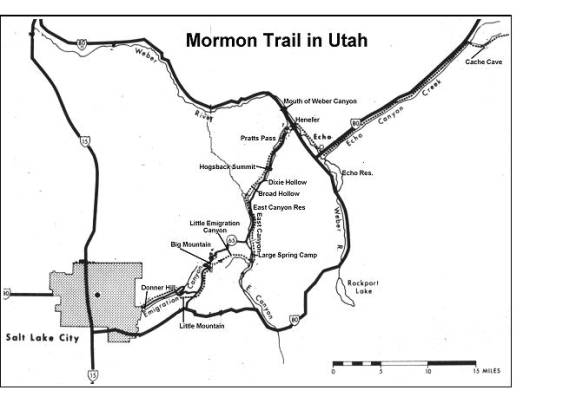
Tuesday, July 13, 1847
Near Cache Cave,
Utah:
Two
messengers, John Brown and Joseph Matthews, were sent back to meet with Brigham
Young back at The Needles. The camp did
not want to move on until President Young caught up with them. The messengers returned with Heber C.
Kimball and Howard Egan. They reported
that Brigham Young was feeling a little better but still could not travel. Albert P. Rockwood was near death and
“deranged in mind.”
It was
becoming very urgent for the pioneers to complete their journey and to plant a
crop as soon as possible in the Salt Lake Valley. The Twelve directed Orson Pratt to lead an advance company of 42
men and 23 wagons through the mountains.
They were instructed to make roads to enable the main company to follow
later. Heber C. Kimball returned to The
Needles. At 3 p.m., this company
started their journey and traveled about eight miles and entered Echo Canyon.
The main
company stayed at their camp near Cache Cave.
Thomas Bullock went to explore the cave which was thirty‑six feet
by twenty‑four feet and was about four to six feet high. Many of the brethren carved their names on
the walls. Brother Bullock observed
about fifty swallows nests near the roof of the cave.
The
hunters brought in twelve antelope.
Wilford Woodruff and Willard Richards took a walk to search for a
spring. They reminisced about their
missionary days when Elder Woodruff served at the Fox Islands in Maine, and
when they labored together in Preston, England. As the main camp rested in the evening, Thomas Bullock
wrote: “Our camp was stiller to night
than it has been since we left Fort [Laramie.]”
Mormon Ferry,
Wyoming:
The
ferrymen divided into two companies.
The first company would stay at the ferry and the second would journey
back to Fort Laramie to meet the second pioneer company. Those who stayed at the ferry were: William
Empey, John Higbee (who was sick), Appleton Harmon, Luke Johnson, James
Davenport, and Eric Glines (who had come back from the pioneers.) Those who
left for Fort Laramie were ferrymen, Thomas Grover, Francis M. Pomeroy, Edmund
Ellsworth, and Benjamin F. Stewart.
Also returning were: pioneers,
Aaron Farr, George Woodward, and Phinehas Young, and battalion members William
Walker, John Cazier, and Jonathan Pugmire.
After the
brethren left the ferry site, the rest were busy drying buffalo meat.
On the Platte
River, Nebraska:
The “Big
Company” of pioneers started the day’s journey at 7 a.m. They crossed a “multitude” of trodden down
buffalo paths that led from the bluffs to the river. Isaac C. Haight went to hunt buffalo. He chased a herd but fell off his horse and lost the chase.
Winter Quarters:
It was
very hot in Winter Quarters. Hosea
Stout’s last living child, Marinda Stout, born at Garden Grove, was very sick
and Brother Stout feared that she was dying.
Delia Ann
Covey, age one month, died of consumption.
Clarinda McCoulough, died of consumption. She was the wife of Levi McCoulough.
Kearny detachment
of the battalion, in Idaho:
The
detachment reached the Oregon Trail at noon, and followed it to the east,
toward Fort Hall. They reached the
Columbia River.
Company B, Mormon
Battalion, marching to Los Angeles:
During the
day the battalion company crossed over a plain where they saw about twenty
thousand cattle and horses grazing. The
hills could be seen covered with cattle, horses, sheep, and goats.
Sources:
Watson, ed., The
Orson Pratt Journals, 445; “Luke S. Johnson Journal,” typescript, BYU, 16;
Kenney, ed., Wilford Woodruff’s Journal, 3:229; “Albert P. Rockwood
Journal,” typescript, BYU, 62; Howard Egan Diary, Pioneering the West,
95; “The Journal of Nathaniel V. Jones,” Utah Historical Quarterly,
4:21; Appleton Milo Harmon Goes West, 40, 41; “The Journal of Robert S.
Bliss,” Utah Historical Quarterly, 4:111; Bagley, ed., The Pioneer
Camp of the Saints, 225‑26; Brooks, ed., On the Mormon Frontier,
1:266; The Personal Writings of Eliza Roxcy Snow, 184; Smart, ed., Mormon
Midwife, 91; “Isaac C. Haight Journal,” typescript, 42
Wednesday, July 14, 1847
Advance Company in
Echo Canyon, Utah
The
advance company traveled through Echo Canyon.
Orson Pratt wrote: “Our journey
down Red Fork has truly been very interesting and exceedingly picturesque. We have been shut up in a narrow valley from
10 to 20 rods wide, while upon each side the hills rise very abruptly from 800
to 1200 feet, and the most of the distance we have been walled in by vertical
and overhanging precipices of red pudding‑stone, and also red sand‑stone.” Levi Jackman added: “The valley was fertile but very narrow and
the hills on both sides were several hundred feet high. In many places it was difficult
passing. A little before night we
struck the Weber Fork and camped. We
came about 14 miles today.” Their plans
were to follow the Weber River to the valley.
Main Camp, near
Cache Cave, Utah:
Wilford
Woodruff and Barnabas Adams traveled back to the rear company, to see how the
sick were doing.
Thomas
Bullock sat in the cool cave all day and caught up on his writing. Many of the other brethren spent the day
hunting and killed several antelope.
Wilford
Woodruff returned in the evening and brought back news regarding the sick in
the rear company. A meeting was called
around Willard Richards’ wagon. It was
decided to hitch up and move the camp a short distance in the morning.
William
Clayton wrote about the mountain fever:
There are
one or two new cases of sickness in our camp, mostly with fever which is very
severe on the first attack, generally rendering its victims delirious for some
hours, and then leaving them in a languid, weakly condition. It appears that a good dose of pills or
medicine is good to break the fever.
The patient then needs some kind of stimulant to brace his nerves and
guard him against another attack. I am
satisfied that diluted spirits is good in this disease after breaking up the
fever.
Rear Company at The
Needles, Wyoming:
Wilford
Woodruff and Barnabas Adams visited the rear company of sick brethren. They were pleased to see that Brigham Young
was getting better and they ate supper with Heber C. Kimball. Wilford Woodruff planned to bring his
carriage from the main camp in the morning for Brigham Young and Albert P.
Rockwood to ride in.
Albert P.
Rockwood’s fever still raged and he was delirious. He later wrote: “Br
Lorenz Young and many others look upon me as dangerous ill. I so considered myself and so told the
brethren that if no relief came in 24 hours, they might dig a hole to put me
in.”
Howard
Egan, Heber C. Kimball, Ezra T. Benson, and Lorenzo Young climbed to the top of
a high mountain and offered prayers for the sick and for their families so far
away.
Mormon Ferry,
Wyoming:
The
ferrymen started to move their belongings, six miles up the river where the
feed was better. An emigrant company
arrived and needed some blacksmithing performed. All the blacksmith tools were moved up the river and set up for
business. Luke Johnson stayed at the
ferry site overnight to guard the rest of the things that had not yet been
moved up. During the night, he was bothered
by wolves that wanted to eat the buffalo meat.
Brother Johnson shot one, reloaded and fired again. “Then the gun burst. It burned his face and arm and hand
considerably, and slightly wounded his other arm and hand. A piece of the lock or something passed
through his hat with great violence, which closely grazed his head.”
On the Platte
River, Nebraska:
The
Jedediah M. Grant Company had difficulties and was delayed. During the night their herd broke out of the
yard and crushed two wheels on Willard Snow’s wagon, killed a cow, broke of
some horns, and broke the leg of a horse.
They had to spend the day repairing Brother Snow’s wagon. The Charles C. Rich company remained behind
with them. Abraham Smoot’s company
passed them during the day.
The
pioneers arrived at the location where the first pioneer company camped on May
9, 1847. They found the post,
guideboard, and box with a letter and history of the journey up to that
point. The guideboard stated that they
were 300 miles from Winter Quarters.
The company spotted several herds of buffalo and their hunters were
successful in killing some for meat.
Jedediah M. Grant showed Eliza R. Snow a buffalo skull on which was
written, “All well ‑‑ feed bad ‑‑ we only 300 ms. from
W.” It was dated May 9th.
Winter Quarters,
Nebraska:
Daniel H.
Wells, who was baptized into the Church the previous year, arrived from
Nauvoo. Hosea Stout was surprised that
he joined the Saints, but he observed that he now appeared to be an influential
and faithful member of the Church.
St. Louis, Missouri:
A son,
James Munro Pyper, was born to John and Madaline Gardener Pyper.
Kearny detachment
of battalion, west of Fort Hall Idaho:
The Kearny
detachment of the Mormon Battalion met several companies of Oregon
emigrants. These emigrants were
certainly among those who came in contact with the pioneers and may have let
the Mormon Battalion members know that they met the pioneers on the Oregon
Trail in Wyoming. One of these
emigrants wrote that the Kearny party was “anxious to buy provisions but we
were afraid to sell. They report peace
in California and were anxious to obtain newspapers which were very scarce.”
Company B, Mormon
Battalion, marching to Los Angeles
The
company traveled twenty miles and camped at Riota Ranch where there was an
excellent spring.
Sources:
Howard Egan Diary, Pioneering
the West, 95‑6; “Albert P. Rockwood Journal,” typescript, BYU, 62;
Kenney, ed., Wilford Woodruff’s Journal, 3:229‑30; Autobiography
of John Brown, 77; Watson, ed., The Orson Pratt Journals, 446;
Bagley, ed., The Pioneer Camp of the Saints, 225‑26; William
Clayton’s Journal, 292; “Levi Jackman Autobiography,” typescript, BYU, 39;
“The Journal of Robert S. Bliss,” Utah Historical Quarterly, 4:111; Appleton
Milo Harmon Goes West, 40, 41; “The Journal of Nathaniel V. Jones,” Utah
Historical Quarterly, 4:21; Brooks, ed., On the Mormon Frontier,
1:266; The Personal Writings of Eliza Roxcy Snow, 184; Yurtinus, A
Ram in the Thicket, 520
Thursday, July 15, 1847
Advance Company on
Weber River, Utah
The
advance company journeyed down Weber River, crossing over onto the south
bank. After six miles they halted about
one mile from the canyon which looked impassable for wagons. Orson Pratt and John Brown rode four miles
down the canyon and then returned to camp convinced that this route would be
very difficult. While they were gone,
Stephen Markham and others searched for the Donner‑Reed trail that cut
across the mountains to the south.
Orson Pratt and John Brown also went searching for this trail and soon
found it, but the grass had grown up, making it very difficult to discern. Orson Pratt followed the trail up a ravine
for six miles and then returned to the advance company camp.
Main Camp, near
Cache Cave, Utah:
Wilford
Woodruff left camp early in the morning, right after breakfast, with his
carriage and horses. In two hours he
arrived at Brigham Young’s camp. He
made a comfortable bed for President Young and Albert P. Rockwood in his
carriage, and the rear company started out.
Brother Rockwood wrote: “I was
very weak & low, not able to set up in the carriage, yet I stood the
journey very well. So did B Young.”
At noon,
Brigham Young, Heber C. Kimball and others with eight wagons arrived into the
main camp. Orders were given for the
company to harness up. During this time
a refreshing shower cooled them off.
At 3:30
p.m., after four and a half miles, they formed their camp at the foot of some
high, red bluffs [Castle Bluffs]. The
feed was good and there was a beautiful spring of cool water to the left of the
road.
Mormon Ferry,
Wyoming:
James
Davenport and Appleton Harmon were busy doing blacksmith work. Eric Glines traveled down the river for some
coal and other items at the ferry site.
William Empey and John Higbee dried buffalo meat and tended the cattle.
On the Platte
River, Nebraska:
The
companies had to travel over some sandy bluffs, away from the river, in order
to avoid swampy land. They camped at a
spring of cold water. Patty Sessions
put some milk in it to cool. Because of
problems with cattle, it was thought best to begin forming the wagon circles as
companies of fifty rather than larger groups.
Large numbers of buffalo were beginning to be seen.
Kearny detachment
of the battalion, near Fort Hall, Idaho:
The Kearny
detachment of the Mormon Battalion reached Fort Hall. They stopped for just a short time and obtained some bacon. Nathaniel Jones wrote that they saw “a great
many emigrants. The road is full of
them.”
Company B, Mormon
Battalion, marching to Los Angeles
The
battalion recognized that this was their last official day as soldiers in the
United States army. Company B marched
nine miles, crossed the San Gabriel River, marched nine more miles, and arrived
at Los Angeles. Robert S. Bliss
wrote: “This is the most beautiful
place I ever saw as to some things. The
orchards & vineyards are as fine as heart can wish. Here I drinked of the juice of the vine to
my satisfaction & eat most delicious pears &c.”
Sources:
William
Clayton’s Journal, 293; Watson, ed., The Orson Pratt Journals,
446; Kenney, ed., Wilford Woodruff’s Journal, 3:230; “Albert P. Rockwood
Journal,” typescript, BYU, 63; The Personal Writings of Eliza Roxcy Snow,
184; Smart, ed., Mormon Midwife, 91; “Jesse W. Crosby Journal,”
typescript, BYU, 36; Appleton Milo Harmon Goes West, 40, 41; “The
Journal of Robert S. Bliss,” Utah Historical Quarterly, 4:111; “The
Journal of Nathaniel V. Jones,” Utah Historical Quarterly, 4:21
Friday, July 16, 1847
Advance Company on
Weber River, Utah:
Orrin
Porter Rockwell was sent back to the main camp to report that they thought it
best to follow the Donner‑Reed trail over the mountains rather than the
Hastings trail down Weber Canyon. While
he was away, the advance company started their journey up a small stream,
sending ahead a dozen men to work with spades, axes, and other tools to clear
the road. After ascending six miles, a
five- hundred-foot elevation climb, they crossed over a ridge and then descended into a
ravine. After two and a half more miles
which took four hours to travel, they camped for the night. Levi Jackman and Lyman Curtis were sick.
After camp was established, Orson Pratt and Elijah Newman walked further
down the ravine to examine the road. They
saw evidence that the Donners and Reeds had spent several hours’ effort working
on the road, but evidently gave up and turned back up the ravine taking a
detour.
Main Company in
Echo Canyon, Utah:
After a
morning rain-shower, the main company started at 8:45 and entered Echo
Canyon. They had difficulty crossing
the creek and Harvey Pierce’s wagon broke, but was soon repaired. William Clayton wrote: “The mountains seem to increase in height,
and come so near together in some places as to leave merely room enough for a
crooked road.” Norton Jacob added: “We came into this valley which looks more
cheering than the arid desert we have been passing through.”
They
halted for the noon rest, deep in Echo Canyon.
There was plenty of grass, but no timber except for a few cedar trees on
the sides of the mountains. Orrin
Porter Rockwell returned from the advance company, reporting their location and
the route taken. He explained that they
could not follow the Hastings route through Weber Canyon but were instead going
over the mountains following the route taken by the Donner‑Reed
party. As the animals fed, a few men
hiked to the top of one of the mountains on the north side of the canyon. William Clayton said that they “looked like
babes in size.”
At 1:40
p.m., the company continued into the canyon which became narrower and
narrower. It seemed strange to them
that a road could ever be made in the narrow canyon. At some points they could only see two wagons ahead. They crossed the creek several times with
some difficulty. Patches of oak
shrubbery were appearing and more groves of trees. The elderberries were in bloom.
The high red cliffs on both sides were very impressive.
After
traveling a total of sixteen miles, they camped for the night in Echo
Canyon. William Clayton wrote of the
canyon: “We are yet enclosed by high
mountains on each side, and this is the first good camping place we have seen
since noon, not for lack of grass or water, but on account of the narrow gap
between the mountains.” Erastus Snow
recorded: “Toward night, for about one‑half
or three‑quarters of a mile, the whole camp seemed perfectly immerged in
a dense thicket of large shrubbery and weeds with scattering trees which filled
the valley. As we emerged from the
thicket we passed through some extensive beds of what mountaineers call ‘wild
wheat,’ small patches of which we have seen all the way from Bear River.” This grass was as high as ten feet tall near
the creek. Solomon Chamberlain broke
his wagon two miles back. John Wheeler
unloaded his wagon and went back to retrieve the axletree to be mended.
Echo
Canyon received its name of course because of the echoes heard. William Clayton wrote:
There is a
very singular echo in this ravine, the rattling of wagons resembles carpenters
hammering at boards inside the highest rocks.
The report of a rifle resembles a sharp crack of thunder and echoes from
rock to rock for some time. The lowing
of cattle and braying of mules seem to be answered beyond the mountains. Music, especially brass instruments, have a
very pleasing effect and resemble a person standing inside the rock imitating
every note. The echo, the high rocks on
the north, high mountains on the south with the narrow ravine for a road, form
a scenery at once romantic and more interesting than I have ever witnessed.
After camp
was established, some of the men tried their hand at mountain climbing. William Clayton warned: “The ascent is so steep that there is scarce
a place to be found to place the foot flat and firm, and the visitor is every
moment, if he makes the least slip or stumbles, in danger of being precipitated
down to the bottom and once overbalanced, there is no possibility of stopping
himself till he gets to the bottom, in which case he would doubtless be dashed
to pieces.”
William
Clayton climbed to the top of a mountain and could see the Weber River
ahead. To the rear he could only see
ranges of mountains. The descent which was a much more difficult task
than the climb, but he returned to camp before dark. Wilford Woodruff went one mile more down Echo Canyon and fished
in Weber River. He caught a trout for
Brigham Young.
Big Sandy River,
Wyoming:
About 150
miles behind the main company, the detachments of the Mormon Battalion and the
Mississippi Saints were camping on Big Sandy River, east of Fort Bridger. The soldiers celebrated the end of their
enlistment in the army with a salute of guns at daylight. John Steele noted that this salute “let
every one of Uncle Sam’s officers know we were our own men once more. We still kept up our organization, and
respected the command as usual, and was rather better than some had been
before.”
Mormon Ferry,
Wyoming:
In the
late afternoon, a wedding was held at the camp. Jacob Cooper and Kittean Hucklebee of an Indiana company were
married. Fourteen men arrived at the
river crossing, heading east with fifty pack horses and mules. This company had met the pioneers near Fort
Bridger.
On the North Platte
River, Nebraska:
The second
company traveled about twelve miles and saw thousands of buffalo. Jesse W. Crosby wrote: “On each side of the river, hills, and
valleys were literally covered with them.”
The grass was very short, eaten by all the buffalo. After camp was established, a herd of
buffalo ran into one of the camps among the oxen and cattle. One of the buffalo was shot in full view of
the women and children.
Sarah Rich
wrote:
Some days
we could see herds of thousands together, and several times they would come in
large herds crossing just ahead of our teams as hard as they could go, and in
such large numbers that the roaring of them would frighten our teams. It was all that the drivers could do to
prevent a stampede among our cattle. It
was dangerous traveling through this country, but we were preserved from
serious accident. It was a grand sight
to see these herds of wild animals, thousands of them, racing across the
prairies. The sight of our wagons
seemed to frighten them, and we were afraid they might attack us in their
fright.
Kearny detachment
of battalion, Bear River Valley, Idaho:
The Mormon
Battalion members of the Kearny detachment noted that their enlistment was up,
but they weren’t discharged and continued serving with the detachment riding to
the east.
Mount Pisgah, Iowa:
A
daughter, Abigail Harriet Snow, was born to Lorenzo Snow and his wife.
Mormon Battalion,
in Los Angeles, California:
The
battalion was mustered and formerly discharged from their year’s service in the
United States Army. They received their
discharge from their former commander, Lieutenant Andrew Jackson Smith. Azariah Smith wrote: “At 3 o’clock P.m. the five companies of the
battalion were formed according to the letter of their company, with A in front
and E in the rear, leaving a few feet of space in between. The [notorious] Lieutenant A. J. Smith then
marched down between the lines, then in a low tone of voice said, ‘You are
discharged.’” The men were pleased that the despised Lt. Smith’s remarks were
very short. Captain Daniel Davis, Lt.
James Pace, Lt. Andrew Lytle, Levi Hancock and David Pettigrew all made remarks
followed by three cheers.
Robert S.
Bliss wrote: “I felt to thank my
Heavenly Father that I had been preserved to accomplish the work I was sent to
do thus far.” The men could not leave
for home yet, because they had not yet received their pay. Many of them traveled three miles and camped
on the San Pedro River.
Levi
Hancock recorded: “The 16 of July has
come and what there has passed I cannot tell only there has been a great
struggle for power and to get us enlisted again I said I would not and many
others say the same such crualty on soldiers I never saw men chained and a ball
hung to them and to ware it for 6, 8 or 10 months gagued and imprisoned.”
Those who
reenlisted for six months were put under the leadership of Captain Davis and
prepared to march to San Diego.
Sources:
William
Clayton’s Journal, 294; Kenney, ed., Wilford Woodruff’s Journal,
3:230; “Erastus Snow Journal Excerpts,” Improvement Era 15:360; Watson,
ed., The Orson Pratt Journals, 448; Appleton Milo Harmon Goes West,
40-1; “Journal of William Empey,” Annals of Wyoming, 21:140; Smart, ed.,
Mormon Midwife, 91; The Personal Writings of Eliza Roxcy Snow,
185; Jesse W. Crosby Journal, typescript, BYU, 36; “The Journal of Robert S.
Bliss,” Utah Historical Quarterly, 4:111; Eugene E. Campbell, BYU
Studies, 8:2:141; “Norton Jacob Journal,” typescript, 105; Bagley, ed., Frontiersman,
54; “Levi Jackman Autobiography,” typescript, BYU, 39; “The Journal of
Nathaniel V. Jones,” Utah Historical Quarterly, 4:21; Hoshide &
Bagley, eds., “The 1847 Donner Camp Diary of Levi Hancock”; “Sarah Rich
Autobiography,” typescript, BYU, 75
Saturday,
July 17, 1847
Advance Company in
Broad Hollow, Utah:
A severe
frost fell on the company during the night.
Early in the morning, Orson Pratt went ahead on foot to examine the
country to see if there was a better route to take down Broad Hollow. He was soon convinced that they had taken
the best and only practical route. He
met a large grey wolf as he was returning.
Orson Pratt gave orders that the company should not proceed further
until more labor was performed on the previous day’s road.
While all
the men worked, Orson Pratt and John Brown went ahead to explore. They traveled down [East] Canyon Creek for
about 3 miles and discovered that this route would be impossible to follow
because the creek passed through a very narrow canyon that had a huge boulder
at the foot of the canyon. So instead
they followed the dim Donner‑Reed trail that climbed up East Canyon for
eight miles, crossing the creek thirteen times. The road would require much labor to make it usable by the
wagons. They left the horses and
climbed a mountain summit which appeared to be two thousand feet higher. Orson Pratt wrote: “The country exhibited a broken succession of hills piled on
hills, and mountains on mountains, in every direction.” They returned and found the advance company
had gone on about five miles from their morning camp and ended up in East
Canyon.
Main Company in
Echo Canyon, Utah:
Brigham
Young had a rough night and was very sick again. A forge was set up during the morning to repair Solomon
Chamberlain’s axletree. The cattle and
mules were very uneasy during the morning because they could hear their echoes
and must have though these were other animals answering their calls. Nine horses were lost in the morning. It was decided to journey on while some men
went back to repair Brother Chamberlain’s wagon and while others hunted for the
lost horses.
At 9:40
a.m., the main company pressed on and soon came to the Weber River. They turned to the right and traveled down
the river. The valley had opened up,
allowing them to again see snow on the mountain tops.
Brigham
Young, so very sick, soon could not endure any more traveling. A camp was selected, a few miles further, on
the banks of the river. William Clayton
wrote: “The day very hot and mosquitoes
plentiful; Several of the brethren have caught some fine trout in this stream
which appears to have many in it. In
the afternoon Elders Kimball, Richards, Smith, Benson and others went onto a
mountain to clothe and pray for President Young. They also prayed for their families far away. Howard Egan recorded: “We had a glorious time, and I thank the
Lord for the privilege.” On returning
they rolled down many large rocks from the top of the mountain “to witness the
velocity of their descent, etc. Some
would roll over half a mile and frequently break to pieces.”
In the
evening, Heber C. Kimball, George A. Smith, and Howard Egan rode down the river
to investigate the entrance into Weber Canyon.
They returned at 10 p.m. after riding eight miles down the river, but
they did not reach the canyon.
Mormon Ferry,
Wyoming:
The men
obtained timber to construct a coal pit.
In the afternoon, the emigrant company started to move out, leaving just
the six ferrymen alone at the river.
On the North Platte
River, Nebraska:
During the
night, many cattle belonging to one of the companies broke out of their
yard. About twenty yoke of oxen could
not be found. Patty Sessions wrote of
this day: “I gather a few dry weeds,
built a little fire on a buffalo dung, broiled some meat for my dinner, drank
sweeten ginger and water. I have seen
many thousands of buffalo to day. One
crossed our track just forward of us.
We had a fair view of him.”
Great joy
was felt when the company met some trappers heading east. Theses mountain men said they had met
Brigham Young’s pioneer company at South Pass.
(See June 27, 1847). They
also mentioned that several of the pioneers had been left at the North Platte
River crossing and were operating a ferry.
They said that they had seen as many as forty head of oxen lost by
Oregon emigrants, roaming with a herd of buffalo. The trappers also had brought back letters from the Brigham
Young’s company of pioneers.
As the
pioneer companies were sleeping during the night, they were alarmed by the
bellowing of a huge herd of buffalo on the other side of the river.
Kearny detachment
of battalion, Bear River Valley, Idaho:
The
detachment came upon some hot springs on the Bear River.
Mount Pisgah, Iowa:
Alvah
Hancock, age fifty-one, died. He was
the husband of Juletta Eames Hancock.
Los Angeles,
California:
Henry
Bigler recorded: “All hands were now
busy making preparations to leave for their homes wherever that was; whether on
Bear River, California, or Vancouver Island up in the British possession. For the truth is we do not know where
President Young and the Church is!”
Sources:
William
Clayton’s Journal, 297; “Norton Jacob Journal,” typescript, 105;
Watson, ed., The Orson Pratt Journals, 449‑50; “Levi Jackman
Autobiography,” typescript, BYU, 39; “Journal of William Empey,” Annals of
Wyoming, 21:140; The Personal Writings of Eliza Roxcy Snow, 185;
Smart, ed., Mormon Midwife, 91; “William Scearce Journal,” typescript,
1; “The Journal of Nathaniel V. Jones,” Utah Historical Quarterly, 4:21;
“Jesse W. Crosby Journal,” typescript, 37
Sunday, July 18, 1847
Advance Company in
East Canyon, Utah:
The
Advance company rested. The morning was
cold, with white frost covering the ground.
It became very hot during the day.
A meeting was held in the morning at which Orson Pratt gave the company
good words of encouragement.
Main Company on
Weber River, Utah:
The camp
was called together by Heber C. Kimball.
He reported that Brigham Young was still very sick. He asked the brethren to stop scattering off
hunting, fishing and climbing mountains.
Instead on this Sabbath day, he asked them to pray to the Lord that the
sickness might be taken from President Brigham Young. Wilford Woodruff testified that the devil was “constantly
striving to hinder our progress and thwart the purposes of God and now by
causing the president to be sick, hindering our progress in getting through in
time to return to our families this fall.”
At 10
a.m., a meeting was held in a small grove of shrubs. Elder Kimball proposed that the main body of pioneers go on ahead
to find a place to plant potatoes and other crops. There was very little time to spare. About fifteen wagons would remain behind with Brigham Young. Those who would stay behind would include
Heber C. Kimball, Wilford Woodruff, Ezra T. Benson, Howard Egan, and
others. This proposal was accepted.
At 2 p.m.,
another meeting was held. Several of
the brethren spoke including Elder Kimball, who prophesied wonderful things
concerning the camp. The bishops broke
bread and the sacrament was administered.
William Clayton recorded: “Good
feelings seem to prevail and the brethren desire to do right. A number yet continue sick, but we expect
all will soon recover.” Erastus Snow
wrote: “We had an excellent
meeting. The Holy Spirit was upon us,
and faith seemed to spring up in every bosom.
In the afternoon the President, who had been nigh unto death, was very
sensibly better, and the effects of the prayers of the brethren were visible
throughout the camp.” President Young
had been washed and anointed, fell asleep, and awoke feeling much better.
In the
evening Wilford Woodruff, Heber C. Kimball and Ezra T. Benson went into a high
hill and prayed together. They enjoyed
conversing upon things pertaining to the Kingdom of God.
Mormon Ferry,
Wyoming:
The rest
of the Oregon emigrants left the ferry crossing. They told the ferrymen that more than a hundred head of cattle
had been lost by the last several emigrant company. The ferrymen believed the cause of this loss was from driving the
cattle too hard without water.
On the North Platte
River, Nebraska:
Patty
Sessions baked some mince pies, bread, and meat over buffalo dung. At 11 a.m., a public Sabbath meeting was
held. Jedediah M. Grant’s company,
twenty miles behind, had lost seventy-five head of cattle two nights earlier
and some men were sent out to help find them.
The men were told to quit killing buffalo needlessly. They were told this they of action “was a
disgrace to the people and displeasing to the Lord.”
At 4 p.m.,
another meeting was held at which letters from the men at the North Platte
Ferry were read. The ferrymen reported
that they had ferried across four hundred Oregon emigrant wagons. After the meeting, a baptismal service was
held for many of the youth.
Confirmations were given and many children were blessed.
Sanford
Bingham and Martha Ann Lewis were married.
Summer Quarters,
Nebraska:
John D.
Lee was asked to go quickly to Samuel Gully, to administer to him. Brother Gully was cramped up and nearly
dying. He soon recovered after the
blessing. Others in Summer Quarters had
a similar illness. John D. Lee traveled
to Winter Quarters because he had been summoned to appear before the High
Council.
Winter Quarters,
Nebraska:
A Council
meeting was held in the morning to consider reports of evils in the settlement
of Garden Grove, including stealing and gambling. Orson Hyde pressed to have the whole settlement cut off from them
Church. The subject was “warmly
debated” and the motion was carried by the majority of the High Council to cut
off Garden Grove from the Church.
Later in
the afternoon, Isaac Morley spoke at the Winter Quarters stand. In the evening the High Council heard
several cases. James Clayton was
reprimanded for firing pistols on the Sabbath.
John Berry accused John D. Lee of allowing his horse to be lost and said
Brother Lee had not reimbursed him for this loss. The High Council heard witnesses and decided that Brother Lee was
not at fault but that he should not charge Brother Berry for the use of his own
mule or for boarding the horse before it was lost.
Mormon Battalion,
in Los Angeles:
The
battalion started to receive their pay.
They each received $31.50, but did not receive the promised
transportation money to return home.
Sources:
William
Clayton’s Journal, 300; Kenney, ed., Wilford Woodruff’s Journal,
3:213; “Erastus Snow Journal Excerpts,” Improvement Era 15:361; “Norton
Jacob Journal,” typescript, 105‑06; Watson, ed., The Orson Pratt
Journals, 450; Smart, ed., Mormon Midwife, 91; Brooks, ed., On
the Mormon Frontier, 1:265‑66; Kelly, ed., Journals of John D. Lee,
189‑93; “Levi Jackman Autobiography,” typescript, BYU, 40; “William
Scearce Journal,” typescript, 1; Cook, Joseph C. Kingsbury, 120; “Jesse
W. Crosby Journal,” typescript, 37; “Journal of William Empey,” Annals of
Wyoming, 21:140; Hoshide & Bagley, eds., “The 1847 Donner Camp Diary of
Levi Hancock”
Monday, July 19, 1847
Advance Company in
East Canyon, Utah:
Orson
Pratt and John Brown left shortly after sunrise to scout the road ahead. They traveled up East Canyon and then
climbed four miles up to a ridge. They
then left their horses and climbed Big Mountain. Orson Pratt wrote: “Both
from the ridge where the road crossed, and from the mountain peak, we could see
over a great extent of the country. On
the south‑west we could see an extensive level prairie, some few miles
distant, which we thought must be near the Lake.” John Brown added: “Here
we had a view of the valley for the first time. We went on to the mountain to the right and saw what we supposed
to be one corner of Salt Lake.”
After
finding the wagon trail used by the Donner‑Reed party to climb Little
Emigration Canyon, they head back toward the advance company’s camp. They found them more than six miles further
up East Canyon. The advance company had
crossed over East Canyon Creek about eight or nine times. Much work had been accomplished on improving
the road. The company rejoiced in
hearing that the brethren had viewed the valley. Orrin Porter Rockwell returned and reported that the main company
of pioneers was only a few miles behind.
He brought back instructions from Brigham Young, who said that when they
arrived in the valley, they were to turn a little to the north and plant seeds
of all kind.
Main Company on
Weber River, Utah:
Brigham
Young was feeling much better. The main
company departed at 7:45 a.m. on a rough road down Weber River. They were under the leadership of John Pack. After two miles, they forded the river which
was only eighteen inches deep. Erastus
Snow asked the company to halt until Willard Richards caught up. One of his oxen was missing, but he still
wished to be with the main company.
They proceeded on until the turnoff to ascend the hills on the Donner‑Reed
trail.
The main
company found the cutoff and William Clayton put up a sign that read, “Pratt’s
Pass to avoid canyon. To Fort Bridger
74 1/4 miles.” The company soon started
to slowly make their way up the mountain.
The road was rough and crooked, quite dangerous for wagons. At the top of the ridge, William Clayton put
up another guide board that read: “80
miles to Fort Bridger.” At this point, Heber C. Kimball, Wilford
Woodruff, George A. Smith, and Howard Egan rode up from the rear company to
view the road. The descent into the
next ravine was not very steep, but it was dangerous because of large
cobblestones that made the wagons slide.
At 2 p.m.,
the main company stopped for a rest and then continued on at 3:30. They soon ascended a very long steep hill
for nearly a mile, and then they descended another crooked road. At 5:30 p.m., they camped near some willow
bushes full of mosquitoes inside East Canyon.
Erastus Snow wrote: “Here the
road took up the creek south, and the snowy mountains, encircling us on the
south and west, rearing their heads above the intervening mountains, showed us
plainly that our climbing was not yet at an end.” George A. Smith’s wagon was damaged, but they quickly made a coal
pit, and Burr Frost set up his blacksmith tools to reset the tire.
Rear Company on
Weber River, Utah:
Wilford
Woodruff drove Brigham Young in his carriage for five miles and at this point
stopped for breakfast. They had driven
with the main camp for two miles and then parted. President Young still had a fever but was feeling better. Those traveling with Brigham Young and
Wilford Woodruff included Ezra T. Benson, Heber C. Kimball, Howard Egan,
Lorenzo Young, and his family, Hosea Cushing,
and Carlos Murray. The company
consisted of fifteen wagons. They
camped on the Weber River.
Fort Bridger,
Wyoming:
The Mormon
Battalion detachments and the Mississippi Saints arrived at Fort Bridger. Abner Blackburn wrote: “Old Jim Bridger and his trappers gave us a
hearty welcome to our company. He is
the oldest trapper in the mountains and can tell some wonderful stories.” John Steele recorded: “Captain Brown invited me to go ahead with
him to Fort Bridger. We found the old
mountaineer and in conversation he told us we could not live in Salt Lake
Valley for it froze every month in the year and he would give us a thousand
dollars for the first ear of corn raised there.”
Kearny detachment,
Bear River Valley, Wyoming:
The Kearny
detachment met Charles Smith, who had come from California with Samuel Brannan
and had recently met with Brigham Young and the pioneers. He shared information about the California
Saints and certainly also talked about the pioneers.
Mormon Ferry,
Wyoming:
Luke
Johnson and Eric Glines went hunting.
In the afternoon as they were returning without any luck, Brother
Johnson’s horse became frightened as they were following a little creek. They soon discovered some bear cubs in a
thicket and Brother Johnson dismounted with his 11‑shooter. William Empey later recorded: “The moment he struck the ground, the
[mother] bear discovered him & came towards him at the top of her speed
with her mouth wide open & each jump accompanied with an awah awah
oo.” Luke Johnson stood his
ground. When the bear was within twenty
feet with three of her cubs at her heels, he aimed and fired. The grizzly bear turned to run, but soon
fell dead. Brothers Johnson and Glines
returned to camp with the meat, hide, and the exciting tale.
On the North Platte
River, Nebraska:
The
Jedediah M. Grant Company’s missing cattle could not be found. Some of the other companies continued on and
crossed some bluffs. Several oxen were
found which had probably belonged to Oregon emigrants. The Grant Company was twenty‑five
miles behind the lead companies, stranded without enough oxen.
About this
time, George Washington Hill experienced an amusing incident:
In running
the buffalo along the [North] Platte there was a buffalo cow, in jumping down
the bank broke one of her forelegs.
This crippled her, so that we concluded to drive her to camp and butcher
her, but when we went into the river to driver her out, she only drove at
us. We continued driving until she
drove us clear across the river which was about two miles wide, but when she
got to the bank she refused to go up, so we threw two lariats on her and
undertook to pull her up, but she was too good at holding back. I then went into the river and took my
butcher knife and would prod her in the rump, thinking to make her go up that
way, but it was no go. Finally, Br.
Smoot took a bit of a run and jumped straddle of her, thinking to ride her up
the bank, but she kicked so when I was prodding her that she was just as wet as
water would make her, which made her so slick he never made any stop on her,
but landed head foremost in the river.
But she concluded that she had rather go up the bank alone than to be rode
up, so up she went charging.
Summer Quarters,
Nebraska:
John D.
Lee returned to Summer Quarters and found David I. Young near death with the
strange disease that had come upon several in the settlement. Brother Young was overcome with joy to see
Brother Lee because he wanted Brother Lee to baptize him before he died.
Brothers Martin and Allen came in to assist, but when they put Brother
Young in a chair he was so weak that he kept fainting, so they could not
baptize him. Brother Lee promised
Brother Young that he would be baptized as proxy for him and told Brother Young
to rest. He stopped struggling and soon
died.
Sources:
William
Clayton’s Journal, 300; Watson, ed., The Orson Pratt Journals,
450‑51; Autobiography of John Brown, 78; Kenney, ed., Wilford
Woodruff’s Journal, 3:231; “Luke S. Johnson Journal,” typescript, BYU, 17;
“Erastus Snow Journal Excerpts,” Improvement Era 15:361‑62; Howard
Egan Diary, Pioneering the West, 97‑8; “Levi Jackman
Autobiography,” typescript, BYU, 40; “Journal of William Empey,” Annals of
Wyoming, 21:140‑41; “Jesse W. Crosby Journal,” typescript, BYU, 37;
“William Scearce Journal,” typescript, 2; The Personal Writings of Eliza
Roxcy Snow, 185; Bagley, ed., Frontiersman, 61; “The Journal of
Nathaniel V. Jones,” Utah Historical Quarterly, 4:21; Kelly, ed., Journals
of John D. Lee, 193‑94; “Incidents in the Life of George Washington
Hill,” in Madsen, Journey to Zion, 365
Tuesday, July 20, 1847
Advance Company in
East Canyon, Utah:
Orson
Pratt wrote a letter describing the road and country ahead which he had scouted
out the previous day. He left the
letter in a conspicuous place for the companies that would follow. The advance company resumed their journey at
9 a.m., being somewhat delayed by the stray cattle that they had had to
locate. They climbed the road up Little
Emigration Canyon to Big Mountain.
Brother Pratt measured the top of the mountain to be 7245 feet above sea
level. They descended down the other
side and camped at the base of Little Mountain. Levi Jackman wrote: “Our
journey for a number of days had been rather gloomy. The mountains on both sides have been so high and the ravines so
cracked that we could see but a short distance and it looked as though we were
shut up in a gulf without any chance for escape.” They noticed that much of the timber near the top of Big Mountain
had been burned by forest fires.
Main Company in
East Canyon, Utah:
Burr Frost
was very busy in the morning repairing wagons that had been damaged coming down
the hill into East Canyon. The company continued their journey at 11
a.m. Word came from the advance company
via one of the Mississippi brethren, Brother Crow, that they were nine miles
ahead. Word was pased back that the
road ahead was rough. The men in the
main company worked hard to continue improving the road for those who would
follow. Some of the men in the company
had fallen ill and were left behind for the rear company along with three
wagons.
After four
hard miles, the main company rested their teams and ate dinner. William Clayton wrote: “The road over which we have traveled is
through an uneven gap between high mountains and is exceedingly rough and
crooked. Not a place to be met with
scarcely where there would be room to camp for the dense willow groves all
along the bottom.”
They
traveled on until after 5 p.m. They had
crossed East Canyon Creek eleven times.
Brother Clayton commented: “The
road is one of the most crooked I ever saw, many sharp turns in it and the
willow stubs standing making it very severe on wagons.” The campground in East Canyon was so cramped
that the wagons had to huddle very closely together. This was the camp ground used by the advance company the night
before. They found a letter from Orson Pratt stating
that the next campground was eleven miles ahead, over Big Mountain. Willard Richards and George A. Smith decided
to send Erastus Snow ahead with a letter for Orson Pratt instructing the two of
them to go down into the valley to explore it and find a good place to plant
some crops.
Rear Company on
Weber River, Utah:
The rear
company got an early start at 5:30 a.m., thinking it was best to travel in the
cool morning. They crossed Weber River
and soon came to William Clayton’s guide board directing them up to “Pratt’s
Pass.” After another two miles, they
stopped for breakfast near a cool brook of water. Howard Egan and a few others went ahead to make further
improvements on the road. The company
continued on during the day and finally reached East Canyon Creek, where they
found brethren who had remained behind because of illness including: Stephen H. Goddard, James Case, Henry G.
Sherwood, Benjamin F. Dewey,
Brother Johnson, and William Smoot.
They received word that George A. Smith’s wagon had broken and that
Orson Pratt was about eight miles ahead.
Brothers Johnson and Sherwood were baptized in the creek for their
health. Wilford Woodruff confirmed
them.
Kearny detachment,
Oregon Trail, Wyoming:
The Kearny
detachment of the Mormon Battalion started early and struck out across the
mountain away from Bear River.
Mormon Ferry,
Wyoming:
James
Davenport and Appleton M. Harmon went in search of lost cattle. They ran into a company of emigrants who had
found the cattle more than ten miles away.
Luke Johnson and Eric Glines went out searching for the bear cubs they
had seen the day before, but they could not find them.
On the North Platte
River, Nebraska:
The Grant
Company still could not find the lost oxen.
Parley P. Pratt and John Taylor ordered that each company provide some
oxen to be used by the Grant Company.
Large herds of buffalo could be seen on both sides of the river. The leaders discussed whether they should
cross over the Platte because of the numerous buffalo on the north side. The companies traveled on about twelve
miles. Brother Noble called his company
together in the evening for a prayer meeting.
Winter Quarters,
Nebraska:
John Kay,
age five months, died of summer complaint [cholera infantum]. He was the son of John M. and Ellen
Partington Kay.
Summer Quarters,
Nebraska:
Isaac
Morley, John D. Lee, Levi Stewart, and Absalom P. Free walked to the south of
Summer Quarters about one half mile and selected a location for a new
cemetery. In the late afternoon, David
I. Young was buried. About half of the
settlement attended the funeral.
Los Angeles,
California:
Those who
chose to return to the Saints with Levi Hancock (about 164 men) were organized
into groups of hundreds, fifties, and tens.
Eight‑two men reenlisted for another six months. Henry Boyle wrote:
While a
sufficient number of us have reenlisted to make one company, I did not like to
reenlist, but I had no relatives in the Church to return to. I desired to remain in California til the
Church became located, for it is impossible for us to leave here with
provisions to last any considerable length of time. And if I stay here or any number of us, it is better for us to
remain together, than to scatter all over creation.
Sources:
William
Clayton’s Journal, 303; Howard Egan Diary, Pioneering the West,
98‑99; “Erastus Snow Journal Excerpts,” Improvement Era 15:407;
Kenney, ed., Wilford Woodruff’s Journal, 3:231; Bagley, ed., The
Pioneer Camp of the Saints, 230; Watson, ed., The Orson Pratt Journals,
450‑51; Autobiography of John Brown, 78; “Levi Jackman
Autobiography,” typescript, BYU, 40; Kelly, ed., Journals of John D. Lee,
194‑95; “The Journal of Nathaniel V. Jones,” Utah Historical Quarterly,
4:21; “William Scearce Journal,” typescript, 2; “Jesse W. Crosby Journal,”
typescript, BYU, 37; “Journal of William Empey,” Annals of Wyoming,
21:141; The Personal Writings of Eliza Roxcy Snow, 185; Ricketts, The
Mormon Battalion, 261
Wednesday, July 21, 1847
Advance Company
near Little Mountain, Utah:
Orson
Pratt’s company ascended Little Mountain and then came down on the other side
to the creek that runs through Emigration Canyon. They called the stream, “Last Creek.” Erastus Snow arrived during the morning from the main camp with
instructions to explore the valley. So
Orson Pratt and Erastus Snow rode on ahead down Emigration Canyon. They came to Donner Hill, a hill climbed by
the Donner Party to avoid an area of blockage in the canyon.
Orson
Pratt wrote:
Mr. Snow
and myself ascended this hill, from the top of which a broad open valley, about
20 miles wide and 30 long, lay stretched out before us, at the north end of
which the broad waters of the Great Salt Lake glistened in the sunbeams,
containing high mountainous islands from 25 to 30 miles in extent. After issuing from the mountains among which
we had been shut up for many days, and beholding in a moment such an extensive
scenery open before us, we could not refrain from a shout of joy which almost involuntarily
escaped from our lips the moment this grand and lovely scenery was within our
view.
Erastus Snow added: “On ascending this butte we involuntarily both at the same
instant, uttered a shout of joy at finding it to be the very place of our
destination, and beheld the broad bosom of the Salt Lake spreading itself
before us.”
They
immediately descended into the valley and with just one horse between them
traveled a circular 12‑mile route exploring the valley. Erastus Snow recorded: “We descended a gradual slope, some four
miles towards the center of the valley, and visited several small creeks
flowing from the mountains into the Utah outlet [Jordan River,] traveled some
ten or twelve miles in the valley, and returned to the company about nine
o’clock in the evening.”
While they
were away, the advance company had climbed up Little Mountain. Levi Jackman wrote: “From the top of this hill, like Moses on
Pisgah’s top, we could see a part of the Salt Lake Valley, our long anticipated
home. We did truly rejoice at the
sight.” They descended down into
Emigration Canyon and a few also climbed Donner Hill to see a view of Great
Salt Lake.
Main Company in
East Canyon, Utah:
The main
company journeyed onward at 6:30 a.m.
They crossed East Canyon creek one more time and then started to
gradually ascend Big Mountain via Little Emigration Canyon. They spent much time cutting down stumps and
moving heavy rocks to improve the road.
They saw much timber destroyed by fire near the top.
At 11
a.m., they arrived at Big Mountain Pass and caught their first glimpse of the
Salt Lake Valley floor. William Clayton
wrote: “From this ridge we can see an
extensive valley to the west but on every other side high mountains, many of
them white with snow. It seems as
though a few hours’ travel might bring us out from the mountains on good road
again.”
The road
down the other side of Big Mountain was very steep. They had to lock their hind wheels for safety. The road was full of stumps, many of which
were removed by the men. They found a
bridge over a deep ravine which had been constructed by the advance
company. Joseph Rooker tipped over his
wagon at this point but did not experience much damage.
They rested their teams near a spring on the way down as the road
leveled out somewhat. They pressed on
and during the long afternoon climbed Little Mountain. At 7:30 p.m., they made their camp in
Emigration Canyon, only about a half mile behind the advance company.
Rear Company in
East Canyon, Utah:
The rear
company with Brigham Young did not travel this day because of sickness. They worked at setting the wheel on John S.
Fowler’s wagon. Heber C. Kimball, Ezra
T. Benson, and Lorenzo Young explored up East Canyon. Wilford Woodruff went down the creek and caught eight small
trout. He wrote: “The country is very mountainous, rough
& steep.”
Mormon Ferry,
Wyoming:
A company
of eighteen men with sixty horses and mules heading east came to the river
crossing. They reported seeing the
pioneer company at Fort Bridger.
William Empey wrote: “The
remainder part of the day passed away very lonesome, we being in a strange land
and far from our homes and families being near to us. We would often talk what we would give if we only knew the
situation of them.”
On the North Platte
River, Nebraska:
The second
pioneer company traveled on. Jesse W.
Crosby recorded: “Came in sight of
buffalo, almost without number, the river for six miles swarmed with them. As we approached they ran in multitudes over
the bluffs.” Some of the companies had
to pass directly through the herd.
Seventeen yoke of oxen were brought back to the Grant Company to help
replace those that were lost. Eliza R.
Snow wrote: “This is truly a land of
buffalos ‑‑ they are in sight all the time ‑‑ an almost
innumerable herd of them came over the bluff today & seem’d about to cross
our Camp on their path to the river ‑‑ our hunters met them &
they chang’d their course, much to our gratification.” That evening the cattle were very uneasy
because of the sounds of numerous buffalo.
Patty Sessions wrote: “I went
into the waggon, looked out, saw them go round and round like a whirlpool, the
men saying they would break and runaway.
I knelt down and prayed for the Lord to quiet them. I arose, they were quite still. We went to bed, heard no more from them.”
Winter Quarters,
Nebraska:
Don Carlos
Smith, age ten months, died of diarrhea.
He was the son of George A. and Lucy Smith.
Levi Hancock
company, north of Los Angeles, California:
An advance
group of former battalion soldiers started their journey to return to their
families. Robert S. Bliss wrote: “Just 12 months ago to day we left C. Bluffs
for this country & to day the camp commenced to move on for our destined
home. [I] was appointed one of the
Pioneers to go ahead of the main body, consequently we marched about 8 or 10
miles to day & encamped on the Purbelo River near a rancheros or farm; Some
beautiful & picturesque mountains on either side of us.”
Sources:
William
Clayton’s Journal, 304; Watson, ed., The Orson Pratt Journals,
452‑53; Autobiography of John Brown, 78; “Erastus Snow Journal
Excerpts,” Improvement Era 15:407‑08; Kenney, ed., Wilford
Woodruff’s Journal, 3:232; “Levi Jackman Autobiography,” typescript, BYU,
40; “Journal of William Empey,” Annals of Wyoming, 21:141; “Jesse W.
Crosby Journal,” typescript, BYU, 37; Cook, Joseph C. Kingsbury, 120; The
Personal Writings of Eliza Roxcy Snow, 185; Smart, ed., Mormon Midwife,
92; “The Journal of Robert S. Bliss,” Utah Historical Quarterly, 4:111; Journal
of Discourses, 12:88‑9, August 11th, 1867
Thursday, July 22, 1847
Advance Company in
Emigration Canyon, Utah:
Orson
Pratt went to the main camp, a half mile back, to consult with members of the
Twelve. It was decided to send a small
group down into the valley to find a good place to start plowing and planting. So Orson Pratt, George A. Smith, John Brown,
Joseph Matthews, John Pack, Orrin Porter Rockwell, Jesse C. Little, Erastus
Snow, and one other man rode down to explore the valley. As they passed by Donner Hill, they determined
that the obstructions in the canyon could be removed rather than hauling all of
the wagons up the hill as the Donner‑Reed party did the previous
year. They left a note on a pole
instructing the main company to clear the road.
Orson
Pratt wrote:
After going
down into the valley about 5 miles, we turned our course to the north, down
towards the Salt Lake. For 3 or 4 miles
north we found the soil of a most excellent quality. Streams from the mountains and springs were very abundant, the
water excellent, and generally with gravel bottoms. . . . We found the drier
places swarming with very large crickets, about the size of a man’s thumb. This valley is surrounded with mountains,
except on the north: the tops of some of the highest being covered with snow. Every 1 or 2 miles streams were emptying
into it from the mountains on the east.
John Brown
also noted the crickets and wrote:
“There were hosts of black crickets all over the valley and apparently
harmless.”
The
pioneers discovered some hot springs.
Orson Pratt wrote: “We found as
we proceeded on, great numbers of hot springs issuing from near the base of the
mountains. These springs were highly
impregnated with salt and sulphur: the temperature of some was nearly raised to
the boiling point.” Erastus Snow added:
It bursts
from the base of a perpendicular ledge of rock about forty feet high and emits
a volume of water sufficient for a mill.
We had no instrument to determine the degree of temperature, but suffice
it to say that it was about right for scalding hogs. Here are the greatest facilities for a steam doctor I ever
saw. A stone, in the center of the
stream before the aperture in the rocks, seemed to say, this is the seat for
the patient. At any rate, I tried it,
but had little desire to remain long upon it.
After
traveling further toward the lake and finding the soil becoming sterile, they
returned toward the canyon. Norton
Jacob explained: “They got within some
eight or ten miles of the Great Salt Lake, but it is hemmed in with small
lakes, ponds and pools so that it appears difficult to get near it.”
Main Company in
Emigration Canyon, Utah:
The main
company of pioneers started out at 8:30 a.m., and soon caught up with the
advance company working on the road in Emigration Canyon. They soon reached the obstruction in the
canyon that caused the Donner‑Reed party to climb Donner Hill. Stephen Markham, like Orson Pratt,
determined that the road would be too steep up the hill so instead the men were
asked to spend a few hours clearing the obstructions so the road could continue
down the canyon.
William
Clayton wrote:
While the
brethren were cutting the road, I followed the old one to the top of the hill
and on arriving there was much cheered by a handsome view of the Great Salt
Lake lying, as I should judge, from twenty‑five to thirty miles to the
west of us; and at eleven o’clock I sat down to contemplate and view the
surrounding scenery. . . . For my own part I am happily disappointed in the
appearance of the valley of the Salt Lake, but if the land be as rich as it has
the appearance of being, I have no fears but the Saints can live here and do well
while we will do right. When I commune
with my own heart and ask myself whether I would choose to dwell here in this
wild looking country amongst the Saints surrounded by friends, though poor,
enjoying the privileges and blessings of the everlasting priesthood, with God
for our King and Father; or dwell amongst the gentiles with all their wealth
and good things of the earth, to be eternally mobbed, harassed, hunted, our
best men murdered and every good man’s life continually in danger, the soft
whisper echoes loud and reverberates back in tones of stern determination; give
me the quiet wilderness and my family to associate with, surrounded by the
Saints and adieu to the gentile world till God says return and avenge you of
your enemies.
Brother
Clayton descended from Donner Hill into Emigration Canyon. He noted:
“The ground seems literally alive with the very large black crickets
crawling around up grass and bushes.
They look loathsome but are said to be excellent for fattening hogs
which would feed on them voraciously.”
After
working four hours, the men cleared the way through Emigration Canyon, and the
wagons continued their journey. Thomas
Bullock wrote:
We
succeeded in getting thro’ the narrow spot of the Kanyon about 4 o’clock, when
we turned round the hill to the right & came in full view of the Salt Lake
in the distance, with its bold hills on its Islands towering up in bold relief
behind the Silvery Lake. A very
extensive valley burst upon our view, dotted in 3 or 4 places with Timber. . .
. I could not help shouting ‘hurra, hurra, hurra, there’s my home at last.
Levi
Jackman added: “When we finally got
through, it seemed like bursting from the confines of prison walls into the
beauties of a world of pleasure and freedom.
We now had entered the valley and our vision could extend far and wide. We were filled with joy and rejoicing and
thanksgiving.”
They
proceeded on into the valley. Thomas
Bullock continued:
We
descended a gentle sloping table land to a lower level where the soil &
grass improve in appearance. As we
progressed down the valley, small clumps of dwarf oak and willows appear and
the wheat grass grows 6 or 7 feet high.
Many different kinds of grass appear, some being 10 or 12 feet
high. After wading thro’ thick grass
for some distance, we found a place bare enough for a camping ground, the grass
being only knee deep, but very thick; we camped on the banks of a beautiful
little stream which was surrounded by very tall grass.
William
Clayton recorded: “At this place, the
land is black and looks rich, sandy enough to make it good to work. The grass grows high and thick on the ground
and is well mixed with nice green rushes.
Feed here for our teams is very plentiful and good and the water is also
good.”
Orson Pratt
and his company returned. The large
pioneer company gathered around a campfire to hear his report. He said that his exploration group had found
a good spot to plant crops by a creek [City Creek] a few miles to the
north. They enjoyed hearing news of the
hot springs. A company council meeting
was held at Willard Richards’ wagon. It
was decided to move to the place found by Orson Pratt in the morning. Also, two men, John Pack and Joseph
Matthews, would be sent back to make a report to Brigham Young. The rest would start plowing and planting
about ten acres of potatoes.
On this
historic first evening in the valley, the men talked about their new home. William Clayton concluded the day with: “The evening was fine and pleasant and the
night feels much warmer than in the ravines of the mountains.” Norton Jacob wrote: “We have here mild summer weather. Serene atmosphere; a most beautiful clear
sky, with an excessive dry climate and arid soil. If it could receive timely rains, it would be one of the most
beautiful fertile regions on the face of the earth.”
All the
pioneers noted some disappointment that there was not very much timber in the
valley. They realized that they would
have to make homes of brick and stone.
Orson
Pratt, Willard Richards, and George A. Smith completed a letter that would be
taken back to Brigham Young. It
included:
The
brethren have done a great deal of labor on the road for our Pres. & his
company to come over, but after so many wagons passing we presume you will find
some repairing necessary, & should you find it very bad we hope you will
look upon our labors with a lenient eye, for we have tried to do the best we
could. . . . Brothers Pratt & Smith & seven other horsemen explored the
valley north of this as far as possible for lime & met the camp on their
return at this point. They report some
beautiful creeks north of this about 4 miles, whence we propose to remove in
the morning & prepare for planting a short distance north of that
point. The land becomes more barren;
warm, hot sulphur, poison & a variety of other spring around. . . . Timber
can hardly be said to be scarce in this region for there is scarcely enough of
it to be named, & sage is as scarce as timber, so that if you want to raise
sage & greese wood here you had better bring the seed with you from the
mountains. In many places the grass,
rushes &c. Are 10 feet high, but no
more. Mammoth crickets abound in the
borders of the valley. There are some
sand hill cranes and karobs feed abundant, and of the best quality; water in
the creeks passably good. We hardly
need enter into particulars at this time as we anticipate you will be here in a
day or two and see for yourself and see much more than we have had time to look
at. Our prayers are in your behalf
continually, that you may be strong in spirit & in boday & come to us
speedily.
Rear Company in
East Canyon, Utah:
While most
of the pioneers were reaching their new valley home, Brigham Young, Heber C.
Kimball, Wilford Woodruff, and the rest of the small rear company spent a hard
day traveling up East Canyon. Wilford
Woodruff wrote: “We crossed the creek
eleven times in going 8 miles & the worst 8 miles we have had on the
journey. Br. [James] Case smashed one
of his hind waggon wheels to peaces & we had to wait 2 hours to bring his
oxen up.” Elder Woodruff caught two
trout in the creek while waiting. The
sick men were feeling better.
They found
the letter left by Orson Pratt two days earlier which included:
To Willard
Richards, G. A. Smith or any of the Saints: From this point it is five miles
west to the summit of the dividing ridge [Big Mountain]. The road will be of a moderate descent, and
considerable better than the one you have passed over for a few miles
back. The ravine up which you will go
is without water, except two or three small springs, which soon loose
themselves beneath the sol. You will
pass through groves of quaking asp, balsam, and cottonwood, more than you have
seen for many days.
Near the Green
River, Wyoming
The Kearny
detachment met many emigrants heading to Oregon. Private Nathaniel Jones met an old acquaintance, Orlando
Strickland. The detachment reached the
Green River and traveled nearly all night.
Mormon Ferry,
Wyoming:
Two
buffalo were spotted toward the mountains in the morning. Luke Johnson and Eric Glines went after then
and returned in the late afternoon with some of the meat. A company of ten men from Oregon
arrived. They were heading back to the
States with about forty ponies and mules.
James Davenport stated his intentions to go back to Winter
Quarters. He offered to pilot this
company back to Council Bluffs if they would sell him a horse. Seeing that James Davenport was about to
leave, William Empey, the appointed leader at that time at the ferry said that
they must divide up their recent earnings.
It amounted to $29.85 for each man.
Brother Davenport, who had brought in much of the money through his
blacksmithing, accused the brethren of robbing him of his earnings. He neglected to consider that the other men
did the cooking, built his fires, and herded his cattle. And not all of the money had been earned
through blacksmithing. They tried to
convince Brother Davenport and even bought some of the things he could not take
with him. Still, he was dissatisfied.
On the North Platte
River, Nebraska:
Dead
carcasses of thirteen buffalo were spotted, indicating that there were probably
Indians nearby. Jesse W. Crosby wrote:
At midday
we came in sight of 100 or 110 Indian Lodges.
We were no sooner in camp at evening, than they came running on
horseback to our camp, about 100 in number.
Report rang through the camp that a body of Indians were coming with a
Red Flag, but on near approach it proved to be the Stars and Stripes. They are of the Sioux nation ‑‑
the neatest and most cleanly Indians I ever saw. They were friendly; we gave them a feast of bread etc. After firing a cannon, the Indians retired
to their lodges about 2 miles distance.
Patty
Sessions noted that these were the first Indians that the second company had
seen since leaving Winter Quarters. She
added: “We have fired the cannon and
one six‑shooter for them to see and hear, gave them some bread and they
feasted, rode round the camp and then we rang the [Nauvoo] bell, our men
paraded and motioned to them to go away.”
Winter Quarters,
Nebraska:
Luman
Israel Calkins, age one year, died of consumption. He was the son of Luman H. and Methitabel Russell Calkins.
Council Bluffs,
Iowa:
A son,
Alfred Welker, was born to James and Annie Pugh Welker.
Near Los Angeles,
California:
Jefferson
Hunt led a company of fifty‑one former battalion soldiers out of their
camp and headed toward San Francisco, along the coastal route of El Camino
Real. Other companies left to follow a
route through the central valleys. Levi
Hancock moved three miles north of the fort and camped on the San Gabriel
River. He was hunting for his
horses. Robert S. Bliss and the others
who were part of an advance company passed through a valley, reached San
Fernando, and camped at the foot of some mountains. A few more men arrived from Los Angeles with news that most of
the 164 men led by Levi Hancock would be underway on the following day.
Sources:
William
Clayton’s Journal, 306‑12; Watson, ed., The Orson Pratt
Journals, 454‑55, 555; “Norton Jacob Journal,” typescript, 107‑8;
“Erastus Snow Journal Excerpts,” Improvement Era 15:408‑09; Autobiography
of John Brown, 78; Bagley, ed., The Pioneer Camp of the Saints, 231‑32;
“Levi Jackman Autobiography,” typescript, BYU, 40; Kenney, ed., Wilford
Woodruff’s Journal, 3:232; “The Journal of Nathaniel V. Jones,” Utah
Historical Quarterly, 4:21; Hoshide & Bagley, eds., “The 1847 Donner
Camp Diary of Levi Hancock”; “The Journal of Robert S. Bliss,” Utah
Historical Quarterly, 4:111‑12; “Jesse W. Crosby Journal,” typescript,
BYU, 37‑8; Smart, ed., Mormon Midwife, 92; Howard Egan Diary, Pioneering
the West, 100-01
Friday, July 23, 1847
Salt Lake Valley,
Utah:
John Pack
and Joseph Matthews left in the morning to give a report to Brigham Young
regarding the arrival of the pioneers in the valley. Thomas Bullock included a chart of distances that estimated
Winter Quarters as 1,073 miles from Salt Lake Valley.
At the
same time, the main camp moved on to “the final location” on the banks of City
Creek. The soil was good by the creek
and the grass was about four feet high and thick.
As soon as
the camp was formed, the pioneers were called together for a special
meeting. Orson Pratt stated that they
had been striving for two years to reach this place. He said that they had been greatly blessed in their journey and
he proposed that they return their thanks to their Heavenly Father. They all united in a prayer. Orson Pratt thanked the Lord for their
preservation and prosperity. He then
asked the Lord to bless their labors and to send rain on the land for the crops
they would be planting. Elder Pratt
consecrated and dedicated themselves and the land to the Lord.
Willard
Richards spoke about the need to work faithfully and diligently to plant the potatoes,
corn, beans, peas, buckwheat, turnips, and other crops in the ground. He mentioned that in times past there had
been a spirit of selfishness among the camp that must now be thrown aside. All must go to work to put in seeds, taking
no thought as to who would be the ones to eat the fruits of the labor. If they disputed as to who should eat the
crops, their labors would not be blessed.
He made reference to the Donner‑Reed party, who quarrelled among
themselves and ended up starving. It
would be worse for the pioneers unless they worked together for those who would
follow after them. Other speakers at
this historic meeting included Shadrach Roundy, Seth Taft, Stephen Markham,
Robert Crow, and Albert Carrington.
The
meeting ended and the men went to work.
Committees were appointed to do the various work. Shadrach Roundy, Seth Taft, Stephen Markham,
Robert Crow, and Albert Carrington were appointed to find a place to plant the
crops. Charles Harper, Charles Shumway, and Elijah Newman were put on a
committee to stock plows and drags, and enlist men to assist them. Henson Walker, William Wardsworth and John Brown were to be in
charge of moving and rigging up the scythes.
Stephen Markham was appointed to attend to the teams and make sure a
fresh set of cattle was hitched up every four hours. Almon Williams was asked to oversee the making of a coal
pit. George A. Smith asked the men to
only use dead timber for their cooking, to leave the live trees alone.
William
Clayton wrote:
The
brethren immediately rigged three plows and went to plowing a little northeast
of the camp; another
party went with spades, etc., to make a dam on one of the creeks so as to throw
the water at pleasure on the field, designing to irrigate the land in case rain
should not come sufficiently. This land
is beautifully situated for irrigation, many nice streams descending from the
mountains which can be turned in every direction so as to water any portion of
the lands at pleasure.
The first
furrow was turned at noon. William
Carter was credited with plowing the first ground. At 2 p.m., work was started on the dam. At 4 p.m., grass was mowed for a turnip patch. At 6 p.m., their prayers were quickly
answers as heavy clouds collected and it rained for two hours. Some of their plows broke in the hard ground
during the day, but they usually had three plows going at all times. The afternoon temperature was ninety‑six
degrees. By nightfall, they had plowed
three acres.
In the
evening, the camp was called together again.
Willard Richards spoke again.
They made arrangements to rotate the teams during the next day from 4
a.m. to 8 p.m. John Pack and Joseph
Matthews returned and reported that Brigham Young’s company was within ten
miles and all the sick were doing better.
Brigham Young
Company in East Canyon, Utah:
Brigham
Young and the rest of the pioneers started their journey at 6:45 a.m.. Brigham Young recorded this historic journal
entry: “July 23rd: I ascended and
crossed over the Big Mountain, when on its summit I directed Elder Woodruff,
who kindly tendered me the use of his carriage, to turn the same half way
round, so that I could have a view of a portion of Salt Lake valley. The Spirit of Light rested upon me, and
hovered over the valley, and I felt that there the saints would find protection
and safety. We descended and encamped
at the foot of the Little Mountain.”
Howard
Egan wrote of the view on Big Mountain:
“Here we had a fine view of the snowy mountains and the open country in
the distance.” While coming down Big
Mountain, the company was kept very busy dodging all the stumps from trees
cleared out by the advance companies.
Lorenzo Young’s wagon with children was turned over and smashed on a
rock. The children were not hurt
although part of the wagon load had been dumped on top of them. They were freed by cutting a hole in the
wagon cover.
The rear
company spent the noon rest at the base of Little Mountain. While there, John Pack and Joseph Matthews
arrived from the valley. Wilford
Woodruff recorded:
They
brought a letter to us & informed us it was only 10 miles to the valley of
the Salt Lake or great basin & 14 to their camp. They had explored the country as far as possible & had made
choice of a spot to put in seeds. They
considered it the greatest grazing country in the world but was destitute of
timber as far as they had been. Several
fine streams of fresh water cutting through the valley.
After the
noon rest, they climbed Little Mountains and descended into Emigration canyon
where they made their camp. Howard Egan
wrote:
A short
time after our arrival at this place, the sky became overcast with clouds, and
a strong wind, setting in from the southwest, gives the appearance of a very
heavy storm. The grass here is rather
tall and rank, though in places is pretty good. The sick are gaining strength as fast as could be expected,
considering the fatigue of the journey.
The day has been the hottest we have experienced since we left Winter
Quarters. There was not a breath of air
in the ravine, and the dust was almost suffocating.
Wilford
Woodruff climbed the top of a very high mountain. “Was in a high state of perspiration when I reached the top of
it.”
Mormon Ferry,
Wyoming:
James
Davenport left the ferry site to return to Winter Quarters. He left dissatisfied and said he would tell
the Saints that they had robbed him. An
emigration company arrived, heading for Oregon. They had lost oxen and horses, run off by buffalo. In their company was a Mormon widow who was
going to Oregon with her brother. She
intended to rejoin the main body of the church at an early opportunity. She was acquainted with John Higbee.
On the North Platte
River, Nebraska:
It rained
during the night and into the morning.
The pioneer companies remained in their camps while they waited for the
Jedediah M. Grant Hundred to catch up.
The Indians again visited the camp in even larger numbers, including
women and children. Trading took place
for moccasins, buffalo robes, and other items.
In the evening a feast and dance were held. The Indians would dance for the Saints and then the Saints would
return the compliment by playing violins, fifes, and drums. Cheers were heard throughout the camp. The pioneers fired two cannons and soon all
the Indians returned to their lodges in peace.
The Grant Company pulled within three miles of the other companies. They had heard the cannons in the
distance. As they traveled, they
noticed initials inscribed on the sides of a bluff.
Summer Quarters,
Nebraska:
A terrible
sickness continued to take hold of Summer Quarters. Isaac Morley called the brethren together and asked them to
settle all their differences, that unity would prevail in the community. Some members of the settlement had said that
they would wait for Brigham Young to return.
Brother Morley told them that this was a wrong spirit and if he had to,
he would cut some of them off the Summer Quarters branch of the Church. They received the message well and agreed to
drop their differences. John D. Lee and
his family were suddenly struck down by the illness.
Near Los Angeles,
California:
Robert S.
Bliss and the advance company passed over a mule path on a ridge. He wrote:
“On either side of us was an awful gulf. My head grew dizzy & I dare not look into the chasms below;
We passed in safety down the other side of the Mts to a spring & encamped 8
or 10 miles from our last encampment.”
Behind them, the rest of Levi Hancock’s company left the camp north of
Los Angeles. They traveled in a
scattered state toward General Pico’s ranch of the “arcaldres” which had two
large gardens and a vineyard covering two hundred acres. They saw grapes, figs, pears, apricots,
cherries, plums, peaches, apples, olives, and dates.
Sources:
William
Clayton’s Journal, 312; “Norton Jacob Journal,” typescript, 108‑09;
“Charles Harper Journal,” 31; Watson, ed., The Orson Pratt Journals, 456‑57;
Bagley, ed., The Pioneer Camp of the Saints, 233‑34; Erastus Snow
in Utah Pioneers, P. 46; Collected Discourses, Vol.1, Wilford
Woodruff, July 24, 1888; Kenney, ed., Wilford Woodruff’s Journal, 3:232‑33;
“Journal of William Empey,” Annals of Wyoming, 21:143; Jesse W. Crosby
Journal, typescript, BYU, 38; William Scearce Journal, typescript, 2; “The
Journal of Robert S. Bliss,” Utah Historical Quarterly, 4:111; Kelly,
ed., Journals of John D. Lee, 196‑97; The Personal Writings of
Eliza Roxcy Snow, 186; Hoshide & Bagley, eds., “The 1847 Donner Camp
Diary of Levi Hancock”; Howard Egan Diary, Pioneering the West, 101‑02;
The Discourses of Wilford Woodruff, 317; Collected Discourses,
Vol.3, President Wilford Woodruff, June 12th and 13th, 1892
Saturday, July 24, 1847
Emigration Canyon,
Utah:
As Brigham
Young and the remaining pioneers in Emigration Canyon arose, they discovered
that some of the horses were missing.
They belonged to Horace K. Whitney, William Smoot, Howard Egan, and
Frank Dewey. Howard Egan returned three
miles and found them. This group
started their journey about two hours after Brigham Young and the others.
Wilford
Woodruff recorded in his journal:
July 24,
1847: This is an important day in the history of my life and the history of the
Church of Jesus Christ of Latter‑day Saints. On this important day, after traveling from our encampment six
miles through the deep ravine‑valley ending with the canyon through the
Last Creek, we came in full view of the great valley or basin [of the] Salt
Lake and the land of promise held in reserve by the hand of God for a resting
place for the saints upon which a portion of the Zion of God will be built. We gazed with wonder and admiration upon the
vast, rich, fertile valley which lay for about twenty‑five miles in
length and 16 miles in width, clothed with the heaviest garb of green
vegetation in the midst of which lay a large lake of salt water. . . . Our
hearts were surely made glad after a hard journey ‑‑ from Winter
Quarters ‑‑ of 1200 miles through flats of Platte river and steeps
of the Black Hills and the Rocky Mountains, and burning sands of the eternal
sage region, and willow swales and rocky canyons and stumps and stones ‑‑
to gaze upon a valley of such vast extent entirely surrounded with a perfect
chain of everlasting hills and mountains, covered with eternal snows, with
their innumerable peaks like pyramids towering towards heaven, presenting at
one view the grandest and most sublime scenery that could be obtained on the
globe. Thoughts of pleasing meditation
ran in rapid succession through our minds while we contemplated that not many
years hence and that the House of God would stand upon the top of the mountains,
while the valleys would be converted into orchards, vineyards, gardens and
fields by the inhabitants of Zion, the standard be unfurled for the nations to
gather thereto. President Young
expressed his full satisfaction in the appearance of the valley as a resting
place for the saints, and was amply repaid for his journey.
Brigham
Young’s journal entry read: “I started
early this morning and after crossing Emigration Kanyon Creek eighteen times
emerged from the kanyon.”
Howard
Egan recorded: “We then left the ravine
and turned to the right and ascended a very steep pitch, where we beheld the
great valley of the Salt Lake spreading out before us. My heart felt truly glad, and I rejoiced at
having the privilege of beholding his extensive and beautiful valley, that may
yet become a home for the Saints. From
this point we could see the blue waters of the Salt Lake.” Brother Egan climbed a ridge at the mouth of
the canyon to get a better view.
The whole
surface of the valley appears, from here, to be level and beautiful. The distance from here to the lake is judged
to be forty to fifty miles. Throughout
the whole extent of the valley can be seen very many green patches of rich
looking grass, which no doubt lays on the banks of creeks and streams. There is some little timber also on the
streams, and in the direction of the great lake many small lakes appear upon
the surface.
Albert P.
Rockwood recorded that they shouted “hallelujah” when they came within full
view of the valley. Horace K. Whitney
wrote: “We passed over a level shelf or
bottom for some distance & then descended to the 2nd shelf or bottom below,
from whence we had a plain view of the camp of the Saints ahead. After going 7 1/4 miles, we came to it &
encamped with the remainder of the brethren.”
Salt Lake Valley,
Utah:
Plowing
and planting continued in the morning.
Potatoes were put into the ground. Work continued on damming city creek for
irrigation. During the morning, the
ditches were filled with water and the newly planted ground was soaked. Corn was also planted. John Pack and Joseph Matthews returned to
Emigration Canyon to fix two bridges near the mouth of the canyon.
At 11:45
a.m., Brigham Young, Heber C. Kimball, Wilford Woodruff, and the rest of the
wagons arrived at the City Creek camp.
The pioneers rejoiced to see President Young feeling much better.
Brigham
Young later said: “[George A.] Smith
came about 3 miles from [City Creek] to meet me . . . I then pointed to a peak
on the north and said, ‘I want to go up on that peak, for I feel fully
satisfied that was the point shown me in the vision, where the colors fell, and
near which I was told to locate and build a city.’”
The
brethren together discussed the valley.
William Clayton wrote:
There
appears to be a unanimous agreement in regard to the richness of the soil and
there are good prospects of sustaining and fattening stock with little
trouble. The only objection is a lack
of timber and rain. The latter God will
send in its season if the Saints are faithful and I think yesterday was a proof
that He listens to and answers the prayers of the Saints. We can easily irrigate the land at all
events which will be an unfailing and certain source of water, for the springs
are numerous and the water appears good.
Wilford
Woodruff wrote:
As soon as
we were located in the encampment, before I took my dinner, having one‑half
bushels of potatoes I repaired to the plowed field and planted my potatoes,
hoping with the blessings of God at least to save the seed for another
year. The brethren had dammed up one of
the creeks and dug a trench, and by night nearly the whole ground was irrigated
with water. We found the ground very
dry. Towards evening, in company with
Brothers Kimball, Smith and Benson, I rode several miles up the creek into the
mountains to look for timber and see the country, etc. There was a thunder shower and it extended
nearly over the whole valley, also it rained some the forepart of the night, we
felt thankful for this as it was the general opinion that it did not rain in
the valley during the summer time.
Howard
Egan added:
This valley
is bounded by high mountains, some of them covered with snow, and from what
knowledge we have of it at present, this is the most safe and secure place the
Saints could possibly locate themselves in.
Nature has fortified this place on all sides, with only a few narrow
passes, which could be made impregnable without much difficulty. The scarcity of timber has probably been the
reason that this beautiful valley has not been settled long since by the
Gentiles. But I think we can find
sufficient timber up the creeks for present purposes, and also coal in the
mountains. The saints have reason to
rejoice, and thank the Lord for this goodly land unpopulated by the Gentiles.
Not
everyone was pleased with the valley.
Harriet Young, tired and recovering from illness wrote: “We arrived in the valley of the Great Salt
Lake. My feelings were such as I cannot
describe. Every thing looked gloomy and
I felt heart sick.”
Joseph
Hancock had been sent up City Creek Canyon to hunt. Norton Jacob recorded:
“Brother Hancock returned at evening from up the creek and reported
abundance of bear signs and a large quantity of valuable timber on the mountain
and in the valley of the creek, rock maple, white oak, fir and norway pine, all
of which suitable for sawing into lumber.
Killed nothing but a prairie chicken.”
Lewis B. Myers and one of Brother Crow’s sons left, taking packhorses to
hunt for food for the Mississippi families.
They planned to be gone a month, getting their supply of meat for the
winter.
Heber C.
Kimball announced plans to send an exploring party on Monday to travel north to
Bear River and Cache Valleys. Another
expedition would be sent south to Utah Lake.
South Pass,
Wyoming:
The Kearny
detachment including members of the Mormon Battalion passed through South Pass
and camped on the Sweetwater.
Mormon Ferry,
Wyoming:
Four men
from California with twelve mules and a horse arrived at the river
crossing. They told the brethren that
they had met the pioneers on July 10, only four days travel [by horse] from the
Salt Lake. They also said that they had met the Mormon
Battalion soldiers at Green River. A
company of sixteen wagons heading to Oregon soon arrived. They believed that they were the last
company on the road. They had a
terrible problem losing their horses among the thick herds of buffalo. They had lost 17 horses and 40 head of
cattle.
On the North Platte
River, Nebraska:
About 677
miles behind, the second company of pioneers, unaware that their new home had
been found, left their camp at Cedar Bluffs and passed the Indian lodges which
were on the other side of the river.
Jesse W. Crosby recorded:
Some of our
men went over to their lodges and were kindly received and invited to dine,
which invitation they accepted. Their
meal consisted of dried meal pounded.
Our men bought some oxen of them which they had found with Buffalo. All the dishes which the Indians has were
earth shells; skins of beasts were used to carry water, corn, etc. . . . This
body of which we speak is merely a hunting party ‑‑ 2 or 3 hundred
strong, with considerable number of horses, for pack horses.
Eliza R.
Snow wrote: “I took a view of their
town thro’ a spy‑glass ‑‑ their tents or lodges are small of
skins gaily painted.” Many of the
Indians followed the companies as they traveled, still trying to make bargains
with the pioneers.
Winter Quarters,
Nebraska:
Mary Richards
wrote: “Weather quite hot,
churned. Cleaned the house, baked and
braided 1 yard.”
North of Los
Angeles, California:
Robert S.
Bliss and the advance company arrived at Francisco Ranch, where they bought
cattle and more provisions for their journey over the Sierra Nevadas. He wrote:
“We are in a delightful Valley surrounded by the Everlasting hills of
California; we are now about 180 miles north of San Diego still the sun at noon
is almost vertical or overhead but we have the trade winds from the Ocean which
makes the atmosphere delightful.”
Other
soldiers, a day behind, traveled on a rugged, steep ridge. Daniel Tyler recorded: “Two pack‑animals lost their footing
and rolled twenty or thirty feet before they could regain it.”
Cohose, New York
Elder
Lyman O. Littlefield reached Cohose, a little town on the Mohawk River near
present‑day Albany, New York. He
wrote:
Standing on
the Erie Canal, one half mile west of the village, a magnificent scene spread
before the beholder. There is a long
succession of canal locks. The Cohose
Falls, down which the clear waters pour, send upwards a mist of spray to dance
in wreaths of playful fantasy in the glancing sunbeams, while the waters of the
“old canal” rested in their basins, a few feet below. . . . Night soon hovered
over the scene, and Dr. Daniel Olts, of Cortland County, (that state), and
myself returned to our boat and passed the evening with our books.
Sources:
William
Clayton’s Journal, 314; Kenney, ed., Wilford Woodruff’s Journal,
3:233‑35; Autobiography of John Brown, 78; “Albert P. Rockwood
Journal,” typescript, 63; Watson, ed., The Orson Pratt Journals, 458;
Watson, ed., Manuscript History of Brigham Young, 564; Howard Egan
Diary, Pioneering the West, 103‑05; “Norton Jacob Journal,”
typescript, 109‑10; James R. Clark, Messages of the First Presidency,
6:265; “Lyman Littlefield Reminiscences (1888),” 196‑97; Smart, ed., Mormon
Midwife, 93; Ward, Winter Quarters, 152; The Personal Writings of
Eliza Roxcy Snow, 186; “Excerpts from Journal of Horace K. Whitney,” Improvement
Era, July 1947, 447; “The Journal of Nathaniel V. Jones,” Utah
Historical Quarterly, 4:21; “The Journal of Robert S. Bliss,” Utah
Historical Quarterly, 4:111; “Jesse W. Crosby Journal,” typescript, BYU,
38; “Journal of William Empey,” Annals of Wyoming, 21:143; Tyler, A
Concise History of the Mormon Battalion, 306; Hartley, “On the Trail in
July,” Ensign, July 1997.
Sunday, July 25, 1847
Salt Lake Valley,
Utah:
Wilford
Woodruff wrote: “This is the first
Sunday that the Latter Day Saints ever spent in the Great Salt Lake
Valley. We washed, shaved & cleaned
up & met in the circle of the encampment.”
The Bishops opened the meeting with singing and prayer. Then George A. Smith preached the first
sermon standing on a cannon. He
proclaimed that the House of the Lord was being established on the tops of the
mountains. He was followed by Heber C.
Kimball and Ezra T. Benson. They all
expressed positive feelings about the valley.
Heber C. Kimball made mention of wonderful blessings that they had
received during their historic journey.
“Not a man, woman, or child has died on the journey, not even a horse,
mule, ox, cow or chicken has died during the whole journey.”
The brethren were encouraged to stay faithful and obey the counsel of
their leaders.
At 1 p.m.,
Heber C. Kimball held a special meeting with those brethren who were part of
his family by adoptive sealing. He
mentioned that those who planned to spend the winter in the valley might need
to return to the Sweetwater to hunt buffalo for winter meat. He also said:
We shall go
tomorrow if Brigham is well enough, in search of a better location ‑‑
if indeed, such can be found ‑‑ if not, we shall remain here. There should be an enclosure made for the
purpose of keeping the horses and cattle in nights for there are plenty of
Indians in the vicinity. I should
advise you to keep the Sabbath day holy whether others do or not. . . . If you
wish to go hunting, fishing, or to see the country, select a week day and not
the Lord’s day for that purpose. Do not
let us get giddy and light minded as the Nephites did of old, but strive to
work righteousness in the beginning, inasmuch as we have reached the promised
land. . . . I am not going to take anything back with me to Winter Quarters
except what is actually necessary,‑‑even some of my clothes I shall
leave behind. I shall leave Bishop
[Edson] Whipple with you. He is quite a
steady and economical man, and as such I recommend him to you.
He asked
Robert Baird and Hans
Hansen to make garments of buckskins.
Thomas Cloward was asked to make shoes, Philo Johnson to make hats.
Elder
Kimball offered a prayer. Charles
Harper recorded: “[It] appeared as
though the spirit of the Lord rested mightily upon him, asking Heavenly Father
to pour his blessings upon us and our families and that we might be guided by
his spirit and be preserved from all evil.”
At 2 p.m.,
the whole camp was again assembled for another meeting. The sacrament was blessed and passed. They were addressed by Wilford Woodruff,
Orson Pratt, Willard Richards, Lorenzo Young, John Pack, and others. Elder Richards said that in order to go and
proclaim the gospel to the Lamanites, it would be necessary for the elders to
enjoy the gifts of speaking in tongues, interpretation of tongues, and the
discerning of spirits. They would
obtain those gifts by following the counsel of their leaders.
Brigham
Young, still feeble, was able to share a few thoughts. “Those that do not like our look and customs
are at liberty to go where they please, but if they remain with us, they must
obey the laws sanctioned by us. There
must be no work done on the Sabbath.”
He warned them that they would lose five times as much as they would
gain by trying to work on the holy day.
“As soon as we select a place of permanent location, we shall take the
compass and chain and lay out a city and every man shall have his inheritance
therein. We shall also lay out ground
for cultivation and every man shall have his inheritance and cultivate it as he
pleases, only he must be industrious.
We do not intend to buy any land or sell any.” He spoke out against dishonesty.
If any of the pioneers had found articles of any kind on the road, they
must make it known so that they may be returned to the rightful owners. He said that a dishonest man was a curse to
the Saints. He anyone tried to keep
something that was not his, “it would prove a curse to him, and would be a
stain on him and his posterity that never would be wiped out in time and
throughout eternity, and the stain never would be wiped out until it was burned
out in hell.” He announced that they would
have a meeting every Sabbath.
The
brethren discussed sending back some wagons to help lighten the loads of the
second pioneer company. It was reported
that there was much timber in the canyons above the valley, especially in the
mountain to the northeast. They decided
to delay the start of a northern expedition to Bear River and Cache Valleys
because Brigham Young was still ill. A
company would be sent to the south to explore Utah Lake.
Echo Canyon, Utah:
The
detachments of the Mormon Battalion and Mississippi Saints probably reached
Echo Canyon. Abner Blackburn
wrote: “Crossed to Echo Canion, that
celebrated place where every noise makes an echo. The boys made all the noise they could going through. It was truely wonderful.”
Sweetwater,
Wyoming:
The Kearny
detachment traveled seventeen miles down the Sweetwater and camped. They saw many buffalo and antelope.
Mormon Ferry,
Wyoming:
The men at
the ferry were becoming quite anxious for the second pioneer company to
arrive. Little did they know that the
company was still far away, about 260 miles down the trail. William Empey wrote: “This day passed of very lonesome as we can
get no news of or from the long expected co[mpany] of our brethren & the
matter for journalism is rather scarce of this day unless I should record the
expressions of anxiety now & then dropped from the brethren of the long
looked for appearance of our comp[any] from Winter Quarters.”
On the North Platte
River, Nebraska:
In the
morning, the second company of pioneers were excited about the arrival of those
brethren sent back by the pioneers: Phinehas Young, ferryman Edmund Ellsworth,
battalion member Jonathan Pugmire, and six others.
They held a meeting and read letters from Brigham Young and Willard
Richards. William Scearce wrote that it
“much rejoiced our hearts to see them and to hear from the brethren
ahead.” Eliza R. Snow wrote: “It was truly like clusters of grapes by the
wayside.”
Jonathan
Pugmire and another man were returning to Winter Quarters, thus many of the
pioneers wrote letters for him to take back with them. Phinehas Young was thinking of returning but
soon changed his mind.
Elders
Parley P. Pratt and John Taylor wrote a letter to Orson Hyde, back at Winter
Quarters:
We were
agreeably surprised this morning with the arrival of Elder P[hinehas] Young and
four others of the Pioneers. We were
glad to hear that those of the Mormon Battalion left at Pueblo were enroute to
join the Pioneers. We have travelled as
expeditiously as could be expected of so large a company, indeed almost as fast
as the Pioneers. We have had the
pleasure of receiving several letters from different post offices which they
have established on their route, giving us the particulars of their journey,
the news of course in the wilderness was highly interesting. We have had only two deaths since we left,
and those, children; several children have been run over by wagons, but no
serious injury sustained. We have been
greatly blessed as a camp and people, and bless the God of Israel for this
preserving care. Elder Grant’s company
had the misfortune to lose thirty‑six head of cattle, besides several
milch cows. All the companies assisted
in searching for them, and as that was unavailing, they supplied them with
thirty yoke of cattle and all proceeded on our journey.
Parley P.
Pratt recommended to the companies that they start traveling in fifties. Some of the companies started to move out in
the evening.
Winter Quarters,
Nebraska:
Benjamin
Clapp, Isaac Morley, and William W. Major spoke at a public Sabbath
meeting. They instructed the Saints to
be faithful and to fulfill their covenants.
The Saints were also told to stop taking the name of the Lord in vain.
Orson Hyde
proposed to the High Council that the people of Garden Grove, Iowa, should have
to enter into a special covenant before they would be allowed back into the
church. He wanted them to swear that
they had not stolen from anyone since they had left the Mississippi River and
that they would inform the leaders about anyone they knew who had stolen
goods. The proposal was totally vetoed
by the High Council. In the evening a trial
was held between a Brother Young and Daniel H. Wells. Brother Young claimed that Brother Wells had brought in a span of
mules from Nauvoo that belonged to him.
North of Los
Angeles, California:
Levi
Hancock passed over the Mountain Ridge.
He wrote: “We had got to the top
of what is seen we had not got half up and we had to go winding our course
around on the tops untill we had gained the summit then turned to the left and
went down into another canyon. While on
the top the sea breeses blew cool & good we followed down an easterly
course and come to the ranch of the Arcaldies.” They found there two companies of men who had previously arrived.
Sources:
William
Clayton’s Journal, 315‑18; “Norton Jacob Journal,” typescript,
110; “Charles Harper Journal,” 31; Howard Egan Diary, Pioneering the West,
108; Watson, ed., Manuscript History of Brigham Young, 565; Kenney, ed.,
Wilford Woodruff’s Journal, 3:235‑36; Bagley, ed., The Pioneer
Camp of the Saints, 238; “Journal of William Empey,” Annals of Wyoming,
21:143; “Issac C. Haight Journal,” typescript, 45; “William Scearce Journal,”
typescript, 2; Smart, ed., Mormon Midwife, 93; The Personal Writings
of Eliza Roxcy Snow, 186; Brooks, ed., On the Mormon Frontier,
1:267; Ward, Winter Quarters, 152‑53; Bagley, ed., Frontiersman,
61‑2; “The Journal of Nathaniel V. Jones,” Utah Historical Quarterly,
4:21; Hoshide & Bagley, eds., “The 1847 Donner Camp Diary of Levi Hancock”;
Bigler, The Gold Discovery Journal
of Azariah Smith, 95
Monday, July 26, 1847
Salt Lake Valley,
Utah:
The
pioneers arose early at the sound of the bugle at 6 a.m. and went back to work
plowing and planting. Some of those who
were still sick went to bathe in one of the warm springs and said the effects
were greatly beneficial. Others left in
the morning to also try out the springs which were 109 degrees. A company of fifteen men left to make a road
to the timber in City Creek Canyon. A
tent was raised in a grove near the camp for men to work in making
clothes. Robert Baird made buckskin
pants and Thomas Cloward mended the pioneers’ shoes. Joseph Matthews and John Brown headed toward the mountain to the
west.
It was
probably on this morning that a historic event took place. Wilford Woodruff later said:
He
[President Young] said to me in the morning, “Brother Woodruff, I want to take
a walk.” “All right, “ said I. A number of the Twelve Apostles were there
and they got together. He commenced to
walk from our encampment across this barren desert, this sage plain without any
guide to mark anything appertaining to the future of the children of men in
this land. President Young was quite
feeble. He wore his little green cloak
upon his shoulders and he walked slowly along.
As we advanced from below on to the rising ground we came to a certain
spot where he stopped very suddenly. He
took his cane, which had a spike in the end of it, and stuck it down into the
ground, and said, “Here shall stand the Temple of our God.” . . . I asked him to stop there till I could
break a piece of sage brush or something that I could drive down into the
place. I did nothing else until I put a
stake in that spot that he marked with his cane, and then we went on about our
business.
Wilford
Woodruff took Brigham Young in his carriage about two miles to the north to
choose a nice spot for a garden.
At 10
a.m., an exploring company left the camp consisting of Brigham Young, Heber C.
Kimball, Wilford Woodruff, George A. Smith, Ezra T. Benson, Willard Richards,
Albert Carrington, and William Clayton.
They traveled to the north and climbed the bench of land which would
later be called “Capitol Hill.” William
Clayton wrote:
We arrived
on a beautiful table land, level and nicely sloping to the west. Here we halted to view it and the more we
viewed, the better we were satisfied that it is as handsome a place for a city
as can be imagined. At the east part
there is a considerable creek of clear cold water descending from the mountains
and just above this place it branches into two forks, one running northwest the
other southwest and the two nicely surrounding this place, and so well arranged
that should a city be built here the water can be turned into every street at
pleasure.
Brigham
Young wanted to climb the peak to the north.
His brother, Lorenzo had joined in with the company. William Clayton further recorded this
historic climb: “After some hard toil
and time we succeeded in gaining the summit, leaving our horses about two‑thirds
the way up. President Young felt pretty
well fatigued when he got up. Some of
the brethren feel like naming this Ensign Peak. From this place, we had a good view of the Salt Lake and could see
that the waters extend for a great many miles to the north of us.”
Wilford
Woodruff’s record of this hike reads:
“We all went onto the top of a high peak in the edge of the Mountain
which we considered a good place to raise an ensign upon which we named Ensign
Peak or Hill. (I was the first person
that ascended this hill.) Brother Young was very weary in climbing the peak, he
being feeble.”
They
divided into two groups to descend Ensign Peak. Heber C. Kimball, George A. Smith, Albert Carrington, and William
Clayton descended on the northwest corner, while the rest went back down on the
east side and visited the warm springs.
Elder Kimball’s group had a long hike down. They wound their way around the hill and came to the warm sulphur
springs where water was boiling out of a rock at the foot of the mountain.
After a
cool drink of fresh water from a stream, George A. Smith, William Clayton, and
Albert Carrington decided to go on and see the river which they had seen from the top
of Ensign Peak. They found the road
used by the Donner‑Reed party and others during the previous year. After traveling about two more miles, they
came to the river which was about 80 feet wide and three and a half feet deep
at a crossing point. The soil along the
river was good. While at the river,
they saw Wilford Woodruff’s carriage in the distance heading to the north, so
they started to follow it. The carriage
headed to a large hot sulphur spring near the mountain. Before George A. Smith’s group caught up,
the carriage had already started back toward camp. The group decided to go ahead and visit the hot spring.
William
Clayton wrote about this visit to the hot spring:
We arrived
at the big spring about four o’clock and making our horses fast, we went down
to where it boils out of the rock. This
spring is also situated at the foot of the mountains and at the base of a large
rock, perpendicular on the west side and gradually losing itself on the east in
the mountain. The spring, as I have
said, is at the base of this rock. There
is a circular hole about four feet wide and a yard high from the top to the
surface of the water from whence the water boils out in a considerable
stream. The water itself in the spring
seems to be about two feet deep. There
is a rock at the mouth of the spring where a person can stand and see
inside. Standing on this rock with your
face near the mouth of the spring a strong warm sulphurous air is felt to come
in gusts out of the rock and it is so hot that it requires only a few minutes
to start the perspiration. On putting
my hand in the spring, I was startled with the heat and found I could not bear
to hold my hand in five seconds. It is
as hot as the hottest dish water ever used for dishes.
Thomas
Bullock also visited this hot springs earlier and wrote: “The water was so very hot that I was unable
to bear [keeping] my fingers in four or five seconds.”
The men
saw that the spring water formed a little, deep lake, and then flowed in a
little stream to the north. They went
downstream about a hundred feet, thinking they would dip their feet in the warm
water. “But on taking off our boots and
socks we found it impossible to hold our feet in it a moment and could barely
wash by dashing the water on with our hands and suddenly dipping them in and
out. It is supposed this would boil an
egg in about ten minutes.”
At 5 p.m.,
they returned back to the camp, four miles away. They saw that the brethren had finished planting about three
acres of potatoes, peas, and beans, and were now planting four or five acres of
corn. Two miles to the southeast, some
of the brethren started to make a garden.
When Heber
C. Kimball had returned to camp in the afternoon, he discovered that he had
lost his spy glass during his hike to and from Ensign Peak. He retraced his steps and hiked all the way
back up Ensign Peak but could not find it.
When he came down, he saw Willard Richards and Ezra T. Benson bathing in
the warm springs. He joined them and
found the effects of the warm water “pleasant and beneficial.” After the bath, they started back toward
camp and Elder Kimball soon found his spy glass near the road.
Brigham
Young directed some men to start working on a boat which would later be called
“Mud Hen” and would be used to explore the Great Salt Lake.
Joseph
Matthews and John Brown returned from the mountains to the west which ended up
being about sixteen miles away. They
found a horse near the mountain and brought it back to camp. It was believed to be a stray horse from the
previous year’s emigrants. The country
was quite barren toward the west.
On the North Platte
River, Nebraska:
With
permission to travel in smaller groups of “fifties,” the companies were free to
depart from camp whenever they were ready.
They ascended some sandy bluffs during the day, “the hardest sand hill
we have found.” Large numbers of
Indians were seen traveling on the other side of the river. Eliza Snow, traveling back in the Grant
Company wrote: “Many Ind[ians] pass us
with tents & baggage fasten’d to mules, horses & on drays form’d of
tent poles drawn by horses, mules & dogs.
Covers for the little ones made by fastening skins over bows which are
fix’d to the upper side of the drays.”
Her company traveled into the night under the moon. They passed by the Indian camp. “Come up to the Ind[ian] tents where they
come out in scores ‑‑ some shake their blankets which frightens the
cattle.”
Mount Pisgah, Iowa:
Isaac
Ensign, age sixty-six, died. He was the
husband of Mary Bryant Ensign.
Sources:
William
Clayton’s Journal, 318‑23; Kenney, ed., Wilford Woodruff’s
Journal, 3:236‑37; Watson, ed., Manuscript History of Brigham
Young, 565‑66; Howard Egan Diary, Pioneering the West, 108‑09;
Bagley, ed., The Pioneer Camp of the Saints, 238‑39; “The
Historians Corner,” BYU Studies, 14:1:110; Salt Lake Tribune, 18
March 1910, P. 2.; Deseret News, August 3, 1996; Jenson, Encyclopedic
History of the Church, p.231; “Isaac C. Haight Journal,” typescript, 45;
“Jesse W. Crosby Journal,” typescript, BYU, 38; The Personal Writings of
Eliza Roxcy Snow, 187; Smart, ed., Mormon Midwife, 93; Our
Pioneer Heritage, 16:114‑16; Collected Discourses, Vol.5,
Wilford Woodruff, Afternoon, August 29, 1897
Tuesday, July 27, 1847
Salt Lake Valley,
Utah:
Two Ute
Indians came into camp during the morning to trade. Jackson Redden traded a gun for a horse and George Grant traded a
gun for a pony. The Indians said in
sign language that they had a large party of their tribe about forty miles to
the south.
At 8:30
a.m., sixteen of the brethren, including the Twelve, riding with one carriage
and several mules and horses, traveled toward the Oquirrh mountains to the
west. Before they were out of sight,
four horsemen were seen coming toward camp.
Heber C. Kimball waited until they arrived. The men were Amasa M. Lyman, Rodney Badger, Roswell Stevens, and
Samuel Brannan, who arrived in advance of the company from Pueblo that included
the Mormon Battalion sick detachments and the rest of the Mississippi
Saints. They announced that they left
the Pueblo company on the Weber River, and they would be arriving in the valley
in a day or two. They were currently
improving the roads in the canyons.
Elder Lyman mentioned that he heard there was a large company on the way,
and they should arrive in 15 or 20 days.
Elder Lyman and Brother Brannan joined Heber C. Kimball in the exploring
expedition, and they rode off to catch up with the rest of the party.
The men in
the camp continued to plow and plant.
Five teams were constantly plowing and three teams harrowing. Burr Frost set up his forge to make more
plows. A company of men went east to
the mountains for some lumber to build a skiff. During the morning, at the request of Brigham Young, Norton Jacob
and another man went to explore City Creek Canyon for timber. They found a nice grove of “spruce pine,”
rock maple, and white oak. They
observed that a forest fire had run through the area during the past year. Brother Jacob also found some good grit for
grind stones and some good sandstone that could be using for buildings. They saw signs of elk, deer, and bear.
Howard
Egan had received instructions from Heber C. Kimball that Brigham Young’s
wagons, along with Elder Kimball’s should be moved across City Creek about
three‑quarters miles to the northwest.
Brother Egan moved the wagons and tent to this new location. Ezra T. Benson and Willard Richards’ wagons
were also moved up.
The men
who had been sent to find timber returned in the evening with some very nice
pine logs, twenty inches in diameter, sixty feet long. Two more Indians came to trade. Some of the brethren did not make very good
trades. They gave away too many items
in exchange for buckskins. Several
Indians remained in camp overnight.
Near the Oquirrh
mountains:
As the
exploring party led by the Twelve was crossing the Jordan River, Amasa Lyman
and the others rode up. At 1 p.m., they
all arrived at the base of the Oquirrh mountains. The party went to the north end of these mountains and arrived at
the southeast corner of the Great Salt Lake.
They
halted and had a “fine bathing frolic.”
Brigham Young was the first to dip his hand into the lake. Erastus Snow wrote: “The water was warm and very clear, and so
salty that no fish can live in it. The
waters of the ocean bear no comparison to those of the lake, and those who
could not swim at all floated upon the surface like a cork, and found it out of
their power to sink. When we dressed
ourselves, we found our hair and skin perfectly coated with fine salt.” Orson Pratt, being a bit more scientific,
wrote: “We all bathed in the salt
water, which is fully saturated with salt: its specific gravity is such as to
buoy us up in a remarkable manner.”
Wilford Woodruff added:
We made up
our minds at once that the Great Salt Lake ought to be added as the eighth
wonder of the world. . . . It was so strong that if a particle got into the
eyes, nose or mouth, it would strangle & put one in pain. . . . A person
would float & roll on the top of the water like a dry log & while
standing to our waist in water, we could not get our knees to the bottom but
would rise to the top like a cork. We
found the most beautiful white salt that I ever saw lying in bunches on the
shore where the water dryed away.
William
Clayton was later told: “One of the
brethren lay down on the water and another got on him but could not sink him.”
Heber C.
Kimball and others also visited a nearby cave which was 60 feet long. They saw evidence of Indians visiting there
and the remains of a campfire. Porter
Rockwell went up a high bluff chasing a flock of Mountain Sheep. The brethren then continued their journey
around the point of the mountain and entered present‑day Toelle
Valley. Orson Pratt recorded: “This valley we judged to be about 12 miles
in diameter. On the south there was a
small opening, which we supposed might be a continuation of the valley, or an
opening into a plain beyond. They
observed that there was not much water in the valley and returned to camp for
the night at a spring near the point of the mountain.
Independence Rock,
Wyoming:
The Kearny
detachment, with several members of the battalion, arrived at Independence
Rock. A member of the detachment
recorded that he had counted more than 3,500 emigrants on the Oregon Trail,
with a ratio of two men for every woman over sixteen.
Mormon Ferry,
Wyoming:
William
Empey, Luke Johnson, and Appleton Harmon went hunting. They took a wagon and headed ten miles up
Casper Creek on the North side of the Platte.
They saw a large herd of buffalo but could not catch any. Luke Johnson killed two antelope and they
returned back to their camp.
On the North Platte
River, Nebraska:
The “Big
Company” traveled about eighteen miles.
Along the way they met another party of Indians who were friendly to the
pioneers. Eliza R. Snow wrote: “The Ind[ians] that annoy’d us last night,
pass us & strike their tents & travel with us till near night when they
fall in our rear & we encamp near them.”
Patty Sessions added: “In the
forenoon the Indians came some we have not seen before a big chief among
them. When we stopped to bait they came
like bees. Their lodges were across the
river.”
Sister
Snow commented: “It commenc’d raining
just as we stop’d ‑‑ no time to cook supper ‑‑ I am
quite sick this afternoon ‑‑ glad to crawl to bed.” During the day they traveled across from Ash
Hollow which was still 650 miles from the Salt Lake Valley. At this point the Grant Company obtained
timber to take with them to repair wagons.
Sources:
William
Clayton’s Journal, 324; “Erastus Snow Journal Excerpts,” Improvement
Era 15:410; “Norton Jacob Journal,” typescript, 111; Howard Egan Diary, Pioneering
the West, 109‑10; Autobiography of John Brown, 80; Watson,
ed., The Orson Pratt Journals, 458‑59; Kenney, ed., Wilford
Woodruff’s Journal, 3:238; Journal of Discourses, 15:59‑60,
Orson Pratt, December 18, 1870; Jenson, Encyclopedic History of the Church,
69‑70; Journal of Discourses, 13:120‑21, George A. Smith,
October 9, 1868; “Journal of William Empey,” Annals of Wyoming, 21:143;
“Jesse W. Crosby Journal,” typescript, BYU, 38; Bagley, ed., The Pioneer
Camp of the Saints, 239‑40; The Personal Writings of Eliza Roxcy
Snow, 187; Smart, ed., Mormon Midwife, 93; Yurtinus, A Ram in the
Thicket, 521
Wednesday, July 28, 1847
Near the Oquirrh
mountains:
Wilford
Woodruff realized that he lost his carriage whip during the previous evening’s
return to the campsite. He started out
on horseback to look for it.
As I got
near the place I discovered two objects appear on a ridge before me, about 1/2
a mile distant. I at first took them to
be bears but after approaching a little nearer, I discovered about 20 objects
appearing over the Hill. I soon saw
that they were Indians and as I was unarmed & over 3 miles from camp, I did
not consider it prudent to go among them.
I wheeled my horse & started on my return in a slow trot.
They soon
called after him and one mounted his horse and rode at top speed toward
him. He discovered that they were Ute
Indians who just wanted to trade. Elder
Woodruff let him know that his camp was near and invited him to come to the
camp. After arriving in camp, they
smoked the pipe of peace and the pioneers left.
They
traveled about ten miles to the south along the base of the Oquirrh
Mountains. Orson Pratt went up on a
rise of ground and could see Utah Lake about twenty miles to the south. He counted nine streams flowing into the
lake. He concluded that Utah Valley
would also be a fine place for irrigation.
The pioneers then turned and headed back to the City Creek camp. They stopped to drink at the Jordan River
and soon arrived to their home after a weary ride.
Salt Lake Valley,
Utah:
The
temperature was 80 degrees at 8 a.m.
The men started work on a saw pit to saw lumber for the boat. Joseph Hancock and Lewis Barney returned
from a two-day hunting trip to the mountains.
They found plenty of good timber for building, but it would be difficult
to haul out of the canyons. Howard Egan
wrote: “Brother Redden and myself
harnessed up a mule that never had been worked, in order to brake him in so he
could be used to plow. He worked very
well, and we hauled some poles to make a bowery, over our wagons.”
At 3:30
p.m., Brigham Young and the exploration company returned and shared the
exciting tale of their journey to the Great Salt Lake. They reported seeing up to one hundred
mountain goats, in addition to many sheep and antelope in the hills and valley.
Brigham
Young wrote: “Some of the brethren
talked about exploring the country further for a site for a settlement; I
replied that I was willing that the country should be explored until all were
satisfied, but every time a party went out and returned, I believed firmly they
would agree that this is the spot for us to locate.”
Erastus
Snow later said that Brigham Young proclaimed:
“This is the
place where I, in vision, saw the ark of the Lord resting; this is the place
whereon we will plant the soles of our feet, and where the Lord will place his
name amongst his people.” And he said to that band of pioneers ‑‑
“Organize your exploring parties, one to go south, another north, and another
to go to the west, and search out the land, in the length and the breadth
thereof, learn the facilities for settlement, for grazing, water, timber, soil
and climate, that we may be able to report to our brethren when we return; and
when the parties were organized, said he unto them ‑‑ “You will
find many excellent places for settlement.
On every hand in these mountains are locations where the people of God
may dwell, but when you return from the south, west and north to this place,
you will say with me, ‘this is the place which the Lord has chosen for us to
commence our settlements, and from this place we shall spread abroad and
possess the land.’”
Wilford
Woodruff stated that President Young said:
“Now, brethren, go where you please; go north, go south, go to any part
of the country, and when you come back you will say this is the place.”
At some
point, Samuel Brannan tried to talk Brigham Young out of the idea of stopping
in the Salt Lake Valley. Brother
Brannan was convinced that California was the promised land for the
Church. Wilford Woodruff later
said: “I heard President Young give his
answer to Samuel Brannan in the following language, striking his cane into the
soil: ‘No, sir; I am going to stop right here.
I am going to build a city here.
I am going to build a temple here, and I am going to build up a country
here.’”
At 5 p.m.,
Brigham Young called for a meeting of the Council of Twelve Apostles. Eight were present in the valley at that
time. Wilford Woodruff recorded this
historic meeting:
We walked
from the north camp to about the centre between the two creeks when Prest.
Young waved his hands & said, “Here is the forty acres for the
Temple.” (We had conversed upon the
subject of the location for the temple previous to this) & the city can be
laid out perfectly square north & south, east & west. It was then moved & carried that the
Temple lot contain 40 acres on the ground where we stood.
It was
also decided that the city would be laid out into blocks of ten acres. Each block would and consist of eight
lots. Each street would be 8 rods (128)
feet wide and there should be a side walk on each side 20 feet wide. Each house was to be built on the center of
the lot, 20 feet from the front line.
President Young remarked that he did not want the houses close together
for fear of fire danger. There would be
four public squares of ten acres each.
At 8 p.m.,
all the brethren in the camp were called together on the Temple Square site and
addressed by Brigham Young. He asked
some of the brethren to express their feelings if this location should be the
place for them to build their city. The
brethren were in favor of settling at this spot. President Young then shared the plan to divide the city into
blocks. He stated other rules for the
city:
No house
will be permitted to be built on the corners of the streets, neither pretty
shops. Each house will have to be built
so many feet back from the street and all the houses parallel with each
other. The fronts are to be beautified
with fruit trees, etc. No filth will be
allowed to stand in the city but the water will be conducted through in such a
manner as to carry all the filth off to the River Jordan. No man will be suffered to cut up his lot
and sell a part to speculate out of his brethren. Each man must keep his lot whole, for the Lord has given it to us
without price. The temple lot will be
forty acres and adorned with trees, ponds, etc.
A
committee was appointed to survey the city.
All the proposals were unanimously sustained.
President
Young then launched into a forceful sermon condemning the past actions by the
States and the U.S. Government. The
Saints had been driven from Illinois and even though the raising of the Mormon
Battalion brought temporal salvation, President Polk would be cursed for his
desire to waste away the Saints. He
blamed the government for the deaths of Joseph and Hyrum. If the government ever tried to send troops
to interfere with the Saints, they would be very sorry for trying. He pledged to the Lord to prepare to avenge
the blood of the prophets and the Saints.
He stated that the Saints would embrace the Indians. They would teach them the gospel “and not
many generations hence they will become a white & delightsome people and in
no other way will it be done.”
President
Young lectured the men to be faithful and do their duty. To the women, if they were there, he would
want to remind them of a wife’s primary duty, “to take care of her children,
keep herself clean and house and keep clothes clean.” He said that he planned to establish a school for his family and
hire tutors to watch his children. He
spoke of the important need to care for a woman carrying a child. Her husband needs to be considerate and
kind. He believed that the spirit entered
the embryo when life was first felt and that from that time the infant partook
of the mind and nature of the mother.
He said that the mother should be very careful about giving into
temptations while in this state, because it would also affect the child. She should be calm and composed, and should
exercise her mind. The meeting
concluded at 10:10 p.m.
Emigration Canyon,
Utah:
The Pueblo
company of the Mormon Battalion and Mississippi Saints were camping in
Emigration Canyon. They spent the day
working on the road. Abner Blackburn
recorded:
Three of us
soldiers undertook to climb a high mountain in sight of the camp to take a view
of the surrounding country. We went up
until nearly exhausted and kept going until the top was reached. We would not have undertaken the job if we
had known the difficulties to be surmounted.
Passed the timber line far enough and landed on the summit of the
highest peak in sight. It was the
grandest view that ever mortal beheld.
The air was clear and perfect for a good view ‑‑ the Great
Salt Lake glittering under the suns rays, range after range of mountains in
every direction, the great desert to the west and Utah Lake to the south east
and the mountains beyond. A more
sublime view was seldom seen from a mountain top.
There were
some very large granite boulders on top which would weigh several tons. We dug and pried them loose. Started them down the mountain. They sped through the air. Some split to pieces and some held together
and crashed down the mountain until they reached the timber line. They would strike the fir trees nearly to
the top and go right through them and start other rocks and make an awful
avalanche. The grouse and wild animals
scattered in all directions. Rolling
rocks paid us for the feterge of climbing up.
On the North Platte
River, Nebraska:
The
pioneers reached Ancient Bluff Ruins, about 612 miles from Salt Lake
Valley. A violent thunder storm blew
in. Sand came down from the hills
covering the Saints, animals, and wagons with dust. Patty Sessions wrote: “In
the afternoon came up a dreadful wind thunder lightning a very little rain
where we were. On the other side of the
river the ground was all aflood. We
passed over sand bluffs in the wind.
The sand and gravel flew in our eyes so we could not see. At times we had to hold our waggon covers to
keep them from blowing off.” After the
storm cleared out, Isaac Haight climbed one of the bluffs shaped in a form of a
pyramid.
Winter Quarters,
Nebraska:
The High
Council heard a case where some young men were accused of stealing a canoe from
Brother Lyman, a fisherman. They had
hid it down the river two or three miles and intended to go off with it at
night. The council decided to wait for
more evidence.
Sally
Fuller Remington, age fifty-six, died of consumption. She was the wife of Joseph Remington. Vansom Pratt, age six months, died of dropsy of the brain. He was the son of Orson and Sarah M.
Pratt. Dexter Stillman, age four
months, died of consumption. He was the
son of Dexter and Barbara Redfield Stillman.
Alvah Tippets, age one year, died.
He was the son of Alvah S. and Caroline Tippets.
Garden Grove, Iowa:
The
presidency of Garden Grove received a harsh letter from Orson Hyde. He stated that there were wicked men and
women in Garden Grove and if they did not rid themselves of them, they would be
considered partakers in their crimes.
The presidency immediately took action and cut off eight of the members
of the settlement who had been involved in stealing, gambling, and other evils.
Ohio:
Oliver
Cowdery wrote to his fellow Book of Mormon witness, David Whitmer: “Let the Lord vindicate our characters, and
cause our testimony to shine, and then will men be saved in his kingdom”
California:
Levi
Hancock’s company left the Francisco Ranch and ascended another mountain
pass. Robert S. Bliss wrote: “Started for home. We ascended one of the most difficult mountains I ever
passed. We lost above half our cattle
in crossing the Mt & heated some others so they probably die & be of no
use to us; we came to the top of the mountain & encamped in a small valley
where we got water in the holes of the Rocks for our animals.”
Sources:
William
Clayton’s Journal, 324‑25; Kenney, ed., Wilford Woodruff’s
Journal, 3:238‑42; Watson, ed., The Orson Pratt Journals, 459‑60;
Autobiography of John Brown, 80‑1; Watson, ed., Manuscript
History of Brigham Young, 566‑67; Journal of Discourses,
16:208, Erastus Snow, September 14, 1873; The Discourses of Wilford Woodruff,
317‑318; Howard Egan Diary, Pioneering the West, 110‑11;
Bagley, ed., Frontiersman, 62; Oliver Cowdery to David Whitmer, Ensign
of Liberty, 1:92; Collected Discourses, Vol.1, Wilford Woodruff, July
24, 1888; Collected Discourses, Vol.5, Wilford Woodruff, June 22nd,
1897; “The Journal of Robert S. Bliss,” Utah Historical Quarterly,
4:112; “Isaac C. Haight Journal,” typescript, 45; Cook, Joseph C. Kingsbury,
120; Smart, ed., Mormon Midwife, 93; Brooks, ed., On the Mormon
Frontier, 1:267; Bagley, ed., The Pioneer Camp of the Saints, 240‑44;
“Luman Shurtliff Journal, typescript,” BYU, 75; B. H. Roberts, Comprehensive
History of the Church, 3:82:282
Thursday, July 29, 1847
Salt Lake Valley,
Utah:
After a
windy night, the morning was refreshingly cool. Thomas Bullock got up early to bathe in the warm springs. He cleared the pool of its scum.
Brigham
Young and the Twelve mounted horses and went to Emigration Canyon to greet the
Pueblo Company of Mormon Battalion soldiers and Mississippi Saints. They met them at the mouth of the
canyon. Wilford Woodruff wrote: “We were truly glad to meet with them.” They continued on up the canyon and met with
the officers, James Brown, Nelson Higgins, and Wesley Willis. They determined that there were about 140
members of the battalion and families, and about 100 Mississippi Saints. They had with them 60 wagons, 100 horses and
mules, and 300 head of cattle.
At 10 a.m.
a heavy shower of rain fell. Water came
roaring down the canyon like a flood gate had been opened. Elder Woodruff wrote: “The first rush of the water came down with
a front 3 feet high. Some of the
waggons had to stop untill it fell which was but a short time.”
At noon, a
few soldiers came into camp and announced that the company would soon be
arriving. They were delayed by a broken
lead wagon.
At 3 p.m.,
the Pueblo company of about 240 men, women and children came within sight of
the camp. The soldiers were in military
order and many of them were mounted.
They arrived at 3:30 p.m., marching to the fife and drum, led by the
Twelve and officers of the battalion.
The newcomers established their camp between the two established camps
by City Creek. William Clayton
wrote: “The brethren are represented as
feeling well and cheerful.” Thomas
Bullock recorded: “The brethren were
very much rejoiced at getting once more among their friends & a general
congratulation took place.”
Battalion
member John Hess wrote: “I had only the
outfit of a discharged soldier which consisted of a small tent, a sheet iron
kettle, a mess pan, two tin plates, two spoons, two knives and forks and a pair
of blankets badly worn, two old quilts, ten pounds of flour and my dear,
precious wife Emeline who had been with me through all the trials and the
hardships, and had endured them all without a murmur.”
At 5 p.m. the Twelve returned, then went north to the
warm springs and bathed. Afterwards,
they returned for supper. After a nice
meal, Heber C. Kimball asked Howard Egan to come into his wagon and read the
minutes of the last Sunday’s meeting.
Then, Heber C. Kimball, Edson Whipple, and Howard Egan took a walk. Brother Egan recorded: “We had a very pleasant evening’s
conversation, then joined in prayer and returned to camp about 11 p.m. The evening was pleasant.”
Mormon Ferry,
Wyoming:
As Luke
Johnson was out looking for a lost knife and gun strap, he heard a gun shot
toward the camp. He thought that
Indians might be attacking and rode with great speed to the camp. He arrived back to the camp and told the
others about what he had heard. They
quickly loaded their guns and pistols, hid their purses and best goods, and
made a protective breast work from some chest and boxes. They made ammunition ready and waited.
Soon, they
saw two men on the other side of the river.
One of them crossed and came to the camp. Then they saw forty men and about 140 head of animals appear. It was General Kearny, of the U.S. Army! The
man who approached them was Brother John W. Binley of the Mormon
Battalion. Soon they were delighted to
be greeted by other members of the Battalion.
John C. Fremont came in sight with about two hundred more animals. It was an impressive sight.
Brother
Binley shared the news about the fate of the Donner‑Reed party in the
Sierra Nevadas. He said that he helped
bury many of them, including a woman whose body had been eaten. They reflected on the terrible, tragic
conditions experienced by that emigration party.
Private
Nathaniel V. Jones, a battalion member of the Kearny detachment wrote: “Here we found some brethren, that were
camped and waiting for their families which were behind, and expected them
every hour. This was the first news
that I have had correct since I left.
They [the pioneers] left there [Winter Quarters] in March. Here we left one party that was unwell, by
the name of John Binley.”
On the North Platte
River, Nebraska:
The first
of the pioneer companies arrived across the river from Chimney Rock. They met a party of men on horseback
returning from Oregon. Other companies
were traveling as many as twenty miles to the rear. Eliza R. Snow wrote: “The
bluffs on both sides of the river are very picturesque ‑‑ As we
commence rising the hills, which are said to be the last between this & the
Fort [Laramie], we can see a singular appearing bluff which in an inhabited
country might be mistaken for a large building.
Mount Pisgah, Iowa:
A son,
Lyman Keyes, was born to William H. and Eliza Herrick Keyes.
Garden Grove, Iowa:
David
Fullmer, Luman Shurliff, Duncan McArthur, and Brother Hunt left for Winter
Quarters to meet with the Church leaders about the problems in Garden Grove.
Winter Quarters,
Nebraska:
Vilate
Kimball, after pouring out her soul to the Lord in prayer, wrote the following
lines:
My soul
doth magnify the Lord,
And praise
Him for His holy word,
For He hath
blessed me from above,
And filled
my soul with light and love;
My body,
too, He hath renewed,
My path
with blessings He hath strewed.
My Lord, go
with me through this day,
And may I
never cease to pray
For wisdom,
faith and righteousness,
And may I
never ask amis.
California:
As Levi
Hancock’s company traveled through steep mountain ridges and passes, they kept
losing their cattle as they would slip and fall down the slopes. It was finally decided that all the cattle
should be killed and the meat should be dried for the trip over the Sierra
Nevada Mountains. Azariah Smith wrote: “We came through and over mountains, and in
some places the pass would be so narrow that our pack horses could hardly get
through, and on either side some hundreds of feet nearly perpendicular.” Robert Bliss added: “Passed up the mountain through the most
difficult pass I every beheld in all my travels.” Levi Hancock recorded: “We
have traveled over the worst kind of road between the Mts and over rocks and
between them they would tear our horses hoofs to pieces the worst going I ever
saw we have now camped and have good feed & water this day made 12 miles
and the council is to kill all the cattle tomorrow and dry [the meat].”
Sources:
William
Clayton’s Journal, 326; Kenney, ed., Wilford Woodruff’s Journal,
3:242‑43; Watson, ed., The Orson Pratt Journals, 460; Howard Egan
Diary, Pioneering the West, 112; Bagley, ed., The Pioneer Camp of the
Saints, 244‑45; Our Pioneer Heritage, 1:493; “Journal of
William Empey,” Annals of Wyoming, 21:143; “The Journal of Nathaniel V.
Jones,” Utah Historical Quarterly, 4:22; “Jesse W. Crosby Journal,”
typescript, BYU, 38; The Personal Writings of Eliza Roxcy Snow, 187‑88;
Bigler, The Gold Discovery Journal of Azariah Smith, 96; “The Journal of
Robert S. Bliss,” Utah Historical Quarterly, 4:112; Hoshide &
Bagley, eds., “The 1847 Donner Camp Diary of Levi Hancock”; Woman’s Exponent,
14:18:138
Friday, July 30, 1847
Salt Lake Valley,
Utah:
The Saints
continued their efforts to plow and plant.
They were planting all kinds of seed.
Howard Egan tried on a new pair of buckskin pants made by Robert
Baird. He said they were “the neatest
and best fit I ever had.”
The Twelve
held a large Council Meeting in a tent with Captain James Brown and the other
officers of the battalion. It lasted
three hours. Brigham Young thought it
best to send Captain Brown and some others, piloted by Samuel Brannan, to San
Francisco, California, to present himself to the Army and make a report of the
state of the battalion left behind at the valley. They also discussed much about what occurred on the battalion
march. Dr. Sanderson’s deadly use of
medicine was mentioned and the brethren felt he would be cursed for his crimes
against the brethren.
After the
meeting was concluded, they mounted horses, rode to the warm springs, and also
visited the hot spring. They were
fascinated by it and believed that the water could cook an egg in a few
moments. They returned to camp and the
brethren visited with many of the soldiers.
In the
evening at 8:00, a general meeting was held for all the brethren in the
camp. The meeting was opened with three
hosanna shouts (“Hosanna, Hosanna, Hosanna to God and the Lamb forever and ever
amen”) for the soldiers of the Mormon Battalion. Brigham Young, standing on a wagon made into a platform,
expressed his warm feeling toward the battalion. He said they saved the Saints.
He rejoiced that they were together again. He explained to the men that it was very necessary to raise the
Mormon Battalion because if they would not have complied with the government
requisition, “they would have treated us as enemies, and the next move would
have been to have let Missouri and the adjoining states loose on us, and wipe
us from the face of the earth.”
He stated
that Joseph and Hyrum Smith would yet dwell with them on earth in a resurrected
state. After the Saints died, they
would shortly come forth out of their graves with resurrected bodies that no
mob could kill.
He asked
the battalion to start construction on a bowery to be put up on the temple
lot. They would use it for their
meetings. The meeting concluded at 10
p.m.
Mormon Ferry,
Wyoming:
The Kearny
detachment journeyed on. John W. Binley
was officially discharged by General Kearny and remained with the ferrymen.
On the North Platte
River, Nebraska:
More of
the companies passed by Chimney Rock.
Eliza R. Snow wrote: “The bluffs
truly present views wildly magnificent.
We arrive nearly opposite the peak which we saw yesterday morning &
encamp. The sun has been scorching thro’ the day
tho’ the nights are like October.”
Others reached Scotts Bluff.
Jesse W. Crosby wrote: “Some men
went to visit these heights; they found some creatures and killed them; that
they called Mountain Goat; they resemble our sheep except the wool.”
George
Washington Hill recorded:
Some of us
boys concluded to cross the river and ascent the bluffs. Accordingly several of us went over and
ascended them to the top and rambled all over the top, finding some mountain
sheep on the top of the bluffs. We
chased them, thinking that we could make them jump off of the cliffs and kill
themselves, but we found out that they could ascent or descend precipitous
rocks better than we could. In fact,
they would skip up and down cliffs that seemed to be almost perpendicular.
On coming
down off of these bluffs, I was coming skipping along from one projection to
another. I came suddenly on Parley P.
Pratt paralyzed on a cliff. While
ascending this precipice, he had happened to look down, and seeing the distance
so great below him, he became excited and had stuck his fingers in a crack of
the rock and held on for dear life, continuing to look below him. He could not control his nerves, but was
trembling like an aspen leaf when I got to him. And seeing the condition he was in, I took him in my arms and
carried him by force to a place of safety, thus saving him from falling several
hundred feet and dashing himself to pieces.
I then remained with him until he arrived safely at the bottom of the
bluffs.
Winter Quarters,
Nebraska:
Elijah
Brailey, age one month, died. He was
the son of Jesse C. and Sally Brailey.
Robert Harris, age five months, also died. He was the son of Robert and Hannah Eagles Harris.
Council Bluffs,
Iowa:
A son,
Daniel Brown Woodland, was born to John Woodland Jr. and his wife.
California:
The men
killed all their beef cattle (about twenty‑six) and worked at drying all
the meat and packing it away.
Sources:
William
Clayton’s Journal, 327; Watson, ed., Manuscript History of Brigham
Young, 568; Howard Egan Diary, Pioneering the West, 112; “Luman
Shurtliff Journal,” typescript, BYU, 75; Kenney, ed., Wilford Woodruff’s
Journal, 3:243‑44; Bagley, ed., The Pioneer Camp of the Saints,
245; “Jesse W. Crosby Journal,” typescript, BYU, 38; “The Journal of Robert S.
Bliss,” Utah Historical Quarterly, 4:112; “Journal of William Empey,” Annals
of Wyoming, 21:143; The Personal Writings of Eliza Roxcy Snow, 188;
“Incidents in the Life of George Washington Hill,” in Madsen, Journey
to Zion, 366
Saturday, July 31, 1847
Salt Lake Valley,
Utah:
In the
morning, the men of the Mormon Battalion started construction on the
bowery. It was planned to be forty feet
by twenty‑eight feet. It was
constructed in the northeast part of the Temple Block.
Tow
battalion men were very sick: Thomas
Richardson and Solomon Tindall.
About
twenty to thirty Shoshone Indians came to camp to trade with the brethren. While there, a dispute arose between two of
their young men who started to fiercely fight. William Clayton wrote:
One broke his gun stock on the other’s
head and I expected to see a pretty serious affray, many of the others
gathering around. Soon an old man came
up, father to one of the young men engaged in the quarrel and he used his heavy
whip very freely about both their heads and faces. The antagonist of the son struck the old man and he immediately
gathered a long pole and broke it over the young man’s head. He succeeded in quelling the broil and gave
them a long lecture. They then mostly
left and resumed their trading a little distance from the camp.
Later in
the day, the brethren learned the cause of the dispute. There were about five Ute Indians at the
camp when the Shoshones arrived. One of
the Utes had stolen a horse from the Shoshones and they noticed the stolen
horse. The thief had traded the horse
with the brethren for a rifle, but would not give up the rifle to the
Shoshones. Thus, the fight began. After the fight was broken up, the Ute went
and hid but later snatched and rode off with another horse belonging to the
Shoshones. Four of them went after him,
caught up to him in a canyon, and shot him dead and also the horse.
The
pioneers watched the Indians eat a new type of food. William Clayton wrote:
“When the men returned, they sat down and made a meal of some of these
large crickets. They appear to be
crisped over the fire which is all the cooking required.”
The
Shoshones were displeased that the Saints had traded with the Utes. They told by signs that the land was owned
by the Shoshone, not the Utes. They
wanted the brethren to buy the land for powder and lead. Brigham Young let the brethren know that he
did not intend to buy any of the land from the Indians because “the Lord made
the land, there was enough for both them & us.” They would later teach the Indians to cultivate the earth. Orson Pratt believed that they should not
feed the Indians at all until they tried to learn to grow crops.
Stephen
Markham reported on the progress of planting crops. He said there were thirty‑five acres plowed and about two‑thirds
planted. There was already three acres
of corn standing two inches above the ground.
Some beans and potatoes were also growing after just one week’s labor. John Brown wrote: “Our experiment had already proven the land fertile.” George Billings and John Pack rode back to
Emigration Canyon and cut forty‑one logs for building structures.
Orson
Pratt started to survey the city. The
base line used was the southeast corner of Temple Square. Wilford Woodruff went with several of the
brethren down to Jordan River. He threw
a net in four times but only caught one fish.
On the North Platte
River, Nebraska:
As the
second company of pioneers was traveling near Scotts Bluff, they met James
Davenport, the blacksmith-ferryman, returning to Winter Quarters with a company
of fur traders returning from Oregon.
Many of the Saints were very pleased to see him again.
Winter Quarters,
Nebraska:
Ephraim
Burdick, age nine months, died of “summer complaint.” He was the son of Thomas and Anna Burdick. Mary Lowry Burnham, age eight months, died
of summer complaint. She was the
daughter of Jacob and Mary C. Burnham.
California:
While Levi
Hancock’s company continued to dry meat, he sent his company of pioneers ahead
with an Indian guide. Robert S. Bliss
wrote:
Started
early, continue up the mountain & reached the divide about 2 o’clock p.m
then descended 4 or 5 miles & encamped by a beautiful stream of water. . .
. Found the head of a bear which I brought to camp; our Indian pilot said it
was the bear that killed a man in this place.
While writing, one of our boys said there was a grave within a few rods
of our camp. I left writing &
visited the grave. I read on a tree at
the head of the grave, “Peter Lebeck, killed by a bear, Oct 17th 1837"
with a cross over the writing and the letters I‑‑S.
Missouri:
Elder
Orson Hyde was on a traveling mission away from Winter Quarters. He later wrote on August 5, “I have been
preaching and holding conferences for an extent of 50 miles on both sides of
the Missouri River from Council Bluffs to St. Louis, besides laboring with my
own hands until I have a field of over 50 acres fenced, and 30 acres in
cultivation [near Winter Quarters.]”
Sources:
William
Clayton’s Journal, 327‑28; Our Pioneer Heritage, 8:434;
Kenney, ed., Wilford Woodruff’s Journal, 3:245; Autobiography of John
Brown, 81; “The Journal of Robert S. Bliss,” Utah Historical Quarterly,
4:112; The Personal Writings of Eliza Roxcy Snow, 188; Dennis, ed., Prophet
of the Jubilee, 155
John Young Greene was born in
1826, in New York. He was a nephew of
Brigham Young. He drove a team for his
uncle. He later served a mission in
Denmark. He died in 1880.
George Woodward was born in
1817, in New Jersey. George would meet
his wife in the second pioneer company and go with her to the valley. They settled in the Eighth Ward in Salt Lake
City. Later, he helped settle St.
George, Utah where he worked as a mason.
He died in 1903.
His son, also named Roswell
Stevens served in the Mormon Battalion for a time and he arrived in the Salt Lake
Valley on July 27, 1847.
The members of this advance
party of the battalion were: Thomas S. Williams, John Buchanan, Allen Compton,
Joel J. Terell, Francillo Durfee, Andrew J. Shupe, Samuel Gould, Benjamin
Roberts, James Oakley, George Clarke, Thomas Bingham, William Casto, and
William Walker.
Harley Mowery (age 24) and
Martha Jane Sergeant Sharp, widow of Norman Sharp, who died on the way to
Pueblo.
Fort Moore was located above
the North Broadway tunnel in Los Angeles.
It later was leveled to make way for a playground.
They camped near present‑day
Granger, Wyoming.
Benjamin’s town of birth is
listed as “Dogtown,” certainly a reference to a prairie dog town. Simon Baker
was the author’s 4th-Great Grandfather. He was credited for making the first
molasses in Utah.
The Church bought Fort Bridger
from Jim Bridger and Louis Vasquez in 1855.
During the “Utah War,” the fort was burned. The U.S. army assumed ownership a year later. Today the fort is operated by the state of
Wyoming as a historical attraction.
Andrew S. Gibbons was born in
1825, in Ohio. After arriving to the
Salt Lake Valley, he returned to Winter Quarters in the fall. He went westward again in 1852 and settled
in Davis County. He helped settle Iron
County and later St. Thomas, and St. Johns, Arizona. He died there in 1886.
William Carter was born in
1821, in England. He later served in
the bishopric of the Fourteenth Ward in Salt Lake City. He served a mission in Canada and later
helped settle St. George, Utah. He died
in 1896.
This information was
incorrect. The Donners and Reeds were
from Illinois.
The Houston family later
settled in Alpine, Utah, where Isaac Sr. served as bishop until his death in
1856.
They chose a route traveled by
Heinrich Lienhard during 1846 rather than a longer route used by the Donner‑Reed
party.
This formation is near the present‑day Utah/Wyoming
border.
The company consisted of Orson
Pratt, Orrin Porter Rockwell, Jackson Redden, Stephen Markham, Nathaniel
Fairbanks, Joseph T. Egbert, John M. Freeman, Marcus B. Thorpe, Robert Crow,
Benjamin B. Crow, John Crow, William H. Crow, William P. Crow, George W.
Therlkill, James Chesney, Lewis B. Myers, John Brown, Shadrach Roundy, Hans C.
Hansen, Levi Jackman, Lyman Curtis, David Powell, Oscar Crosby, Hark Lay,
Joseph Matthews, Gilbert Summe, Green Flake, John S. Gleason, Charles Burke,
Norman Taylor, Alexander P. Chesley, Seth Taft, Horace Thornton, Stephen
Kelsey, James Stewart, Robert Thomas, Charles D. Barnam, John S. Eldredge,
Elijah Newman, Francis Boggs, Levi N. Kendall, and David Grant.
Also traveling with
the advance company were Robert Crow’s wife, Elizabeth Brown Crow, and their
daughters, Isa Minda Almarene Crow, Isa Vinda Exene Crow (twins, age sixteen),
and Elizabeth Jane Crow. Also probably along was Robert Crow’s very pregnant
daughter Matilda Jane Therlkill (wife of George) and their children, Milton H.
Therlkill (age three) and James William Therlkill (about age one).
This would have taken them to
present‑day Ogden, Utah.
Barnabas L. Adams was born in
1812, in Canada. After arriving in the
valley, he returned to Winter Quarters for his family. They arrive in 1848 and settled in the mouth
of Little Cottonwood Canyon. He
furnished lumber for the Salt Lake Tabernacle and other public buildings. He died in 1869 from injuries while lifting
the bed of a wagon.
Daniel H. Wells would later
serve as a counselor to Brigham Young in the First Presidency.
They camped at present‑day
Henefer, Utah.
Hogsback Summit, also known as
Heartbreak Ridge.
Lyman Curtis was born in 1812,
in Massachusetts. He was a member of
Zion’s Camp. After arriving in the
valley, he returned to Winter Quarters in the fall. He brought his family to the valley in 1850. The following year they settled in Santa
Clara, Utah. He served a five-year
mission among the Indians near Spanish Fork.
He died in 1898.
This company had left Oregon on
May 6 and was led by T.G. Drake, who had captained the ship Modeste.
They would arrive in St. Louis near the end of August.
They eventually found them nine
miles up Echo Canyon.
Present‑day Lava Hot
Springs, Idaho.
The Bingham family later
settled in Riverdale, Utah, where Sanford served as bishop.
The advance company probably
camped at Large Spring Camp.
They were on Hogsback Summit.
Hosea Cushing was born in 1826,
in Massachusetts. He brought his family
to the valley in 1848 and built a small cabin on the block north the temple
grounds. During the Walker Indian War,
he became lost in the desert and never fully recovered. He died in 1854.
David I. Young was a member of
the Church, but must have wanted the ordinance performed as a form of last
rites.
In the 1997 reenactment, the
pioneers also had trouble descending from Hogsback Summit. A team of mules ran wild down the hill
destroying a wagon.
Benjamin Franklin Dewey was
born in 1829, in Massachusetts. After
arriving in the valley, he would later go to California for the gold
fields. He returned two years later and
was called to serve a mission in India.
He helped settle San Bernardino, California. He helped build the Salt Lake Temple and Tabernacle. He died in 1904.
1867, Orson Pratt said: “Twenty years ago on the twenty‑first
day of July, I stood solitary and alone on this great city plot, near the place
where now stands Bishop Hunter’s house (this would be on the corner of the
block immediately north of the northwest corner of the temple square), being
the first man of the Latter‑day Saints that ever stood on this ground:
this was in the afternoon of the twenty‑first day of July, 1847. Brother Erastus Snow entered the valley with
me in the afternoon. We traveled down
to the southeast of the city. Brother
Erastus lost his coat off his horse, and went back to hunt it up, and told me
if I wanted to look over the country he would wait for me at the mouth of what
we now call Emigration Canyon. I
started from where we parted, and came up and stood on the bank of City
Creek. I gazed on the surrounding
scenery with peculiar feelings in my heart.
I felt as though it was the place for which we had so long sought. . . .
and see if we could find anything of Salt Lake Valley or a country suitable for
a location. What did I see when I came
into this valley? I saw some few green bushes on yonder bench, but saw but
little life throughout the valley, except a certain insect that was afterwards
called a cricket. I saw them cropping
the few isolated bushes, and gnawing everything green around them.”
Joseph Rooker was born in
1818. After arriving in the Salt Lake
Valley, he was appointed to be one of a committee to take teams to meet
oncoming companies. He later settled in
Black Rock, Utah. In 1857, he moved to
California where he died about 1895.
This location was about five
miles from the canyon at 500 East and 1700 South.
The Welker family later settled
in Bloomington, Idaho, where James Welker erected one of the first sawmills in
that area.
Erastus Snow explained: “The creek divided just below this Temple
Block, one branch running west and the other south. It was on the south branch
of the creek we formed our camp on the noon of the 23rd.”
Charles Shumway was born in
1808, in Massachusetts. He later
returned to Winter Quarters for his family and returned to the valley in
1849. He started a gristmill in
Sanpete, Utah, and later a sawmill in Payson, Utah. He settled in Cache County where his three-year-old daughter was
carried off by Indians. He later moved
to Shumway, Arizona, on the Little Colorado River. He died in 1898.
Henson Walker was born in 1820,
in New York. After arriving in the Salt
Lake Valley, he returned toward Winter Quarters to get his family. He met them in the second pioneer company
and returned with them to the valley.
In 1850, he operated the ferry on the Platte River. He settled in Pleasant Grove, Utah, where he
served as bishop. He was also the first
mayor of Pleasant Grove. In 1863, he
presided over the Scottish mission. He
died in 1894.
William Shin Wardsworth was
born in 1810, in New Jersey. After his
arrival in Utah, he worked at building roads and bridges. He died in Springville, in 1888.
This was between 200 and 300
South and State Street and 200 East.
So it appears that Brigham
Young uttered his historic words of approval on Big Mountain, on July
23rd. Thirty‑three years later,
in 1880, after Brigham Young’s death, Wilford Woodruff told a similar account,
but said this event occurred on the 24th at a different place: “When we came out of the canyon into full
view of the valley, I turned the side of my carriage around, open to the west,
and President Young arose from his bed and took a survey of the country. While gazing on the scene before us, he was
enwrapped in vision for several minutes.
He had seen the valley before in vision, and upon this occasion he saw
the future glory of Zion and of Israel, as they would be, planted in the
valleys of these mountains. When the
vision had passed, he said: “It is
enough. This is the right place, drive
on.” (Utah Pioneers, p. 23).
On July 24, 1888,
Wilford Woodruff again told a slightly different version: “When we came upon the bench, where we had a
fair view of the valley before us, I turned the side of the vehicle to the
west, so that he could obtain a fair view of the valley. President Young arose from his bed and took
a survey of the country before him for several minutes. He then said to me, ‘Drive on down into the
valley; this is our abiding place. I
have seen it before in vision. In this
valley will be built the City of the Saints and the Temple of our God.’”
And a third version
given in 1892: “I brought President
Young in my carriage into the valley of Salt Lake. He was sick, and he asked me to turn my carriage so that he could
get sight of the valley. I did so. He cast his eyes over the valley and looked
for some little time. When he got
through he said, “Brother Woodruff, drive on.
Here is our home. This is the
place God has pointed out for us to plant our feet. I have seen this place before.” He began to recover right from
that time.”
Finally, a forth
version given in 1897: “JULY 24, 1847 ‑‑
I brought President Young in my carriage into the valley of Salt Lake. He was sick, and he asked me to turn my
carriage so that he could get sight of the valley. I did so. He cast his
eyes over the valley and looked for some little time. When he got through, he said, “Brother
Woodruff, drive on. Here is our
home. This is the place God has pointed
out for us to plant our feet. I have
seen this place before.” He began to recover right from that time.”
This disease would claim the
lives of seventeen more members of the Summer Quarters settlement.
So Brigham Young expressed
approval both on Big Mountain and at the mouth of Emigration Canyon. The incident recalled by Elder Woodruff,
when the wagon was turned around for Brigham Young, most likely happened on Big
Mountain rather than near “This is the Place State Park.”
This five‑acre potato
patch was near present‑day Main Street from about First South to Third
South.
Horace K. Whitney and those who
got a late start, arrived about 1 p.m.
In 1947, the First Presidency
of the Church issued this statement:
“That little band of weary‑worn travelers gazed upon a barren
landscape so uninviting and desolate that one of the three women in the company
out of sheer disappointment and hopelessness broke down and wept. Truly to her, and to others of the company,
it must have seemed impossible that in such a desert place could be fulfilled
the prophecy of their great leader, Joseph Smith, that the Saints “would become
a mighty people in the midst of the Rocky Mountains.”
This was the group that was
traveling with Miles Goodyear.
Some horses had been lost to
the Indians and others died because of accidents.
Robert Erwing Baird was born in
1817, in Ireland. He settled in Weber
County, where he was justice of the peace and Ogden City councilman. He later was the presiding elder of the
Lynne District, north of Ogden. He died
in 1875.
Thomas Poulson Cloward was born
in 1823, in Pennsylvania. He would later return to Winter Quarters with Brigham
Young. In 1852, he brought his family west and settled in Payson, where he set
up a shoemaker shop. He died in 1909.
These six other men were
probably pioneers, Aaron Farr and George Woodward, ferrymen, Francis M.
Pomeroy, Benjamin F. Stewart, and
battalion members, William Walker and John Cazier. Battalion member Marcus Eastman might have been with them
too. Thomas Grover probably stayed at
Fort Laramie.
This ranch was located on the
Santa Clara River near the present‑day junction of I‑5 and State
Highway 126.
He also noted on another
occasion that the place they marked was nearly in the middle of the Temple as it
stands today.
In later years, histories would
record that on this occasion the brethren unfurled the American flag as the Ensign
of liberty. There is no evidence for
this and it is generally considered false.
At the time of the Pioneer Jubilee in 1897 the “Salt Lake Herald”
erected a tall liberty pole on the top of the mountain from which the “Stars
and Stripes” were unfurled. On July 26,
1934, a monument was erected there commemorating the alleged raising of Old
Glory.
In 1910, William
Smoot, one of the last surviving pioneers spoke of this event: “Brigham Young, Heber C. Kimball and his
associates went up on the hill and toward Ensign Peak which was the name they
gave it, as Kimball said: ‘We will someday hoist an ensign here.’ . . . While
they were up there looking around they went through some motions that we could
not see from where we were, nor know what they meant. They formed a circle, seven or eight or ten of them. But I could not tell what they were
doing. Finally they came down in the
evening. . . . They hoisted a sort of flag on Ensign Peak. Not a flag, but a handkerchief belonging to
Heber C. Kimball, one of those yellow bandana kind.”
On July 26, 1996,
near the foot of Ensign Peak a park was dedicated by President Gordon B.
Hinckley. He said: “We pray that through the years to come,
many thousands of people of all faiths and all denominations, people of this
nation and of other nations, may come here to reflect on the history and the
efforts of those who pioneered this area.
May this be a place of pondering, a place of remembrance, a place of
thoughtful gratitude, a place of purposeful resolution.”
This warm spring was located
near present‑day Children’s Museum of Utah. In 1850, a bathhouse 15 X 30
feet was dedicated and a grove of Locust trees planted. Jesse C. Little built a
hotel there in the 1850's. James Townsend later leased the Warm Springs until
his death in 1886. In 1932 it was named Wasatch Springs Plunge.
The wagons were moved to the
area of present‑day South Temple and Main Street.
The Donner‑Reed party was
at this point on August 15, 1846. Heinrich Lienhard swam in the lake at this
point on August 9, 1846. Future San
Francisco mayor Edwin Bryant passed this spot earlier, on July 31, 1846. Lansford Hasting preceded them all. He passed by this point, heading east, with
James Clyman on June 1, 1846.
B.H. Roberts later
explained: “From time to time
modifications were made of this general plan; as, for example, before the
survey of the city was completed, it was decided that it would be “more
convenient” to have the temple block ten rather than forty acres, in area, and
it was reduced accordingly. Also as the city extended into the sharp hills on
both sides of City Creek, it was found that the ten acre blocks, with their one
and one-quarter acre lots, were inconvenient because of the broken nature of
the land in that part of the city; and the blocks were reduced to two and a
half acres. Also in the matter of having but four houses built on one side of a
block, and these on alternating sides was in time given up; but very generally
the first plan was adhered to in the early decades of the city’s history, and
even now gives a uniqueness to the city that distinguishes it from other
American cities, and very much contributes to that air of spaciousness and
breadth of conception in the ground plan of it that prophesies its coming
greatness, and is at the same time a testimony of the largeness of the ideas of
those who were its founders.”
When the trial came up again
two days later, the young men had already fled.
They lumped in the wives and
children of the battalion members with the totals of the Mississippi
Saints. There were probably 190 members
of the battalion including, wives and children, and 50 Mississippi Saints.
The number of Saints now in the
Valley was about 400. The battalion
still planned to head for San Francisco to be discharged and to receive their
pay, but their wagons were broken and their animals were failing, so it was
time to rest.
These new arrivals included a
very welcome number of women. Included
were these women of the battalion: Ruth
Markham Abbott, Susan Smith Adams, Elizabeth Manwaring Allred, Ezadie Ford
Allred, Harriet St. John Brown, Agnes Brown, Mary McCree Brown, Eunice Reasor
Brown, Mary Bittels Button, Almira Higgins Chase, Jane Wells Cooper Hanks,
Emeline Bigler Hess, Sarah Blackman Higgins, Mary Ann Hirons, Celia Mounts
Hunt, Matilda Nease Hunt, Fanny Maria Allen Huntington, Sarah Kelley, Martha
Jane Sargent, Mary Emeline Sessions, Elizabeth Trains Shelton, Sarah Shupe,
Catherine Campbell Steele, Sophia Tubbs, and Isabella McNair Wilkin, and Albina
M. Williams.
The soldiers of the
battalion who arrived in the valley this day included (note that a few of these
men might have arrived earlier): Joshua
Abbott, Orson B. Adams, Franklin Allen, James T. Allred, Reuben W. Allred,
Jeduthan Averett, Lorenzo Babcock, Samuel Badham, William E. Beckstead, James
Bevan, Erastus Bingham Jr. Thomas Bingham Sr., William Bird, Abner Blackburn,
Richard Brazier, John Brimhall, Alexander Brown, Daniel Brown, James Brown,
James P. Brown, Jesse S. Brown, John Buchannan, Thomas R. Burns, William Burt,
Montgomery Button, John M. Bybee, Alva C. Calkins, James W. Calkins, John H.
Calvert, James G. Camp, Isaac Carpenter, William H. Carpenter, William W.
Casto, James Cazier, John D. Chase, Haden W. Church, Albert Clark, George S.
Clark, Allen Compton, George W. Cummings, Josiah Curtis, Edward Dalton, Harry
Dalton, James Davis, Ralph Douglas, James Dunn, Francillo Durfee, James C.
Earl, David I. Frederick, David Garner, Philip Garner, William W. Gifford,
Luther W. Glazier, James H. Glines, John C. Gould, Samuel J. Gould, William
Gribble, Ebenezer Hanks, James Hendrickson, John W. Hess, Eli B. Hewitt, Alfred
Higgins, Nelson Higgins, Azra E. Hinckley, James P. Hirons, Lucas Hoagland,
Elijah E. Holden, Charles A. Hopkins, Henry Hoskins, Schuyler Hulet, Gilbert
Hunt, Dimick B. Huntington, Charles A. Jackson, Henry B. Jacobs, Jarvis
Johnson, Jesse W. Johnstun, Thomas Karren III, Nicholas Kelley, Loren E.
Kenney, Barnabas Lake, Lisbon Lamb, Thurston Larson, David S. Laughlin, Elam
Luddington, Maxie Maxwell, Erastus D. Mecham, Peter I. Mesick, Daniel M.
Miller, Harley W. Mowrey, William C. McClelland, Jabez T. Nowlin, James E.
Oakley, William A. Park, David M. Perkins, Harmon D. Pierson, Judson A.
Pierson, Thomas L. Richardson, Benjamin B. Richmond, Benjamin M. Roberts, Caratat
C. Rowe, William Rowe, William W. Rust, Henry W. Sanderson, Abel M. Sargent,
John Sessions, Albert Sharp, Sebert C. Shelton, Joseph Shipley, Andrew J.
Shupe, James W. Shupe, Joseph Skeen, John G. Smith, Richard D. Smith, William
Squires, John Steele, Lyman Stevens, Benjamin F. Stewart, James Stewart, Clark
Stillman, Dexter Stillman, Myron Tanner, Joel J. Terrell, Hayward Thomas,
Nathan T. Thomas, Solomon Tindell, William Tubbs, Madison J. Welch, Almon
Whiting, Edmond W. Whiting, Francis T. Whiney, David Wilkin, Thomas S.
Williams, William Wesley Willis, George D. Wilson, Lysander Woodworth, Charles
Wright, Isaac N. Wriston, and John P. Wriston.
Let us not forget
the battalion children who arrived, including:
Mary Ann Brown (five years), David Black Brown, John Taylor Brown (one
month), Sarah Jane Brown (thirteen years), John Reed Hancock (five years) Nathan
Hart, Louisa Button, Almira Higgins, Drusilla Higgins (fourteen years), Wealthy
Matilda Higgins, (two months), Mary Hunt (two years), Martha Zina Huntington
(three years), Parley Kelly, Sarah Mayfield, Jackson Mayfield, John Mayfield,
Andrew Duncan Park (two years), Caroline Sargent (eleven years), Sarah Ellen
Sharp (eight months), Carolyne Shelton, Mariah Shelton, Elizabeth Margaret
Shupe (four months), Mary Steele (six years), Caroline Marian Williams (four
years), and Ephraim Thomas Williams (two years).
The Mississippi
company of Saints coming into the valley this day, usually forgotten in
history, included this partial list:
Absalom Porter Dowdle, Sarah Robinson Dowdle, Sarah Catherine Dowdle
(age two months), George Washington Gibson, Mark Sparks Gibson, Robert M.
Gibson, Mary D. Gibson, William Gibson (twelve years), Moses Gibson (seven
years), Frances A. Gibson (fifteen years), Laura A. Gibson (thirteen years),
Manomas L. Gibson (five years), Joseph Smith Gibson, James Harmon, Mary Blanks
Harmon, Josephine Harmon (two years), James B. Harmon, Paralee A. Harmon, Sarah
E. Harmon, John T. Harmon (three months),
John Holladay, Catherine Higgins Holladay, John Daniel Holladay, Karen
H. Holladay (seventeen years), Kezia D Holladay (fifteen years), David H.
Holladay (Thirteen years), Thomas M. Holladay (eleven years), Leonora Holladay
(eight years), Lydia Gibson Hunt, William Decatur Kartchner, Margaret Casteel
Kartchner, Allen Freeman Smithson, Letitia Holladay Smithson, John Bartley
Smithson (five years), Sarah Catherine Smithson (four years), James David
Smithson (two years), Mary Emma Smithson (one year), William Cox Smithson,
George W. Sparks, Lorena Roberds Sparks, Benjamin F. Mathews, Temperance Weeks
Matthews, and Mary E. Matthews.
This was Courthouse Rock.
On the way they would learn
that the entire settlement, including themselves, had been cut off from the
Church. The misunderstanding would later be resolved and these brethren would
return, put the affairs in order at Garden Grove, and re‑baptize all the
worthy Saints.
In 1849 a larger bowery was
constructed on the southeast portion of Temple Square. This bowery was 100 feet
by 60 feet.
Jacob D. Burnham was among the
pioneers in the valley. He was born in 1820, in New York. He later went to
California and died while mining for gold in 1850.